- The paper introduces a dual-domain EP detection framework that reduces matrix inversion complexity from cubic to linear order.
- It exploits quasi-banded sparsity in the AF and time domains to tailor detection for frequency-selective and doubly-selective channels.
- Extensive simulations show up to 7.8 dB SNR gains and significant complexity reduction compared to MMSE and conventional EP methods.
Low-Complexity Dual-Domain Expectation Propagation Detection Aided AFDM
Introduction
This paper presents a dual-domain, low-complexity expectation propagation (EP) detection framework for affine frequency division multiplexing (AFDM), targeting reliable high-throughput communication over highly dispersive (frequency- and doubly-selective) wireless channels prevalent in next-generation high-mobility scenarios. The AFDM waveform, structured via the inverse discrete affine Fourier transform (IDAFT) onto orthogonal chirp subcarriers, is recognized for exploiting full channel diversity and maintaining computational efficiency due to its FFT compatibility.
A significant challenge in practical AFDM deployments is efficient, accurate detection—particularly over channels with severe delay and Doppler spreads. While prior detectors (MMSE, MRC, MP) exploit AF domain channel matrix sparsity for complexity reduction, their performance degrades substantially under doubly-selective channels, where the channel matrix becomes dense. This work introduces domain-adaptive EP detectors that fully leverage the quasi-banded sparsity in either the AF or time domain, enabling a reduction of matrix inversion complexity from cubic to linear order without performance compromise.

Figure 1: Block diagram of the AFDM transceiver system.
Channel Matrix Sparsity Analysis
Analysis reveals the effective channel matrices’ sparsity patterns depend fundamentally on the underlying physical channel. In frequency-selective channels, the AF domain channel matrix exhibits quasi-banded sparsity with bandwidth lmax+1; the Gram matrix is also banded, with bandwidth 2lmax+1. In contrast, under doubly-selective fading—where both multipath delay and Doppler effects are present—the AF domain channel matrix becomes dense due to fractional Doppler, while the time domain matrix retains a quasi-banded structure with bandwidth lmax+1.
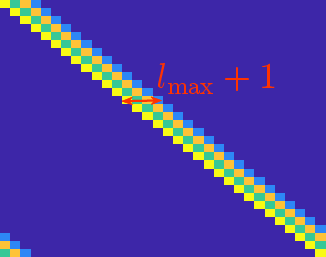
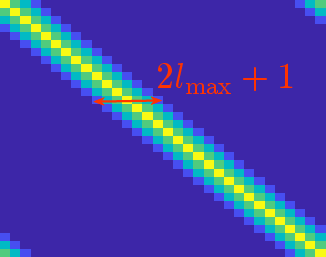
Figure 2: Illustration of matrix sparsity in the AF domain with N=32 and P=4 under frequency-selective channels.
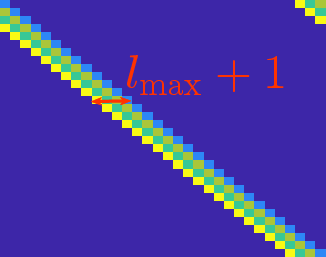

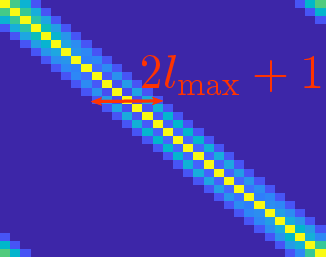

Figure 3: Illustration of matrix sparsity in the time and AF domains with N=32, P=4, and νmax=1 under doubly-selective channels.
This domain-dependent sparsity motivates the dual-domain EP detection paradigm: inference proceeds in the AF domain for frequency-selective channels and in the time domain for doubly-selective channels, always capitalizing on the accessible matrix structure to minimize computation.
Dual-Domain Low-complexity EP Detection
Two tailored EP-based detectors are developed:
- EP-AF: Targets frequency-selective channels, performing iterative Gaussian approximation and moment matching on AF domain symbols. It avoids dense matrix inversion via low-complexity LU-based inversion exploiting the quasi-banded AF domain channel matrix.
- EP-T: Designed for doubly-selective channels, it migrates inference to the time domain where the effective channel matrix remains sparse. Gaussian posterior approximations are iteratively refined, with symbol priors and posteriors mapped between time and AF domains (via DAFT/IDAFT) to enforce symbol constraints and facilitate detection.
The functional pipeline of both methods, including symbol prior/posterior updates and domain transformation, is summarized in the detection process block diagram.
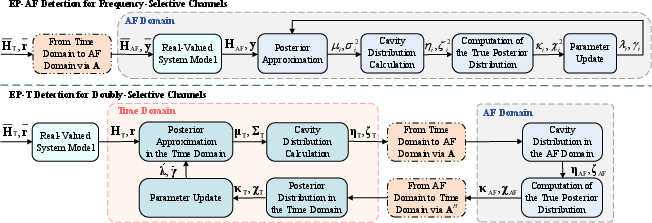
Figure 4: Block diagram of the proposed EP-AF detector for frequency-selective channels and EP-T detector for doubly-selective channels.
Notably, both detectors exploit quasi-banded LU matrix factorization to reduce inversion complexity from O(N3) to O(Nlmax2) per iteration, with additional FFT-based transform steps in EP-T, yielding overall cost 2lmax+10 or 2lmax+11.
Numerical Results
Extensive simulation results validate the proposed methods.
- In frequency-selective channels (4QAM, 2lmax+12, 9 paths), the low-complexity EP-AF detector achieves BER closely matching conventional EP (full inversion), outperforming MMSE and MRC detectors. At BER 2lmax+13, the EP-AF detector delivers at least 5.2 dB SNR gain over MMSE, with negligible loss from matrix inversion approximation.
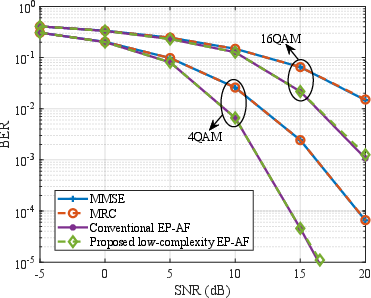
Figure 5: BER performance of AFDM using MMSE, MRC, conventional EP-AF, and the proposed low-complexity EP-AF detectors under frequency-selective channels.
- In doubly-selective channels (4QAM, 2lmax+14, 8 paths), the EP-T detector provides 7.8 dB gain over MRC at BER 2lmax+15 and 4.4 dB gain over MMSE at BER 2lmax+16. Again, the performance achieved with low-complexity matrix inversion is virtually indistinguishable from the full inversion case.
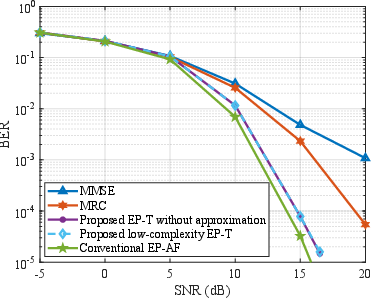
Figure 6: BER performance of AFDM using MMSE, MRC, conventional EP-AF, the proposed EP-T without the approximation calculation, and the proposed low-complexity EP-T detectors under doubly-selective channels.
- Complexity comparisons demonstrate that the low-complexity EP-T detector incurs nearly one order of magnitude less complexity than MMSE and two orders less than conventional EP-AF, while retaining high detection accuracy. MRC, although cheapest, is significantly outperformed in terms of BER.
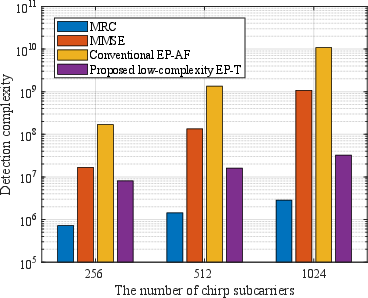
Figure 7: Complexity comparison of AFDM using MMSE, MRC, conventional EP-AF, and the proposed low-complexity EP-T detectors under doubly-selective channels.
Implications and Future Directions
This framework demonstrates that optimal domain selection and explicit exploitation of underlying channel matrix structures can significantly reduce AFDM detection complexity, making advanced EP-based inference feasible for large-scale deployments in 6G and beyond. The paradigm extends naturally to other structured channel models and can be generalized to related waveform classes (e.g., OTFS, SCMA variants) via appropriate signal/domain transformations. The quasi-banded LU inversion methodology is broadly applicable for high-dimensional inference tasks with similar structured sparsity.
The practical implications include enabling reliable communications for high-mobility applications (e.g., rail, UAV, satellites) without the excessively high computational costs that preclude full Bayesian inference. Theoretically, these results reinforce the importance of model-domain alignment—selecting the right inferential domain as dictated by channel physics yields both computational and statistical benefits.
Future developments may explore online domain-adaptive switching, joint channel-estimation-enhanced EP strategies, and further complexity reduction via hardware-optimized algorithms or approximate message passing variants.
Conclusion
This work delivers a rigorous, domain-adaptive EP detection architecture for AFDM, explicitly leveraging quasi-banded sparsity in both time and AF domains to decisively lower computational complexity without sacrificing BER performance. The results solidify dual-domain, structure-aware inference as a key enabler for practical deployment of AFDM in high-mobility, high-dimensional wireless systems.