- The paper presents the first systematic calculation of unpolarized quark gravitational TMDs, linking them to mechanical observables like pressure and shear.
- Analytical expressions derived within the light-front quark-diquark model connect gravitational TMDs to canonical TMDs, validating operator relations in QCD.
- The study quantifies average longitudinal momentum and flavor-dependent pressure distributions, offering actionable insights for future experimental programs such as the EIC.
Gravitational Transverse Momentum Distributions of the Proton in the Light-Front Quark-Diquark Model
Introduction
The systematic exploration of the internal structure of the proton in terms of quark and gluon degrees of freedom is a central program in quantum chromodynamics (QCD). While generalized parton distributions (GPDs), transverse-momentum-dependent distributions (TMDs), and their unifying "mother" distributions (GTMDs) have enabled increasingly nuanced multidimensional mappings of nucleon structure, the extension of such approaches to the energy-momentum tensor (EMT) yields access to the so-called gravitational form factors (GFFs). This in turn provides information on the mechanical structure, such as pressure and shear distributions, within the proton.
Building on recent formal developments that introduce "gravitational" TMDs—TMD analogues of GFFs, defined via fully unintegrated matrix elements of the quark EMT—this paper presents the first systematic calculation of unpolarized quark gravitational TMDs (and the associated gravitational PDFs) in the light-front quark-diquark model (LFQDM) with soft-wall AdS/QCD-inspired wavefunctions. Analytical results are derived for up and down quarks, the gravitational TMDs are mapped and scrutinized, and connections to mechanical properties such as isotropic pressure and the average longitudinal momentum are quantified.
Theoretical Framework
The gravitational TMD framework generalizes the EMT—central to defining GFFs and accessing mechanical information—to a correlation function that is bilocal and gauge-invariant on the light front. Parity, hermiticity, and time-reversal constraints allow a parametrization in terms of 32 independent scalar functions (gravitational TMDs) for spin-$1/2$ hadrons: ten unpolarized (T-even) and 22 polarized (T-odd) components. For the unpolarized analysis, focus is placed on the six non-vanishing T-even functions.
Upon integration over transverse momentum, gravitational PDFs emerge from gravitational TMDs, in full analogy to the relation between usual TMDs and PDFs. Crucially, gravitational TMDs quantify the distribution of the EMT in both longitudinal and transverse hadron momentum space, providing access to momentum-space mechanical observables such as pressure.
The computations utilize the well-established LFQDM, where the proton is modeled as a bound state of a valence quark and a recoiling scalar or vector diquark, with SU(4) spin-flavor symmetry coefficients. All relevant Fock-space and light-front wavefunction (LFWF) overlaps are computed using wavefunctions inspired by soft-wall AdS/QCD, with parameters fitted to reproduce form factors and empirical constraints at a low model scale.
Analytical Results: Gravitational TMDs and Their Relations
Analytical expressions are derived for all six nonzero unpolarized gravitational TMDs (functions a1(β),...,a8(β)) and closed-form expressions are given for their transverse integrations (the gravitational PDFs). Model-independent algebraic relations are shown to hold among these distributions and the underlying twist-2, twist-3, and twist-4 TMDs, as expected from the formal operator definitions.
The explicit connection between the gravitational TMDs and canonical TMDs in the absence of gluonic degrees of freedom in the model further validates the computational framework (reducing, e.g., a1(β)(x,k⊥2)=xf1(β)(x,k⊥2)).
Numerical Evaluation and Distributions
Three-Dimensional Structure of Gravitational TMDs
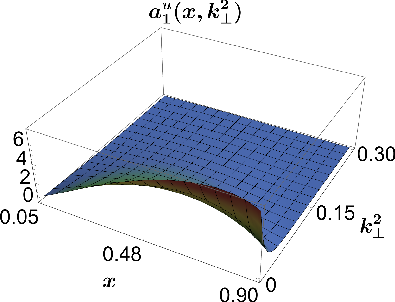
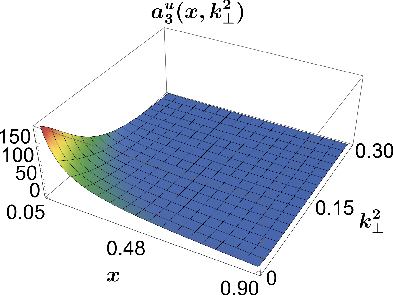
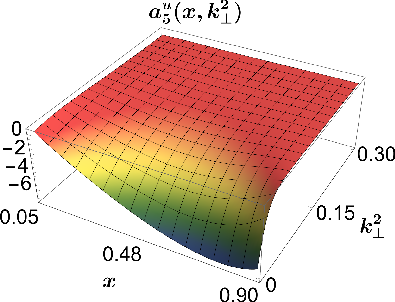
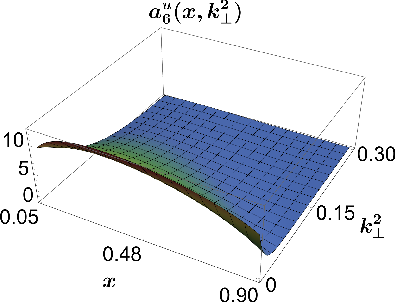
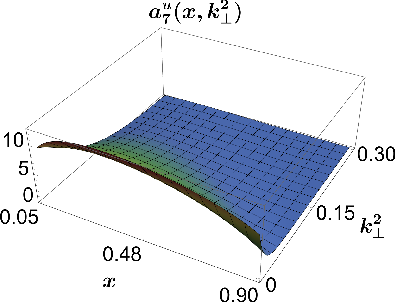
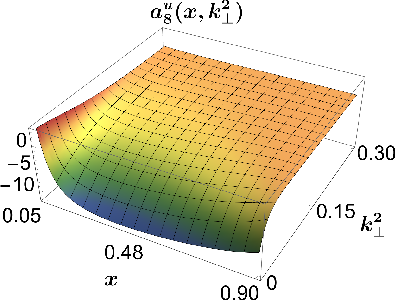
Figure 1: The gravitational transverse momentum distributions a1(β)(x,k⊥2), a3(β)(x,k⊥2), a5(β)(x,k⊥2), a6(β)(x,k⊥2), a7(β)(x,k⊥2), and a8(β)(x,k⊥2) for the up quark, visualized over x and a1(β),...,a8(β)0.
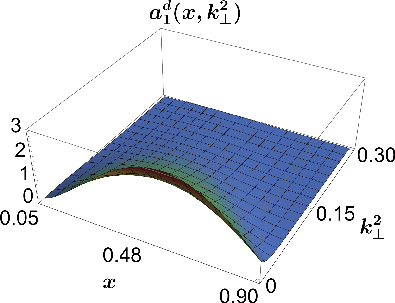
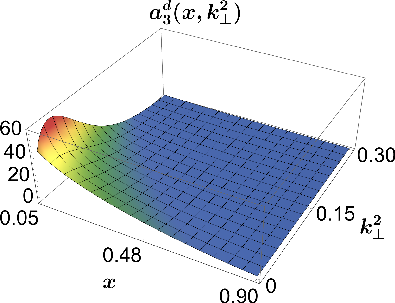
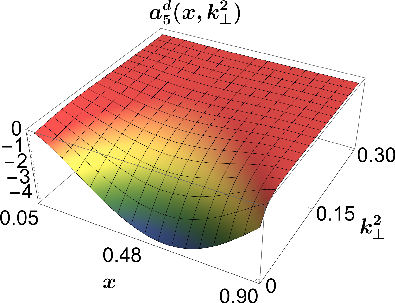
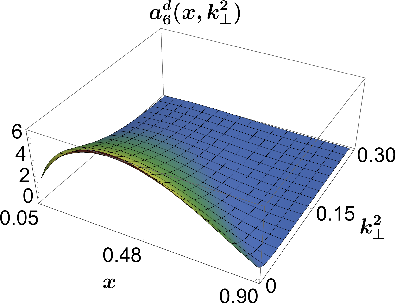
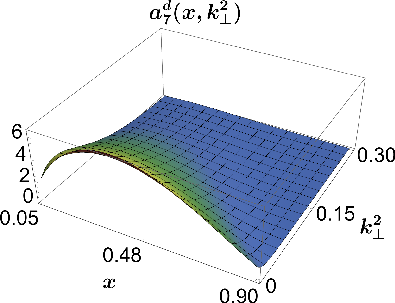
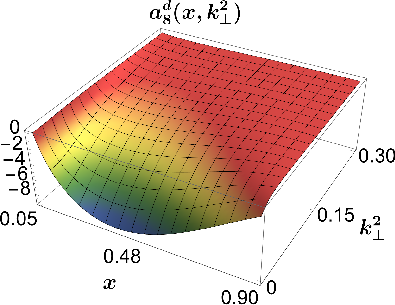
Figure 2: Analogous gravitational TMDs for the down quark.
All unpolarized gravitational TMDs except a1(β),...,a8(β)1 and a1(β),...,a8(β)2 are found to be positive definite, peaking at intermediate a1(β),...,a8(β)3 and low a1(β),...,a8(β)4, and vanishing towards kinematic endpoints. Notably, a1(β),...,a8(β)5 and a1(β),...,a8(β)6 are negative over wide kinematic regimes due to subtractions in their definitions, and show divergent tendencies at low a1(β),...,a8(β)7 due to a1(β),...,a8(β)8 (or a1(β),...,a8(β)9) prefactors.
When plotted as functions of a1(β)(x,k⊥2)=xf1(β)(x,k⊥2)0 at fixed transverse momenta, gravitational TMDs universally display strong suppression at large a1(β)(x,k⊥2)=xf1(β)(x,k⊥2)1, dictated by the exponential tail of the AdS/QCD-inspired LFWFs.
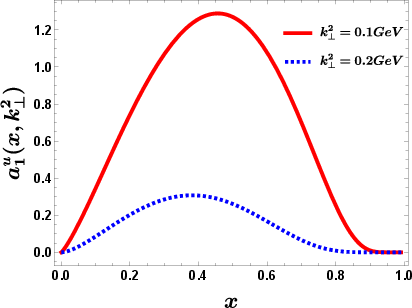
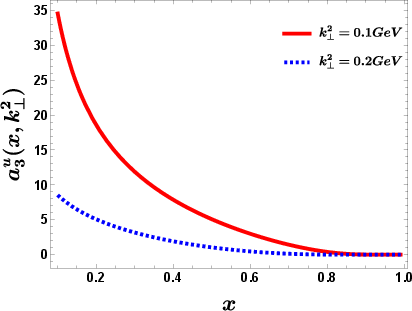
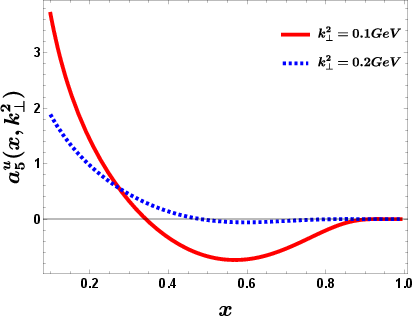
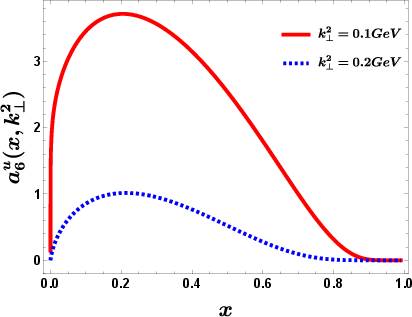
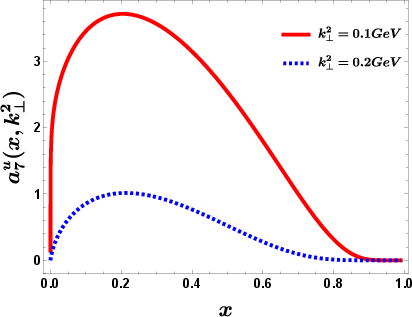
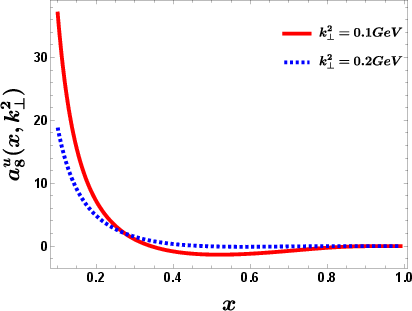
Figure 3: The unpolarized gravitational TMDs for up quarks, as functions of a1(β)(x,k⊥2)=xf1(β)(x,k⊥2)2 for different fixed a1(β)(x,k⊥2)=xf1(β)(x,k⊥2)3.
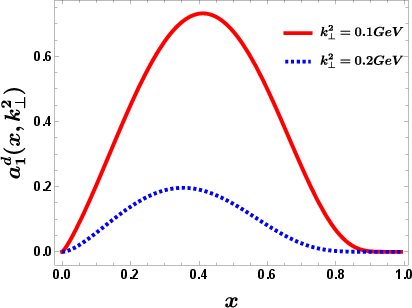
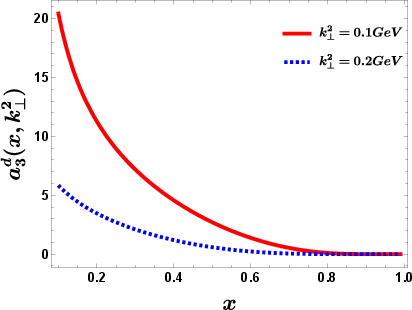
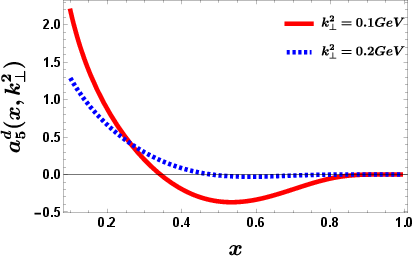
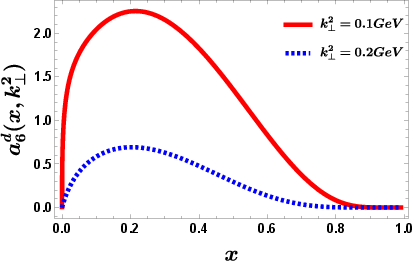
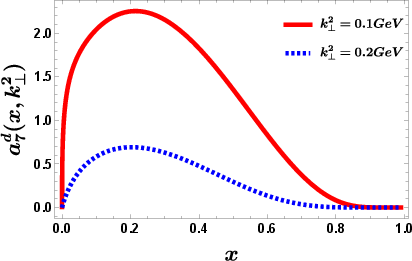
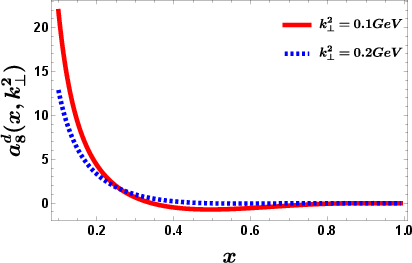
Figure 4: Analogous results for down quarks.
Gravitational PDFs
Upon integrating gravitational TMDs over transverse momentum, three nonzero gravitational PDFs are identified: a1(β)(x,k⊥2)=xf1(β)(x,k⊥2)4 (related to average longitudinal momentum), a1(β)(x,k⊥2)=xf1(β)(x,k⊥2)5, and a1(β)(x,k⊥2)=xf1(β)(x,k⊥2)6. a1(β)(x,k⊥2)=xf1(β)(x,k⊥2)7 shows a valence-like structure, peaking for a1(β)(x,k⊥2)=xf1(β)(x,k⊥2)8, suppressed at both a1(β)(x,k⊥2)=xf1(β)(x,k⊥2)9 and a1(β)(x,k⊥2)0. a1(β)(x,k⊥2)1 and a1(β)(x,k⊥2)2 have divergent small-a1(β)(x,k⊥2)3 behaviors.
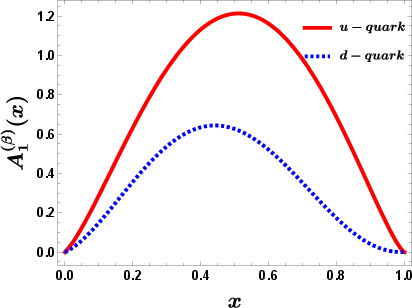
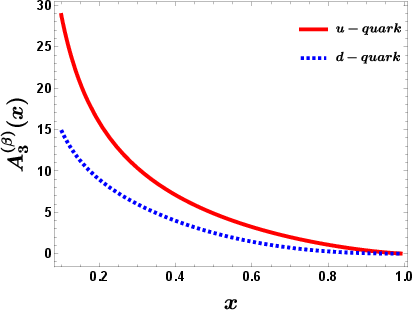
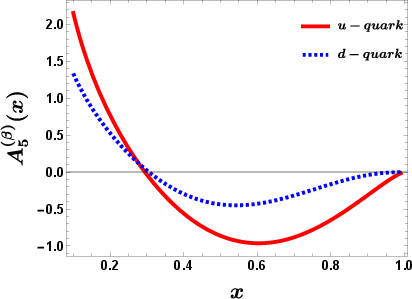
Figure 5: Unpolarized gravitational PDFs a1(β)(x,k⊥2)4, a1(β)(x,k⊥2)5, a1(β)(x,k⊥2)6 for up and down quarks.
Mechanical Properties in Momentum Space
The mechanical interpretation is realized by expressing the transverse EMT in terms of isotropic transverse pressure and shear-force distributions in transverse-momentum space. The pressure distribution is calculated as a function of both a1(β)(x,k⊥2)7 and a1(β)(x,k⊥2)8.
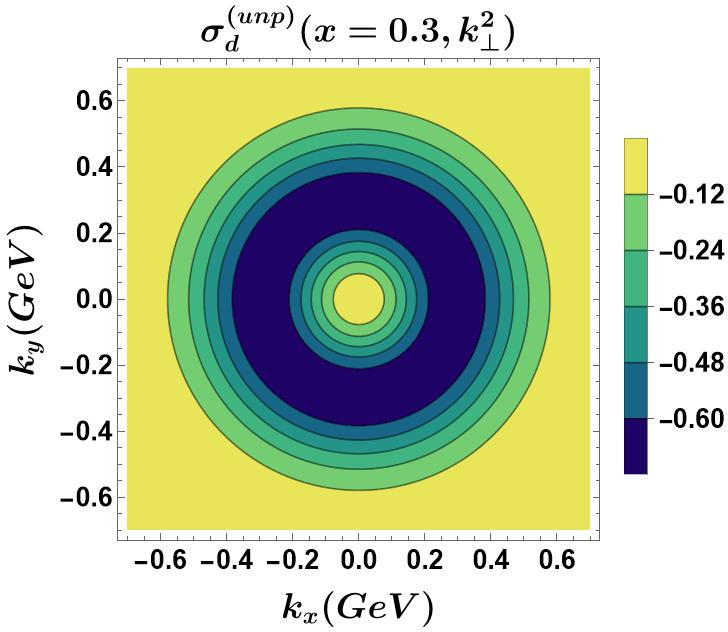
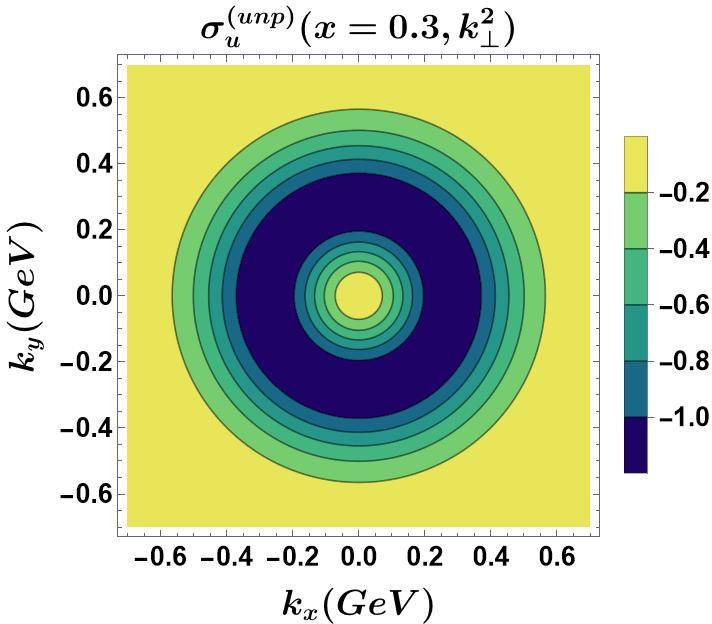
Figure 6: Isotropic transverse pressure for the down (left) and up (right) quarks, as contour plots in the a1(β)(x,k⊥2)9-a3(β)(x,k⊥2)0 plane at fixed a3(β)(x,k⊥2)1.
Both flavors exhibit circular symmetry in the pressure distribution. Pressure is minimal at a3(β)(x,k⊥2)2, grows steeply negative, and then decays. The negative sign attests to overall confinement-driven compressive forces.
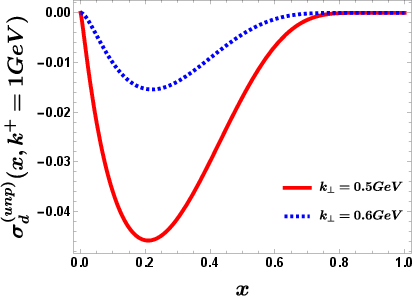
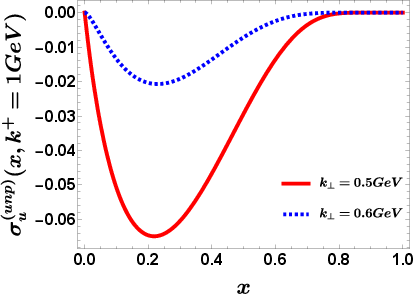
Figure 7: Isotropic transverse pressure for the down (left) and up (right) quarks as a function of a3(β)(x,k⊥2)3 at representative a3(β)(x,k⊥2)4 values.
The maximal (negative) pressure occurs in the valence domain (a3(β)(x,k⊥2)5–0.4) and is consistently larger in magnitude for up than down quarks, reproducing the model’s flavor asymmetry.
Average Longitudinal Momentum Fractions
Integration of a3(β)(x,k⊥2)6 over all a3(β)(x,k⊥2)7 and a3(β)(x,k⊥2)8 yields the average light-front longitudinal momentum:
- a3(β)(x,k⊥2)9 GeV,
- a5(β)(x,k⊥2)0 GeV,
for a reference proton with a5(β)(x,k⊥2)1 GeV. This numerical dominance of the up-quark sector reflects the canonical valence composition of the proton.
Implications and Outlook
This analysis provides the first comprehensive mapping of gravitational TMDs for proton constituents in a fully relativistic model. The validation against model-independent TMD relations, and the emergence of physical properties directly connected to the pressure and shear (for unpolarized distributions), establish the formalism as consistent and reveal mechanical interpretation in momentum space for the first time.
Phenomenologically, these distributions provide theory input relevant to future experimental programs, such as at the EIC, seeking access to operator moments of the EMT via deeply virtual exclusive processes. The distinction between momentum-space (TMD) and position-space (GFF) interpretations of pressure is clarified: TMDs provide detailed momentum-resolved information complementary to, yet distinct from, spatial distributions derived from GFFs. In QCD, genuine gluonic degrees of freedom will modify these relations, but the analytic and numerical results afforded by LFQDM set a transparent baseline.
The extension to polarized gravitational TMDs—including T-odd and higher-twist effects—will enable investigations of the full mechanical structure, including torque, pressure anisotropy, and spin-orbit correlations within the proton. Comparison with forthcoming lattice QCD computations and phenomenological parametrizations will further test the fidelity and universality of the model.
Conclusion
This work accomplishes the first analytical and numerical investigation of unpolarized gravitational transverse-momentum-dependent distributions and associated PDFs for the proton within the LFQDM. The model reveals a clear connection between gravitational TMDs and canonical TMDs, and allows for a mechanical interpretation directly in momentum space, including detailed pressure and average longitudinal momentum analyses for up and down quarks. Key numerical results support the physical picture of strong, flavor-dependent compressive forces operative within the proton. Future developments will address polarized distributions and full mapping of the nucleon EMT in the TMD framework.

