- The paper introduces a one-step diffusion framework that integrates dual spatial and temporal priors for enhanced video face restoration and computational efficiency.
- The methodology employs a novel spatio-temporal dual-codebook extraction and an asymmetric fusion module, achieving state-of-the-art metrics on benchmarks like VFHQ-Test.
- The approach preserves high-quality details, temporal coherence, and identity, setting a new standard for video generative restoration and potential applications to broader video tasks.
DVFace: Spatio-Temporal Dual-Prior Diffusion for Video Face Restoration
Introduction
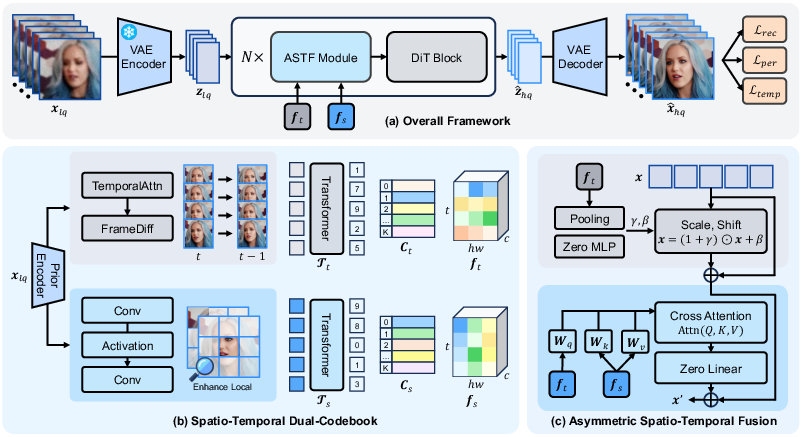
DVFace introduces a one-step diffusion-based approach for video face restoration, explicitly addressing the simultaneous demands for high-quality detail reconstruction, temporal coherence, and identity preservation in degraded video sequences. The approach diverges from prior multi-step diffusion and codebook-based methodologies by incorporating a spatio-temporal dual-codebook prior extraction module and an asymmetric spatio-temporal fusion (ASTF) mechanism, yielding distinct improvements in both restoration efficacy and computational efficiency.
Methodology
One-Step Diffusion Framework
DVFace operates within a single-step diffusion paradigm, significantly reducing inference latency compared to iterative denoising schemes. The model leverages a pretrained text-to-video backbone (Wan2.1), with a conditional denoising trajectory determined by explicit spatial and temporal priors extracted from the degraded input. This backbone is augmented to accept dual priors, integrating them at each DiT block via a specialized fusion module rather than generic cross-modal conditioning.
To capture the intrinsic multi-frame dynamics of face videos, DVFace introduces a dual-codebook approach:
- Spatial Codebook: Encodes canonical, high-fidelity appearance and morphological structures, robustly representing static facial patterns.
- Temporal Codebook: Encodes frame-to-frame motion and dynamic expressions, modeling evolution across short spatio-temporal segments.
Latent representations are extracted from the LQ input and computed via an encoder, then decoupled into spatial and temporal branches. Each branch utilizes Transformer-based sequence processing for accurate code selection, mitigating the distributional shift induced by severe degradation. The dual codebooks are learned and refined in a two-stage training scheme, aligning LQ-inferred codes with their HQ correspondents for consistent prior extraction.
Asymmetric Spatio-Temporal Fusion (ASTF)
Recognizing the disparate roles of spatial and temporal priors, DVFace’s ASTF module fuses these signals distinctly:
This partitioned fusion prevents the intermingling of global and local information, circumventing the artifact amplification and temporal instability observed in naive multi-prior conditioning.
Experimental Results
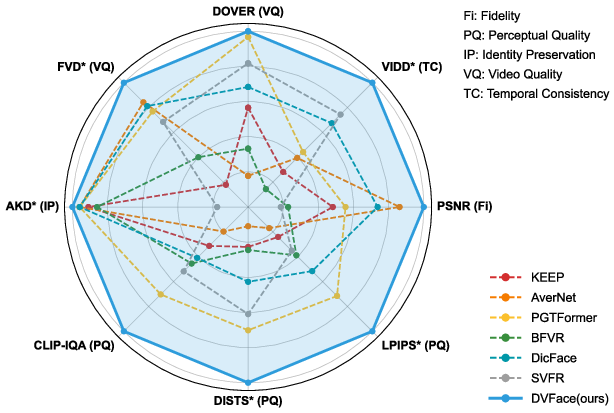
Comprehensive evaluations are conducted on benchmarks including VFHQ-Test, HDTF, RFV-LQ, and VoxCeleb2. DVFace establishes new state-of-the-art performance across fidelity (PSNR, SSIM), perceptual (LPIPS, DISTS, CLIP-IQA, MUSIQ, NIQE, MANIQA, LIQE), temporal (VIDD, Ewarp∗), and identity metrics (AKD, DOVER, FVD).
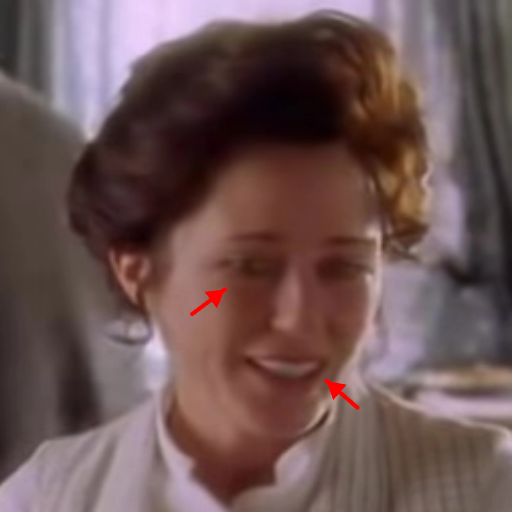
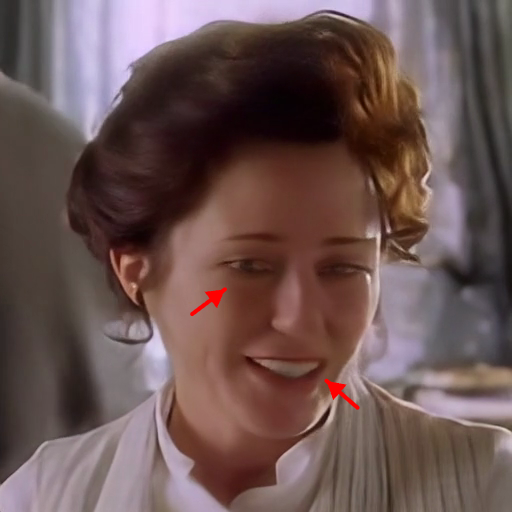
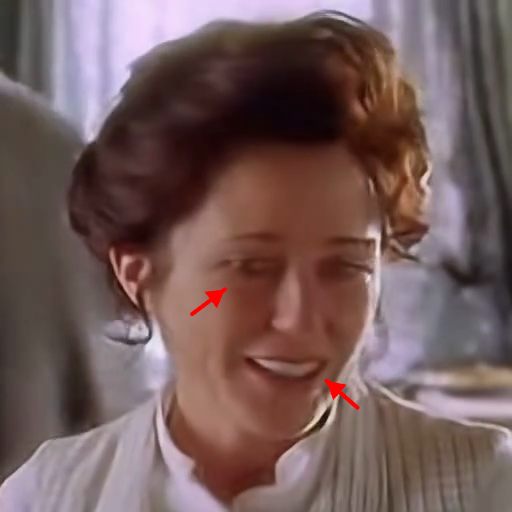
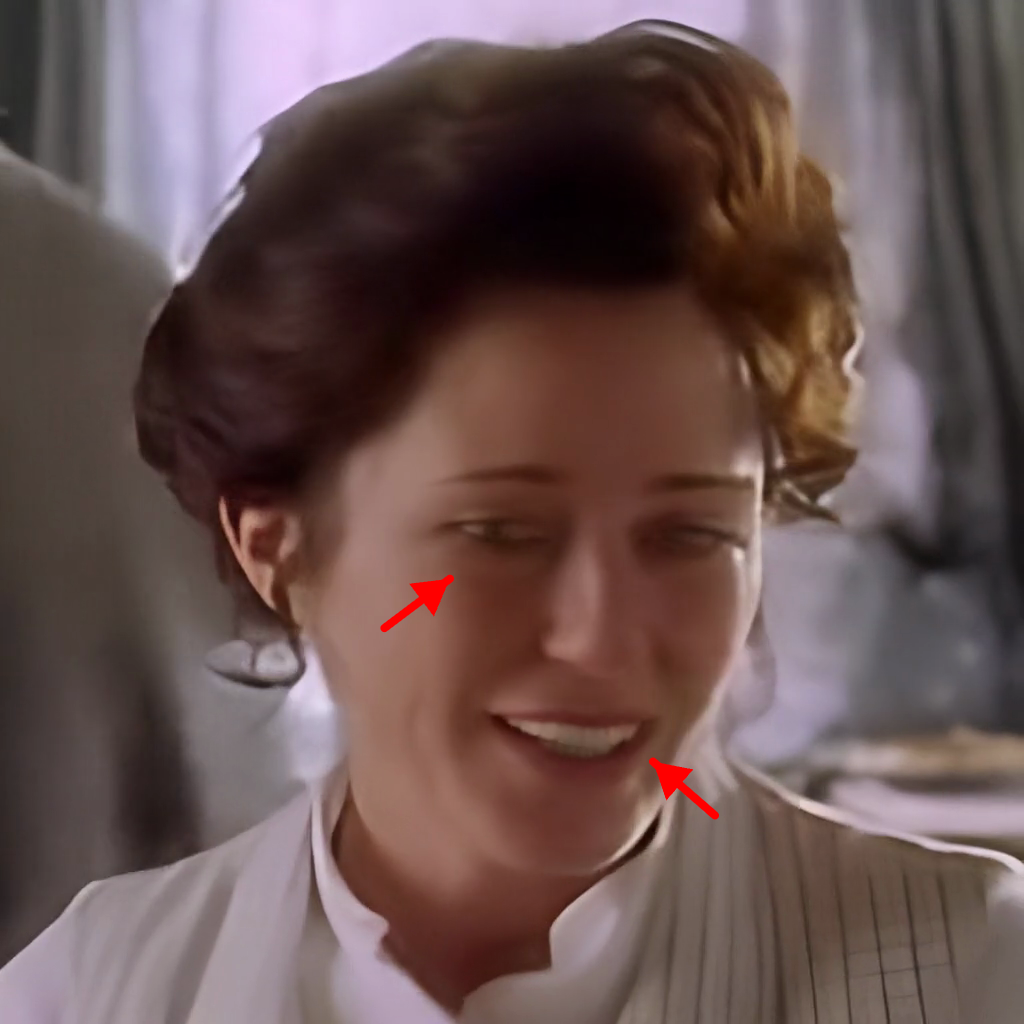
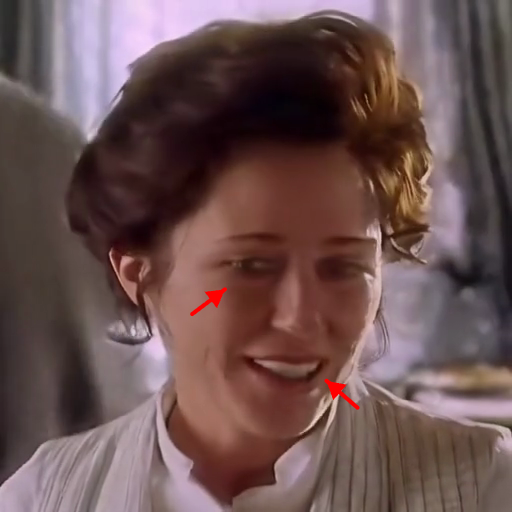
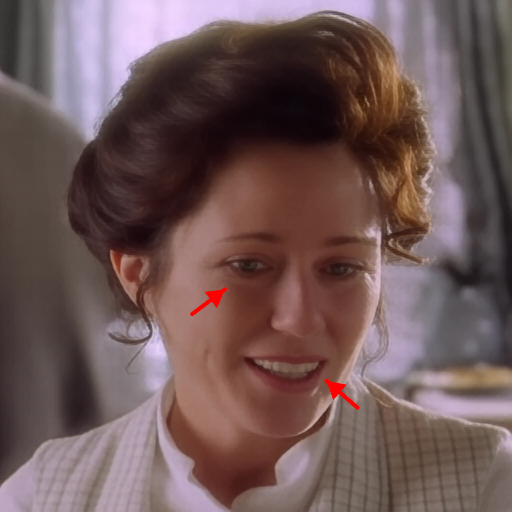
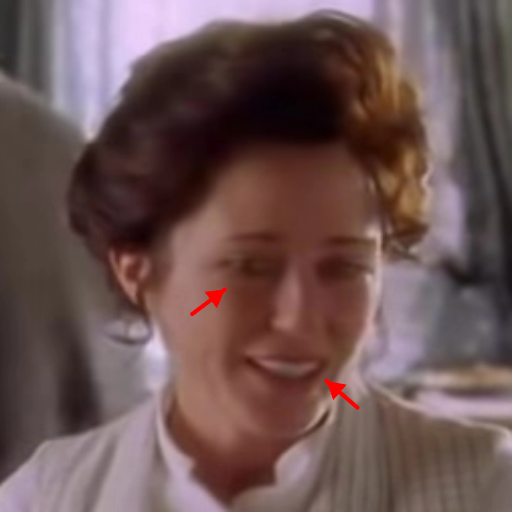
Figure 3: Visual comparison on synthetic and real-world data. DVFace reconstructs sharper, more faithful details, robust to the absence of HQ reference in-the-wild videos.
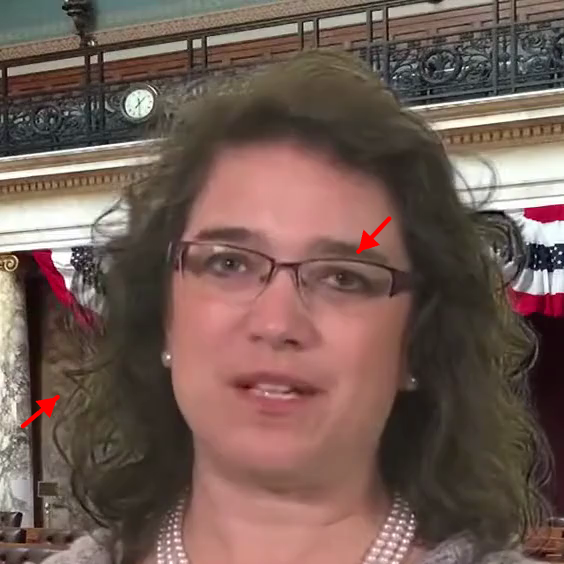
Figure 4: Qualitative evaluation on challenging synthetic cases. Fine-structure restoration and temporal stability are superior in DVFace.
Figure 5: Robustness on difficult real-world examples. Competing methods show instability and blur; DVFace maintains fidelity.
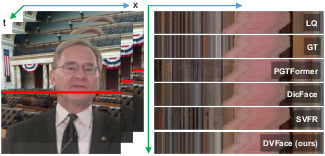
Figure 6: Temporal consistency stacked across frames—DVFace achieves smooth consistency, mitigating typical framewise flicker.
Ablation Studies
Ablations substantiate:
- Necessity and Complementarity of Dual Priors: Removing either spatial or temporal prior decreases both static and temporal metrics; their joint utilization is strictly optimal.
- Design of ASTF: Shared temporal global modulation and temporally-refined spatial injection outperform independent or naive fusions.
- Prior Form: Codebook-based priors provide more direct, effective signals for restoration than fixed prompts or extracted text (e.g., DAPE).
Implications and Future Developments
DVFace demonstrates that efficient, high-fidelity video face restoration is achievable without the computational overhead of multi-step diffusion when dual priors are explicitly and asymmetrically integrated. The separation of spatial and temporal priors, and the use of a robust injection mechanism, directly addresses the entanglement that previously limited generative restoration in video domains.
The architectural recipe—decoupled prior extraction, asymmetric fusion, and one-step generative inference—has implications for other structured video restoration and generation tasks wherein detail and global consistency are simultaneously demanded. Future directions include further generalization to non-face video domains, real-time deployment, and exploration of adaptive codebook capacity for unconstrained in-the-wild degradation.
Conclusion
DVFace provides a technically rigorous framework for video face restoration, advancing the state of the art in both efficiency and quality through a one-step diffusion backbone, explicit spatio-temporal prior extraction, and asymmetric fusion. The approach sets new performance standards and offers a transferable methodology applicable to broader video generative restoration challenges.