- The paper constructs and analyzes explicit holomorphic Lagrangian correspondences between moduli spaces of Higgs bundles and holomorphic connections, linking them to Hilbert schemes.
- The paper demonstrates that the constructed subvarieties are generically Lagrangian or co-isotropic, ensuring precise dimension counts and connections with integrable systems.
- The paper advances the geometric Langlands program by relating these correspondences to Fourier-Mukai transforms and conjectural quantization frameworks.
Lagrangian Correspondences for Moduli Spaces of Higgs Bundles and Holomorphic Connections
Introduction and Motivation
This paper constructs and analyzes holomorphic Lagrangian correspondences between moduli spaces of rank-n Higgs bundles (and holomorphic connections) on a compact connected Riemann surface C (of genus g≥2) and Hilbert schemes of points on T∗C (or its twisted variants). The key innovation is a systematic study of Higgs bundles and holomorphic connections transverse to line subbundles, which leads to explicit families of Lagrangians in moduli spaces, parameterized by effective divisors D on C. These constructions not only provide geometric insights into the structure of Hitchin and de Rham moduli spaces, but also establish concrete links to the geometric Langlands program. The results further relate to reductions of Kapustin-Witten equations, separation of variables in integrable systems, as well as classical and quantum aspects of conformal field theory (CFT).
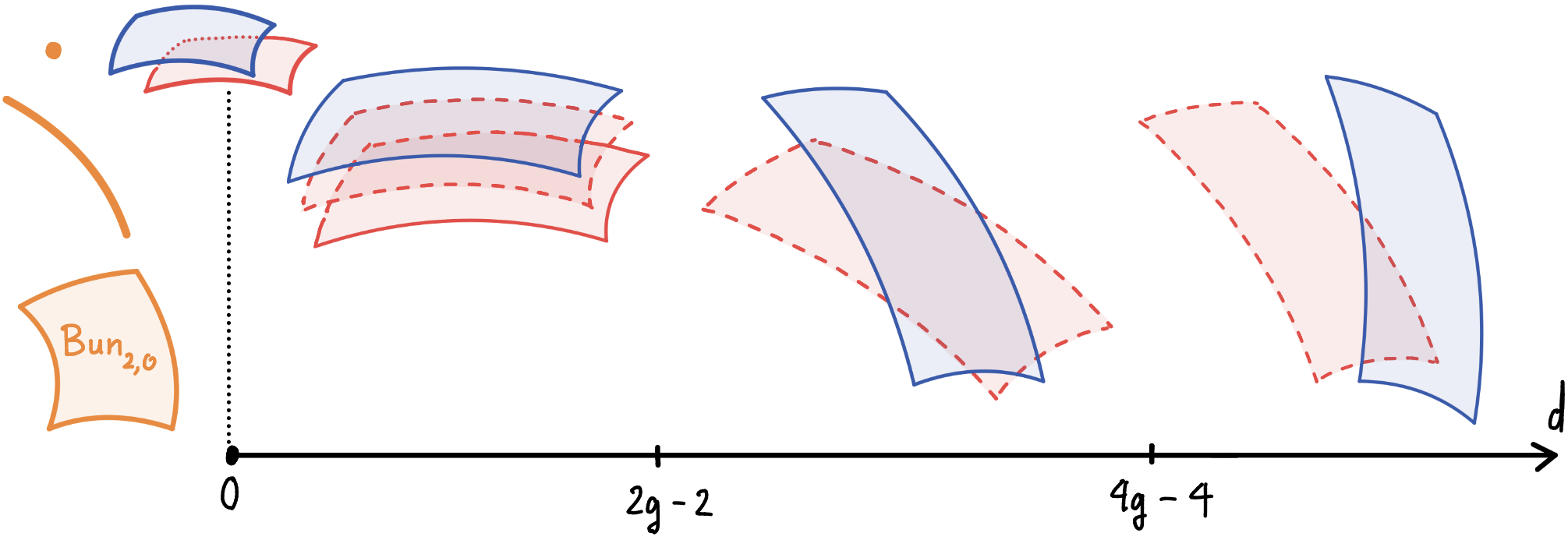
Figure 1: Illustration of Lagrangians LH(D) (red) and LdR(D) (blue) in rank $2$ moduli spaces as degD varies, showing their stratification and projection structure.
Construction of Lagrangian Subvarieties
Triples and Induced Divisors
The central objects are triples C0 (for Higgs bundles) and C1 (for holomorphic connections), subject to generic transversality constraints. The choice of line subbundles C2 induces morphisms C3 and C4, whose zeros define divisors C5 and C6 on C7. These divisors encode spectral data: for Higgs bundles, lifts to spectral curves yield divisors on C8. For connections, apparent singularities correspond to divisors together with residue parameters, forming points in twisted cotangent bundles.
Lagrangian Subvarieties in Moduli Spaces
Fixing an effective divisor C9 and a suitable line bundle g≥20, one forms subvarieties g≥21 and g≥22 inside the respective moduli spaces by requiring g≥23 or g≥24 for some embedding g≥25. In the g≥26 case, the compatibility condition g≥27 appears naturally.
The paper proves:
- g≥28 is non-empty with an open dense Lagrangian subset in g≥29.
- T∗C0 is co-isotropic, and generically Lagrangian in T∗C1 for reduced divisors.
These results generalize earlier constructions for T∗C2 and for divisors of maximal or minimal degree, extending the Lagrangian property to arbitrary congruent degrees.
Lagrangian Correspondences with Hilbert Schemes
Higgs Bundles and Hilbert Schemes
Given a triple T∗C3 and a smooth spectral curve T∗C4, the spectral line bundle admits a canonical decomposition as T∗C5. Effective divisors T∗C6 on T∗C7 may be viewed as points in T∗C8.
Defining T∗C9 as the collection of pairs D0 matching spectral and divisor conditions, one obtains a Lagrangian correspondence:
D1
Holomorphic Connections and Twisted Hilbert Schemes
For connections, additional data — residue parameters at apparent singularities — yield points in the Hilbert scheme D2, where D3 is a D4-torsor. The paper constructs D5, a Lagrangian subscheme of D6, again providing a correspondence structure.
Dolbeault and de Rham Geometric Langlands
The constructed correspondences are shown to generically realize the Dolbeault geometric Langlands correspondence (GLC) via Fourier-Mukai transforms between Hitchin moduli and Hilbert schemes. The de Rham GLC is conjectured to arise via quantization of these correspondences, echoing Drinfeld's construction of Hecke eigensheaves. The paper provides evidence for these claims, both algebraic-geometric and from integrable systems.
Extended Kapustin-Witten Equations and Hodge Moduli
A reduction of Kapustin-Witten equations to extended Bogomolny equations relates solutions to the triple-based Lagrangian structures, particularly through conformal and Hodge limits. The interplay with D7-actions and stratifications in the Hodge moduli connects dynamical flows, Lagrangian strata, and the geometric representation theory of branes.
The technique of fixing divisors — corresponding to separated variables in integrable systems — finds classical and quantum avatars in Hitchin moduli and CFT partition functions. Apparent singularities and their residue parameters emerge naturally in BPZ equations with degenerate fields, placing the present constructions at the interface of Langlands, integrability, and quantum field theory.
Strong Results and Implications
- Dimension Counts: Lagrangian subvarieties have dimension exactly D8 of their ambient moduli spaces; corresponding correspondences are generically finite-to-one.
- Explicit Formulae: The morphisms D9, C0, and associated spectral divisors are described via explicit determinants and Wronskian constructions.
- Generic Lagrangian Property: The Lagrangian property is shown to hold for a broad class of divisors beyond previous results, both in the Hitchin and de Rham settings.
- Quantization Conjectures: The quantized Lagrangian correspondences are conjectured to realize functorial equivalence between categories of C1-modules, underpinning quantum GLC.
Applications, Examples, and Future Directions
The paper details the stratification and fiber structures of constructed Lagrangians, especially in rank C2 cases, linking them to Hodge moduli and wobbly bundles. The explicit descriptions facilitate computation of Darboux coordinates, analysis of brane-type subvarieties, and investigation of flows and stratifications in moduli. Practically, these results open new avenues for explicit parameterizations in geometric Langlands, for analysis of spectral data in integrable systems, and for understanding quantum phenomena in moduli spaces.
Theoretical implications include strengthened conjectures about quantization commutativity, the realization of Hecke eigensheaves and Whittaker models via Lagrangian microlocal supports, and new geometric perspectives on analytic and quantum Langlands correspondences.
Conclusion
By systematically exploiting transversality to line subbundles, this paper constructs explicit holomorphic Lagrangian correspondences between Hitchin/de Rham moduli spaces and Hilbert schemes (twisted and untwisted). These geometric structures generically realize classical geometric Langlands correspondences, with conjectural extensions to the quantum setting via functorial quantization. The results provide concrete bridges between algebraic geometry, integrable systems, and quantum field theory, offering new computational and conceptual tools for the study of moduli spaces and correspondences. Future work is likely to focus on higher rank generalizations, the explicit quantization framework, and deeper analytic aspects in Langlands and CFT.