Finding and characterising physical states of Euclidean Abelianized loop quantum gravity using neural quantum states
Published 15 Apr 2026 in gr-qc, hep-th, and physics.comp-ph | (2604.14067v1)
Abstract: We study physical (near-kernel of constraints) states of 4-d Euclidean loop quantum gravity in Smolin's weak coupling limit on the complete graph $K_5$ using variational Monte Carlo with neural network quantum states. We investigate the Hamilton constraint $\hat{H}$ in the ordering proposed by Thiemann, as well as $\hat{H}\dagger$ and $\hat{H}+\hat{H}\dagger$. We find that the variational optimisation selects distinct solution families for $\hat{H}$ and $\hat{H}\dagger$ across several considered cutoffs on the kinematical degrees of freedom. The solution family of $\hat{H}$ is flat on all minimal loops and has non-vanishing volume expectation values. Its edge-charge marginals delocalise with increasing cutoff, which indicates they are approximations to solutions that are non-normalisable in the kinematical inner product. The solution family for $\hat{H}\dagger$ is normalisable, shows non-trivial charge correlations, lies in the kernel of volume and is not flat. $\hat{H}+\hat{H}\dagger$ turns out to be much harder to solve and yields quasi-solutions combining features of both previous families. We characterise all solutions using chromaticity 1- and 2-point functions, minimal loop holonomies, geometric area and volume observables and show that the two families can be interpreted as, on the one hand, a family of states close to the Ashtekar-Lewandowski vacuum and the Dittrich-Geiller vacuum with some numerical noise on the other hand. We also present some results that link solutions of the truncated theory to solutions of the continuum theory.
The paper demonstrates that variational optimization with neural quantum states effectively minimizes quadratic Hamiltonian constraints in Euclidean Abelianized LQG.
It distinguishes two solution families (Type-A and Type-B) via operator ordering, revealing stark differences in geometric properties and edge charge correlations.
The study establishes a robust diagnostic framework linking constraint ordering to physical sector selection, setting a new standard for quantum gravity simulations.
Neural Quantum States for Physical Sectors of Euclidean Abelianized Loop Quantum Gravity
Introduction and Context
This work addresses the challenge of finding and characterizing physical (i.e., near-constraint kernel) states in 4-dimensional Euclidean loop quantum gravity (LQG) in Smolin's weak coupling limit. Adopting a finite, Abelianized U(1)3 gauge theory formulation on the non-trivial, complete K5 graph, the study leverages modern variational Monte Carlo techniques with neural network quantum states (NQS) to systematically explore solutions to different orderings of the regularized Hamiltonian constraint operator. By doing so, it provides new computational tools for traversing the vast, combinatorial state space of LQG and empirically investigates the intricate landscape of constraint satisfaction and sector selection in discrete quantum geometry.
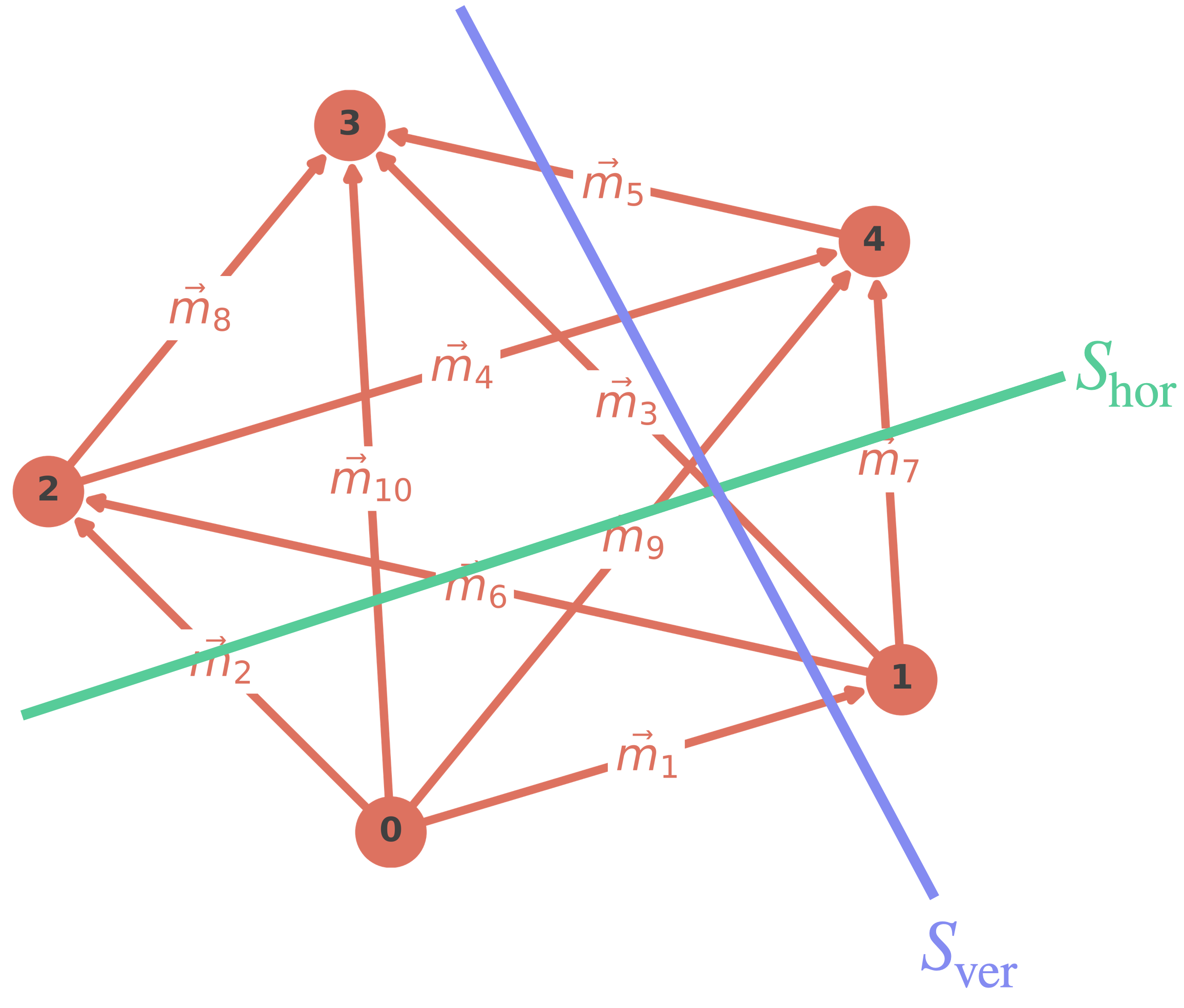
Figure 1: A planar representation of the oriented K5 graph used in this work. Each edge carries a charge vector (U(1)3 representation label) mi.
Theoretical and Computational Framework
The study considers loop quantum gravity in the canonical formalism, where the quantization proceeds via the Ashtekar-Barbero variables, and physical states are those annihilated by the set of quantum constraints: Gauß, diffeomorphism, and Hamiltonian. By working on the K5 graph (the boundary graph of a 4-simplex), a highly symmetric and non-planar structure, both non-trivial combinatorics and embedding-dependence of geometric operators are addressed. The Abelian U(1)3 model—emerging as the weak coupling limit of the non-Abelian SU(2) theory—truncates the theory for computational tractability, allowing each edge to carry integer-valued charge vectors capped at ∣me(i)∣≤mmax. This truncation enables finite, but exponentially large, Hilbert spaces which are still inaccessible to brute-force methods at moderate mmax.
A graph-adapted neural quantum state ansatz is designed to encode the relevant gauge-invariant wavefunctions. The architecture privileges locality and permutation invariance to mirror the physical properties of operators and the symmetry of the K50 graph, achieving extreme compression rates—often with variational parameter counts vastly smaller than the underlying Hilbert space dimensions.
Three forms of the vertex Hamiltonian constraint are investigated: K51 (standard Thiemann ordering), K52 (adjoint ordering), and their symmetrized combination. The quadratic constraints K53 and K54 are variationally minimized using VMC-NQS, and a variety of observables (holonomies, geometric operators, correlation functions) are computed for the resulting states.
Distinct Solution Families and Their Numerical Characterization
Kernel Proximity and Compression
The study demonstrates that the variational optimizer can drive the expectation value of the quadratic constraints to near zero across a range of cutoffs up to K55, substantiated by high compression factors (parameter-to-basis ratios as low as K56). This confirms the efficiency and expressivity of suitably crafted NQS for quantum gravity problems.
Solution Family Dichotomy: Type-A vs. Type-B
Despite formal similarity in constraint satisfaction, the variational approach identifies two sharply distinct classes of near-kernel solutions, each robust across cutoffs and random seeds, and directly associated with the constraint ordering:
Type-A (Standard Ordering, K57):
States are flat (all minimal loop holonomies trivial), have nonzero expectation values of volume, but become increasingly delocalized in edge charge—strongly indicating non-normalizability in the K58 sense as K59 increases.
Chromaticity (edge charge) marginals are nearly uniform, indicating maximal entropy and little local structure.
Long-range connected correlations are negligible beyond those imposed by local gauge constraints.
Type-B (Adjoint Ordering, K50):
States concentrate on volume-degenerate (zero volume) configurations, are normalizable, and exhibit pronounced, nontrivial charge correlations (dominated by the all-zero charge state, with local compensating excitations).
Minimal loop holonomies are nontrivial; such states do not correspond to flat configurations.
Connected charge correlations between adjacent edges are robust (order of magnitude higher than for disjoint edges), evidencing strong gauge-induced local structure.
These features are substantiated through several diagnostics, such as stratified state-vector sampling, edge chromaticity profiles, and two-point connectivity analysis.
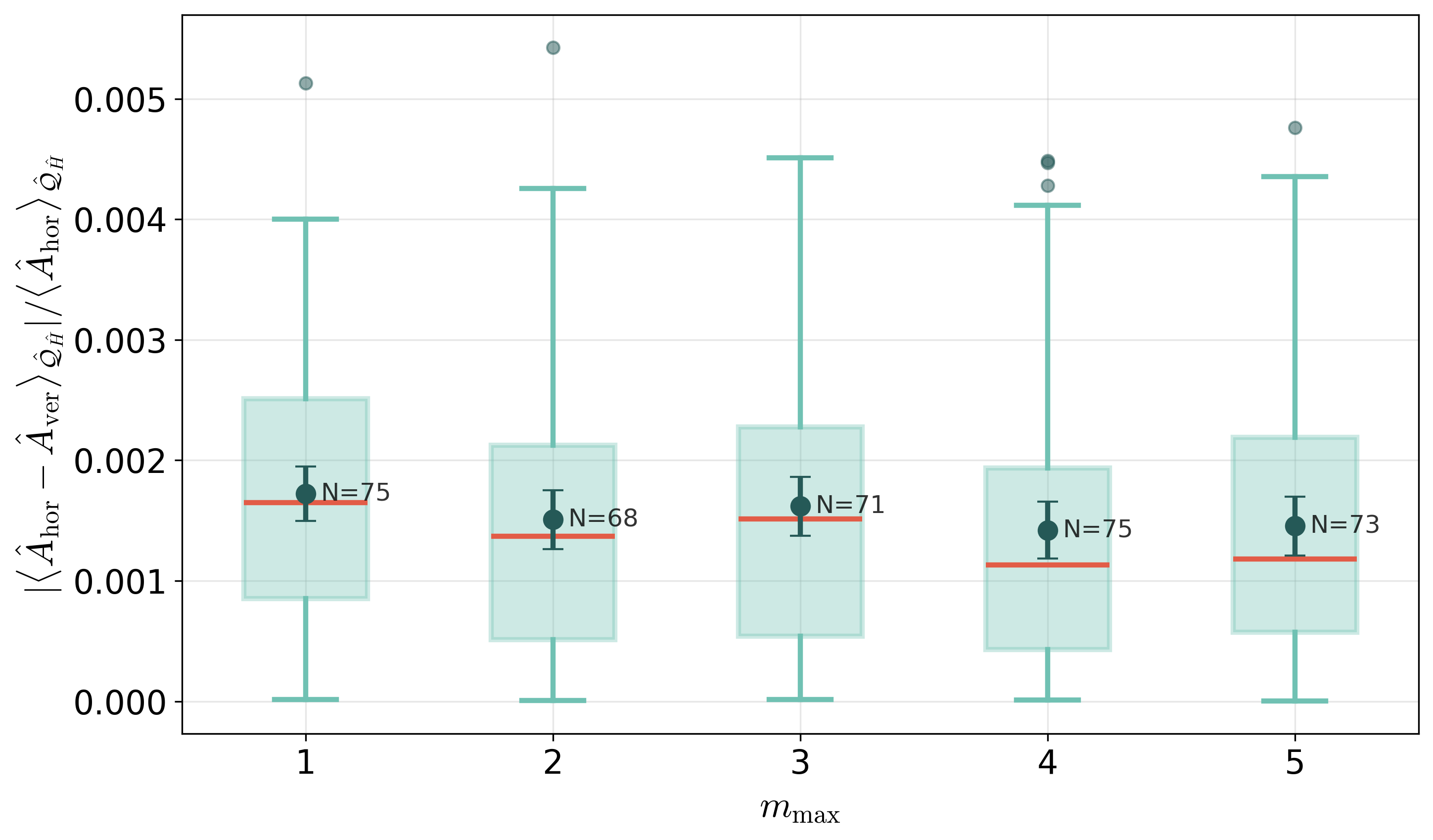
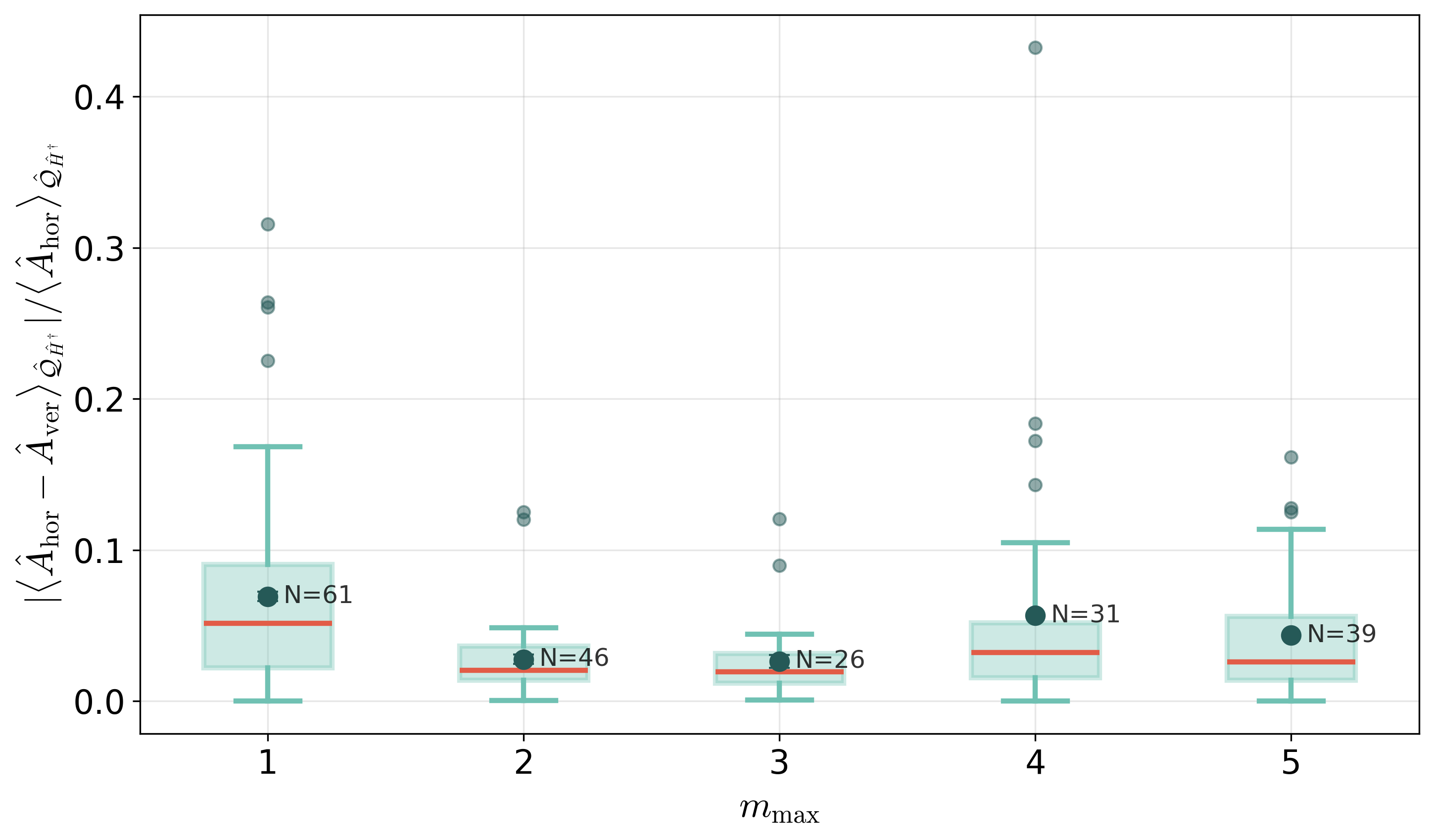
Figure 2: Distribution of the anisotropy magnitude K51 (relative area asymmetry across two transverse cuts of the K52 graph) for type-A and type-B solution families, showing near-isotropy for type-A and enhanced anisotropy for type-B.
Geometric Diagnostics
Flatness and geometric content of the solutions are probed through minimal loop holonomies, area, and volume diagnostics. For type-A states, all minimal loops yield holonomy traces consistent with flatness, and volumes at vertices are nonzero (with large fluctuations, increasing with K53). Type-B solutions display exactly vanishing vertex volume but support non-flat holonomy, indicating that algebraic ordering in the constraint directly sorts solutions into geometric sectors with distinct spatial properties.
Isotropy is assessed via comparison of area expectations across distinct slices of the graph. Type-A solutions are markedly isotropic, with area differences K54 at the permille level; type-B solutions are more heterogeneous and anisotropic, consistent with their degenerate geometric content.
Figure 3: The two area surfaces K55 and K56 used to probe anisotropy in the reconstructed discrete geometry on the K57 graph.
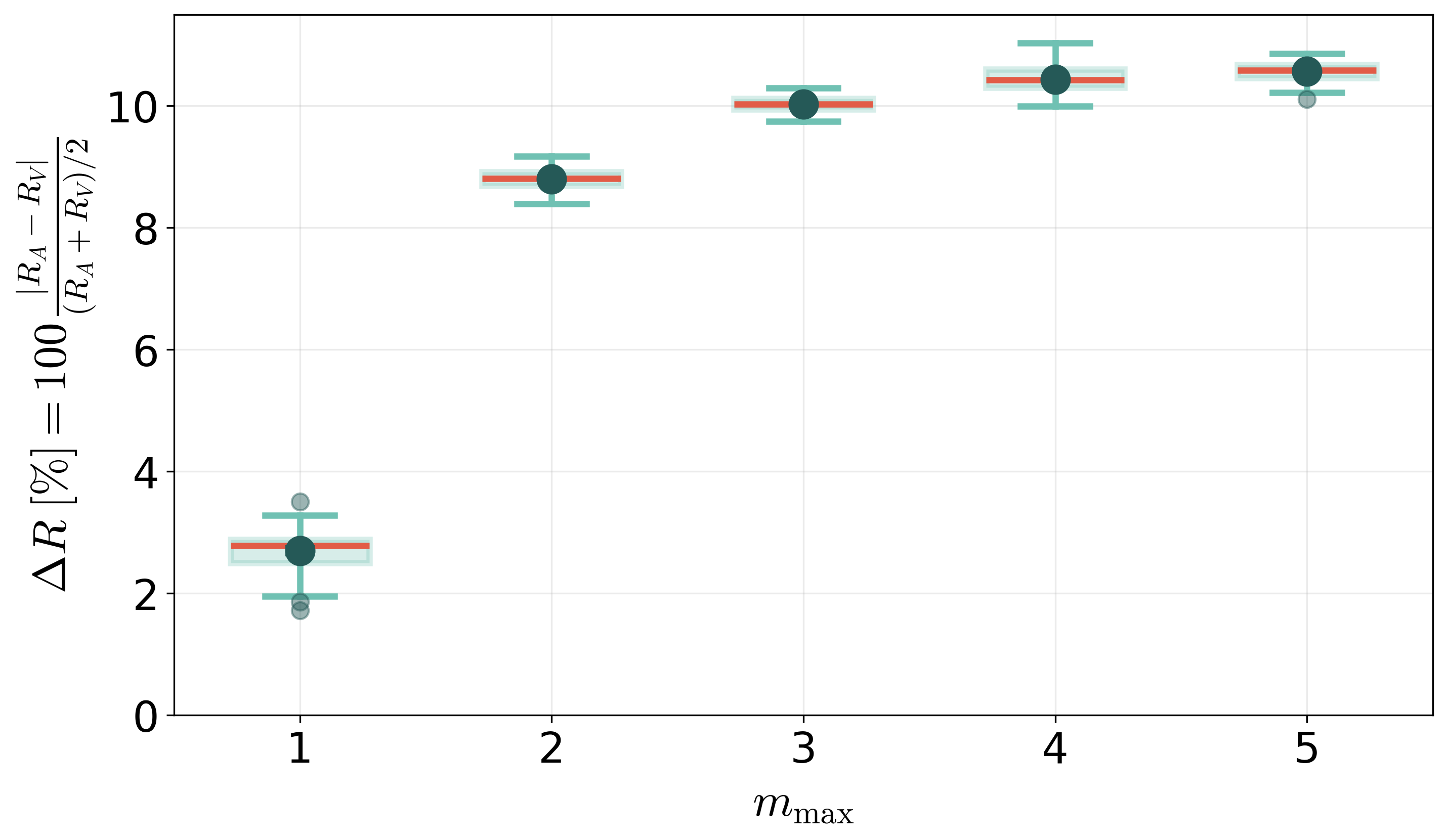
Figure 4: Distribution of the radius mismatch K58 (between area-derived and volume-derived effective radii) for type-A solutions as a function of cutoff; type-B solutions are excluded due to volume degeneracy.
Sector Selection and Quasi-Solutions
The ordering ambiguity in quadratic constraint quantization thus operates as a robust sector selector: K59 ordering yields a family close to the Dittrich-Geiller (DG) vacuum (flat, non-normalizable, extended geometry), while U(1)30 produces a family akin to the Ashtekar-Lewandowski (AL) vacuum (concentrated, volume-degenerate, non-flat). This is further corroborated by the observed features in correlation diagnostics.
Efforts to interpolate between families via penalty-augmented objectives or direct symmetrization of the constraint yield quasi-solutions that mix properties—exhibiting, for instance, type-B-like charge correlations and type-A-like geometric isotropy—though with higher residual constraint expectation values.
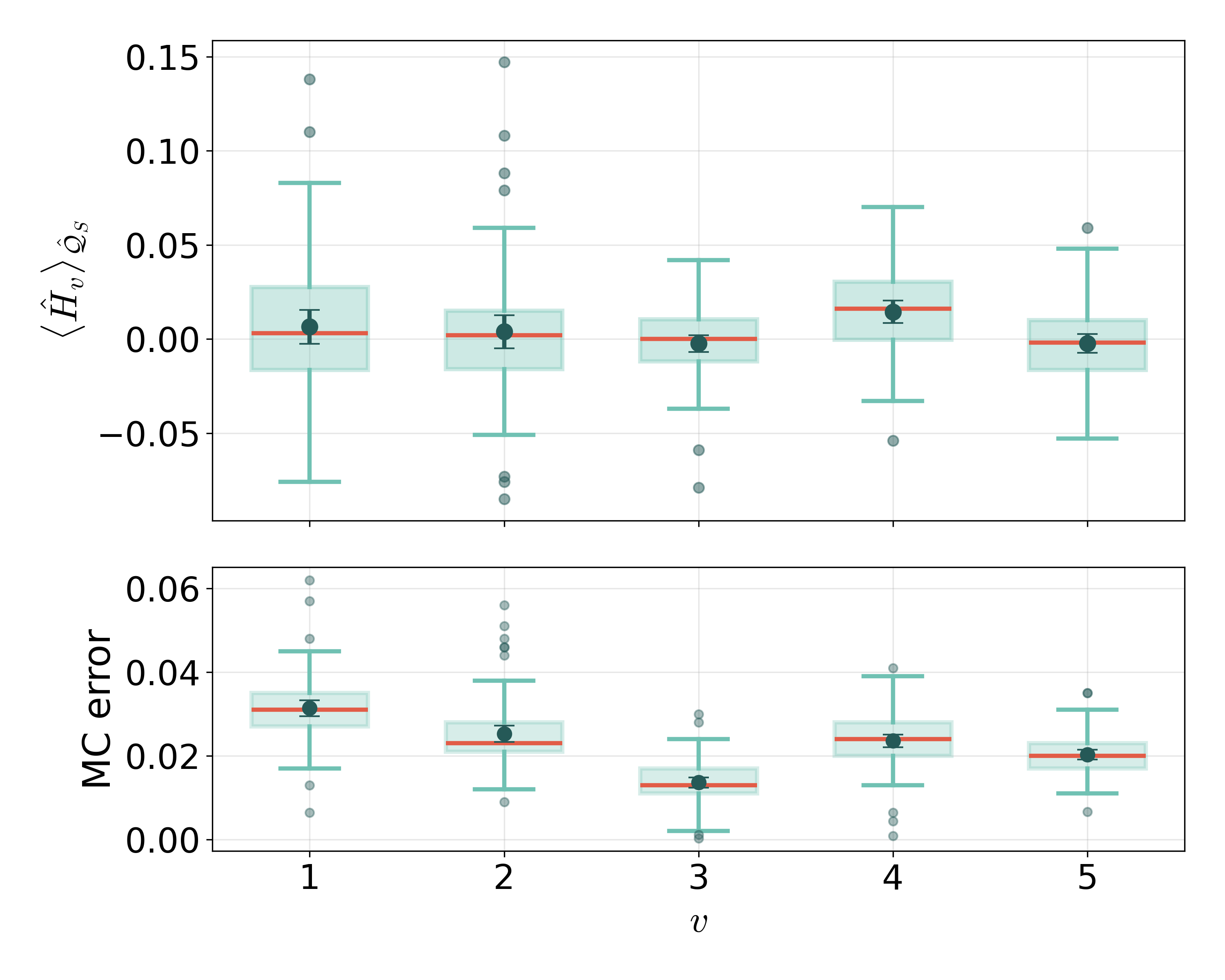
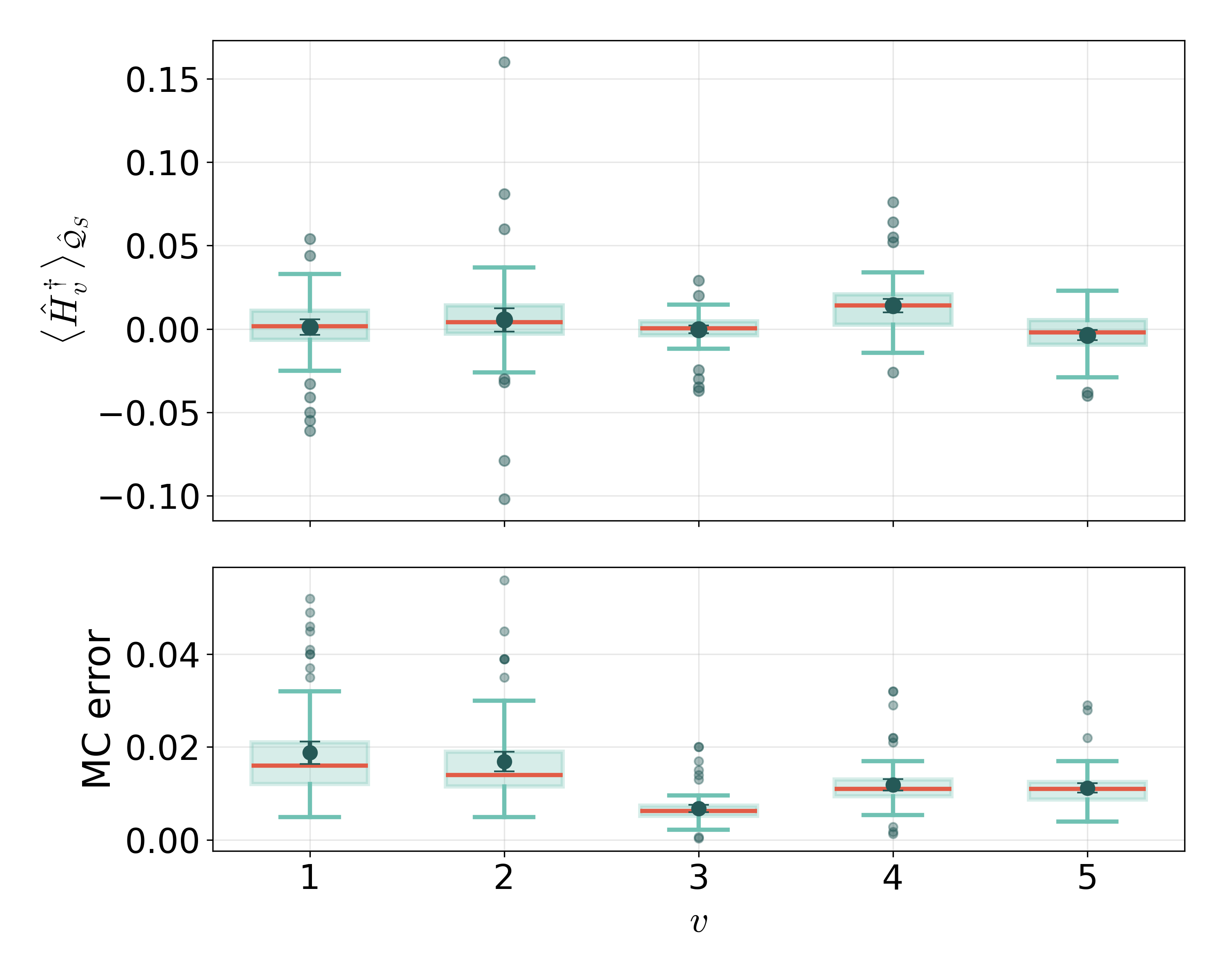
Figure 5: Constraint diagnostics for the U(1)31 quasi-solution ensemble; both U(1)32 and U(1)33 are centered near zero across the U(1)34 vertices, but with substantial variance.
Implications and Outlook
This study demonstrates that scalable, variational quantum methods with NQS architectures can render the physical sector of truncated, graph-based LQG empirically tractable even at large system sizes. Notably, operator ordering is shown to be a structurally significant parameter, inducing sharp geometric and correlation differences among near-kernel solution families, rather than a benign or merely technical implementation detail. Consequently, any physical interpretation or continuum extrapolation of such numerical results must contend with precisely which operator ordering has been realised in the constraint quantization.
The approach sets a new technical standard for quantum gravity simulations, providing a systematic diagnostic methodology via geometric observables and correlation functions to interpret the content of candidate physical states. This diagnostic power is critical, especially as variational solutions can hide subtle nonlocal or pathological behaviors under mere expectation value minimization. The extension to full non-Abelian U(1)35 theory and the analysis of continuum limits and inner product structure—possibly guided by sector selection effects observed here—is a prominent direction for subsequent research.
Conclusion
Using graph-adapted neural quantum states and VMC, the physical solution space of Abelianized 4d Euclidean LQG on nontrivial graphs is made accessible at scale. The results reveal that constraint ordering plays a pivotal role in selecting between different physically and geometrically distinguished sectors—flat, non-normalizable (DG-like) and concentrated, degenerate (AL-like). The methodology introduced here—fusing NQS, large-scale sampling, and targeted physical diagnostics—lays a groundwork for exploration of more complex LQG settings and provides a flexible platform for systematic, high-resolution analysis of quantum geometric constraint systems.
“Emergent Mind helps me see which AI papers have caught fire online.”
Philip
Creator, AI Explained on YouTube
Sign up for free to explore the frontiers of research
Discover trending papers, chat with arXiv, and track the latest research shaping the future of science and technology.Discover trending papers, chat with arXiv, and more.