- The paper introduces dqc_simulator, a full-stack simulator that automates distributed quantum circuit partitioning, noise modeling, and hardware instantiation.
- It employs a modular design with hardware, qlib, software, and util subpackages to support circuit parsing, automatic partitioning, and inter-QPU communication simulation.
- It leverages NetSquid's discrete-event backend to achieve realistic fidelity tracking and error analysis for experimental distributed quantum computing systems.
Authoritative Analysis of "dqc_simulator: an easy-to-use distributed quantum computing simulator" (2604.13909)
Motivation and Context
Distributed quantum computing (DQC) is viewed as a critical architectural paradigm for circumventing the scalability bottleneck of current quantum devices. The transition from monolithic architectures to DQC introduces complex requirements around inter-QPU entanglement, circuit partitioning, noise modeling, and network topology design. Existing quantum network simulators (e.g., NetSquid, Sequence, QuNetSim) provide general-purpose functionality but enforce a burdensome manual specification for DQC tasks, with limited abstractions for realistic distributed hardware simulation and circuit compilation. Specialized DQC simulators such as CUNQA and Interlin-Q address some aspects but lack robust noise modeling, hardware topology constraints, or full-stack simulation breadth. "dqc_simulator" addresses these gaps by presenting an open-source, Python-based, full-stack DQC simulation toolkit that leverages NetSquid's discrete-event simulation backend for physical accuracy while automating key workflow aspects.
Architectural Overview
The dqc_simulator package is organized into four modular subpackages: hardware, qlib, software, and util.
- hardware: Contains classes for QPU specification, inter-QPU connection abstraction, network topology instantiation, and the principal DQC wrapper. It enables rapid construction of realistic distributed quantum hardware, including user-extendable component definitions.
- qlib: Provides libraries of quantum gates, states, circuit macros, resource parameters, and extensibility for algorithmic primitives and identities. This modularity supports community-driven expansion and custom circuit designs.
- software: Supports circuit parsing (.qasm import), custom and automatic partitioning, compilation, and an interpreter for distributed quantum circuits including remote gate subroutines. It is agnostic to circuit source, enabling both file-based and programmatic circuit definitions.
- util: Comprises data collection helpers and auxiliary functions for experiment orchestration and result aggregation.
The architecture is tightly integrated with NetSquid, ensuring compatibility with various quantum state formalisms (ket, density matrix, stabilizer, graph state with local Cliffords), and exploiting its time-dependent noise simulation via discrete-event modeling. The interface enables seamless switching between formalisms and custom hardware/software configurations, substantially reducing development overhead.
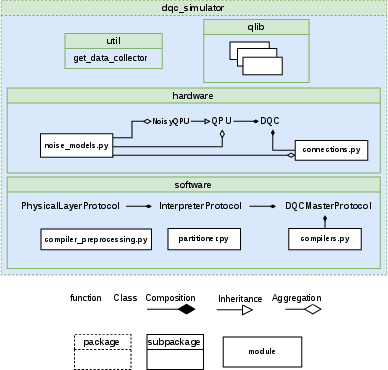
Figure 1: A UML-style overview of dqc_simulator's software architecture, highlighting the modular specialization and user-facing interfaces.
Functionalities and Workflow Automation
dqc_simulator automates previously labor-intensive tasks:
- Easy distributed circuit specification: Supports both direct gate tuple lists and OpenQASM circuit parsing. Gate tuples encode local and remote operations, including explicit remote gate subroutine selection.
- Automatic circuit partitioning and compilation: Monolithic circuits can be partitioned algorithmically or through user-provided schemes. Compilation is extensible, with interfaces for user-defined compilers.
- Communication qubit handling: Ancilla management for remote entanglement is handled transparently, freeing users from manual resource orchestration.
- Noise modeling: Arbitrary and time-dependent noise scenarios are supported by NetSquid, and all quantum formalism modes are switchable with minimal code changes.
- Data collection: Simulation runs facilitate fidelity measurement, state comparison, and custom observable tracking, with helper functions for experiment repetition and result aggregation.
The streamlined workflow is illustrated in provided Python code snippets, demonstrating hardware instantiation, circuit specification, experiment protocol definition, and simulation execution. These examples underscore the reduction in code complexity and cognitive load, in contrast with typical NetSquid-based manual implementations.
Impact and Comparative Analysis
dqc_simulator offers significant practical advantages for DQC research:
- Lowering the technical barrier: Automates circuit parsing, partitioning, hardware instantiation, and noise modeling, obviating manual specification typical of general-purpose quantum network simulators.
- Full-stack simulation: Supports simultaneous evaluation of hardware and software proposals, enabling rapid benchmarking and robustness analysis of DQC systems.
- Extensibility and accessibility: Open source, actively maintained, and extensively documented, making it a practical foundation for both experimental and theoretical studies. Users can add hardware components, algorithms, or compilers as needed.
- Integration with quantum internet research: The toolkit is designed to interface with broader quantum networking simulations, facilitating the study of DQC in quantum internetwork environments.
- Strong numerical claims: The package enables fidelity tracking for distributed circuits, as exemplified by the simulation result quantifying perfect fidelity ($1.0000...$) in noiseless scenarios, and degradation (e.g., $0.892$) under realistic error rates—empowering systematic noise analysis and error mitigation studies.
Compared to prior DQC-specific simulators (CUNQA, Interlin-Q, DQCS, dqc-executor, SimDisQ), dqc_simulator uniquely combines flexible circuit parsing, robust noise modeling, full-stack evaluation, and ease-of-use. These attributes position it as a versatile platform for hardware architecture evaluation, compilation and scheduling studies, and quantum networking research.
Implications and Future Directions
Practically, dqc_simulator can accelerate experimental design, algorithm evaluation, and architectural exploration in the DQC context. The theoretical implications include advancing the understanding of distributed quantum error propagation, optimal circuit partitioning strategies, and resource-efficient network topology design. The tool's modularity and open architecture invite community contributions, potentially expanding the library of emulated hardware, compilation protocols, and algorithms. As quantum hardware scales and DQC systems evolve, dqc_simulator may serve as a benchmarking backbone for distributed circuit fidelity, quantum networking research, and cross-platform software validation.
Future developments may include:
- Enhanced cross-platform support (e.g., Windows native compatibility).
- Integration with quantum cloud deployment pipelines.
- Deeper support for hybrid quantum-classical algorithms and scheduling.
- Expansion of noise models and physical device emulators.
Conclusion
dqc_simulator provides a robust, modular, and user-friendly toolkit for simulating distributed quantum computers at both hardware and software levels. Its automation of circuit partitioning, noise modeling, and experiment workflow distinguishes it from both general-purpose and DQC-specific simulators, enabling rigorous benchmarking, hardware/software co-design, and quantum network simulation. The package's extensibility and comprehensive documentation support ongoing community-driven development, facilitating future advances in distributed quantum computing research.

