- The paper demonstrates that global monopoles enhance deflection angles and expand Einstein ring radii using both analytic and numerical methods.
- It quantifies how increased monopole parameters shift ISCOs, enlarge shadow radii, and modify photon sphere properties.
- The QNM analysis reveals that higher monopole strength lowers oscillation frequencies and prolongs ringdown signals, affecting observational signatures.
Strong Gravitational Lensing and Quasinormal Modes of Black Holes with Global Monopoles
Introduction
The paper "Strong Lensing and Quasinormal modes of black hole around global monopole" (2604.05686) presents a comprehensive study of the spacetime structure and observational signatures of static, spherically symmetric black holes endowed with global monopoles. The analysis encompasses strong field gravitational lensing, shadow formation, timelike geodesic motion, and the spectrum of electromagnetic quasinormal modes (QNMs). Notably, the impact of the global monopole parameter η and the self-coupling constant λ on lensing observables, shadow radius, ISCO, Lyapunov exponent, and QNM frequencies is rigorously quantified using both analytical and numerical techniques.
Black Hole Metric and Horizon Structure
The monopole-modified metric employs a spherically symmetric ansatz, with the line element incorporating the parameters η (symmetry-breaking scale) and λ (self-coupling). Analysis of the metric function reveals that, for sufficient values of M and λ, the spacetime admits two horizons: a Cauchy and an event horizon, whose separation and radii depend sensitively on η and λ.
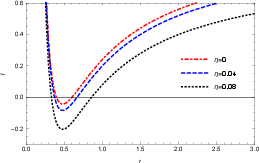
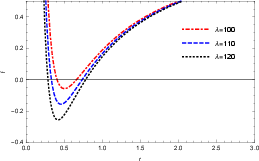
Figure 1: Variation of the metric function as a function of η (left) and λ (right). Enhanced monopole effects increase the event horizon radius and separation between horizons.
Strong Gravitational Lensing: Deflection Angles and Observables
Application of the strong deflection limit formalism, following Bozza and related works, leads to analytic expressions for the deflection angle λ0, lensing coefficients λ1 and λ2, and critical impact parameter λ3 for photon orbits near the black hole. The results demonstrate a monotonic increase in the deflection angle and divergence at larger λ4 as either λ5 or λ6 increases. This effect translates to notable changes in strong field lensing observables, including the limiting angular position λ7, angular separation λ8, and the flux ratio λ9.
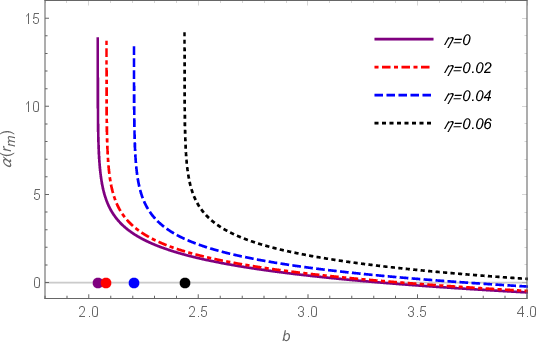
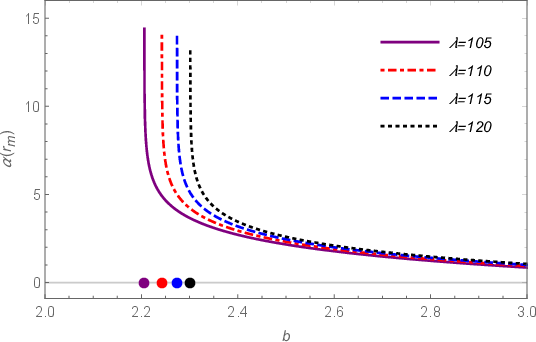
Figure 2: The plot shows η0 as a function of the impact parameter η1 for various η2 (left) and η3 (right); divergence reflects the photon sphere's role.
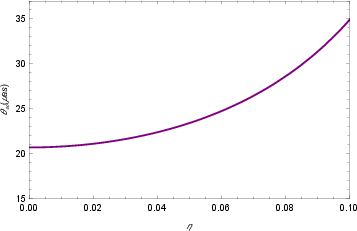
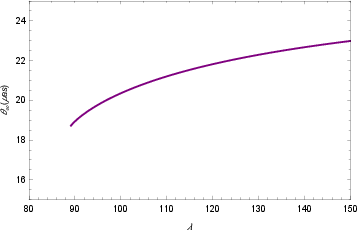
Figure 3: η4 increases as either η5 or η6 is raised, indicating a larger angular radius for the limiting set of unresolved images.
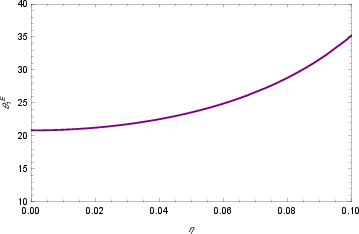
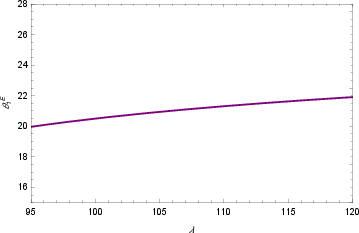
Figure 4: The separation η7 grows with η8 and decreases with η9, reflecting shifts in the location of relativistic images.
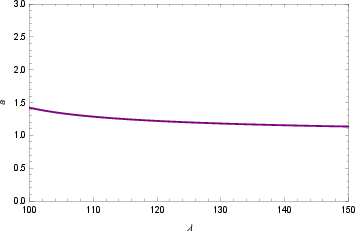
Figure 5: The flux ratio λ0's non-monotonic dependence on λ1 and monotonic growth with λ2 affects detectability of relativistic images.
The paper further shows analytic and numerical evidence for monotonic growth in the Einstein ring radius with λ3 and λ4, directly linking strong field lensing to topological defect parameters intrinsic to the spacetime.
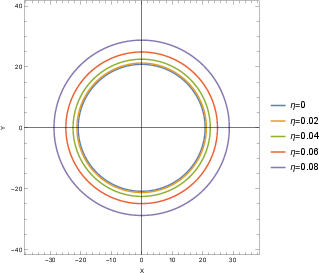
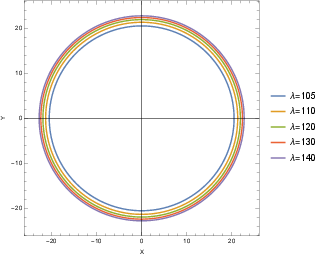
Figure 6: The radius of the outermost Einstein ring grows with rising λ5 and λ6, directly tied to spacetime modifications induced by the monopole field.
Figure 7: Behaviour of the Einstein ring λ7 highlights increased ring size for larger λ8 and λ9.
Additionally, the relative time delays between differentiated relativistic images increase with both parameters, indicating a potentially measurable strong lensing signature in time-domain multi-image observations.
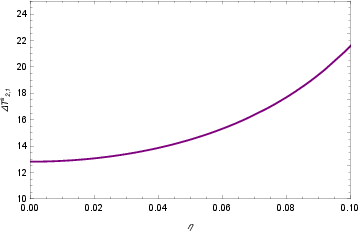
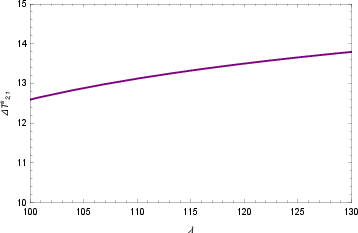
Figure 8: Time delay M0 between the first and second relativistic images as a function of M1 (left) and M2 (right).
Black Hole Shadow and Photon Sphere
The structure of photon orbits and corresponding critical impact parameter leads to quantitative predictions for the shadow radius as seen by distant observers. The photon sphere and shadow radius both exhibit strong sensitivity to M3 and M4:
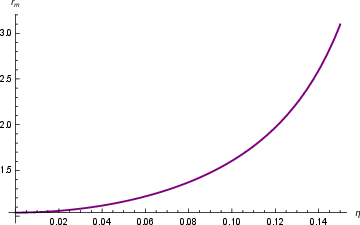
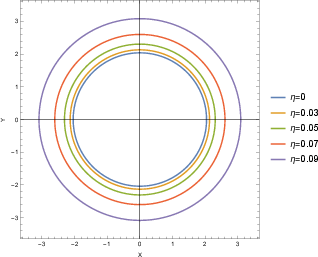
Figure 9: Photon sphere radius and shadow radius both increase with M5, expanding the region accessible to unstable photon trajectories.
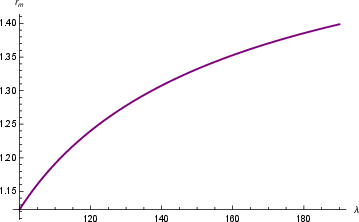
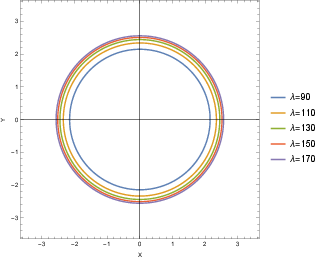
Figure 10: Photon sphere and shadow radius growth with M6 displays a saturating trend at high coupling.
Tabulated results confirm that the shadow size is more responsive to M7, implying that detection of unusually large black hole shadows would be indicative of nontrivial monopole structure or other topological defects.
Timelike Geodesics, ISCO, and Stability
The detailed analysis of the effective potential for timelike geodesics yields explicit dependence of circular orbit structure—including M8, M9, and λ0—on both black hole parameters. The ISCO radius monotonically increases with both λ1 and λ2, with enhanced λ3 inducing a steeper increase and indicating a repulsive shift due to the topological defect. This effectively moves the zone of stable accretion disk orbits outward.
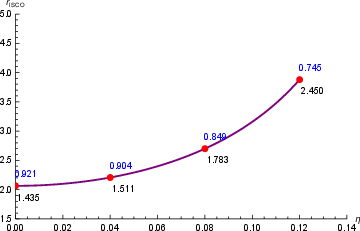
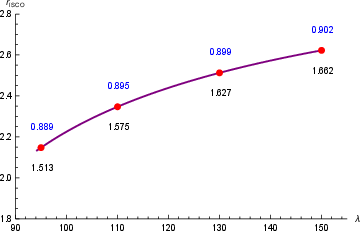
Figure 11: Radius of the ISCO as a function of λ4 (left) and λ5 (right); robust increase with both parameters extends the stable orbital region outward.
The Lyapunov exponent λ6, quantifying instability of circular timelike orbits, decreases with increasing λ7 (more stability) and increases with larger λ8 (more unstable orbits), although the effect of λ9 is dominant.
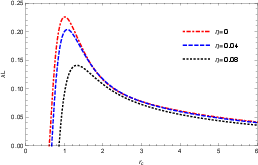
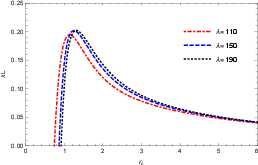
Figure 12: Lyapunov exponent η0 for varying η1 (left) and η2 (right); larger η3 yields more stable orbits.
Electromagnetic Perturbations and Quasinormal Mode Spectrum
The electromagnetic QNM spectrum is computed via both WKB-Padé and AIM methods, confirming excellent mutual agreement. A primary result of the paper is that increasing η4 suppresses the real and imaginary parts of QNM frequencies, lowering the oscillation frequency and yielding slower damping—that is, longer-lived ringdown signals. In contrast, increasing η5 produces a subtler, non-monotonic effect in the imaginary part, especially at low η6 and η7.
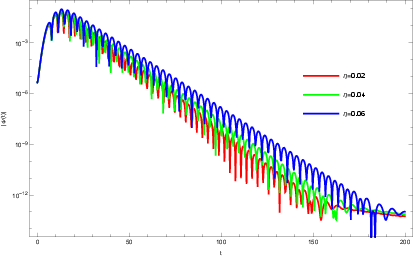
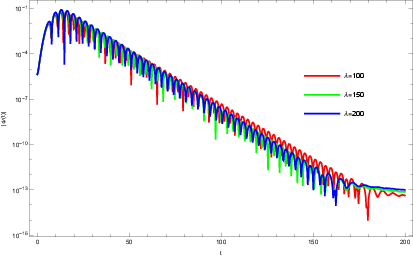
Figure 13: Time-domain profiles of η8 show that increasing η9 yields slower decaying quasinormal ringing; increasing λ0 prompts faster decay.
This behaviour is traced to modifications of the effective potential barrier (height reduction and narrowing with higher λ1 and λ2), allowing wave leakage and affecting mode lifetimes.
Implications and Outlook
The paper establishes that the presence of a global monopole introduces observable signatures in strong gravitational lensing (enhanced deflection angles, increased shadow size, enlarged Einstein rings, and longer time delays), geodesic orbital structure (outward-shifted ISCO and photon sphere), and in the stability and mode content of electromagnetic perturbations (longer-lived ringdown). These shifts provide feasible targets for precision lensing and multi-messenger gravitational wave observations, thus opening a pathway toward direct or indirect detection of topological defects through black hole phenomenology.
Future directions include:
- Extension to spinning and charged monopole black holes;
- Analysis of non-spherically symmetric lensing and shadow shapes;
- Application to realistic astrophysical systems where ISCO/ringdown frequency mismatches may signal underlying monopole structure;
- Inclusion of plasma and quantum corrections in the computation of observable shadows and lensing coefficients.
Conclusion
This work provides an in-depth and rigorous characterization of the influence of global monopoles on observable properties of static black holes. By connecting modifications of fundamental spacetime structure to measurable lensing, shadow, and oscillation parameters, the paper delineates a robust theoretical framework for testing the presence of topological defects via black hole astrophysics. The analytic and numeric methodology extends naturally to further settings in alternative gravity and topological defect cosmology, reinforcing the importance of precise strong-field astrophysical signatures for fundamental physics.

