- The paper presents a multi-field axion-like EDE model that distributes energy injection over distinct redshifts, significantly easing the H0 tension.
- It employs both Bayesian and frequentist methods to constrain the model using data from CMB, BAO, SNeIa, and local H0 measurements.
- Model selection favors a two-field scenario that improves high-ℓ CMB fit with minimal added complexity, aligning with axiverse predictions.
Multi-Field Axion-like Early Dark Energy and the Hubble Tension
Introduction
The ∼5–7σ discrepancy between local (e.g., the H0DN and SH0ES measurements) and early-universe (e.g., Planck-based ΛCDM) determinations of the Hubble constant, H0, is one of the most robust theoretical challenges in cosmology. Early Dark Energy (EDE) models, where a non-negligible dark energy component briefly modifies the expansion rate before recombination, have been consistently investigated as a framework to alleviate the tension. Axion-like scalar fields remain the minimal, theoretically motivated EDE candidates, but recent CMB data (notably Planck NPIPE and PR4) severely restrict the viable parameter space for standard single-field EDE models. This work demonstrates that extending the EDE sector to multiple non-interacting axion-like fields, each with independent critical redshift and energy density, relaxes the constraints and can further ameliorate the residual H0 tension (2604.13535).
Multi-Field Axion-like EDE Framework
The analysis considers Nax=1,2,3 axion-like EDE fields, ϕi, with individual masses mi, decay constants fi, and potential
Vi(ϕi)=mi2fi2[1−cos(ϕi/fi)]n,n=3,
yielding well-behaved post-recombination dilution. For each field, the phenomenologically relevant parameters are the critical redshift 7σ0 (when field 7σ1 becomes dynamical) and the fractional energy density 7σ2 injected at that epoch. The fields are taken as non-interacting, and their perturbations propagate as in single-field axion EDE. This sector is efficiently implemented in the mAxiCLASS Boltzmann code. In the multi-field scenario, the parameter space is partitioned into distinct redshift bins per axion, enabling each field to contribute at different points in the pre-recombination expansion history.
Statistical Analysis and Cosmological Constraints
The model is comprehensively constrained by Planck PR4/NPIPE CMB data, DESI DR2 BAO, PantheonPlus SNeIa, and the H0DN Gaussian prior on 7σ3. Bayesian inference (MontePython-based MCMC) is complemented by frequentist profile likelihoods to avoid prior-volume artifacts. Model comparison leverages the Akaike information criterion (AIC).
The principal effect of introducing 7σ4 is to allow the total EDE energy injection to be distributed over a wider range of redshift, softening the sharp perturbations required in single-field realizations. This is directly reflected in the marginalized posterior distributions for the EDE fractions and 7σ5:
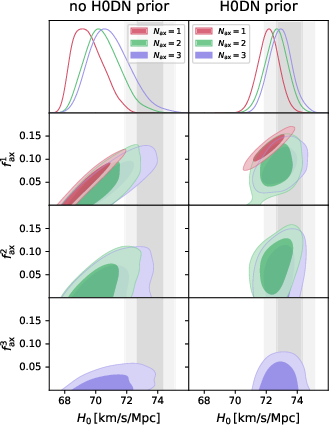
Figure 1: Marginalized posteriors for 7σ6 and 7σ7 in 7σ8 EDE models, with and without the H0DN prior.
The single-field model yields a mean 7σ9 shifted upwards with respect to Λ0CDM, but the statistical tension with the H0DN anchor remains above Λ1 even when allowing for increased uncertainty. In contrast, the two-field model further increases the posterior Λ2 (Λ3 with H0DN prior), and—crucially—the residual Λ4 tension with the local determination is reduced to Λ5. Addition of a third EDE field does not produce a statistically significant further improvement.
This behavior is corroborated by the profile likelihood analysis:
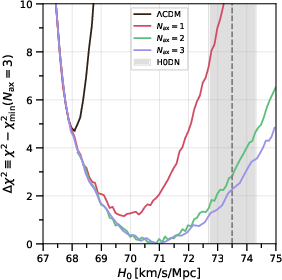
Figure 2: Profile likelihood of Λ6 in Λ7CDM and Λ8 EDE models (without H0DN prior), demonstrating the extension of allowed Λ9 to values consistent with local measurements for H00.
Impact on Expansion and Parameter Evolution
The time/redshift structure of EDE fraction is critical: with more than one field, energy injection is both smoother and covers a broader range, admitting viable expansion histories that can fit high-precision CMB data without the overconcentration at the recombination era characteristic of the single-field models. The reconstructed posterior for the total H01 illustrates this:
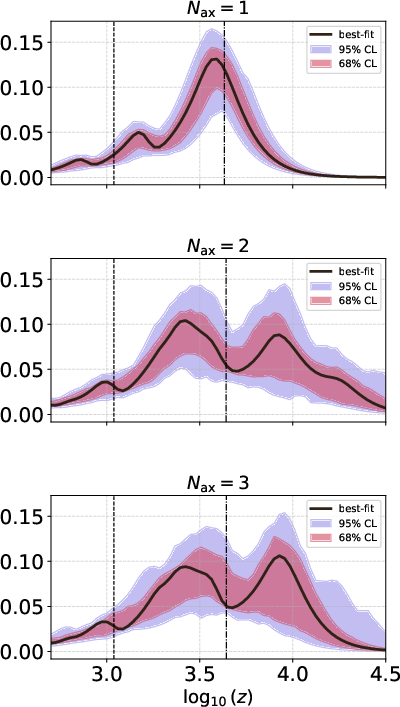
Figure 3: Redshift evolution of the total EDE fraction for H02 in the presence of the H0DN prior, demonstrating smoother, spread-out energy injection for H03.
The improvement in data fit is also evident at the level of the best-fit H04 as a function of H05:
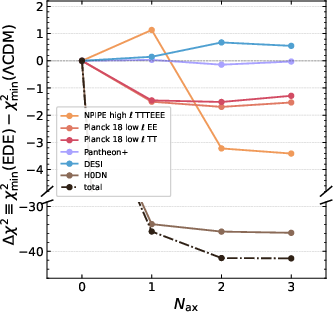
Figure 4: Difference in best-fit H06 for H07 EDE models versus H08CDM for various likelihood components.
The strongest improvement from the second axion is localized to the Planck high-H09 CMB spectrum, which is where single-field EDE models are otherwise most severely disfavored. For more than two axions, the H00 quickly saturates, indicating diminishing returns and model predictivity.
EDE Parameters and Standard Cosmological Parameter Shifts
The marginalized posteriors for the critical redshifts and energy densities of the EDE fields, as well as for standard parameters like H01, H02, and H03, show that the second axion reduces the need for high peak H04 at the matter-radiation equality and shifts the injection epochs apart. Tension with the H05 parameter remains at H06 with respect to DES-Y6, not exacerbated by the second axion, and the small increase in H07 moderately intensifies the existing discrepancy with the PRIMAT deuterium-inferred baryon density.
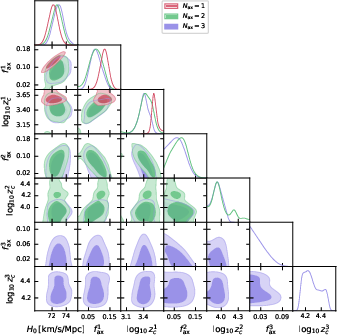
Figure 5: Marginalized posteriors for the EDE parameters (H08, H09) for Nax=1,2,30 in the PDH0 dataset.
Model Selection and Theoretical Implications
Bayesian and frequentist criteria agree that two-field EDE is favored over both Nax=1,2,31CDM and the single-field EDE model, with Nax=1,2,32AIC favoring the former. Notably, further increasing Nax=1,2,33 does not improve the fit commensurately with the additional model complexity—signaling that multi-field axion-like EDE is a predictive, not arbitrarily flexible, prescription.
The results provide a physically and theoretically motivated example of a nontrivial pre-recombination expansion history compatible with all current high-precision cosmological probes. This suggests the Nax=1,2,34 tension, in the context of EDE solutions, can point at a richer scalar-field sector as naturally realized within the broader string axiverse landscape.
Conclusion
This work rigorously establishes that strong Planck NPIPE constraints on single-field axion-like EDE do not reflect a generic exclusion of EDE solutions to the Nax=1,2,35 tension, but rather the limitations of overly restrictive model-building. A two-field axion-like EDE framework—still minimal and controlled—significantly reduces the residual global Nax=1,2,36 tension to a level (Nax=1,2,37) consistent with statistical fluctuations and improves the fit to small-scale CMB data. The framework is theoretically anchored in axiverse scenarios and presents a robust phenomenological target for upcoming CMB-S4 and DESI data. Its predictive power, saturation of fit improvements with Nax=1,2,38, and interplay with other cosmological tensions (e.g., Nax=1,2,39, ϕi0) motivate future model-independent reconstructions of the pre-recombination expansion history and experimental searches for axion multiplets in cosmology.

