- The paper presents an EDE+thaw model that recalibrates early cosmic distances and raises H0 to 70.87±0.94, reducing tensions from 7σ to 2.1σ.
- The study employs both frequentist and Bayesian methods using MCMC and profile likelihoods to demonstrate a Δχ² improvement of up to −12.6 compared to ΛCDM.
- The combined approach resolves CMB-BAO and SN discrepancies while avoiding unphysical phantom energy instabilities, providing a stable path for future cosmological inference.
Disentangling Cosmic Distance Tensions with Early and Late Dark Energy
Overview and Motivation
Cosmological parameter inference from the CMB, BAO, and SN Ia datasets under ΛCDM has revealed substantial tensions, notably the ∼7σ discrepancy in the Hubble constant H0 between the CMB-inferred value and the local distance ladder, as well as secondary tensions among CMB, BAO, and SN probes. Phenomenological solutions employing dynamical dark energy (e.g., w0wa parameterizations) often require phantom crossing, leading to theoretical instabilities. This work demonstrates that these tensions, particularly between CMB/BAO and SN, can be systematically decoupled and resolved with early dark energy (EDE) and a late-time thawing quintessence component, allowing for tension mitigation without resorting to unphysical phantom energy regimes.
Methodology
The authors utilize a comprehensive frequentist and Bayesian framework, combining Metropolis-Hastings MCMC (MontePython) and profile likelihood computations (Procoli), to rigorously quantify model preference and tension resolutions. Three principal cosmological extensions are explored:
- Early Dark Energy (EDE): An axion-like scalar field, characterized by (fEDE,zc,θi), contributing to the expansion rate near matter-radiation equality and diluting rapidly thereafter.
- Thawing Quintessence: A non-phantom scalar field, parameterized via the CPL form w(a)=w0+wa(1−a) with wa=−1.58(1+w0), adding late-time dynamical dark energy.
- w0wa model: Fully phenomenological, allowing phantom crossing but manifestly unstable physically.
Datasets include Planck, ACT, SPT-3G CMB; DESI DR2 BAO; and multiple SN samples (DES Dovekie, DESY5, Pantheon+), with nuisance and calibration parameters carefully marginalized.
Resolution of CMB-BAO Tension and Hubble Discrepancy
The EDE model modifies the sound horizon at the drag epoch rd, directly altering the BAO/CMB distance ratio and increasing H0 inferred from the CMB.
After EDE calibration, BAO residuals relative to fiducial ∼7σ0CDM show systematic ∼7σ1–∼7σ2 improvements across ∼7σ3 (Figure 1).
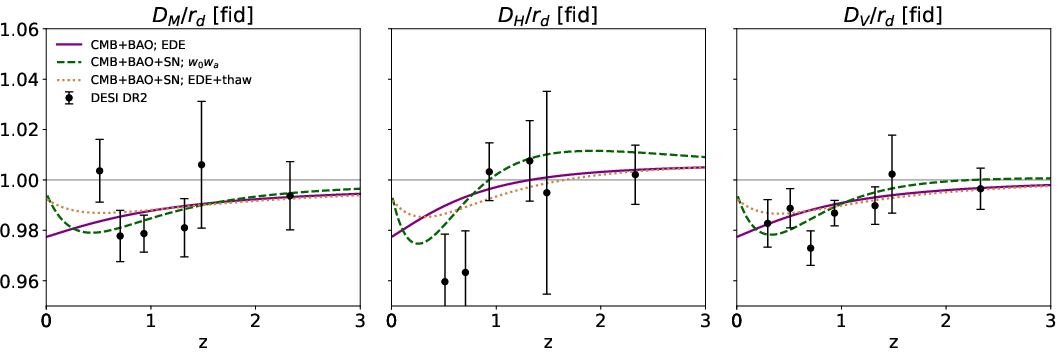
Figure 1: DESI DR2 BAO data compared to predictions from various models, illustrating the improved fit from EDE and EDE+thaw.
Posterior distributions for ∼7σ4 and ∼7σ5 demonstrate that EDE robustly shifts parameters toward BAO preference (Figure 2), with the profile likelihood confirming ∼7σ6 improvement for CMB+BAO relative to ∼7σ7CDM.
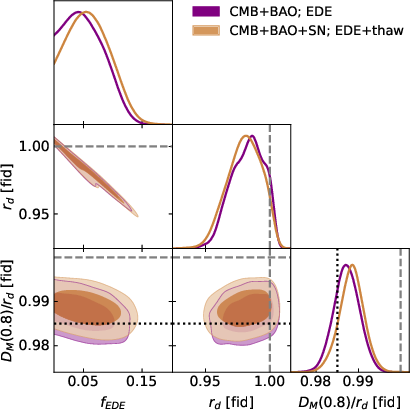
Figure 2: Posterior distributions on ∼7σ8 and ∼7σ9 revealing CMB-BAO tension resolution via EDE.
Profile likelihood analysis avoids prior-volume effects and confirms quadratic, non-Gaussian behavior from marginalized posteriors (Figure 3). EDE raises H00 to H01 and lowers the Hubble tension to H02 (vs H03 in H04CDM) for H0DN.
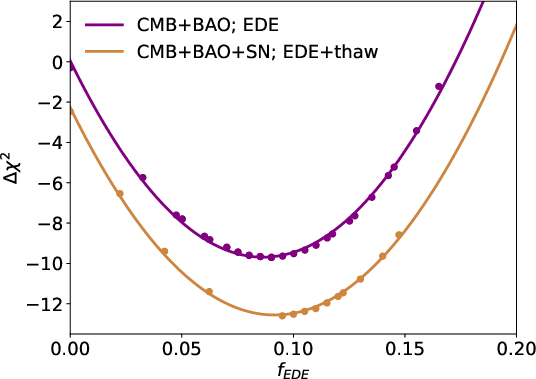
Figure 3: Profile likelihoods for EDE fraction, demonstrating improved fit over H05CDM for both CMB+BAO and CMB+BAO+SN.
CMB primary anisotropy decomposition (Figure 4) isolates improvements from EDE to low H06 (lowered H07), intermediate H08 (coherent TE spectrum reduction), and high H09 (lensing anomaly mitigation).
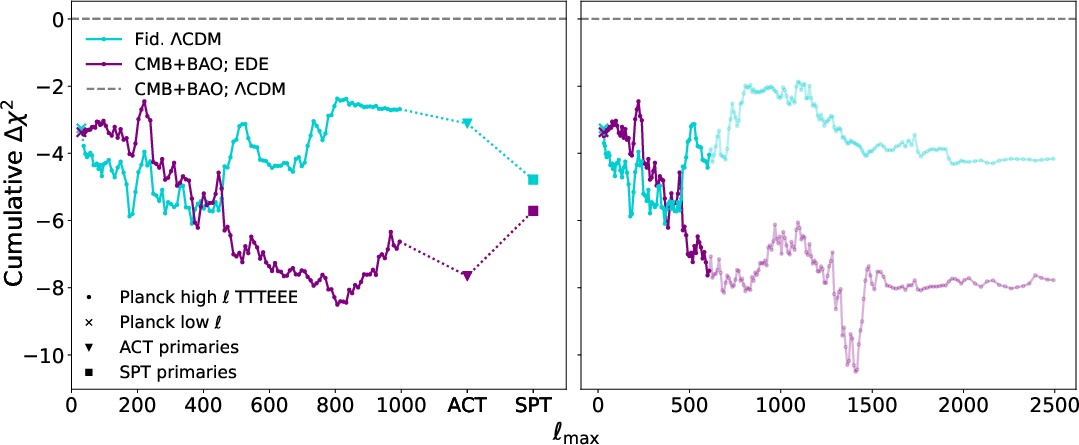
Figure 4: Cumulative contributions to w0wa0 in primary CMB anisotropy for EDE versus w0wa1CDM.
Comparison of likelihoods for w0wa2 from cosmological and local probes affirms EDE's capacity to realign cosmological w0wa3 with distance ladder results, as shown in Figure 5.
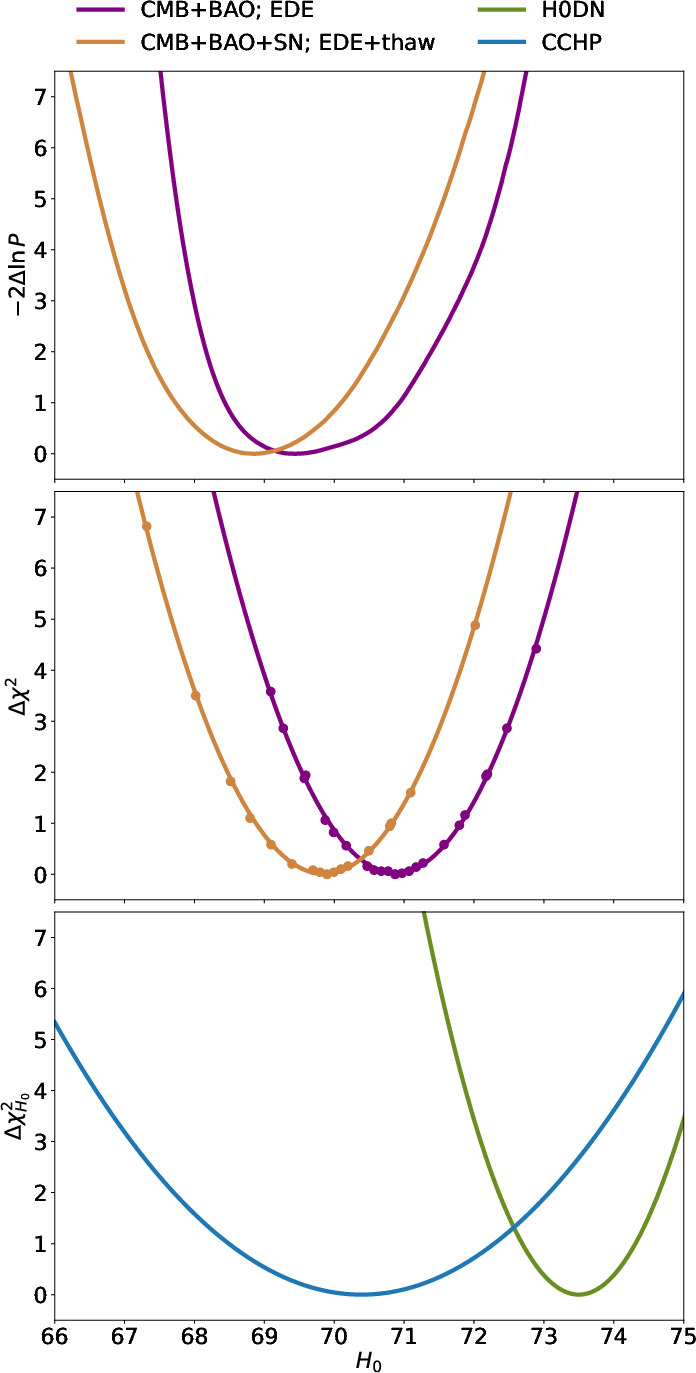
Figure 5: One-dimensional probability distributions for w0wa4, highlighting EDE's reduction of Hubble tension.
Disentangling SN Tension and Late-Time Dynamics
SN Ia data, particularly at w0wa5, favor evolving late dark energy, which is in tension with the pure EDE solution. Adding thawing quintessence to EDE resolves this tension without requiring a phantom regime in w0wa6. The EDE+thaw model achieves w0wa7 for CMB+BAO+SN (DES Dovekie), close to w0wa8 (w0wa9), but avoids theoretical instabilities.
Alternative SN catalogs (DESY5, Pantheon+) yield varying levels of preference for thawing and (fEDE,zc,θi)0, but EDE's impact on CMB-BAO and Hubble tension is largely invariant.
SN distance modulus residuals (Figure 6) show that EDE+thaw fits low-(fEDE,zc,θi)1 SN while maintaining CMB-BAO improvements, whereas (fEDE,zc,θi)2 achieves similar fits only via phantom crossing.
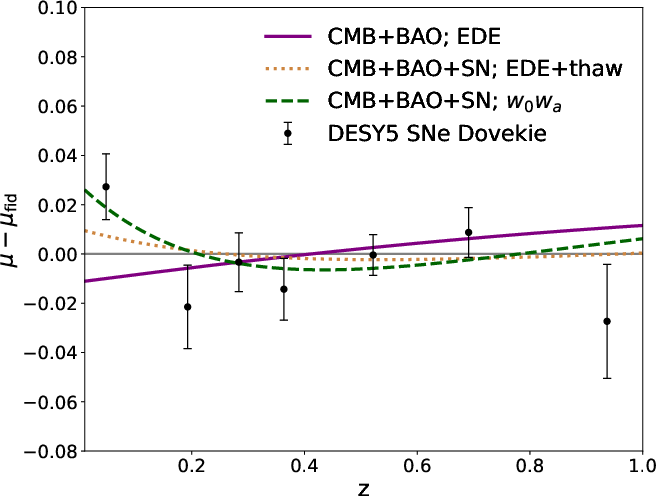
Figure 6: SN distance modulus data relative to fiducial (fEDE,zc,θi)3CDM, showing the fit improvement from EDE+thaw.
Implications, Theoretical and Practical Impact
The segmentation of the cosmic tensions into early (CMB-BAO, Hubble) and late (SN) components allows targeted model extensions without unphysical behavior. EDE robustly calibrates early distance measures and (fEDE,zc,θi)4, while thawing quintessence absorbs residual low-(fEDE,zc,θi)5 SN preferences. This division points toward future high-precision cosmology relying on both early and late universe modeling.
Upcoming CMB surveys (Simons Observatory, SPT-3G Ext-10k) and SN datasets (LSST, Roman) will sharply test these models. The combination of EDE and thawing quintessence constitutes a theoretically sound avenue for tension resolution, provided robust calibration at low redshift SN is achieved.
Conclusion
This study rigorously demonstrates that early dark energy can resolve CMB-BAO and Hubble tensions by modifying the drag epoch sound horizon, with the improvement quantified via frequentist and Bayesian metrics. The addition of thawing quintessence enables simultaneous SN tension mitigation without recourse to phantom energy. The composite EDE+thaw solution remains stable, sensitive to SN dataset calibration, and has direct implications for future cosmological inference and dark sector physics.

