- The paper presents QumVQD, a framework that computes electronic and vibrational excited states on bosonic quantum processors using variational quantum deflation.
- It leverages symmetry enforcement and Hamiltonian fragmentation to significantly reduce quantum resources and maintain chemical accuracy (errors <10⁻³ Hartree).
- The approach exhibits enhanced noise resilience and lower circuit depths, promising scalable quantum chemical simulations on qumode-based hardware.
QumVQD: Excited-State Quantum Chemistry on Qumode-Based Processors via Variational Quantum Deflation
Introduction
This work presents a comprehensive framework, QumVQD, for the computation of excited-state energies in quantum chemistry on bosonic (qumode-based) quantum processors utilizing the variational quantum deflation (VQD) algorithm. QumVQD generalizes ground-state approaches to target both electronic and vibrational excitations by leveraging the natural mapping between bosonic modes and the structures encountered in computational chemistry. The methodology integrates symmetry enforcement in the Fock basis to conserve particle number and applies Hamiltonian fragmentation for tractable vibrational calculations, culminating in robust, resource-efficient quantum circuits implementable on bosonic hardware.
Theoretical Framework and Qumode Encoding
Central to QumVQD is the use of qumodes—quantized harmonic oscillators—as quantum hardware primitives. Unlike qubit-based devices, qumodes provide an infinite-dimensional Hilbert space per physical unit, aligning natively with both vibrational and electronic structure problems. For electronic calculations, qumodes encode spin orbitals compactly, and Hamiltonian subspace restrictions are imposed via Hamming weight filtering, ensuring only physically meaningful (correct electron number) subspaces are addressed. This reduces the Hilbert space dimension from exponential in the number of orbitals (2M) to a polynomial or combinatorial scale ((neM)), substantially lowering quantum resource requirements and eliminating spurious solutions.
For vibrational structure, QumVQD directly exploits the bosonic nature of molecular vibrations, circumventing the lossy mappings required in qubit approaches. The method is further enhanced with a Bogoliubov fragmentation technique, decomposing complex vibrational Hamiltonians into independently tractable segments.
Variational Quantum Deflation Implementation
QumVQD extends the standard variational quantum eigensolver (VQE) by sequentially incorporating orthogonality penalties in the cost function, which enables systematic targeting of excited states beyond the ground state. The pipeline involves classical-quantum feedback: quantum hardware prepares candidate states, and classical computation evaluates overlaps and energies to enforce orthogonality against previously found eigenstates.
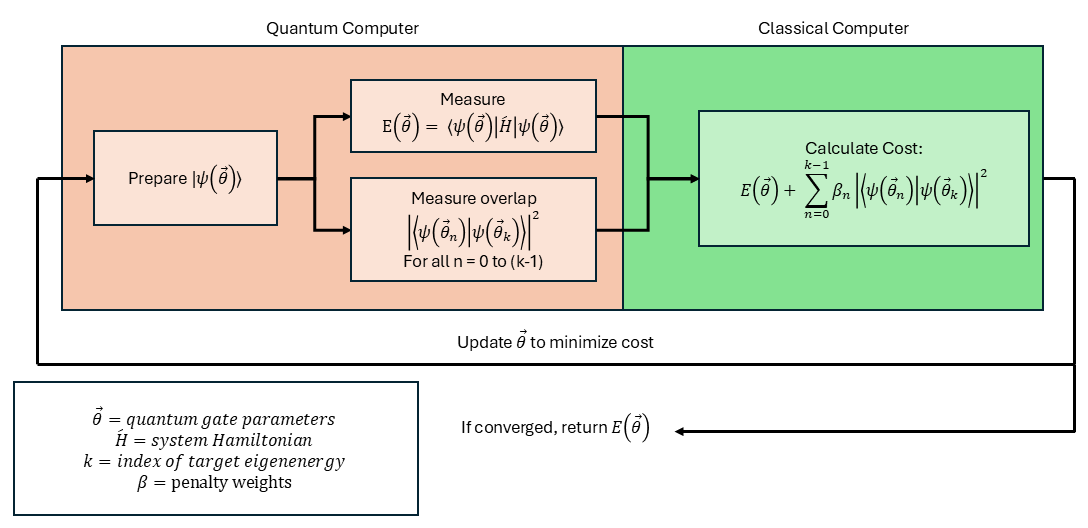
Figure 1: The QumVQD pipeline for obtaining excited states, projecting each state orthogonally to those found in previous iterations.
Circuit parameterization is achieved with concatenated SNAP and displacement gate pairs, whose number (depth D) quantifies the ansatz expressivity. In vibrational contexts, the application of Bogoliubov-derived unitary transforms enables expectation evaluation with minimal gates, further reducing circuit depth and entangling gate count.
Results: Electronic and Vibrational Energetics
QumVQD was benchmarked against full configuration interaction (FCI) for electronic ground and excited states of H2 using the STO-3G basis. The method recapitulates the PES for the four lowest eigenstates with errors well below chemical accuracy (<10−3 Hartree).
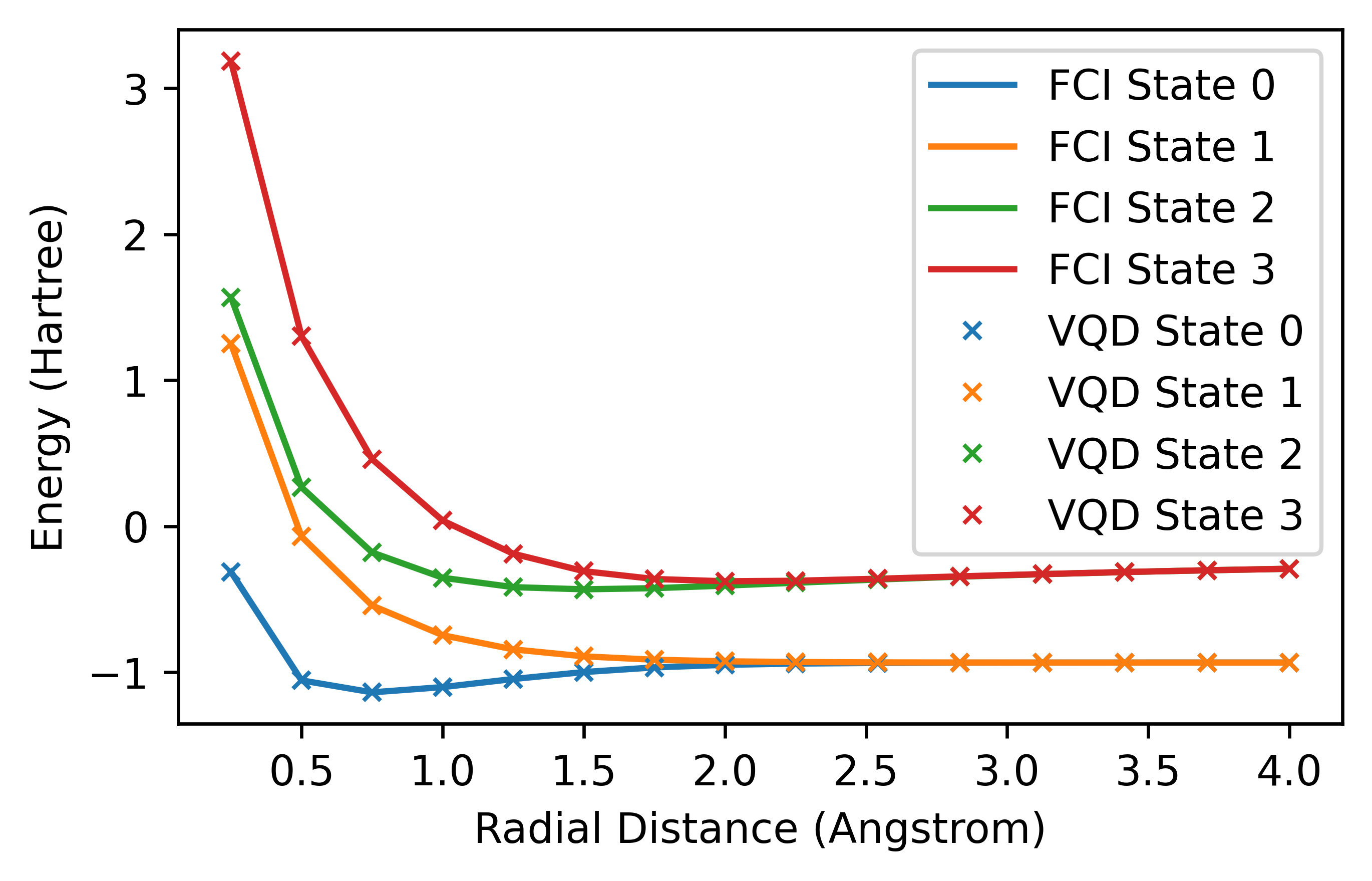
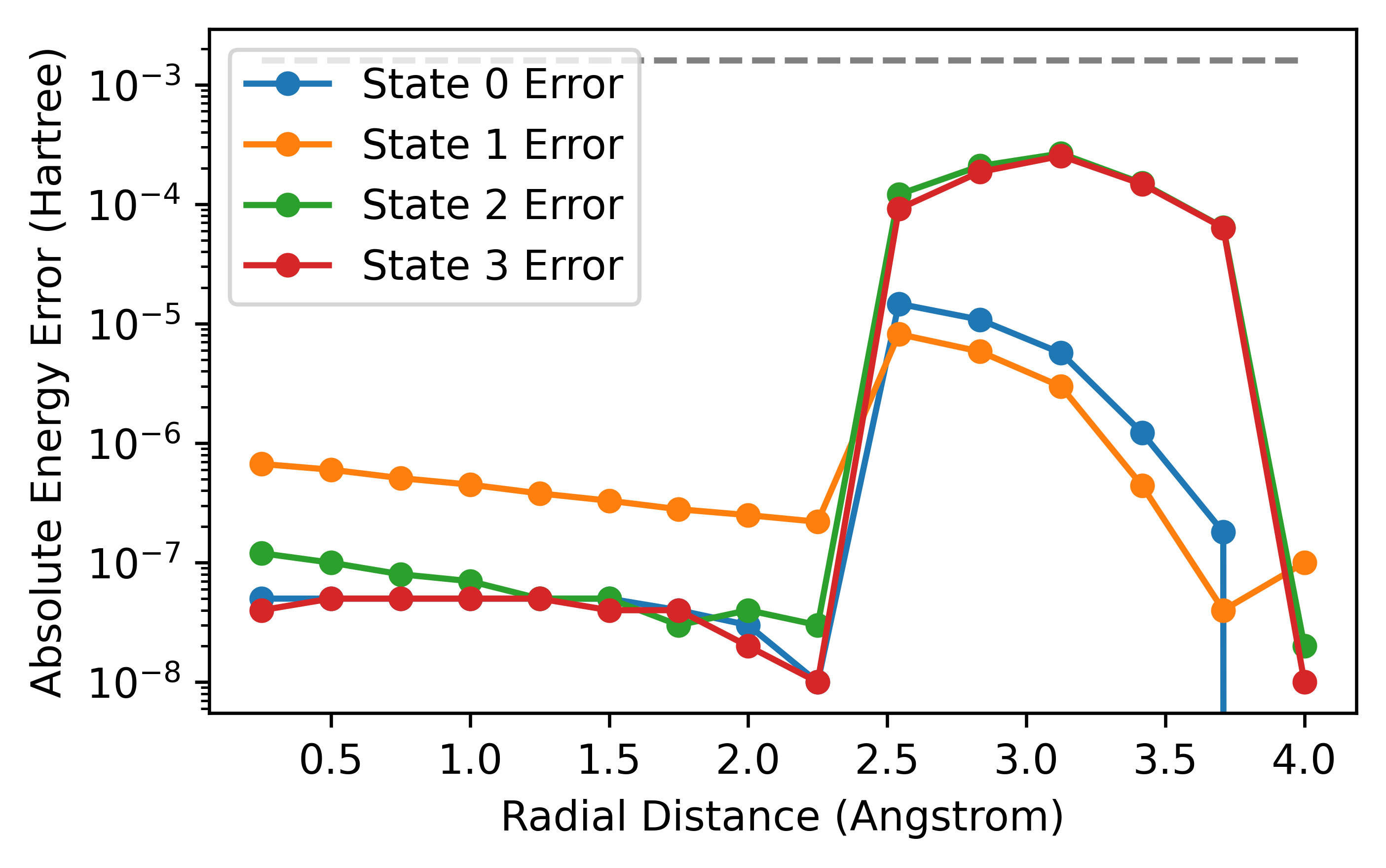
Figure 2: PES for the lowest four eigenstates of H2 by QumVQD and FCI reference.
The absolute energy deviations across the PES confirm robust accuracy retention throughout geometrical changes.
For vibrational structure, the framework is validated on CO2 and H2S, with all five lowest vibrational eigenstates matching direct diagonalization within spectroscopic accuracy. The use of Hamiltonian fragmentation enables parallel execution and yields gate counts 1–2 orders of magnitude lower than state-of-the-art qubit-based circuits.
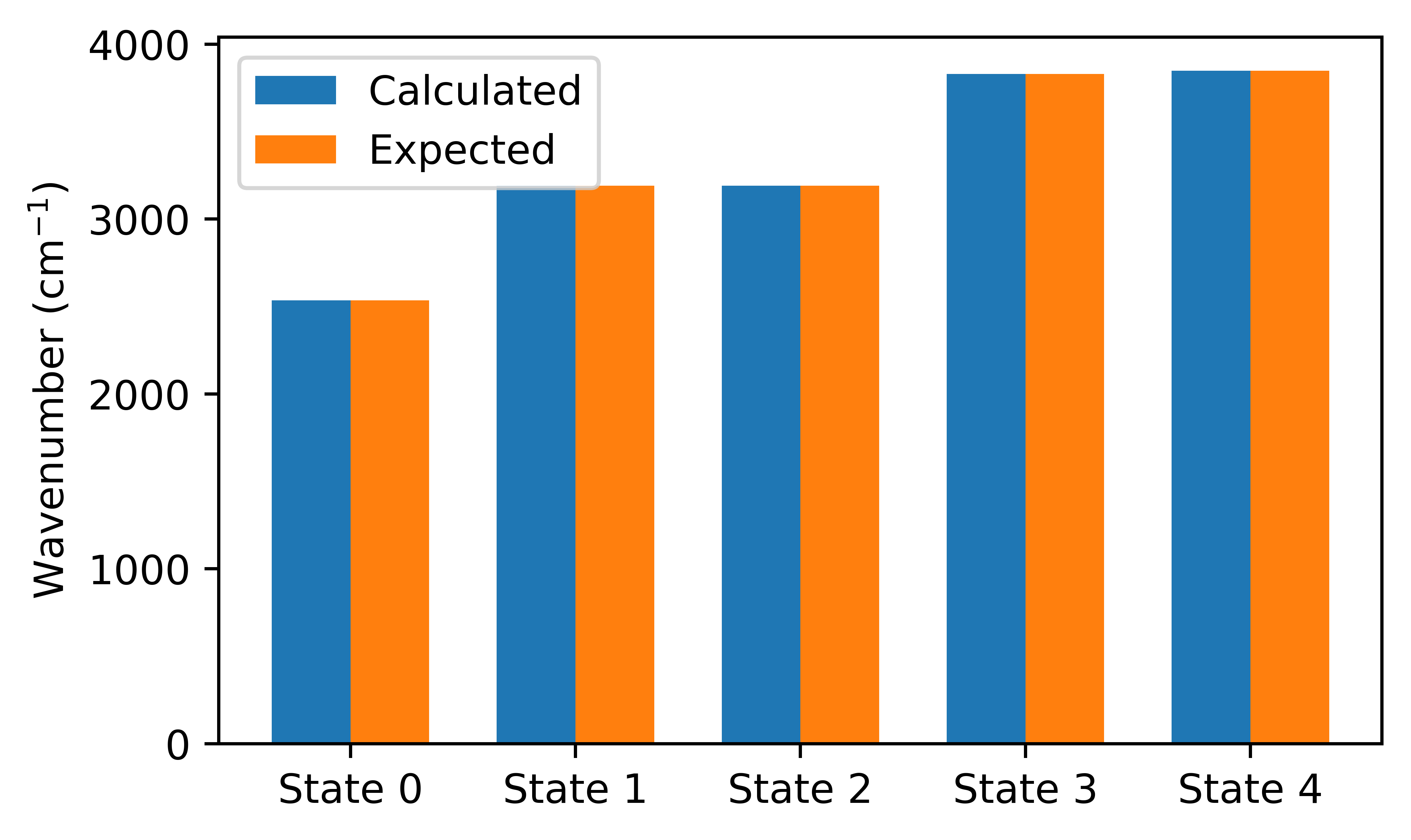
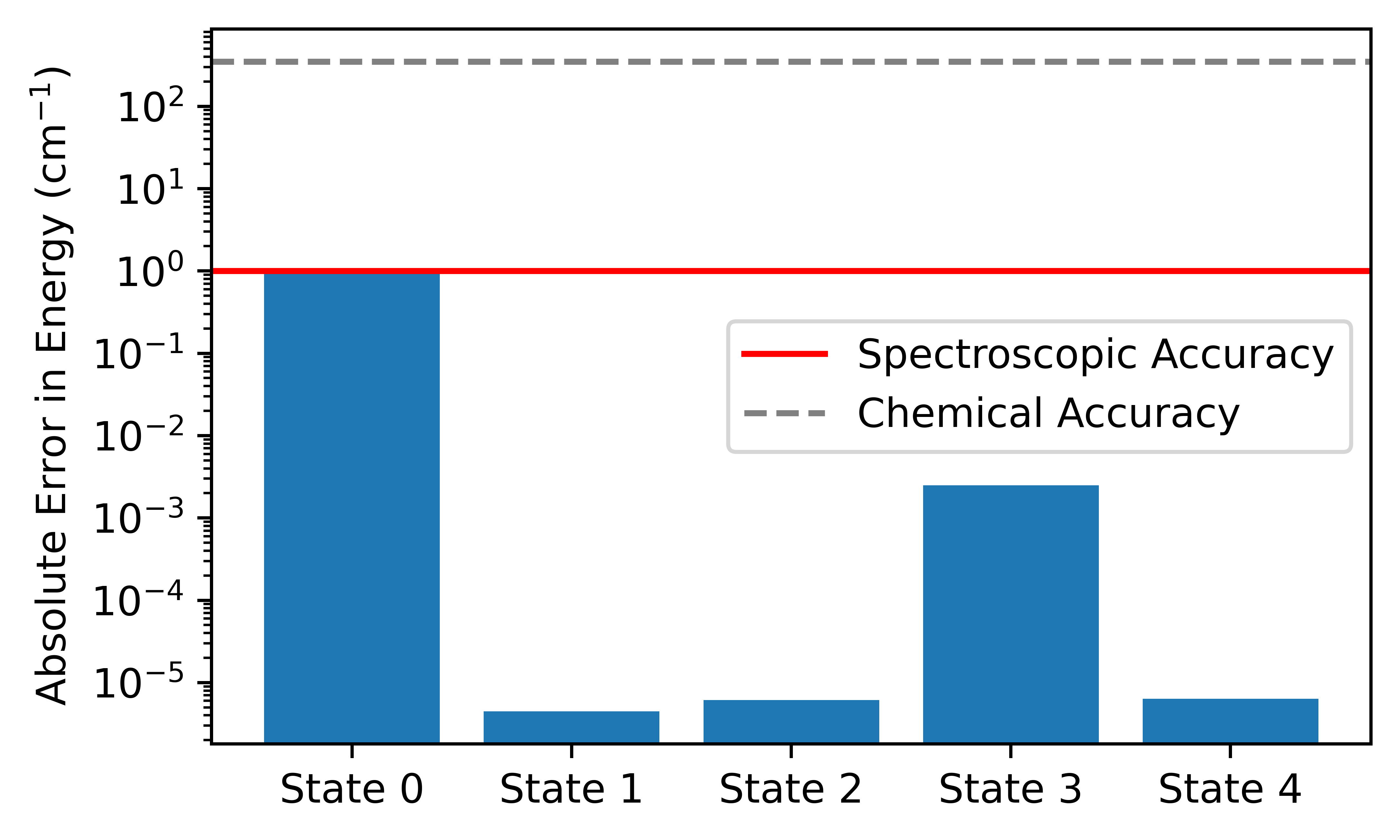
Figure 3: Comparison of computed and benchmark vibrational eigenenergies for CO2, including absolute errors.
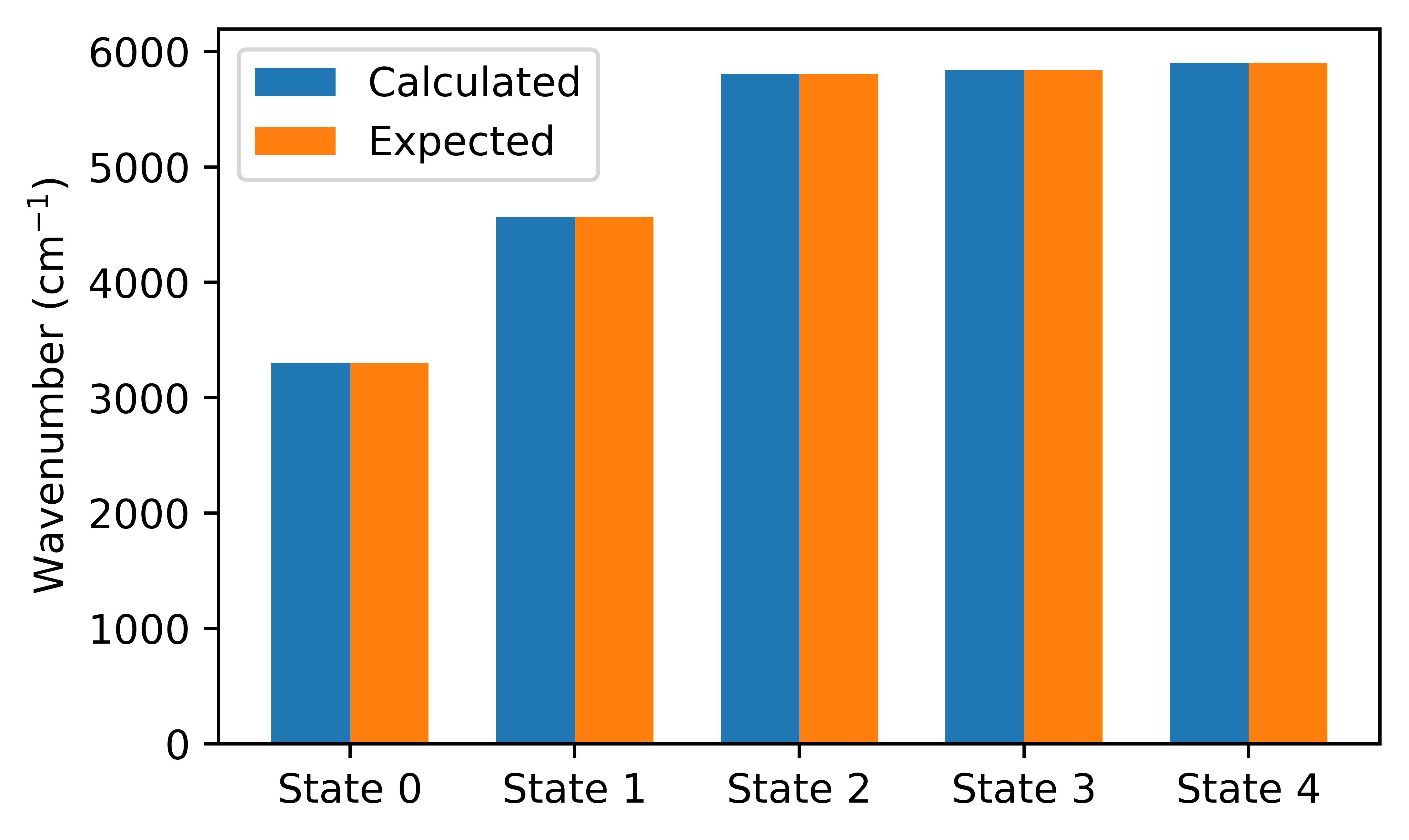
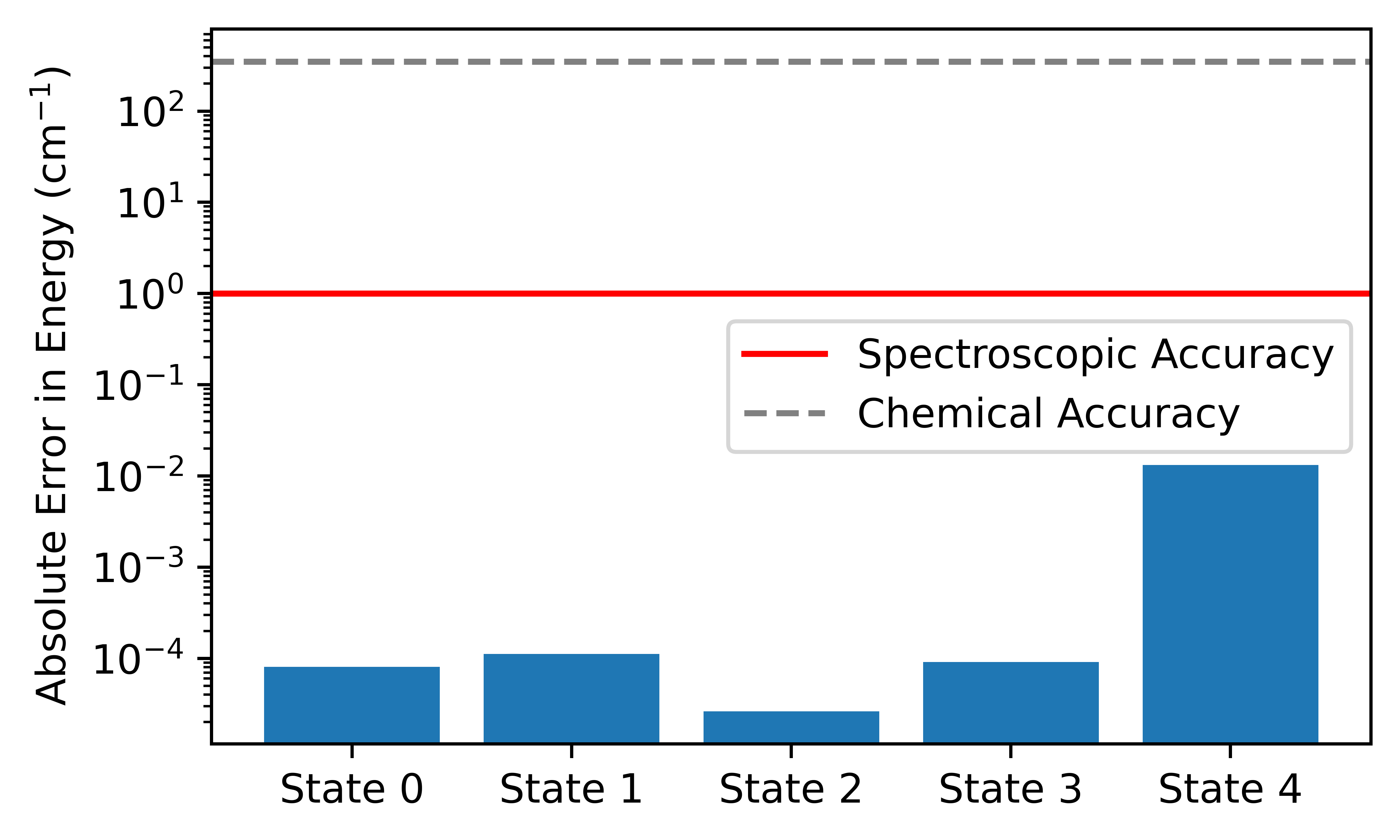
Figure 4: Comparison of computed and benchmark vibrational eigenenergies for H2S, including absolute errors.
These results underscore the capability of QumVQD to efficiently access highly accurate excited-state landscapes for both electronic and vibrational problems.
Resource Reduction and Symmetry Enforcement
Enforcing particle number via Hamming weight filtering dramatically reduces Hilbert space dimensionality and required quantum hardware. For example, systems such as LiH/6-31G transition from needing over four million states (unfiltered) to only a few thousand, directly impacting required qumode or qubit counts and circuit depth. The qumode count for a reduced problem is (neM)0, a significant reduction over the naive mapping.
Noise Resilience and Error Analysis
QumVQD circuits, by virtue of their native bosonic structure and shorter depths, demonstrate superior resilience to hardware noise. Gate fidelity analysis focuses on two-qumode entangling operations, revealing that qumode-based methods maintain chemical or spectroscopic accuracy at higher per-gate error rates compared to qubit methods, due to orders-of-magnitude reductions in gate counts.
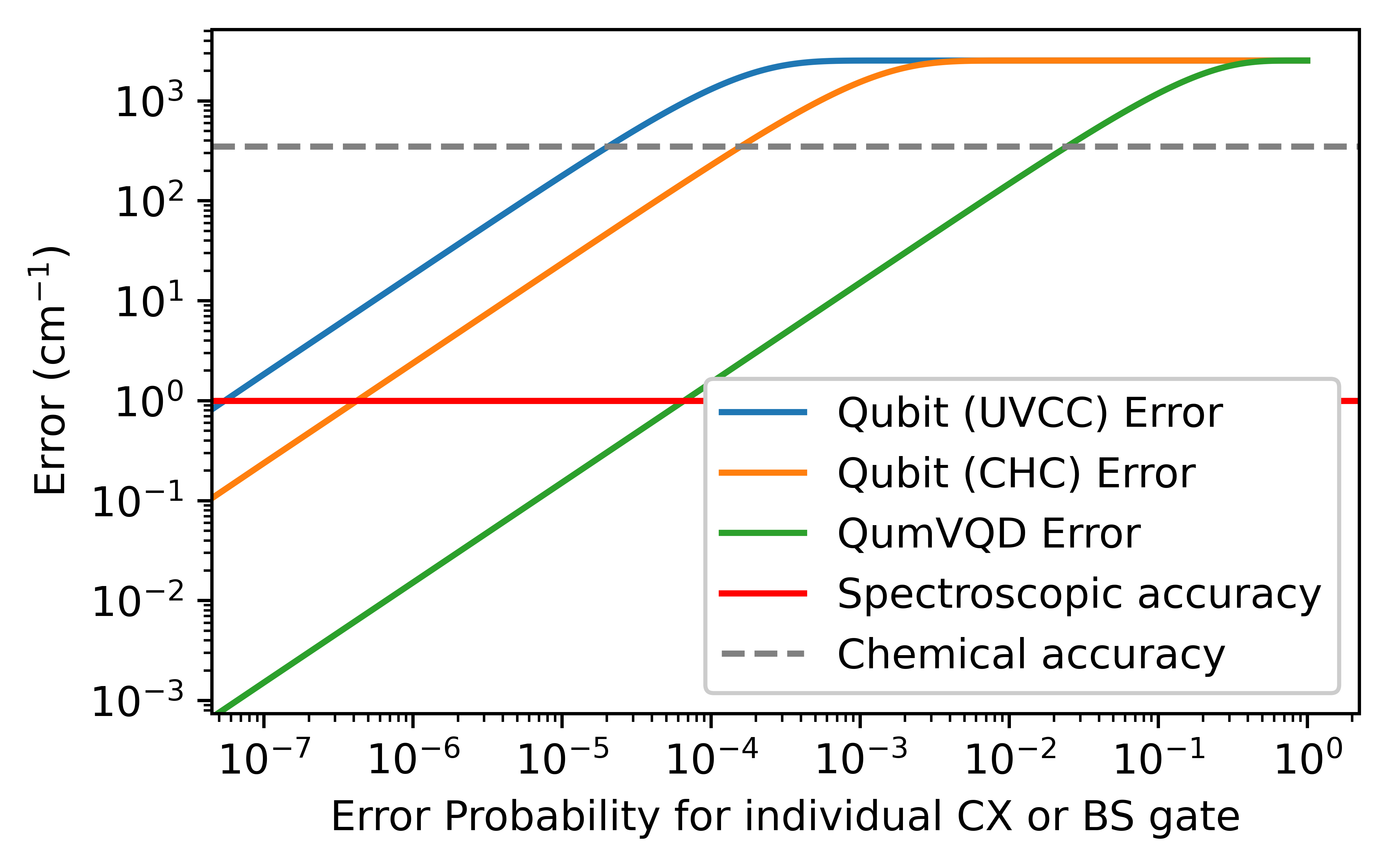
Figure 5: Error in computed ground state vibrational energy (CO(neM)1) versus gate error probability for qubit (CX) and qumode (BS) based circuits.
Amplitude damping noise, modeled with Kraus operators, demonstrates that QumVQD calculations remain within chemical accuracy if the per-gate photon loss fraction ((neM)2) is (neM)3 or lower.
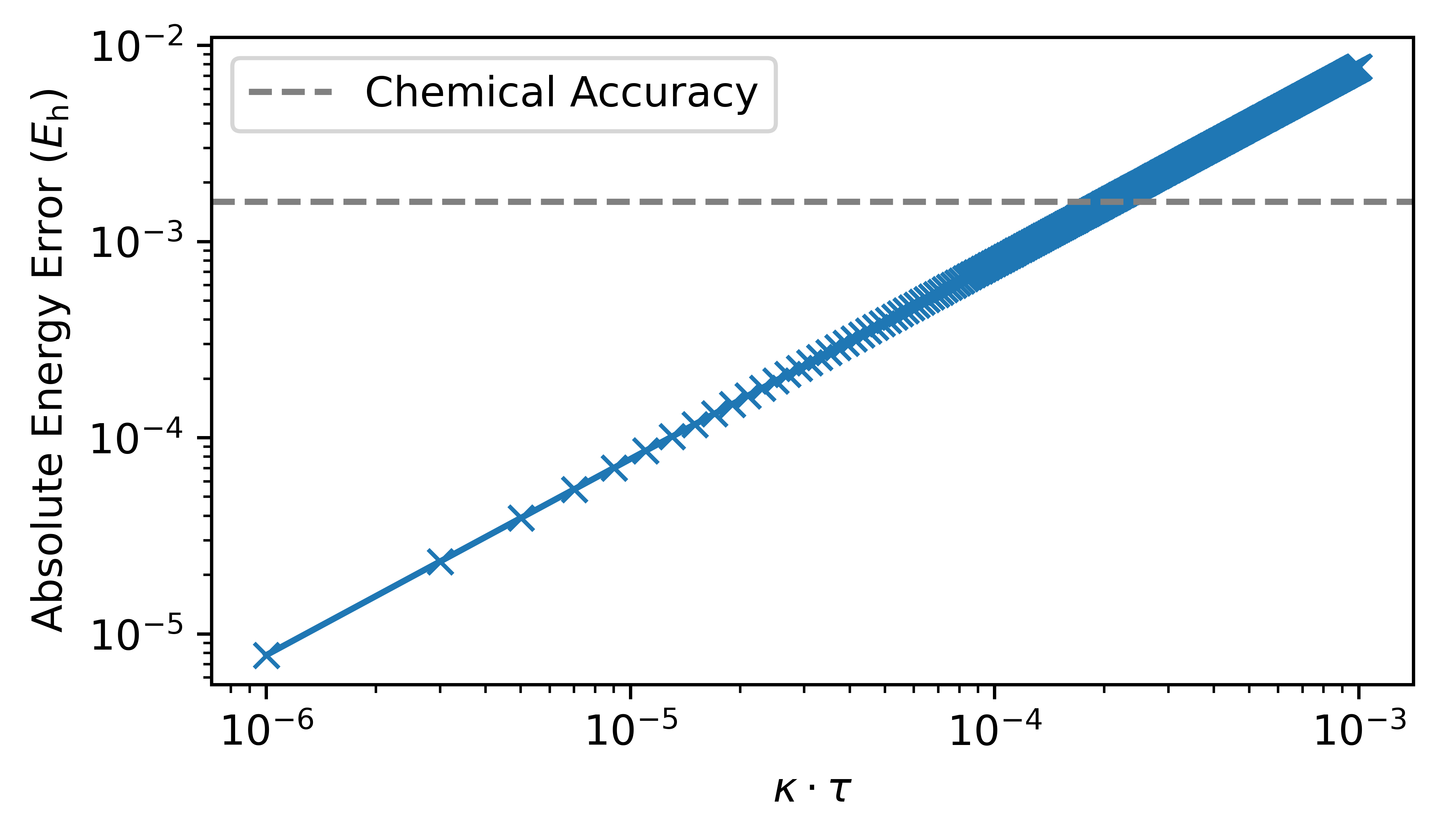
Figure 6: Relationship of amplitude damping ((neM)4) to absolute energy error in electronic ground state calculations for H(neM)5.
These findings highlight gate error thresholds below which bosonic quantum computers can deliver accurate quantum chemical data with current or near-future hardware.
Practical and Theoretical Implications
QumVQD establishes new standards for excited-state quantum chemistry on quantum processors, particularly for bosonic hardware. The elimination of costly boson-to-qubit mappings, drop in required circuit depth, and effective symmetry enforcement indicate clear resource advantages. The direct mapping between vibrational degrees of freedom and qumode registers is anticipated to scale efficiently for high-dimensional vibrational or mixed electron-vibrational problems, which are otherwise prohibitive for both classical and current qubit-based quantum resources.
In addition, the framework's ability to adapt to algorithmic advances (e.g., improved fragmentation strategies or state preparation techniques) and its compatibility with hardware error mitigation protocols position it for immediate integration in experimental bosonic quantum chemistry implementations.
Conclusion
The introduction of QumVQD enables state-of-the-art excited-state quantum chemistry calculations on qumode-based quantum hardware, delivering both electronic and vibrational energies at or below chemical and spectroscopic accuracy thresholds. Leveraging particle number symmetry enforcement and vibrational Hamiltonian fragmentation, QumVQD exhibits significant reductions in required circuit resources and enhanced error tolerance compared to qubit-based approaches. These advancements demonstrate that bosonic quantum devices, equipped with algorithms such as QumVQD, are poised to address central challenges in molecular quantum simulation and expand the quantum computational frontier for quantum chemistry applications.
For full details, see "Excited-State Quantum Chemistry on Qumode-Based Processors via Variational Quantum Deflation" (2604.13457).