- The paper presents a multimodal pipeline that converts lecture videos into interactive sessions by integrating transcript and visual context analysis.
- It introduces a hybrid reinforcement learning mechanism using a 2PL IRT model to dynamically adjust question difficulty and maintain optimal learner engagement.
- The system generates personalized post-lesson summaries through dense semantic vectorization and LLM-driven contextualization, aligning assessments with individual learner needs.
PAL: A Personal Adaptive Learner for Real-Time Interactive Education
Motivation and System Overview
PAL (Personal Adaptive Learner) introduces a comprehensive, multimodal AI system for personalized, real-time adaptation in digital lecture-based learning environments. The framework directly addresses deficiencies in conventional AI education platforms, which predominantly rely on static and pre-defined personalization mechanisms. These limitations result in poor user engagement and ineffective retention, as uniform pacing and generic assessments neither challenge advanced learners nor support those who struggle.
PAL transforms passive lecture videos into highly interactive learning sessions. The system integrates multimodal analysis by parsing transcripts, extracting visual context, and dynamically generating tailored questions. The platform further augments the learning experience by adaptively selecting question difficulty using a hybrid RL mechanism and concludes each session with a learner-specific summary. This combination of context-aware adaptation and continuous learner modeling distinguishes PAL as a substantive advancement in AI-driven education.
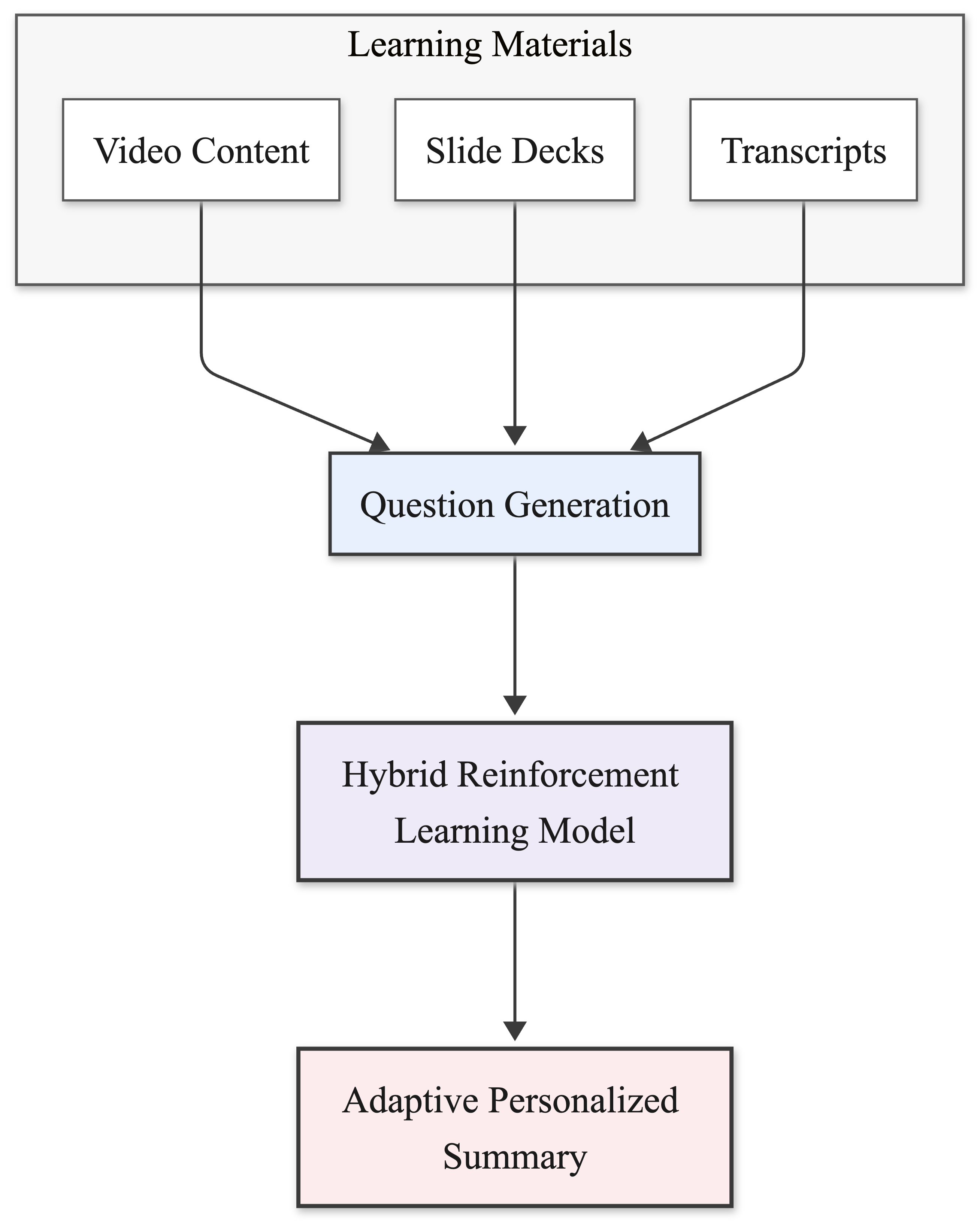
Figure 1: The overall architecture of PAL illustrates its modularity, highlighting the pipeline from multimodal content analysis to real-time learner interaction and personalized post-assessment.
Video-to-Question Dataset Generation Pipeline
PAL's pipeline for transforming lecture videos into interactive content is modular, context-aware, and extensible. The process begins with mining the video transcript for intervention points via linguistic triggers and periodic sampling. At candidate locations, visual context is extracted by OCR and vision-LLMs (LLaVA-mini), which, combined with transcript segments, form a context bundle.
The question generator then produces MCQs of three difficulty levels—easy, medium, hard—classified by heuristics on question structure and semantic type. Difficulty assignments are initially based on simple rule mappings, backed by an LLM-enhanced fallback for ambiguity. The pipeline outputs timestamped, difficulty-rated QA items, structured for downstream adaptive delivery.
Key strengths of this approach include integration of speech, vision, and text modalities for robust context capture, extensibility via modular LLM components, and high accuracy in question-context alignment, as evidenced by a consistent mapping between video content and quiz items.
Hybrid RL for Adaptive Difficulty Selection
A central innovation in PAL is the hybrid RL difficulty adaptation policy. The system encodes learner state xt at each interaction—comprising latent skill, accuracy, response time, behavioral momentum, learning velocity, and confidence. Given this state, PAL selects question difficulty to maximize expected cumulative reward, where reward itself is a composite of correct/incorrect responses, answer latency, progression quality, and sustained streaks.
Statistical priors are enforced using a 2PL IRT model which ensures stable adaptation during initial user modeling, preventing abrupt oscillations in question difficulty. Promotion/demotion is threshold-gated to avoid myopic switching, with cooldowns and hold conditions for further stabilization—mechanisms that address the inherent volatility of RL-driven adaptation in short sessions.
The RL head employs a bandit formulation (three-arm—easy, medium, hard) with Q-learning and ε-greedy exploration, ensuring both sample efficiency and adaptability. A confidence-weighted blending schedules the handover from the prior to the RL head as session evidence accrues. This hybridization achieves a robust balance between prior-driven stability and RL flexibility, outperforming single-strategy adaptive engines in dynamic engagement maintenance and progression pacing.
Personalized Post-Lesson Summary Generation
Upon session completion, PAL synthesizes a personalized, concept-focused recap leveraging the full history of user interactions. The system uses dense semantic vectorization of lecture sentences via SentenceTransformer models to construct a latent semantic map. User queries and potential knowledge gaps are matched through fast vector similarity, which enables extraction of contextually relevant lecture snippets, even in the presence of paraphrase or dispersion.
The extracted material is then delivered to an instruction-tuned LLM (Llama 3.2 1B) via a context-aware, behaviorally adaptive prompt. The prompt is tailored to emphasize conceptual regions where the user excelled ("Territory Mastered") and those with evidence of confusion or interest ("Discovery Zone"). This pipeline ensures that summary explanations are not only accurate and clear, but also specifically responsive to the learner's demonstrated needs and curiosities, ultimately closing the loop between assessment and remediation.
Implications and Future Directions
PAL's architecture and adaptive pipeline introduce a new standard for personalization granularity and contextual fidelity in AI-driven education. The deployment of hybrid RL balancing immediate and long-term progression, coupled with multimodal content curation and responsive summarization, presents a model for scalable, equitable, and high-engagement digital learning.
Practically, this framework can extend to MOOCs, corporate training platforms, and individualized tutoring at scale—domains where passive video consumption and one-size-fits-all assessments remain a barrier to efficacy. Theoretically, the blend of item response theory with RL suggests further work in hierarchical curriculum design, transfer learning across learner cohorts, and agentic feedback networks for group learning scenarios.
Future research will focus on augmenting feedback loops, integrating collaborative interactions, robust automated evaluation protocols, and in-the-wild longitudinal studies to quantify learning gains attributable to PAL's fine-grained adaptation.
Conclusion
PAL operationalizes a multimodal, agentic approach to real-time, individualized learning, addressing the critical challenge of maintaining learners within their optimal engagement zone during video-based instruction. The system's combination of context-rich question generation, hybrid RL adaptation, and personalized session summarization realizes a distinct improvement over prior AI education platforms, suggesting scalable routes both for immediate practical deployment and foundational advances in adaptive educational technology.
(2604.13017)