- The paper introduces a DDPM-based generative model that synthesizes Lagrangian pair trajectories directly from DNS data without relying on traditional closure methods.
- It accurately reproduces joint dispersion statistics, including stretched-exponential tails and inertial-range t^3 Richardson scaling, validating its ability to capture multiscale intermittency.
- The work outlines implications for rapid synthetic dataset generation and improved data assimilation techniques in turbulent flow applications.
Data-Driven Modeling of Turbulent Pair Dispersion via Generative Diffusion Models
Introduction
Pair dispersion in fully developed turbulence encapsulates one of the core multiscale problems in classical and modern fluid dynamics, dictating transport phenomena from pollutant spreading to droplet coalescence in clouds. Traditional treatments invoke the Richardson and Kolmogorov phenomenology, with separation governed by scale-dependent eddy diffusivity laws. However, real turbulent flows are characterized by strong intermittency, non-Gaussian statistics, and non-Markovian temporal correlations, challenging classical closures. Existing stochastic models often remain limited by their inability to generate realistic pairwise Lagrangian trajectories with full statistical consistency across all dynamical scales.
The presented work, "Turbulent Pair Dispersion with Stochastic Generative Diffusion Models" (2604.12932), provides a data-driven solution by leveraging denoising diffusion probabilistic models (DDPMs) to stochastically synthesize pairs of Lagrangian trajectories. The study establishes that these generative models reproduce both joint and marginal Lagrangian statistics—including deviations from classical scaling and rare extreme events—without recourse to physical priors or analytically prescribed stochastic closures.
Diffusion Model Architecture and Training Regimen
The generative model is based on a forward-backward DDPM pipeline, with the forward process corrupting empirical DNS data (velocity trajectory pairs) through a controlled additive Gaussian noise schedule, and a reverse (generative) process, parameterized by a UNet, reconstructing clean velocity trajectories from noise. The specific architecture features 417M parameters, non-linear tanh-based variance scheduling, and extensive attention mechanisms, enabling the capture of intermittent, multiscale dynamics.
Particle pairs are sampled from a database of 3D homogeneous isotropic turbulence DNS, each providing simultaneous time series for particle velocities over thousands of viscous time units. Training occurs by minimizing a variational upper bound on the trajectory data likelihood, allowing the network to learn complex, scale- and history-dependent transport far beyond Markovian approximations.
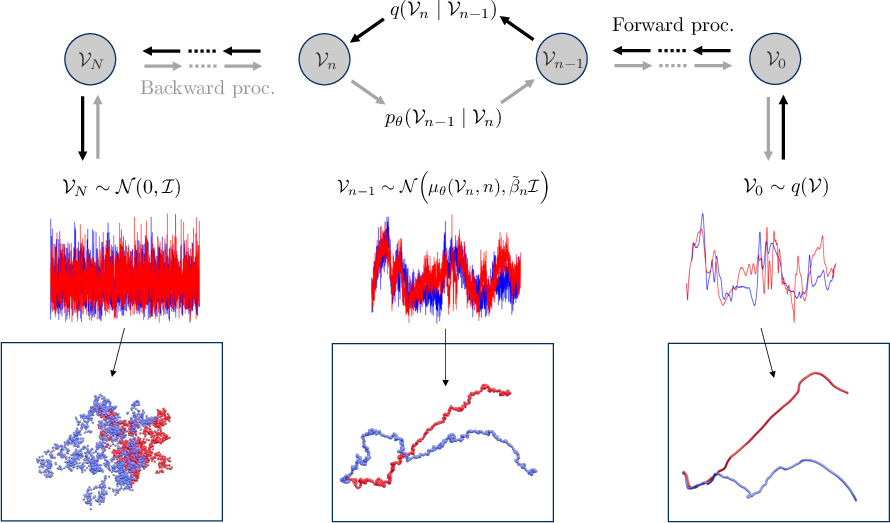
Figure 1: The forward diffusion process corrupts trajectory data with Gaussian noise, while the backward process stochastically reconstructs physically consistent multiscale velocities using a conditioned neural network.
Qualitative and Structural Consistency
A first qualitative assessment reveals that the DM-generated Lagrangian velocity signals possess the expected intermittency and multiscale structure, with trajectories alternating between smooth evolution and abrupt, correlated bursts. The initial velocity correlation and subsequent divergence of the pair, characteristic of turbulent dispersion, mirrors DNS ground truth both in magnitude and temporal coherence.
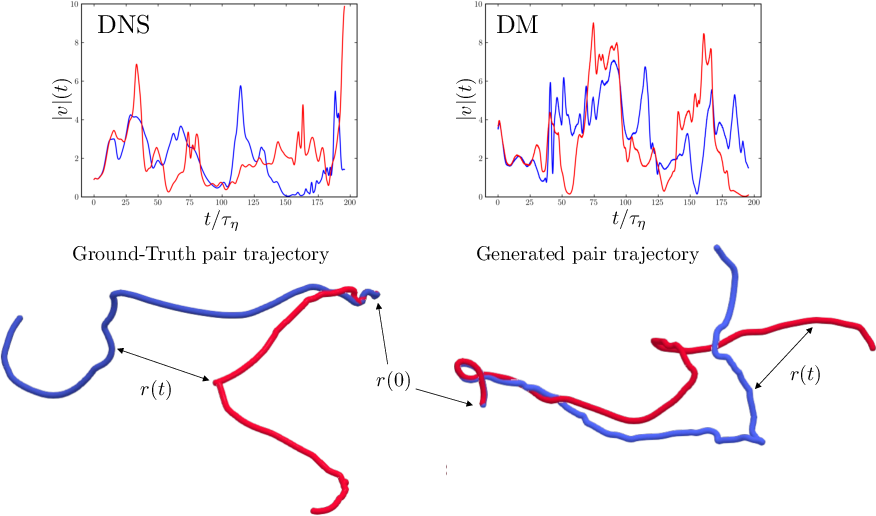
Figure 2: Comparative visualization of velocity magnitude evolution and reconstructed 3D paths for DNS ground-truth (left) and diffusion model output (right), indicating high structural fidelity at the level of individual realizations.
Statistical Reproduction of Turbulent Pair Dynamics
Pair Separation PDFs and Non-Ideal Deviations
The DM framework precisely reproduces the full probability distribution of particle separations, not only for the bulk but for rare, extreme events and stretched-exponential tails. Critically, it also captures deviations from the self-similar Richardson PDF that arise at finite Reynolds numbers and from intermittent dynamics—properties that standard closure models miss.
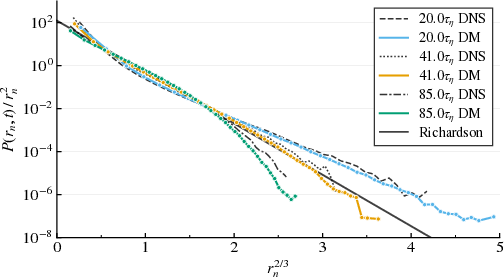
Figure 3: PDFs of pair separation, in compensated and rescaled form, are accurately matched by the diffusion model, including the structure of deviations from the Richardson stretched-exponential law.
High-Order Statistics and Intermittency
Temporal evolution of the second-order and fourth-order moments of separation, as well as separation flatness, validates the performance across both mean and rare events. The DM preserves the inertial-range t3 Richardson scaling in the mean-square separation and accurately tracks higher-order flatness revealing non-Gaussian, intermittent separation dynamics.
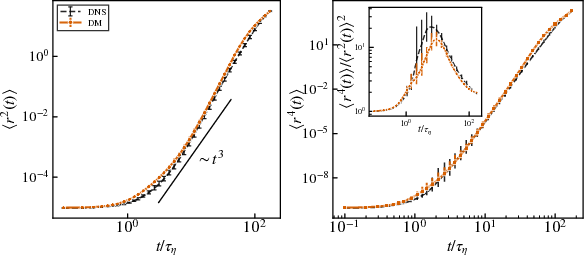
Figure 4: Time-resolved mean-square and fourth-order separation moments, and flatness, demonstrate the DM’s ability to reproduce both standard and high-order dispersion statistics with DNS-level accuracy.
Relative Velocity Structure and Multiscale Dynamics
The model also accurately generates the temporal evolution of moments of velocity differences between pairs. The second- and fourth-order moments and their flatness are fundamentally tied to inertial-range intermittency—a signature missed by memoryless or local-stochastic models. The DM encodes the proper interplay between pair dispersion and multiscale turbulent fluctuations.
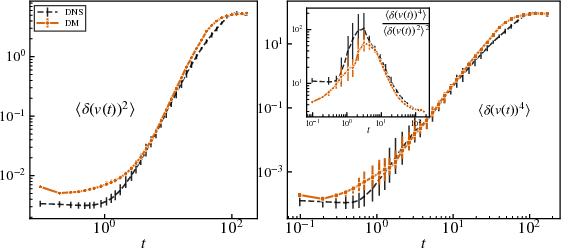
Figure 5: Moments and flatness of the pairwise velocity difference, essential for quantifying multiscale turbulent intermittency, are statistically indistinguishable between DM and DNS.
Preservation of Marginal Single-Particle Statistics
Importantly, the joint generative process does not degrade marginal single-particle Lagrangian statistics. All moments and flatness of single-particle Lagrangian structure functions remain in agreement with DNS benchmarks, confirming that faithful joint generation does not require sacrificing marginal statistical accuracy.
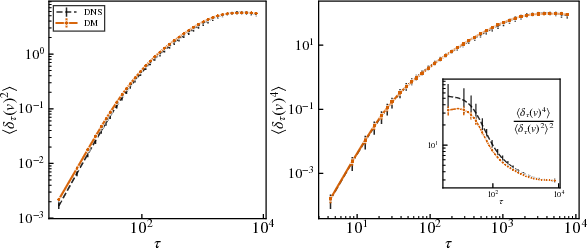
Figure 6: Single-particle velocity increment structure functions and flatness at varying time lags show the DM’s ability to preserve canonical Lagrangian intermittency across scales.
Implications and Outlook
The introduction of generative diffusion models for turbulent pair dispersion reshapes the stochastic modeling paradigm. By training directly on DNS data, such models bypass the need for memoryless or local-eddy closure approximations, adapt naturally to arbitrary flow conditions, and generalize to rare, extreme events—a property essential for geophysical, engineering, or astrophysical turbulence regimes where direct simulation is often intractable.
Practical implications include the rapid generation of arbitrarily large synthetic datasets for Lagrangian particle studies, facilitating uncertainty quantification in predicting pollutant dispersion, cloud microphysics, or inertial particle coalescence. The approach is extensible to more complex multiphase or anisotropic flows, as well as for data assimilation tasks (e.g., assimilation of sparse or gappy Lagrangian measurements), suggesting a paradigm for “data-driven turbulence emulators” that can be embedded within multiscale simulation pipelines or operational forecasting models.
Theoretically, this work demonstrates that generative diffusion models are capable of inferring and emulating non-Markovian, intermittent, and multiscale transport processes directly from high-dimensional data. This raises the prospect of learning physics-consistent stochastic processes in other high-dimensional chaotic systems where analytical closure remains elusive.
Conclusion
This study provides a comprehensive data-driven solution to the long-standing problem of turbulent pair dispersion by establishing generative diffusion models as accurate, high-dimensional emulators of joint Lagrangian dynamics. The model recovers classical and intermittent statistics for pair and single-particle quantities, reproduces deviations from idealized theory, and enables physically consistent synthesis of rare dispersion events. This positions diffusion-based generative modeling as a core tool for future stochastic simulation, analysis, and control of turbulent transport phenomena (2604.12932).

