- The paper introduces a novel non-linear continuous relaxation method that transforms the quantum LogQ algorithm into a fully classical heuristic for NP-hard QUBO problems.
- It leverages phase-based encoding on the complex unit circle to maintain discrete-like behavior without the need for quantum hardware or Pauli decomposition.
- The study emphasizes the potential of quantum-inspired approaches to outperform traditional linear relaxations and improve combinatorial optimization efficiency.
LogQ: A Non-linear Continuous Relaxation Quantum-Inspired Heuristic for QUBO
Introduction
The paper "From quantum to quantum-inspired: the LogQ algorithm as a non-linear continuous relaxation of variables method" (2604.12925) presents a reformulation of the LogQ algorithm, originally designed for quantum combinatorial optimization, as a fully classical, quantum-inspired heuristic leveraging a novel non-linear continuous relaxation of variables. The work demonstrates that techniques conceived in quantum algorithmics can yield innovative classical algorithms for NP-hard problems such as Quadratic Unconstrained Binary Optimization (QUBO).
Background: QUBO and Existing Relaxations
QUBO is a paradigmatic framework for many combinatorial optimization problems, mapping naturally to industrial and scientific settings (e.g., MaxCut, portfolio optimization). Standard heuristics for QUBO, such as linear variable relaxations embedded in Branch & Bound (B&B), often become inefficient on instances of industrial scale due to the persistent NP-hardness [koch2025quantumoptimizationbenchmarkinglibrary]. This limitation has led to substantial interest in quantum heuristics, particularly hybrid quantum-classical algorithms including QAOA [qaoa, qaoa2], VQE [peruzzo2014variational], quantum annealing [Farhi2001QuantumAnnealing], and, most notably here, LogQ.
Quantum LogQ Algorithm
LogQ distinguishes itself by using amplitude encoding rather than computational-basis encoding, which enables an exponential reduction in the number of qubits required (logarithmic in the number of variables) and a quadratic reduction in quantum circuit depth relative to QAOA.
The formal quantum LogQ process is as follows:
- The sQUBO (spin) form is adopted: variables si∈{−1,1}, and the cost operator is a symmetrized matrix Q.
- The statevector is encoded as ∣Ψ(θ)⟩=n1i=0∑n−1f(θi)∣i⟩ with N=⌈log2n⌉ qubits.
- f(θi)=e−iπR(θi) where R is a real function mapping to phase.
- The cost function involves the expectation value ⟨Ψ(θ)∣L^∣Ψ(θ)⟩, where L^ is a Pauli expansion of the QUBO Hamiltonian.
A major challenge is the Pauli decomposition overhead: expanding Q in the Pauli basis incurs O(n2) terms and measurements, degrading practical scaling and quantum advantage.
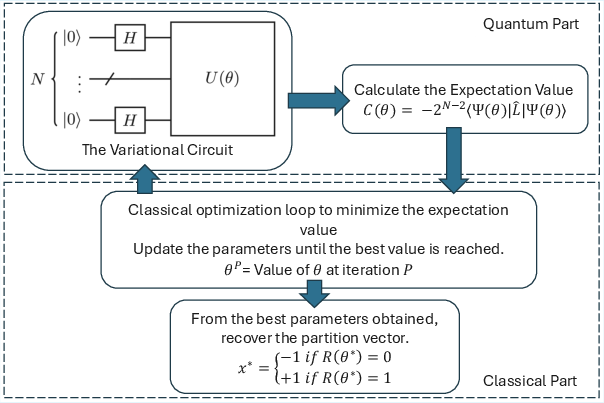
Figure 1: Diagrammatic representation of the hybrid quantum-classical LogQ algorithm.
Gradient-based parameter optimization was initially hindered by vanishing gradients; recent work introduced Q0 parameterizations (e.g., sigmoid combinations), yielding an objective landscape compatible with perturbed gradient methods [chatterjee2025logq].
The paper's central contribution is demonstrating that LogQ admits a purely classical, quantum-inspired analog. The quantum phase-based encoding allows a natural mapping to a continuous relaxation not on the real line but on the complex unit circle:
- Instead of real-valued soft spins Q1, the relaxed variables are Q2 with Q3.
- Each variable is optimized over a phase Q4, with the solution identified once optimization localizes the phases such that Q5, corresponding to the spin assignment.
- The classical cost function is non-linear: pairwise products Q6 are replaced by Q7 couplings, reflecting quantum-inspired interference structure.
Importantly, this construction removes entirely the need for Pauli decomposition and quantum measurement. All computation reduces to classical evaluation of a real-valued, highly structured, non-linear function with a clear correspondence to the original discrete QUBO. Post-optimization, the discrete solution extraction is direct and does not require thresholding aggressive relaxations as in standard linear relaxations.
Technical Implications and Distinctive Aspects
Two features distinguish the quantum-inspired LogQ formulation:
- Unit Modulus Constraint: The relaxation is formulated on the complex unit circle, which enforces Q8. This avoids the ineffectuality of unconstrained real relaxations, which often yield Q9, leading to poor rounding. The phase structure inherently preserves discrete-like behavior.
- Non-linear Coupling: The cost is a sum over ∣Ψ(θ)⟩=n1i=0∑n−1f(θi)∣i⟩0 of phase differences, accentuating sharp minima and separating local minima—as in quantum interference—thereby facilitating more informative heuristics for combinatorial landscapes.
The construction is compatible with flexible gradient-inspired or evolutionary optimizers. The choice of ∣Ψ(θ)⟩=n1i=0∑n−1f(θi)∣i⟩1 remains heuristic; sigmoidal or piecewise polynomial forms allow for control over plateaus and local minima, improving global search and solution quality.
Practical and Theoretical Implications
From a practical standpoint, the quantum-inspired LogQ reframes algorithmic design: it leverages quantum encoding principles without any quantum hardware or measurement. Thus, it bypasses bottlenecks related to current NISQ limitations—circuit depth, qubit number, state preparation, and readout—while exploiting the highly effective encoding/phase coupling structure unique to quantum circuits.
Theoretically, this approach hints at a broader paradigm: quantum-inspired relaxations leveraging non-linear, phase-based, or interference-based formulations may yield new classes of heuristics for classically intractable combinatorial problems. The LogQ construction raises natural questions about the relative expressive power of phase-based relaxations versus traditional convex relaxations, and the role of "quantum-likeness" (e.g., unitary evolution, amplitudes, interference) in the design of efficient classical heuristics.
Potential Directions and Future Work
Immediate follow-up avenues include:
- Exploration of the landscape structure under various ∣Ψ(θ)⟩=n1i=0∑n−1f(θi)∣i⟩2 parameterizations and their impact on escape from spurious minima.
- Embedding LogQ relaxations within standard paradigms like B&B, column generation, or as an incumbent generator.
- Scalability analysis on QUBO instances for which standard solvers and relaxations fail, especially those arising in high-dimensional industrial use cases.
- Generalizations to higher-order unconstrained binary optimization (HUBO) or other combinatorial forms.
Moreover, comparative studies with other quantum-inspired algorithms (e.g., quantum annealing-inspired or semidefinite relaxations) are warranted to benchmark empirical performance and solution quality.
Conclusion
The paper provides a rigorous, technically well-founded pivot of quantum algorithmic structures into a classical, quantum-inspired framework for non-linear continuous variable relaxations of QUBO. The algorithm circumvents quantum hardware limitations while retaining the essence of quantum phase-based optimization, constituting a new classical heuristic paradigm for combinatorial problems. This work exemplifies how quantum algorithmic ideas can drive innovation beyond quantum devices, establishing a foundation for future cross-pollination between quantum and classical optimization methodologies.

