- The paper presents a unified dataset (M³D-Stereo) with 7,904 high-resolution stereo pairs across multiple mediums and degradation levels.
- It shows that state-of-the-art methods like PSIDNet achieve robust restoration performance, with PSNR and SSIM degrading gradually as severity increases.
- The dataset’s fine-grained degradation control and precise geometric alignment enable rigorous evaluation and advancement in stereo restoration research.
M³D-Stereo: A Unified Dataset for Multiple-Medium, Multiple-Degradation Stereo Image Restoration
Motivation and Contributions
Image restoration in visually degraded environments—such as underwater scatter, haze/fog, and low-light conditions—presents significant challenges for both academic study and real-world application. Existing datasets typically exhibit critical limitations: restriction to a single degradation, reliance on synthetic data with questionable realism, or absence of pixel-aligned stereo pairs with consistent ground truths. These constraints fundamentally impede advancement in geometry-aware stereo restoration, especially under complex, progressive degradations.
The M³D-Stereo dataset addresses these deficiencies by providing a unified, large-scale benchmark with 7,904 high-resolution, physically-degraded stereo image pairs. The dataset encompasses four key scenarios (UWST: underwater scatter, HZST: haze scatter, UWLL: underwater low-light, HZLL: haze low-light), each divided into six rigorously controlled degradation levels. M³D-Stereo is acquired in laboratory conditions using calibrated, dual-medium platforms for water and fog, enabling pixel-level alignment with clear ground truths for both photometric and geometric evaluation. With comprehensive coverage and fine-grained degradation annotation, it sets a new standard for real-world stereo image restoration and its downstream tasks.
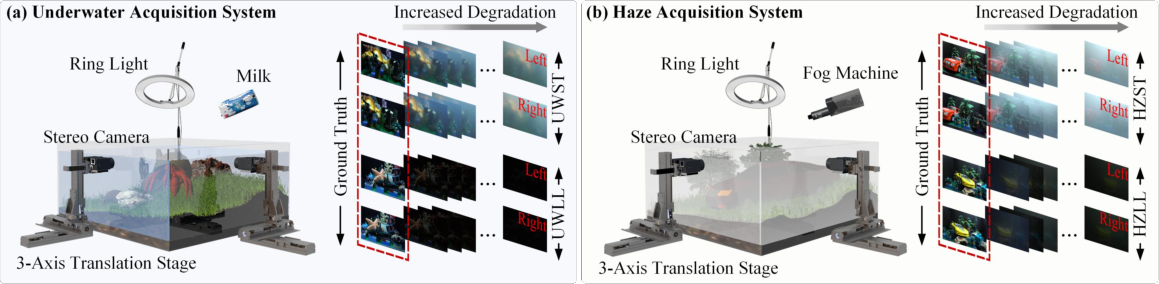
Figure 1: The M³D-Stereo data acquisition platform for underwater and haze/fog stereo capture with precise, progressive control of physical degradations.
Benchmark Dataset Landscape and Limitations
Existing datasets can be categorized as monocular synthetic, monocular real, stereo synthetic, and stereo real. Synthetic datasets—such as HazyKITTI and UWStereo—provide fine control but lack the complex statistics of real adverse environments, leading to poor domain generalization for trained models. Conversely, real datasets (e.g., SQUID, DrivingStereo) capture physical realism but lack systematic control of degradation severity and often omit pixel-aligned ground truths necessary for quantitative restoration analysis and stereo matching.
The fundamental trade-off between controllability and physical realism has hindered the creation of comprehensive benchmarks. Most notably, prior real stereo datasets are unable to realize strictly progressive degradation settings, making it impossible to evaluate algorithm robustness to increasing environmental adversity.
M³D-Stereo explicitly resolves this by enabling cross-comparison across multiple degradation scenarios and levels in a physically controlled setting, while ensuring rigorous photometric and geometric alignment.
Dataset Construction and Calibration
The dataset is generated using custom-built acquisition systems for both underwater and haze/fog conditions. Progressive underwater scatter is achieved via incremental milk dilution (simulating increasing turbidity), while haze/fog conditions are varied using controlled fog machine release times. Low-light settings are precisely realized with PWM-dimmed ring illumination, and complex coupled degradations (e.g., haze + low-light) are synthesized through cross-combinations of base scenario levels.
All scenes are constructed with diverse geometric content (rocks, corals, artificial reefs for underwater; vehicles, pedestrians for atmospheric), and both cameras and objects are strictly immobilized during acquisition to guarantee pixelwise spatial consistency. Stereo calibration is performed independently in air and water to account for refractive index changes, with visual calibration results clearly demonstrating minimized spatial error after rectification.
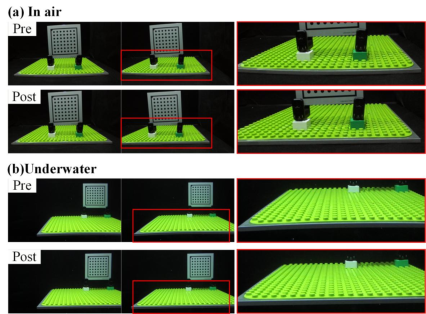
Figure 2: Stereo camera calibration accuracy in air and clear water showing improved alignment post-calibration.
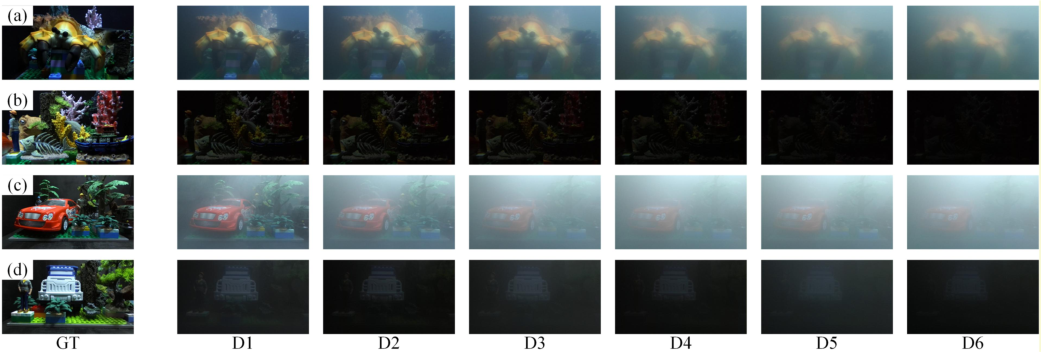
Figure 3: Representative samples from the M³D-Stereo dataset illustrating progression across six degradation levels for each scenario.
Benchmark Evaluation and Results
Two state-of-the-art stereo restoration networks, EPRRNet and PSIDNet, are retrained and evaluated on M³D-Stereo under both single-level and mixed-level regimes. Tasks cover all four degradation scenarios; performance is assessed using standard full-reference metrics (PSNR, SSIM) and color fidelity (ΔE). Key findings include:
- Restoration performance degrades monotonically as severity increases from D2 to D6 for all methods and scenarios, reflecting the increased challenge posed by compounded information loss.
- PSIDNet consistently achieves higher PSNR/SSIM across the board, and this margin widens as degradation becomes more severe, indicating differential robustness to adverse conditions.
- Training on mixed degradation levels (D1–D6) moderately boosts robustness and generalization across unseen scenarios.
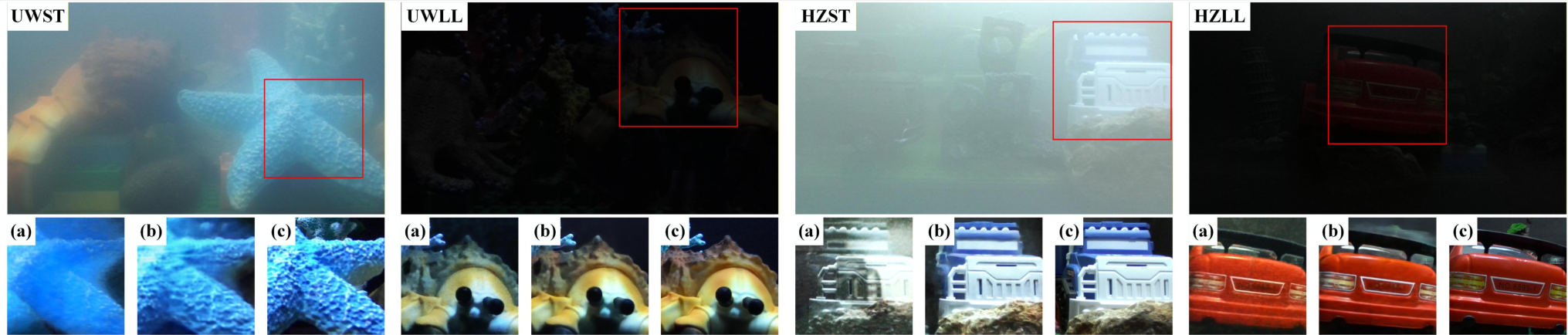
Figure 4: Restoration output comparisons for EPRRNet and PSIDNet across degradation scenarios and levels, showing qualitative and quantitative improvements.
In downstream stereo matching, restoring degraded inputs with PSIDNet before feeding to FoundationStereo significantly recovers scene structure and depth layering—and substantially closes the gap with results from undistorted ground truths.
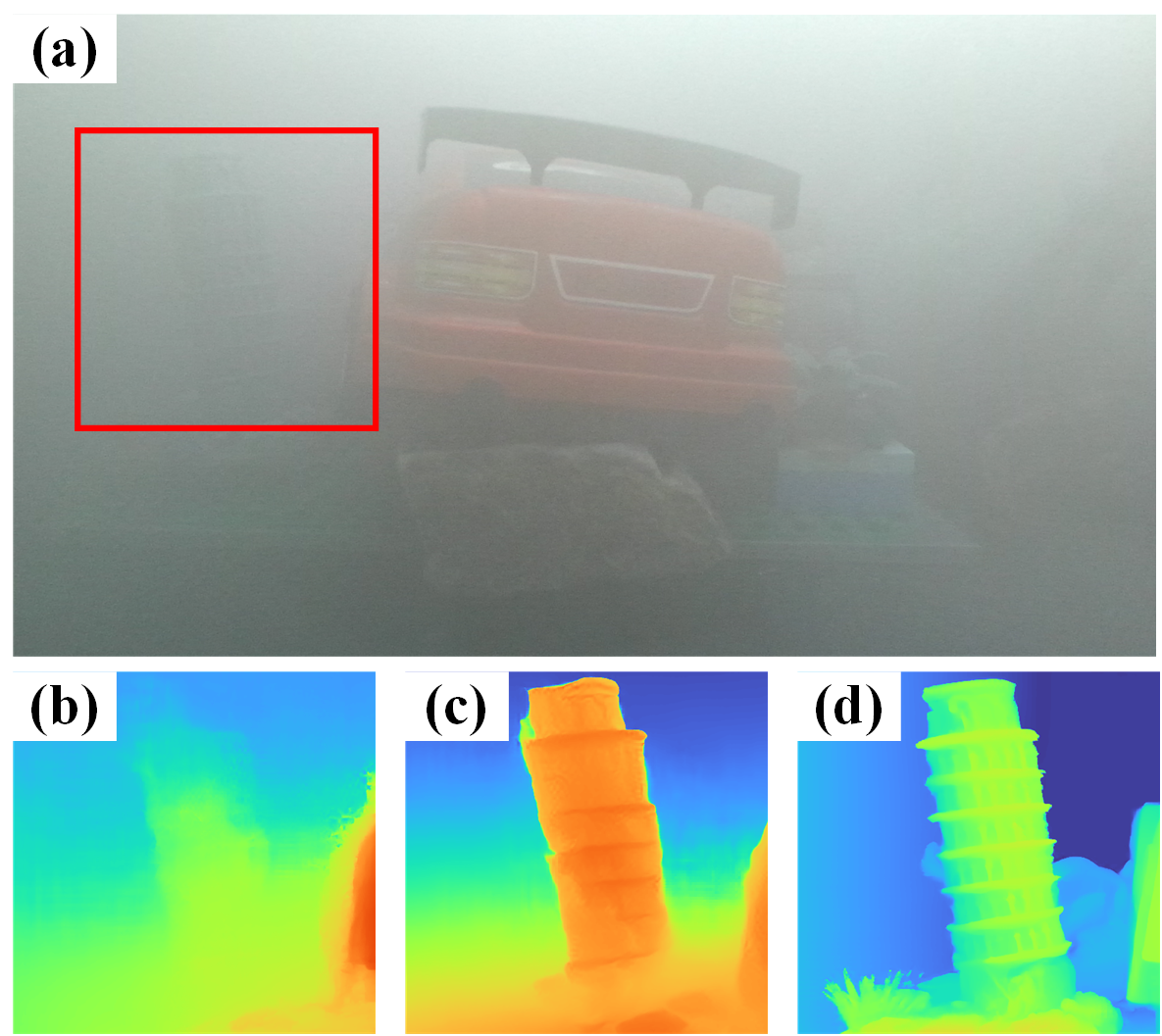
Figure 5: Depth estimation results from FoundationStereo showing degraded input, restorations by PSIDNet, and clean ground truths.
Theoretical and Practical Implications
M³D-Stereo enables controlled, systematic evaluation of stereo image restoration algorithms for both restoration and geometric consistency, facilitating the development of geometry-aware, cross-domain robust models. Its inclusion of realistic, coupled degradations (e.g., haze + low-light) challenges existing architectures and exposes clear performance differentials under increasing adversity, motivating future research in adaptation, uncertainty estimation, and degradation-invariant learning.
Practically, the benchmark supports rigorous development and assessment of vision systems critical for autonomous vehicles, underwater robotics, and AR/VR deployments operating in highly variable real-world environments. Specifically, the dataset's structure is well-suited for novel research in color-depth joint restoration, geometry-constrained enhancement, and domain generalization across physical media.
Limitations and Future Directions
Though M³D-Stereo advances the field, several limitations merit attention. Its scenes are miniaturized and laboratory-controlled, lacking the diversity and scale of open-world environments. Coupled degradation scenarios are limited in breadth. The platform's controlled environment may not fully capture the spatial or temporal dynamics present in natural scenes with moving objects or variable daylight.
Future extensions should aim to:
- Increase scene diversity and scale,
- Introduce additional adverse conditions (e.g., rain, dust, dynamic occlusions),
- Broaden coverage of mixed/coupled degradations,
- Leverage M³D-Stereo for end-to-end geometry-aware restoration and stereo matching tasks in open-set evaluation regimes.
Conclusion
M³D-Stereo constitutes a significant addition to the stereo restoration benchmark landscape, delivering a comprehensive, physically-realistic, and highly controllable resource for systematic algorithm evaluation and development. Its design enables fine-grained analysis of restoration performance, geometric consistency, and domain generalization in complex, adverse environments—catalyzing research in robust stereo vision and image enhancement under challenging real-world conditions (2604.12917).