- The paper introduces a dual framework connecting SYK quantum chaos and JT gravity holography using combinatorial and matrix model techniques.
- It details methodologies such as chord diagram expansions, Schwarzian effective actions, and topological recursion to map chaotic spectral statistics.
- Findings underscore the ensemble-averaged nature of 2D gravity and the need for nonperturbative string completions in holographic models.
Quantum Chaos and the Holographic Principle: A Technical Review
Introduction and Research Context
"Quantum chaos and the holographic principle" (2604.12784) presents an exhaustive technical review of the intricate connections between low-dimensional models of quantum gravity and chaotic many-body quantum systems, focusing on the specific case of two-dimensional holography. At the core of the analysis lies the Sachdev-Ye-Kitaev (SYK) model as a boundary theory and Jackiw-Teitelboim (JT) gravity in the bulk, with the correspondence mediated by deep universal features of quantum chaos. The review meticulously details two bridges between bulk and boundary: information scrambling at early times (chaotic instabilities) and the fine structure of quantum spectra at late times (random matrix correlations and beyond).
The SYK Model: Chaotic Many-Body Quantum Mechanics
The SYK model, built from N≫1 Majorana fermions with random all-to-all four-body interactions, epitomizes a maximally chaotic, non-Fermi liquid zero-dimensional quantum system. Its core analytic tools include the GΣ-theory (capturing emergent conformal symmetry), chord diagram expansions (for many-body spectral statistics), and the nonlinear σ-model (for probing microscopic spectral correlations).
The GΣ-formulation exposes emergent approximate Diff(S1) invariance (broken by UV effects) and yields the Schwarzian effective action as the universal low-energy theory. The spectral density and temporal correlators manifest universal power laws that signal strong quantum fluctuations at timescales t≳N/J.
The out-of-time-order correlator (OTOC), a diagnostic of operator scrambling, exhibits an initial regime of exponential decay at the maximal Lyapunov rate λL=2πT—saturating the chaos bound—followed by a power-law decay F(t)∼t−6 dictated by the underlying Liouville quantum mechanics. This robust separation of timescales and scaling regimes provides a bridge to gravity via holography.
Chord diagrams provide a rigorous combinatorial tool for computing the spectral density in SYK, showing deviations from dense random matrix behavior: the many-body energy levels have a Gaussian density rather than the Wigner semicircle, and edge fluctuations are significant due to the "sparse chaos" seeded by polynomially many random couplings.

Figure 1: Chord diagrams encoding the configurational average of SYK two-point functions, illustrating the combinatorial structure of Fock space operator contractions with random couplings.
Jackiw-Teitelboim Gravity: Two-Dimensional Quantum Gravity
JT gravity is formulated with an action involving a dilaton Φ, rendering 2D gravity dynamically nontrivial. The classical solutions are locally AdS2 with the dilaton profile serving as a physical observable, connecting to black hole thermodynamics via dimensional reduction from higher-dimensional charged black holes.
A central result is the emergence of boundary graviton (Schwarzian) modes, which realize the spontaneous breaking of asymptotic symmetry GΣ0, corresponding precisely to the soft modes in the SYK model. The Schwarzian path integral on both disk and trumpet (“annulus”) topologies is one-loop exact; these geometries are the building blocks for the full quantum theory.
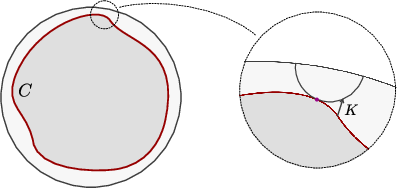
Figure 2: Gravitational manifold with boundary as a subset of the Poincaré disk, where boundary extrinsic curvature is governed by deviations from geodesicity.
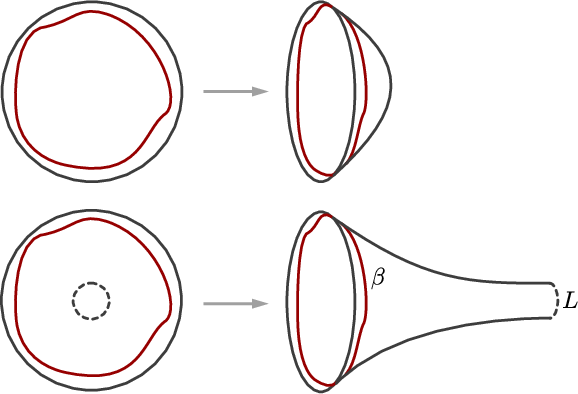
Figure 3: Disk and trumpet geometries underlying the Schwarzian path integral, simultaneously representing key gluing operations for JT quantization.
Matrix Theory and Topological Expansion
Matrix ensembles, from the perspective of both random matrix theory (RMT) and high-energy physics, serve as proxies for bulk geometric structures and encode chaotic correlations. The review details the genus expansion (in powers of GΣ1), classified by ribbon diagrams (topological recursion), and connects these to the universal RMT predictions for spectral statistics such as the form factor and spectral edge.
The SYK model is identified as a "sparse" quantum chaotic model—characterized by significant collective spectral fluctuations at the edge—whereas matrix models and JT gravity correspond to the "dense" regime.
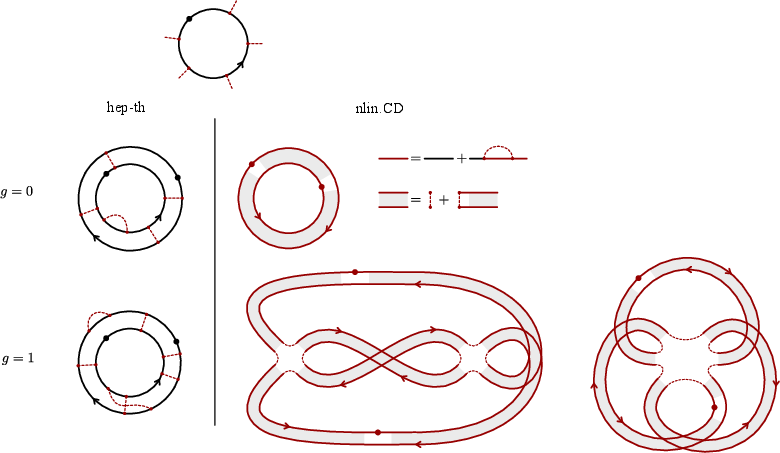
Figure 4: Diagrammatic expansion of matrix resolvent traces, highlighting the connection between diagram topology (genus) and singular correlation structures in quantum chaos.
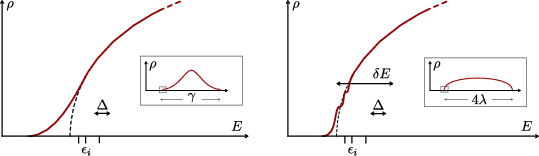
Figure 5: Schematic of the SYK spectral edge (broad and fluctuating) compared with the rigid, crystalline edge of a dense random matrix ensemble.
JT Path Integral, Weil-Petersson Volumes, and Topological Recursion
Quantization of JT gravity proceeds via a sum over Riemann surfaces of varying genus and boundary number, with the path integral naturally reducing to an expansion in Weil-Petersson volumes. Cutting and gluing techniques decompose the path integral into contributions from disk and trumpet geometries and internal moduli, directly paralleling the matrix model topological expansion.
The mathematical tractability is significantly enhanced by Mirzakhani’s recursion for Weil-Petersson volumes, which is explicitly equivalent to the Eynard-Orantin topological recursion for matrix models. Laplace-transformed objects GΣ2 obey recursion formulas that exactly reproduce the matrix model structure, initiating a concrete duality between 2D gravity and random matrix theory.

Figure 6: Pants decomposition and topological recursion: geometric operations that underpin the recursive structure of both matrix models and JT path integrals.
Nonperturbative Completion: Stringy Origins and Quantum Chaos
The review addresses the limitations of the perturbative genus expansion, highlighting the necessity of non-perturbative completion for the resolution of gravitational microstates and the manifestation of the spectral plateau in chaotic spectra. Several approaches to UV completion are outlined:
- Non-unique matrix model completions (minimal string analogs).
- Resurgent and trans-series techniques mapping nonperturbative contributions to tunneling/ZZ-brane effects.
- String field theory constructions (Kodaira–Spencer theory), leading to Universe Field Theory (UFT), where brane dynamics encode chaotic spectra through color and flavor degrees of freedom.
Remarkably, in the string-theoretic approach, integration over color (open string) branes mimics ensemble averaging, while flavor branes encode determinant insertions, reproducing the nonlinear GΣ3-model and Kontsevich model results for the fine structure of the spectrum.
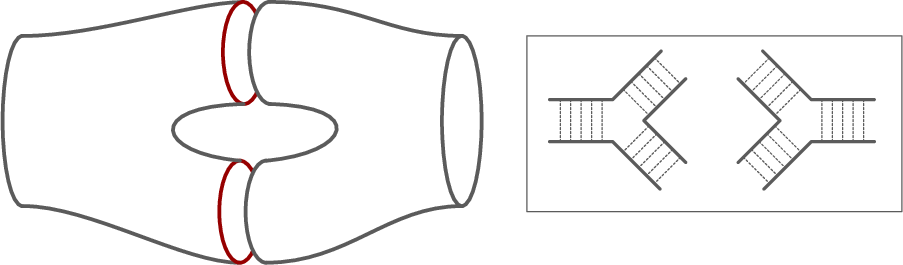
Figure 7: Bulk baby universe splitting/absorption processes in JT gravity and their counterpart cubic vertex pairings in the Kontsevich matrix model.
Implications, Contrasts, and Perspectives
The review emphasizes a formal tension: neither the SYK model nor conventional many-body quantum systems can provide an exactly dual “single boundary Hamiltonian” for JT/gravity due to the mismatched collective spectral structures at the edge (sparse vs. dense chaos). As such, JT gravity and its matrix/string duals describe a statistical (ensemble-averaged) effective theory, raising foundational questions about ensemble averaging and factorization in holography.
The framework solidly establishes two-dimensional gravity as a universal geometric theory of chaotic correlations, with non-perturbative string theoretic completions offering a comprehensive account of spectral microstate discreteness, the emergence of universality, and the geometrization of random matrix behavior.
The authors highlight directions for extension, including higher-dimensional generalizations (e.g., analogs in AdSGΣ4/CFTGΣ5), possible boundary Hamiltonian constructions with correct spectral rigidity, and an improved understanding of geometric "seeds of quantum chaos" in string theory.
Conclusion
This work provides a detailed technical account of the correspondence between low-dimensional quantum gravity, quantum chaos, and random matrix theory, elucidating the role of the Schwarzian sector, the precise mapping of topological recursion, and the necessity for nonperturbative string-theoretic completions. The analysis uncovers both the strengths and limitations of current approaches to holography in 2D and underlines fundamental obstacles to constructing microscopic boundary duals with the exact features of JT gravity. The methods and insights presented open concrete avenues for further research into higher-dimensional chaotic holography, the structure of matrix ensembles, and the string theoretic origin of universal chaotic signatures in quantum gravity.

