- The paper demonstrates how phase-space representations, using PSOS and Husimi functions, reveal the intricate links between classical chaos and quantum phenomena.
- The paper employs semiclassical methods to quantify phenomena such as dynamical tunneling, scarring, and non-Hermitian effects in mesoscopic systems.
- The paper applies these insights to inform the design of devices like microdisk lasers, sensors, and valley-selective transport in materials such as bilayer graphene.
Quantum Chaos in Phase Space: An Authoritative Summary
Classical and Quantum Chaos: Foundations
The paper "Quantum Chaos in Phase Space" (2604.12741) comprehensively explores the interplay between classical and quantum chaos in mesoscopic systems, particularly addressing two-dimensional billiard cavities for electronic and photonic modes. Classical chaos is characterized by exponential sensitivity to initial conditions, exemplified by billiard trajectories that diverge markedly after several reflections, as quantified by Lyapunov exponents. In classical systems, regular trajectories (such as in circular billiards) preserve angular momentum, while deformations induce chaotic trajectories with lost memory of integrable invariants.
The quantum analog is nuanced by the absence of well-defined trajectories; instead, the wave function encapsulates the system’s state, with periodicity and interference rendering fine spatial resolution unattainable below the wavelength scale. The quantum signatures of chaos manifest through distributions of eigenstates, scarring phenomena, and quantum-classical correspondence via semiclassical approximations like Berry-Tabor and Gutzwiller trace formulae.
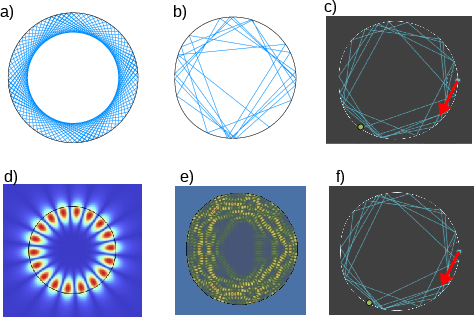
Figure 1: Regular and chaotic dynamics in billiards and their wave solutions; sensitive dependence on initial conditions leads to trajectory divergence in chaotic regimes.
Phase Space Representation and Poincaré Surface of Section
Extending analysis to phase space enables the incorporation of both position and momentum information, revealing nuanced dynamical structures unattainable in real-space observables. The Poincaré surface of section (PSOS) provides a two-dimensional portrayal of the four-dimensional phase space of billiards, utilizing boundary positions and conserved angle-of-incidence as mapped variables. Integrable systems show horizontal lines corresponding to constant angular momentum; perturbations generate chains of elliptical (stable) and hyperbolic (unstable) fixed points as predicted by the Poincaré-Birkhoff theorem.
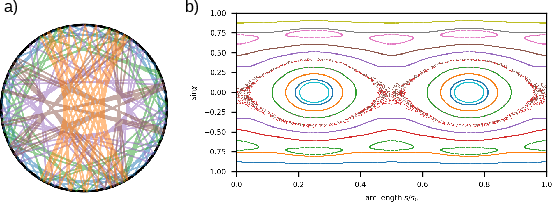
Figure 2: Trajectories in quadrupolar billiards are mapped in PSOS, forming chains of fixed points and structuring phase space.
Chaotic trajectories, lacking invariants, ergodically fill accessible phase space, leaving stable islands unreachable, while real-space tracing fills the cavity.
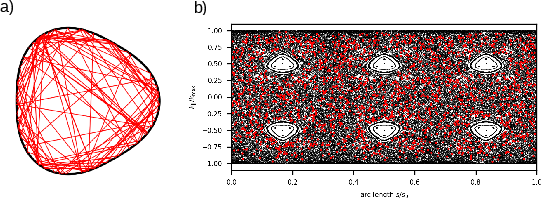
Figure 3: Chaotic trajectories in an onigiri-shaped cavity fill phase space ergodically, as shown in the PSOS.
Anisotropic systems, such as bilayer graphene (BLG) billiards, introduce novel propagation directions, manifesting as chains of islands in PSOS that break chiral symmetry for individual valleys but restore it globally.
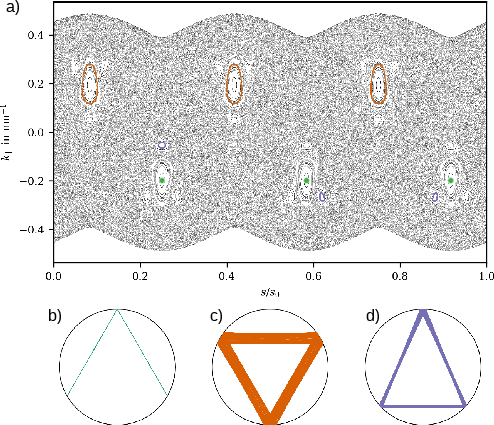
Figure 4: Anisotropic BLG billiard PSOS exhibits three-island chains associated with preferred propagation directions and valley-dependent chiral symmetry.
Husimi Functions and Quantum Phase Space Analysis
Quantum phase space analysis demands mapping of wave functions onto phase space. The Husimi function accomplishes this by projecting the wave function onto coherent (minimum uncertainty) states at boundary points, encoding both spatial and angular momentum information.
For open systems, where both wave function and its derivative are non-zero at boundaries, generalized Husimi functions combine these quantities, enabling the distinction of incoming and outgoing motion inside and outside the boundary. In BLG billiards, Husimi functions identify triangular orbits and distinguish chaotic resonances by their dispersed intensity in both real and momentum space.
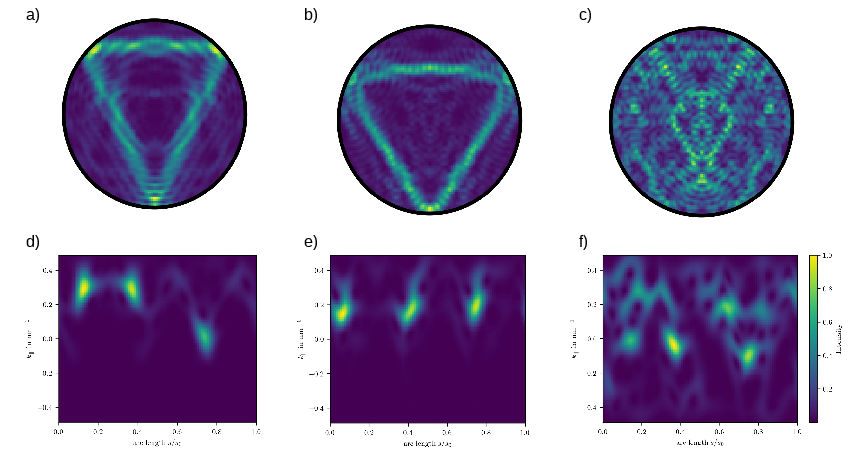
Figure 5: Wave functions and Husimi functions in a circular BLG billiard reveal triangular and chaotic modes through phase space fingerprints.
Phase-Space Perspective: Implications and Phenomena
Quantum Resolution and Scarring
Quantum mechanics imposes resolution limits via the uncertainty principle, masking fine phase-space structures unless wavelengths are sufficiently small. Notably, quantum modes can “scar” along classically unstable trajectories, defying naïve expectations.
Dynamical Tunneling
Quantum tunneling, including chaos-assisted dynamical tunneling, connects classically disjoint regions, enabling energy splitting and facilitating transport in mixed systems with both regular and chaotic domains.
Microdisk Laser Directionality
Mesoscopic optical cavities, such as microdisk lasers, illustrate practical implications. While circular cavities yield isotropic emission, geometric deformations like the limaçon shape exploit the unstable manifold to produce robust, highly directional emission regardless of resonance specifics.
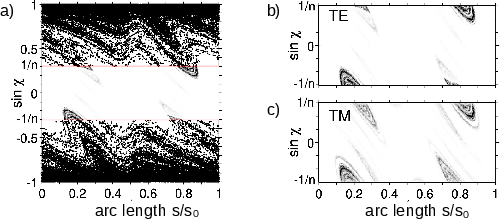
Figure 6: The transformation from unstable manifold in closed billiards to steady probability distribution in open photonic resonators.
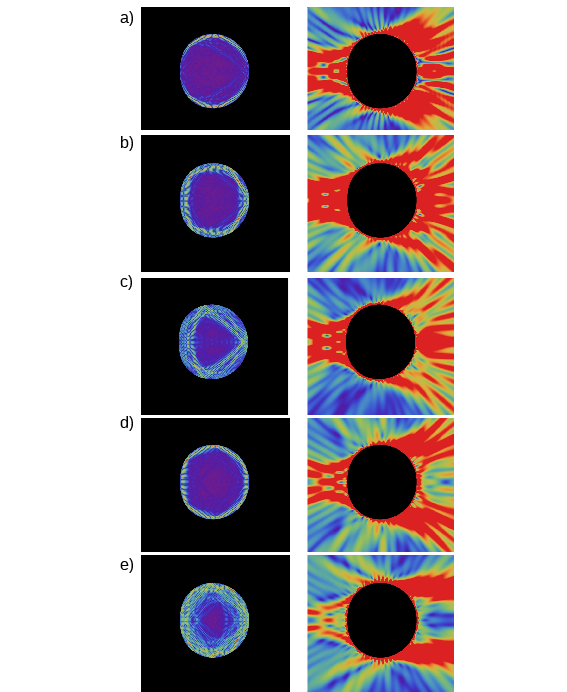
Figure 7: Limaçon cavities demonstrate emission robustness induced by the unstable manifold, largely independent of resonance details.
Ray-Wave Correspondence and Semiclassical Corrections
Ray-wave correspondence is central to semiclassical analysis, tightly coupling classical trajectories with quantum mode structures. Deviations arise due to interference, finite-wavelength effects, and phenomena such as Goos–Hänchen shifts and Fresnel filtering, which manifest as lateral and angular corrections to ray dynamics at interfaces.
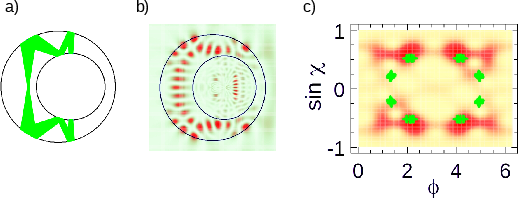
Figure 8: Ray-wave correspondence in optical annular billiard compares ray and wave solutions and their phase space signatures.
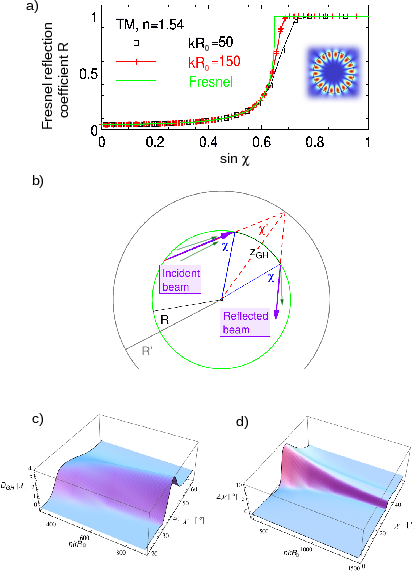
Figure 9: Semiclassical corrections, such as Goos–Hänchen shift and Fresnel filtering, alter ray dynamics at interfaces, with dependence on curvature and wavelength.
Anisotropic Cavity Dynamics
In anisotropic cavities, new orbit types emerge (e.g., bouncing-ball modes) that can be understood via transformation optics; the phase-space analysis confirms ray-wave correspondence even in the presence of strong anisotropies.
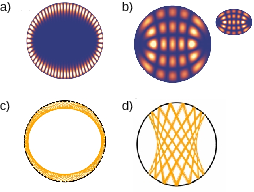
Figure 10: In anisotropic disk cavities, ray-wave correspondence reveals emergence of bouncing-ball modes tied to directionality given by anisotropy.
Non-Hermitian Effects and Exceptional Points
Open systems possess non-Hermitian dynamics, characterized by complex eigenvalues and phenomena such as exceptional points and avoided resonance crossings. Husimi functions facilitate direct access to the angular momentum composition, revealing chirality and resonance coalescence at exceptional points, which underpin enhanced sensitivity in sensor applications and network formation in coupled cavity systems.
Practical and Theoretical Implications
The paper rigorously demonstrates that phase-space perspectives—both classical (PSOS) and quantum (Husimi representations)—enable deeper insight into quantum chaotic systems, driving advances in the understanding and design of mesoscopic devices. Robust numerical evidence is shown for universal directional emission in optical cavities, highly resonance-independent, and for phase-space resolved quantum phenomena (scarring, tunneling, resonance splitting). The formalism is broadly applicable, with Husimi functions and extended ray models facilitating the analysis of transport mechanisms, non-Hermitian effects, and source/leak dynamics.
Theoretically, this connects classical nonlinear dynamics (Poincaré-Birkhoff structures, unstable manifolds) with quantum resonance fingerprints, supporting precise control and prediction of mode behavior in engineered devices. The practical impact is evident in improved laser technologies, enhanced sensor designs exploiting exceptional points, and the potential for valley-selective transport in materials like bilayer graphene.
Conclusion
A phase-space approach to quantum chaos, grounded in PSOS and Husimi function analysis, elucidates the intricate interplay between classical and quantum dynamics in mesoscopic systems. Robust ray-wave correspondence, geometric deformations, and anisotropies enable precise engineering of device properties, while quantum phenomena such as dynamical tunneling and scarring enrich theoretical understanding. The extension to non-Hermitian physics and exceptional points highlights emerging opportunities in sensing and coupled systems. Future developments are poised to leverage these frameworks for advanced control and exploitation of quantum chaotic phenomena in photonic and electronic devices.

