- The paper establishes a link between semiclassical theory and quantum chaos by analyzing periodic orbits, invariant manifolds, and symbolic dynamics in chaotic Hamiltonian systems.
- The paper demonstrates the efficacy of cycle expansions and the role of Sieber-Richter pairs in controlling the exponential proliferation of periodic orbits in semiclassical spectral analysis.
- The paper highlights that slight perturbations preserve global chaotic structures, while complexification is essential to accurately capture classically forbidden quantum processes.
Authoritative Summary of "Hamiltonian Chaos" (2604.12976)
Semiclassical Motivation and Scope
The study of Hamiltonian chaos is centrally motivated by the correspondence principle and the semiclassical analysis of quantum systems with classically chaotic analogs. This synthesis bridges quantum chaos, where asymptotic quantum quantities are constructed via classical trajectories and their properties—most notably, classical actions, stability matrices, and associated phase indices (Maslov indices). The chapter focuses on those aspects of Hamiltonian chaos most directly relevant for such semiclassical quantizations, deliberately omitting topics like stochastic processes or dynamical aspects with no clear quantum correspondence.
Hamilton's equations generate dynamics in a many-dimensional phase space whose qualitative behavior hinges on integrability versus chaos. In fully chaotic Hamiltonian systems, the dynamics is characterized by ergodicity, mixing, and exponential instability (positive Lyapunov exponents for D−1 directions in a system with D degrees of freedom). The structures underlying this chaotic motion include stable and unstable manifolds, which foliate phase space, and their intersections (homoclinic and heteroclinic tangles) which generate complex, fractal geometries.
A fundamental practical tool, the Poincaré surface of section, enables the reduction of continuous chaotic flows (typically in four-dimensional phase spaces for two degrees of freedom) to two-dimensional discrete maps, which facilitates both visualization and rigorous analysis.
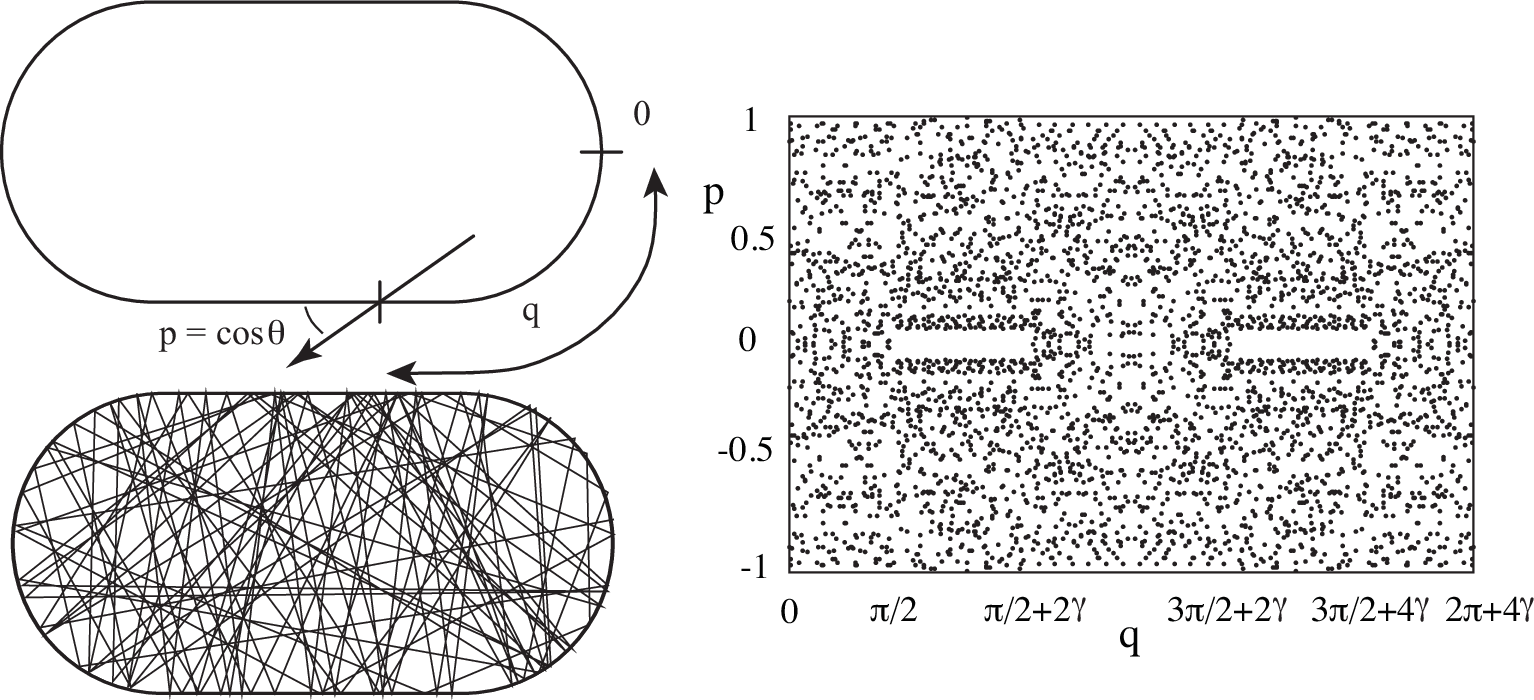
Figure 2: Trajectory evolution and corresponding surface of section in the stadium billiard, illustrating ergodic filling and the persistence of avoided regions due to marginally stable periodic orbits.
Paradigms and Symbolic Dynamics
Paradigmatic systems such as the kicked rotor, various billiards (notably the Bunimovich stadium and Sinai billiard), and analytic maps (e.g., the Arnold cat map, the bakers map) serve both as mathematically tractable models and as links to experimental realizations in atomic, molecular, or condensed matter setups. Special attention is paid to the symbolic dynamics framework, in which trajectories are coded as unique symbol sequences, enabling combinatorial enumeration of periodic, homoclinic, and heteroclinic orbits.
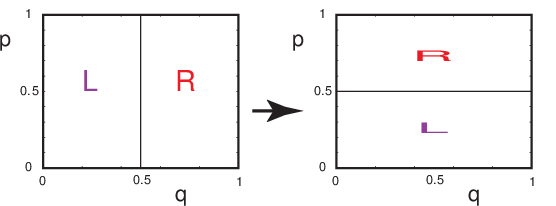
Figure 1: The bakers map as a canonical model of uniform hyperbolic chaos, illustrating the stretching and folding mechanisms characteristic of chaotic mixing.
Periodic orbits form a discrete but dense skeleton organizing chaotic phase space. Their actions enter fundamentally into trace formulas for quantum spectra (Gutzwiller trace formula), and their enumeration grows exponentially with period, controlled by the system's metric entropy. Marginally stable orbits (e.g., bouncing ball modes in the stadium) create significant deviations in phase space mixing, leading to 'sticky' regions affecting both classical and quantum dynamics.
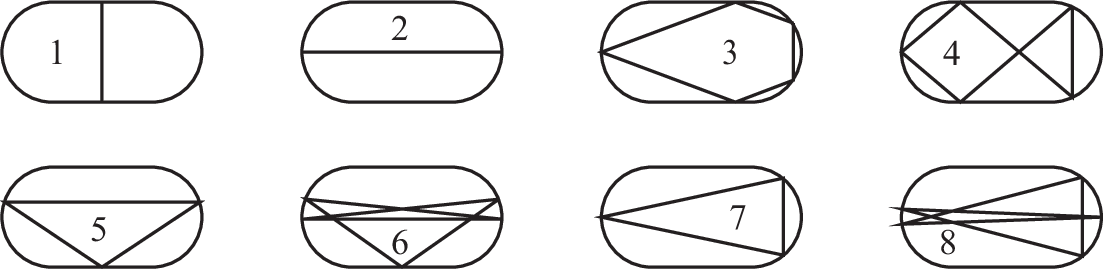
Figure 4: Representative periodic trajectories in the stadium billiard, including bouncing ball orbits (marginally stable), shortest unstable orbits, and orbits shadowing homoclinic excursions.
The uniformity principle, especially as articulated in the Hannay-Ozorio sum rule, dictates that periodic orbits must be properly amplitude-weighted to achieve ergodic coverage in observables, correcting for exponentially large local density fluctuations in the distribution of periodic orbits.
Invariant Manifolds and Transport Structures
Stable and unstable manifolds emanating from unstable periodic orbits partition phase space into resonance zones and establish the structure of turnstiles governing transport between and across these zones.
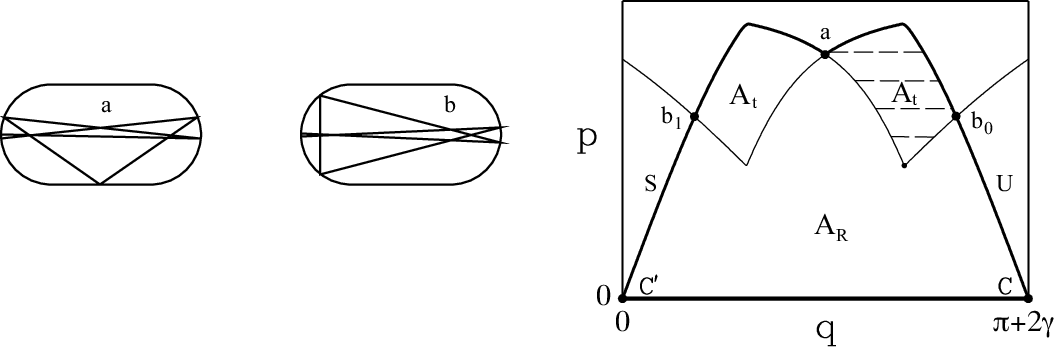
Figure 6: Resonance structure and turnstile mechanism in the stadium billiard, showing the phase space areas that define trapped and escaping trajectory regions.
The intersection hierarchy of these manifolds leads to an infinity of periodic and homoclinic orbits, pivotal not only for classical transport but also for quantum tunneling and interference effects. The methodology for computing these orbits leverages exponential convergence along invariant manifolds rather than direct integration of Hamilton's equations, providing significant numerical advantages.
Cycle Expansions and Sieber-Richter Pairs
The exponential proliferation of periodic orbits is tamed in semiclassical spectral calculations via cycle expansions, which assemble long orbits as combinations of 'primitive' shorter orbits plus small curvature corrections. The manuscript gives explicit numerical examples: the deviation in action for a 6-bounce orbit, constructed from two 3-bounce orbits, is only $0.024616$ out of total actions ∼8.6−8.9 per component (Figure 7), and stability determinant ratios between long and short cycles remain within a percent of unity.

Figure 8: A long periodic trajectory in the stadium billiard shadowing two shorter primitive orbits, exemplifying the exponential smallness of action and stability corrections key to the efficacy of cycle expansions.
A critical class of orbit pairs, the Sieber-Richter pairs, generate close action correlations in time-reversal invariant systems necessary for accurate semiclassical predictions of spectral statistics beyond leading order.
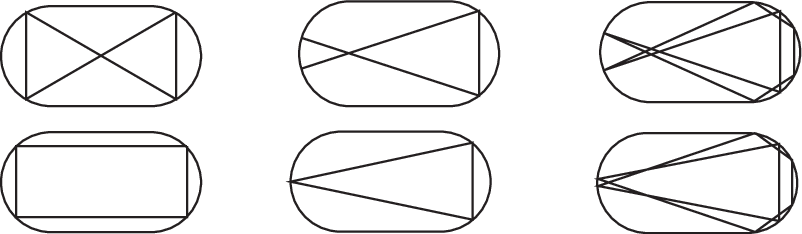
Figure 10: Explicit trajectory realizations of Sieber-Richter pairs in the stadium billiard, demonstrating systematically small action differences and stability ratios.
Structural Stability and Perturbative Response
Chaotic systems, while exponentially sensitive to initial conditions, exhibit strong structural stability: global phase space structures (e.g., manifolds, cycle topology) change only slightly under small system perturbations. This property enables direct computation of quantum (and classical) response statistics and quantifies robustness of semiclassical predictions.
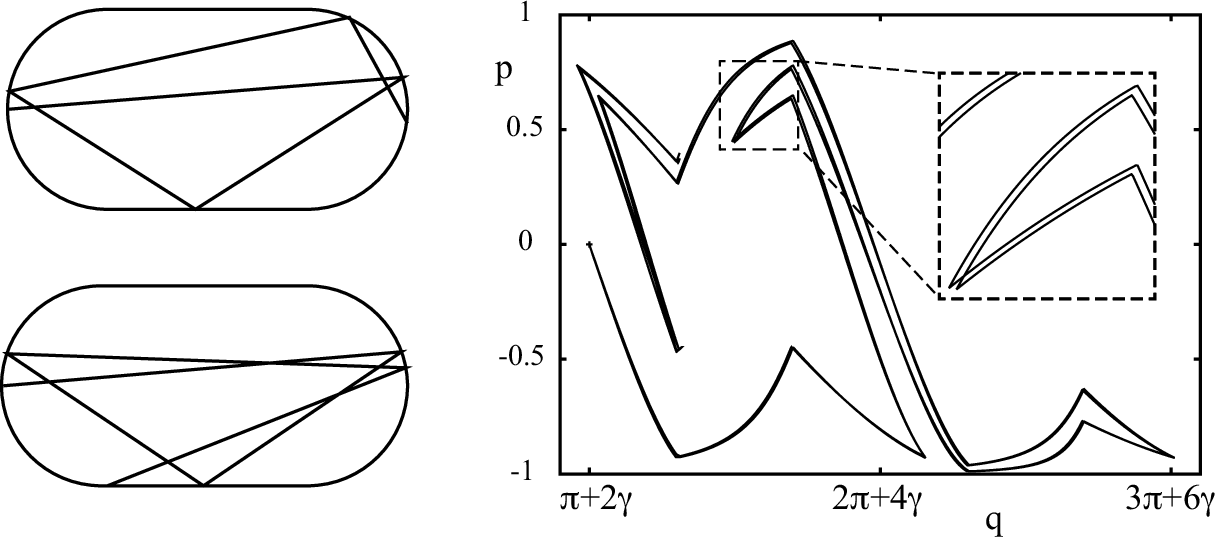
Figure 5: Exponential divergence of neighboring trajectories under parameter change, contrasted with the near-invariance of unstable manifold segments.
Minor topological changes (bifurcations) create new periodic orbits in phase space partitions, leaving most established codes and partitions globally unaffected except in small neighborhoods, but are essential for completeness in spectral trace formulas and explain nonanalytic parametric shifts in quantum spectra.
Complexification and Quantum-Classical Correspondence
Processes forbidden in classical real phase space (e.g., tunneling, diffraction) are encoded via analytic continuation to complex coordinates and time. The paper details the structural implications—branch cuts, saddle point structure, and the proliferation of relevant complex trajectories in chaotic systems—that considerably complicate both analytical and numerical techniques compared to the integrable case.
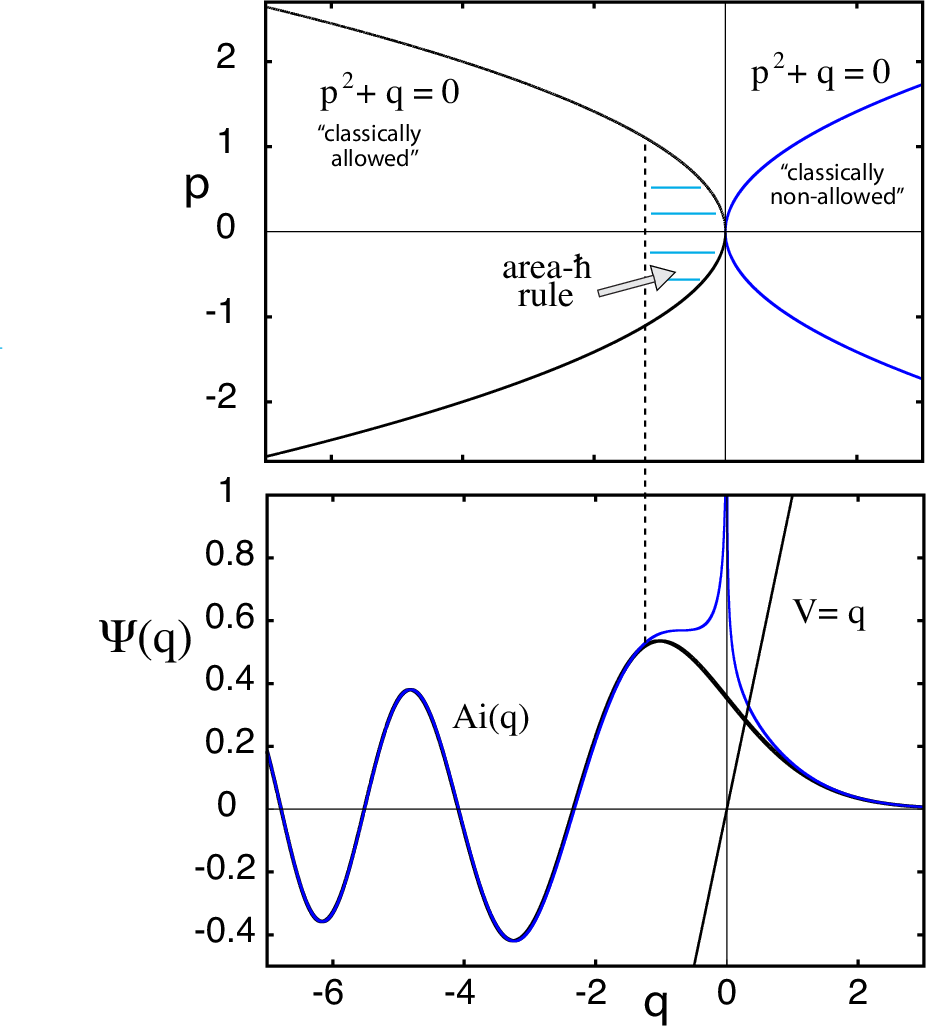
Figure 3: Use of a complex classical trajectory to accurately account for the Airy function tail, illustrating the necessity of complexification in semiclassical analysis of classically forbidden regions.
It is emphasized that for classically allowed processes, complex trajectories are closely related to underlying real heteroclinic excursions, facilitating the construction of practical algorithms to locate relevant saddle points by continuation from real manifold data. For forbidden processes (e.g., tunneling in the presence of chaos), an exponentially growing number of complex orbits can contribute comparable amplitudes, triggering intricate quantum interference patterns and demanding careful control over phase (Maslov) indices—even classical rules for phase tracking fail in the fully complexified regime, requiring revised prescriptions.
Theoretical and Practical Implications
The geometric organization of phase space by invariant manifolds and periodic/homoclinic structures provides a deep, system-independent framework for understanding quantum chaos via semiclassical approximations. The continued development of symbolic dynamics, cycle expansions, and the calculus of invariant manifolds supports scalable algorithms for spectral statistics, transport, and tunneling in both low- and high-dimensional systems, and forms the core of modern approaches to quantum chaotic dynamics. Complexified Hamiltonian theory is essential for systematically extending semiclassical methods to classically inaccessible regimes, though it introduces formidable analytical challenges, particularly in non-integrable systems.
Conclusion
The chapter presents a comprehensive, technically rigorous treatment of those aspects of Hamiltonian chaos most directly bridging semiclassical theory and quantum chaos, with a focus on periodic orbits, manifold geometry, sum rules, perturbation theory, and the unavoidable role of complexification in both allowed and forbidden quantum processes. The analytic tools and geometric perspectives developed are essential not only for theoretical advances in quantum chaos and semiclassical analysis, but also for practical computational frameworks and future generalizations to high-dimensional, open, and many-body systems.

