- The paper demonstrates that using bright squeezed vacuum in a bichromatic setup yields a pronounced asymmetry in photoelectron momentum distributions.
- Simulations with the strong-field approximation reveal that quantum fluctuations during the ionization step, modeled via the Husimi Q function, are key to the asymmetry.
- The findings highlight that even modest BSV intensities can provide a tunable method for extracting temporal and pathway-resolved dynamics in attosecond metrology.
Interferometric Enhancement of Asymmetry in Strong-Field Ionization with Bright Squeezed Vacuum
Introduction and Context
The paper "Interferometrically Enhanced Asymmetry in Strong-field Ionization with Bright Squeezed Vacuum" (2604.12646) presents a theoretical and computational analysis of strong-field ionization modulated by quantum photonic statistics, specifically leveraging the nonclassical properties of bright squeezed vacuum (BSV) states. The central focus is the manipulation of above-threshold ionization (ATI) in a helium atom by employing a bichromatic, linearly-polarized driving field formed by a dominant coherent 2ω component and a weak BSV ω component. The research demonstrates, via simulations based on the strong-field approximation (SFA), that such quantum-modified driving fields induce momentum-space asymmetries in photoelectron distributions inaccessible to classical or merely coherent field configurations.
The analysis is conducted within the framework of semiclassical SFA, augmented to include quantum statistics of the driving field via generalized phase-space methods. Theoretical considerations are validated over a broad range of squeezing parameters, and the results benchmarked against both coherent and thermal perturbing fields.
Theoretical Framework and Methodology
The atom-field system is modelled with the matter initially in its ground state and the bichromatic field constructed as a tensor product of a strong coherent state at 2ω and a BSV state at ω. The BSV mode is implemented through the action of a squeezing operator on vacuum, parameterized by squeezing strength r and angle ϕ. The SFA, implemented without rescattering, provides the dynamics, with continuum electron wavefunctions expressed through Volkov states.
Central to the photoelectron momentum distribution (PMD) calculation is the expression
Y(p)=∫d2αωQ(αω)∣Mα(p)∣2
where Mα is the ATI amplitude for a given field realization, and Q(αω) is the Husimi Q function characterizing the BSV statistics of the ω0 component. This formalism rigorously incorporates fluctuations and phase-space uncertainty of the quantum field, with coherent and thermal cases recovered as limiting distributions.
The analysis also includes a saddle-point approximation for ionization times, yielding insight into the instantaneous tunneling probabilities and their quantum-statistical modulation.
Strong-Field Ionization with Quantum Light: Results
Classical Versus Quantum PMD Morphology
The PMDs for various field configurations—monochromatic, bichromatic with coherent, BSV, and thermal perturbations—are computed for a helium atom at relevant field intensities. With a purely monochromatic or coherent bichromatic driver, PMDs exhibit expected mirror symmetry and well-defined ATI ring structures, reflecting the underlying temporal and spatial symmetries of the light field.
The introduction of a BSV perturbation at even modest intensities (ω1) fundamentally alters these distributions. Notably, the ATI rings become suppressed, interference features are blurred, and most importantly, pronounced asymmetries emerge in the electron momentum distribution, particularly along the polarization axis. The degree of asymmetry and blurring is strongly dependent on the squeezing strength and angle.
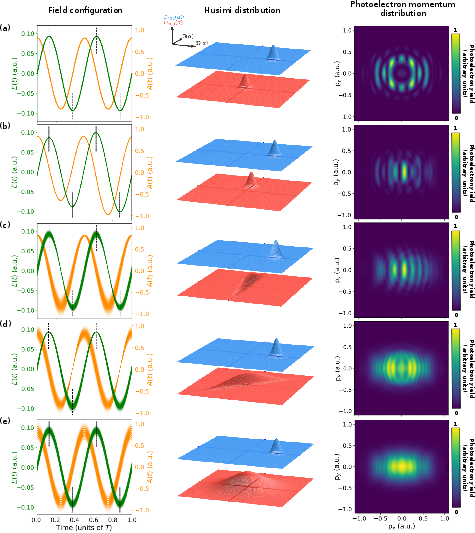
Figure 1: Electric field configurations, Husimi distributions, and PMDs for He in coherent (a), coherent bichromatic (b), BSV bichromatic with ω2 (c,d), and thermal (e) driving fields.
Crucially, the coherent field case yields only marginal asymmetry, while the BSV field leads to orders-of-magnitude enhancement. Thermal statistics, despite similar mean intensities, do not lead to any phase-dependent asymmetry due to their phase-space isotropy.
Quantitative Asymmetry Metrics
Direct comparison of photoelectron yield along the polarization axis (ω3) shows substantial shifts and skewness only for the BSV-driven case, with the distribution systematically biased towards positive ω4 for certain squeezing angles. The mean value and skewness of ω5 as a function of BSV intensity both show a linear dependence in the quantum case, in stark contrast to the weaker, sub-linear scaling under coherent driving.
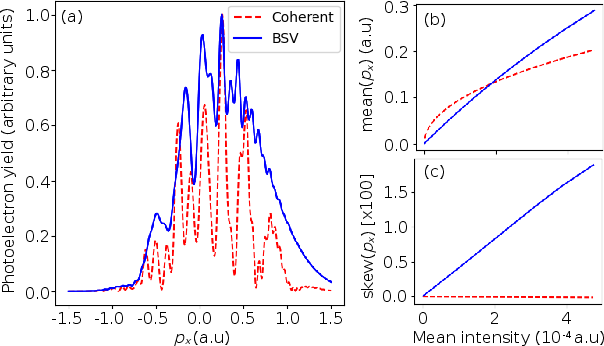
Figure 2: Momentum distribution and central-moment metrics (mean, skewness) for coherent and BSV bichromatic fields.
This demonstrates that BSV-induced quantum fluctuations provide a robust and tunable tool for amplifying and extracting asymmetry in strong-field ionization, exceeding the capabilities of classical field engineering.
Temporal and Pathway-Resolved Ionization Probabilities
Analysis of the differential ionization probability on sub-cycle time scales reveals that the BSV field irreversibly breaks certain temporal symmetries of the driving field, directly mapping quantum fluctuations onto observable electron momentum asymmetries. For appropriately chosen squeezing angle, left-right symmetry in the PMD is severely broken due to exponential sensitivity of the tunneling step to the instantaneous field, which fluctuates substantially under BSV statistics.
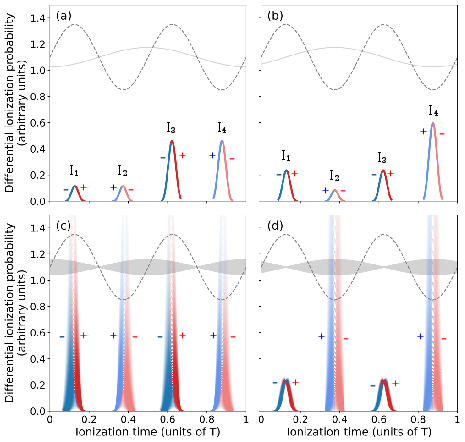
Figure 3: Time-resolved ionization probability for specific temporal windows, under coherent and BSV driving fields—demonstrating phase- and squeezing-dependent bias in PMD.
Contrast this with the thermal and coherent cases, which maintain symmetry in both the PMD and time-resolved yield for all relative phases due to the absence of structured quantum correlations.
Nature and Limitation of the Quantum-Statistical Contribution
Analysis based on the full SFA dynamics, including the so-called "photon statistics force," demonstrates that for the parameter ranges considered (realistic squeezing strengths with negligible ω6), the non-classical field statistics do not alter electron propagation in the continuum. The entire modulation occurs at the tunneling/ionization step—a key distinction from cases such as HHG, where quantum light statistics can directly affect the continuum trajectories.
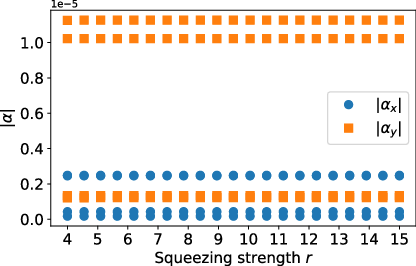
Figure 4: Solutions for ω7 and ω8 in the photon statistics force equations as a function of squeezing, confirming negligible statistical force for PMD modulation in direct ATI.
Squeezing Parameter Dependence
Systematic analysis shows that even moderate increases in the squeezing strength ω9 drive rapid growth in PMD asymmetry and loss of coherence in the interference pattern, with the phase of the squeezing providing an experimental knob for controlling the handedness and amplitude of the observed asymmetry.
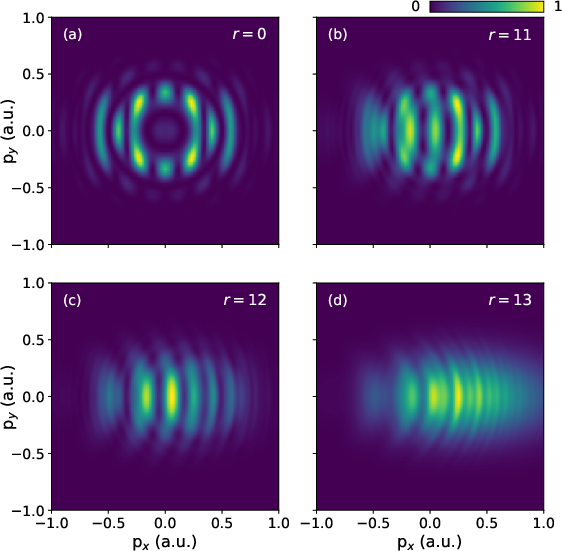
Figure 5: PMDs for He atom versus squeezing parameter 2ω0; increasing 2ω1 amplifies asymmetry and blurring.
Tunneling-Time Uncertainty and Its Manifestation
By examining the Husimi-weighted variance in the imaginary part of the saddle point (ionization) time as a function of 2ω2, the study establishes a quantitative connection between quantum field statistics and the uncertainty in tunneling delay, further underpinning the origin of the PMD modifications. Asymmetry in these variances appears exclusively under BSV driving, aligned with the momentum-direction bias seen in the PMDs.
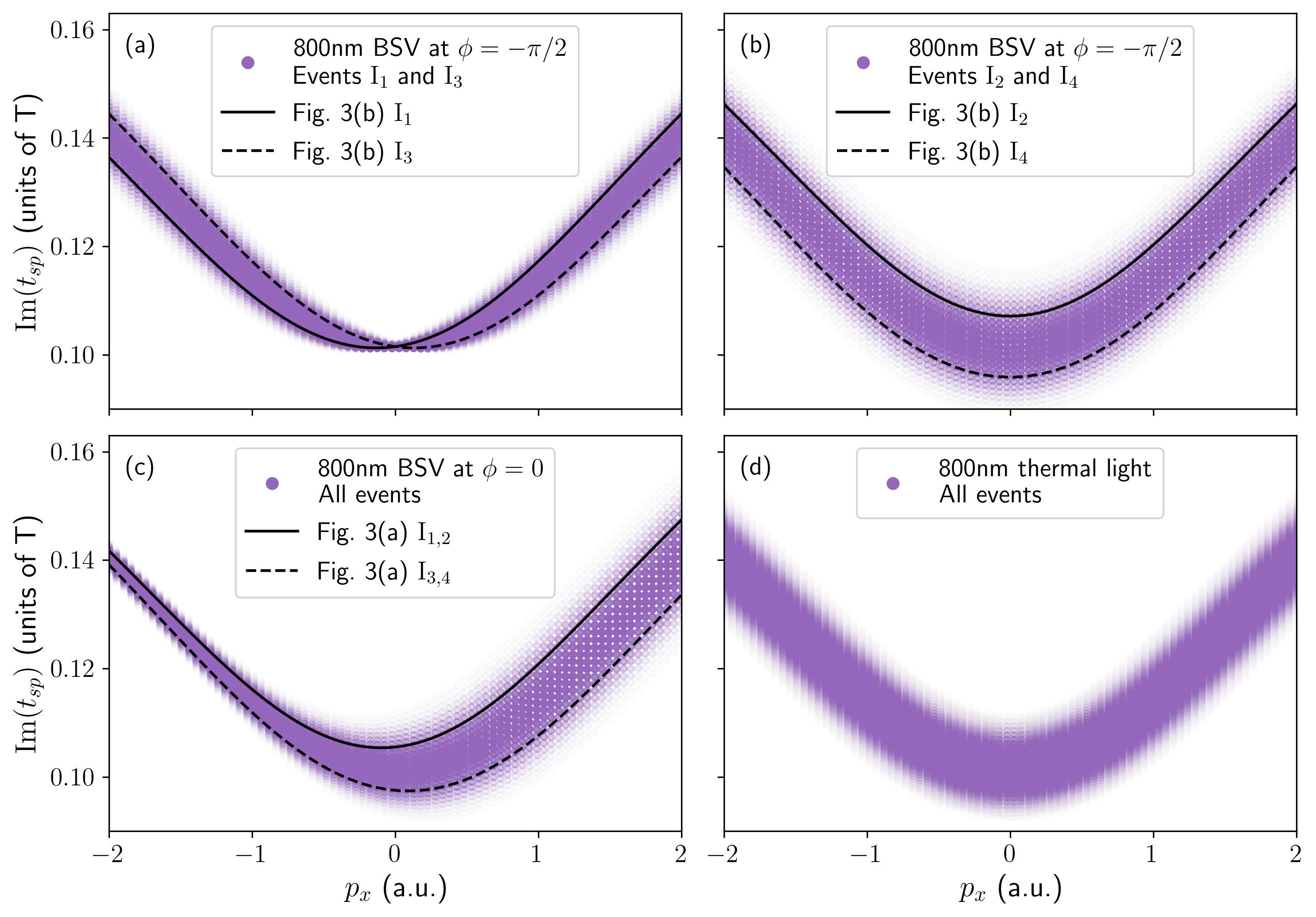
Figure 6: Imaginary part of saddle-point solutions for different field statistics.
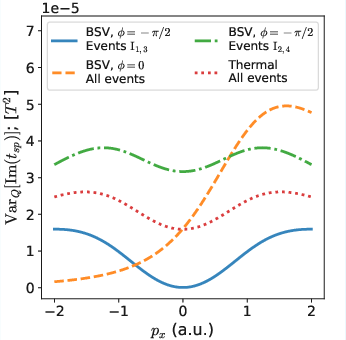
Figure 7: Husimi-weighted variance of tunnel ionization times for four bichromatic field configurations—demonstrating the link between quantum light fluctuations and PMD asymmetry.
Implications and Outlook
The results elucidate that quantum light—specifically, BSV—can serve as a selective lever to amplify and reveal subtle temporal structure in ATI, rendering time-resolved pathway information directly accessible in PMDs without the need for elaborate classical field-engineering or background subtraction. Practically, this approach enables high-fidelity extraction of tunneling times, quantum phases, and subcycle pathway-resolved dynamics, vastly improving signal-to-noise in attosecond metrology and quantum process tomography using strong-field techniques.
Theoretically, the work demonstrates that nonclassical photon statistics can be mapped onto electron observables in a controlled, phase-sensitive manner even when the mean perturbing intensity is low, and without introducing significant backaction or continuum perturbation, distinguishing ATI from HHG in quantum-optical light-matter coupling regimes.
Looking forward, experimental realization of these predictions is compatible with the latest advances in high-flux BSV generation via spontaneous parametric down-conversion, and suggests fertile ground for exploring attosecond electron dynamics, quantum control, and photon-electron hybrid information processing with quantum-structured light.
Conclusion
This work establishes that Bright Squeezed Vacuum fields, when used as weak perturbations in bichromatic strong-field ionization, induce and tune large, controllable asymmetries in ATI photoelectron distributions, rooted entirely in quantum fluctuations of the field at the tunneling step. This represents a substantial amplification over classical symmetry-breaking approaches and provides a robust, selective tool for probing and controlling ultrafast electron dynamics. This methodology opens new paradigms in quantum-limited electron microscopy, strong-field quantum optics, and ultrafast metrology using quantum light.
Reference:
"Interferometrically Enhanced Asymmetry in Strong-field Ionization with Bright Squeezed Vacuum" (2604.12646).