- The paper demonstrates a >20-fold enhancement in nonlinear tunneling ionization using bright squeezed vacuum on sodium atoms.
- It employs multi-mode quantum statistics to achieve super-Poissonian photoelectron distributions and tunable high-energy shifts via g^(2) control.
- The findings establish quantum noise engineering as a powerful method for optimizing attosecond pulse generation and strong-field processes without increasing photon flux.
Quantum-Boosted Nonlinear Tunneling Driven by Bright Squeezed Vacuum
Introduction
This paper presents experimental and theoretical advances in the application of quantum light to nonlinear tunneling ionization, specifically focusing on the enhancement achieved when sodium atoms are subjected to bright squeezed vacuum (BSV) sources. The study validates quantum noise engineering as a tool to dramatically boost nonlinear photoelectron yield and allows precise control over the effective intensity via phase squeezing, even at constant average pulse energy. It addresses fundamental questions about quantum-enhanced strong-field phenomena and establishes new experimental paradigms for attosecond science, high-harmonic generation (HHG), and quantum-controlled molecular dynamics.
Experimental Methodology
Tunneling ionization measurements are conducted in a cold-target recoil ion momentum spectrometer, using both classical coherent light and quantum BSV pulses. Sodium atoms, with relatively low ionization potential, provide an ideal platform to elucidate quantum-enhanced nonlinear effects. BSV is generated through cascaded high-gain parametric down-conversion in β-barium borate crystals, yielding broadband squeezed light centered at 1580 nm with femtosecond pulse duration and tailored photon statistics.
The experimental setup detailed below implements coincidence detection of ionized electrons and parent ions with momentum resolution, enabling careful statistical characterization of photoelectron emission and energy distribution.
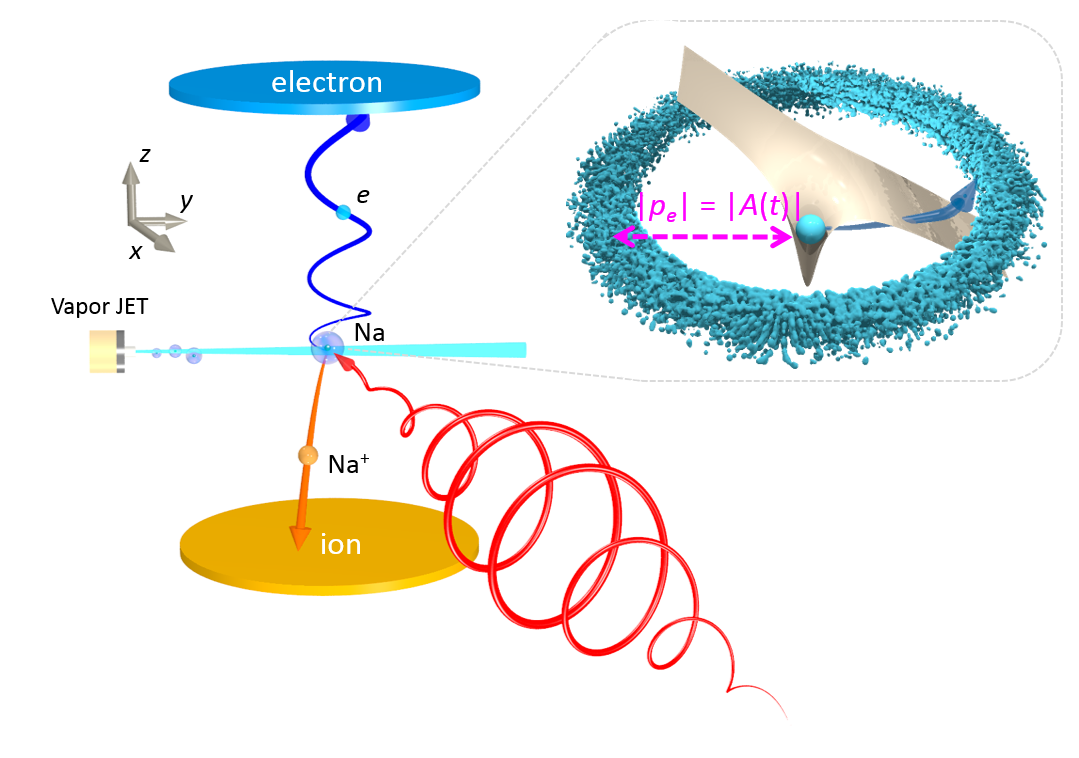
Figure 1: Experimental scheme illustrating tunnel ionization of sodium atoms by classical or quantum sources, and detection via time- and position-resolved spectrometry.
Quantum Statistics and Nonlinear Boost
A central result is the comparison of photoelectron statistics between classical coherent and quantum BSV-driven sources at equivalent average electron counts. Classical light yields Poissonian electron number distributions consistent with coherent processes and strong-field ADK theory, whereas BSV excitation produces super-Poissonian, heavy-tailed distributions. Theoretical modeling confirms these features as direct consequences of multi-mode BSV photon statistics, here captured by an N=5 mode convolution.
Moreover, BSV pulses (300 nJ) induce tunneling ionization equivalent to 7.1 μJ classical light, establishing a >20-fold enhancement in nonlinear efficiency. Coherent pulses at 300 nJ produce no measurable tunneling, underscoring the role of quantum amplitude fluctuations rather than classical intensity.
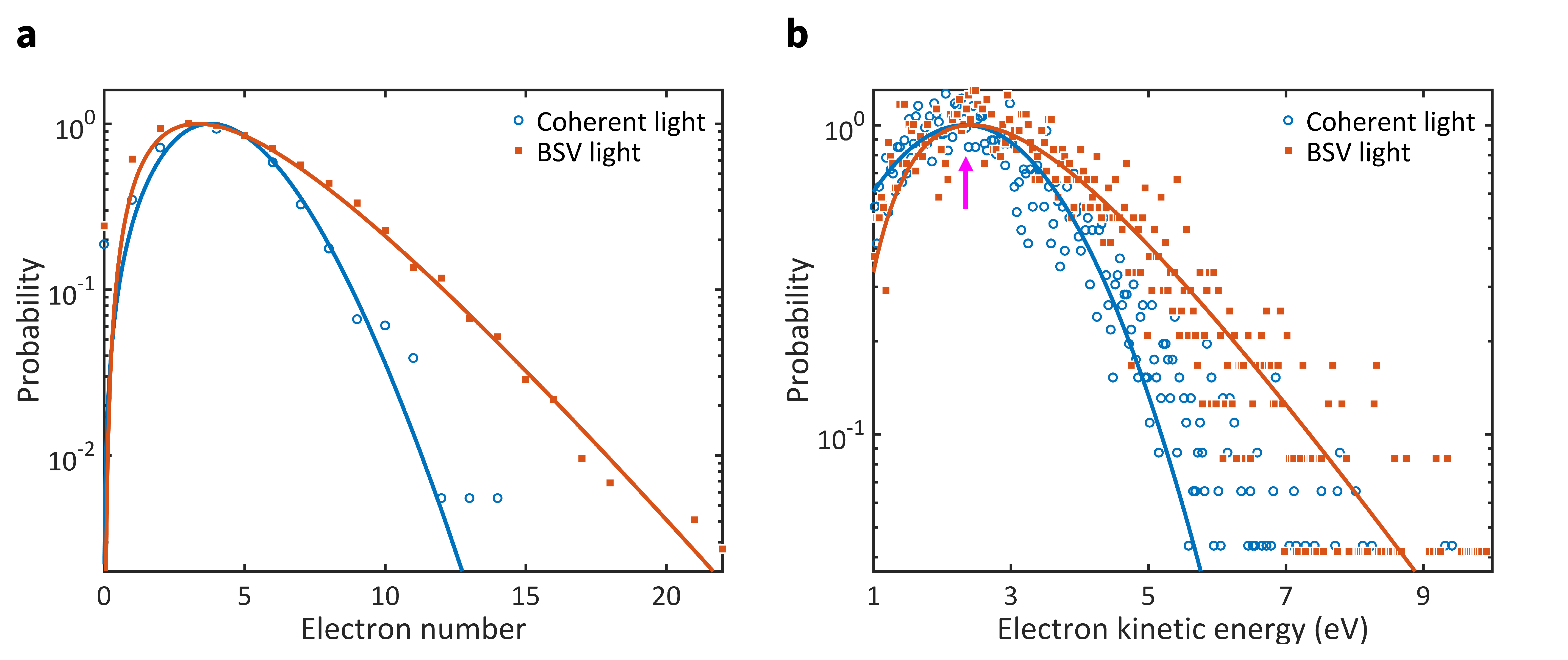
Figure 2: Electron number distributions and kinetic energy spectra for classical and quantum sources, showing quantum-enhanced photoelectron statistics and energy transfer.
Quantum-Controlled Energy Spectra via Noise Engineering
The study demonstrates energy spectrum broadening in BSV-driven ionization. While both classical and quantum sources generate photoelectrons with identical peak kinetic energies when properly intensity-matched, BSV excitation manifests a pronounced high-energy tail, confirming amplitude stretching and enhanced energy transfer induced by quantum fluctuation.
Angular streaking is used to map the vector potential at ionization to final electron momentum, allowing for intensity calibration and direct comparison of effects. This provides the first empirical confirmation of theoretically predicted spectral broadening in quantum-driven strong-field regimes.
Active Quantum Control via g(2)
A novel control paradigm is established by varying the second-order correlation function g(2)—the degree of phase squeezing—for BSV light at fixed average power. As g(2) increases, photoelectron energy spectra systematically shift to higher energies, evidencing tunable nonlinear interaction strength driven solely by quantum statistical manipulation.
Extracted spectral peaks reveal a linear scaling law: effective intensity Ieff is proportional to the product of total power and (g(2)−1), setting g(2) as an experimental knob for strong-field process optimization without raising photon flux. This opens practical avenues for attosecond source engineering, nonlinear spectroscopy, and controlled electron dynamics.
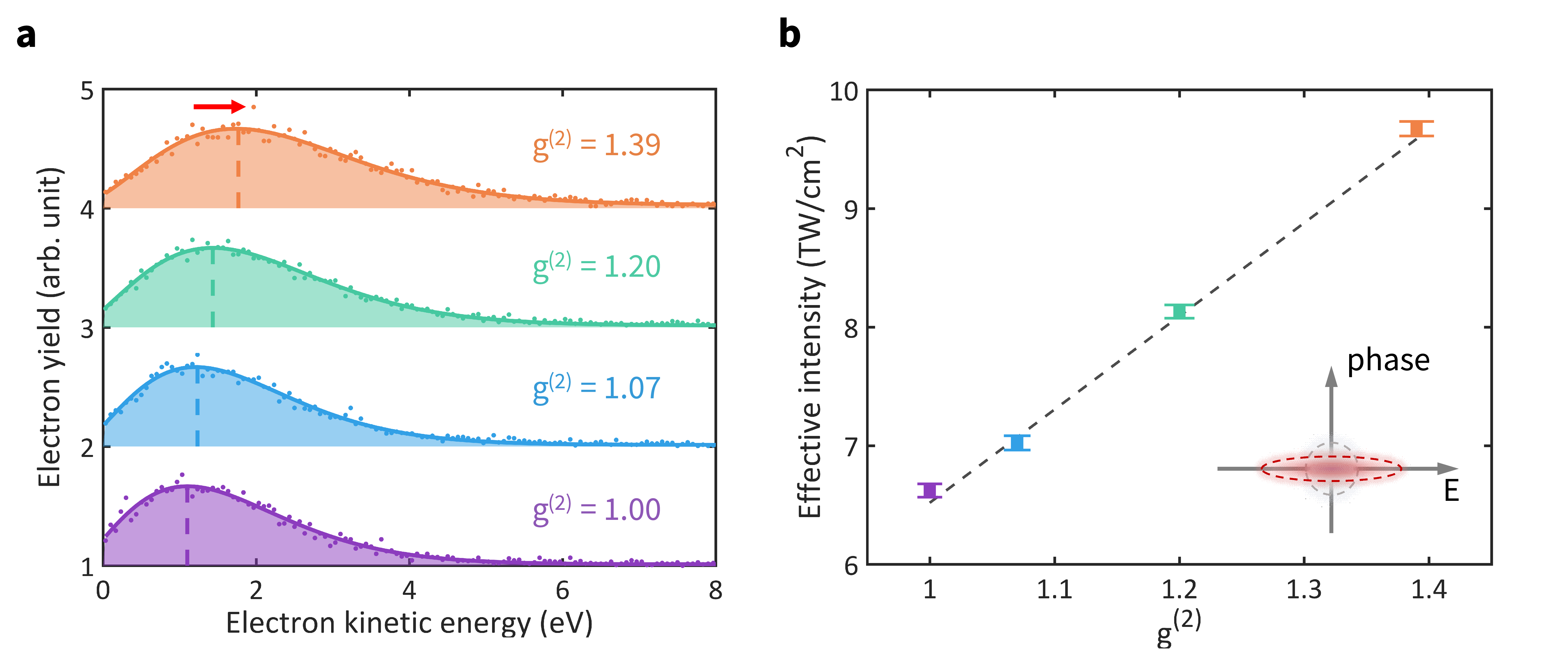
Figure 3: Tunable photoelectron spectra and effective intensity scaling via g(2), enabling quantum-statistics-driven control over strong-field interactions.
Implications and Future Directions
The results establish quantum noise engineering—specifically phase-squeezed BSV—as a transformative tool for boosting and controlling nonlinear tunneling ionization well beyond classical intensity-limited regimes. The quantum advantage demonstrated here suggests deep implications for attosecond pulse generation, frequency conversion, and quantum molecular control. Notably, statistical control via g(2) extends feasible nonlinear enhancement to systems with stringent damage thresholds, circumventing constraints of classical excitation.
On a theoretical level, the framework elucidates multi-mode quantum statistics as integral to strong-field interactions and highlights the importance of precise modal engineering for practical quantum light sources. The linear scaling of effective intensity with quantum statistical parameters provides a foundation for robust optimization strategies in quantum optics.
Future developments may include the extension of this paradigm to HHG in solids, quantum-controlled ultrafast chemistry, and high-fidelity quantum information processing utilizing extreme nonlinearities. Integration of BSV and other non-classical states with attosecond metrology techniques will likely open further possibilities for precision quantum control and spectroscopy.
Conclusion
The study rigorously demonstrates quantum-boosted nonlinear tunneling in atomic systems, backed by strong numerical evidence of >20-fold enhancement and tunable quantum control via g(2). The findings both clarify fundamental limits and establish practical routes for quantum-enhanced strong-field physics, enriching the theoretical foundation and expanding experimental modalities for attosecond science and quantum control architectures.