- The paper introduces a block coordinate descent framework that jointly optimizes transmit precoding, RIS phase shifts, and 3D trajectories for enhanced sum-rate performance.
- It leverages techniques like WMMSE, Riemannian conjugate gradient, and successive convex approximation to handle non-convex and coupled optimization challenges.
- Simulation results reveal up to a 7.05% sum-rate improvement over benchmarks, demonstrating robustness across varying user densities and RIS sizes.
Joint Trajectory and Resource Optimization in Dual-Aerial RIS-Assisted Integrated TNT Networks
Introduction
The integration of terrestrial and non-terrestrial networks (ITNTN) is a strategic architectural direction in the evolution of 6G systems, aiming to extend coverage, bolster resiliency, and improve spectral efficiency via the incorporation of diverse aerial and space-based resources. The paper "Joint Trajectory and Resource Optimization for Aerial RIS-assisted Integrated TNT Networks" (2604.12283) systematically addresses the performance maximization challenge in a dual-aerial reconfigurable intelligent surface (RIS)-aided ITNTN comprising a terrestrial base station (TBS), satellite (SAT), UAV-mounted RIS (UAV-RIS), and high-altitude platform (HAP)-mounted RIS (HAP-RIS). The core contribution is a tractable, convergent optimization framework for simultaneous joint design of communication resources (TBS/SAT precoding, RIS phase configuration) and 3D aerial platform trajectories, validated via strong simulation-based performance gains over competitive baselines.
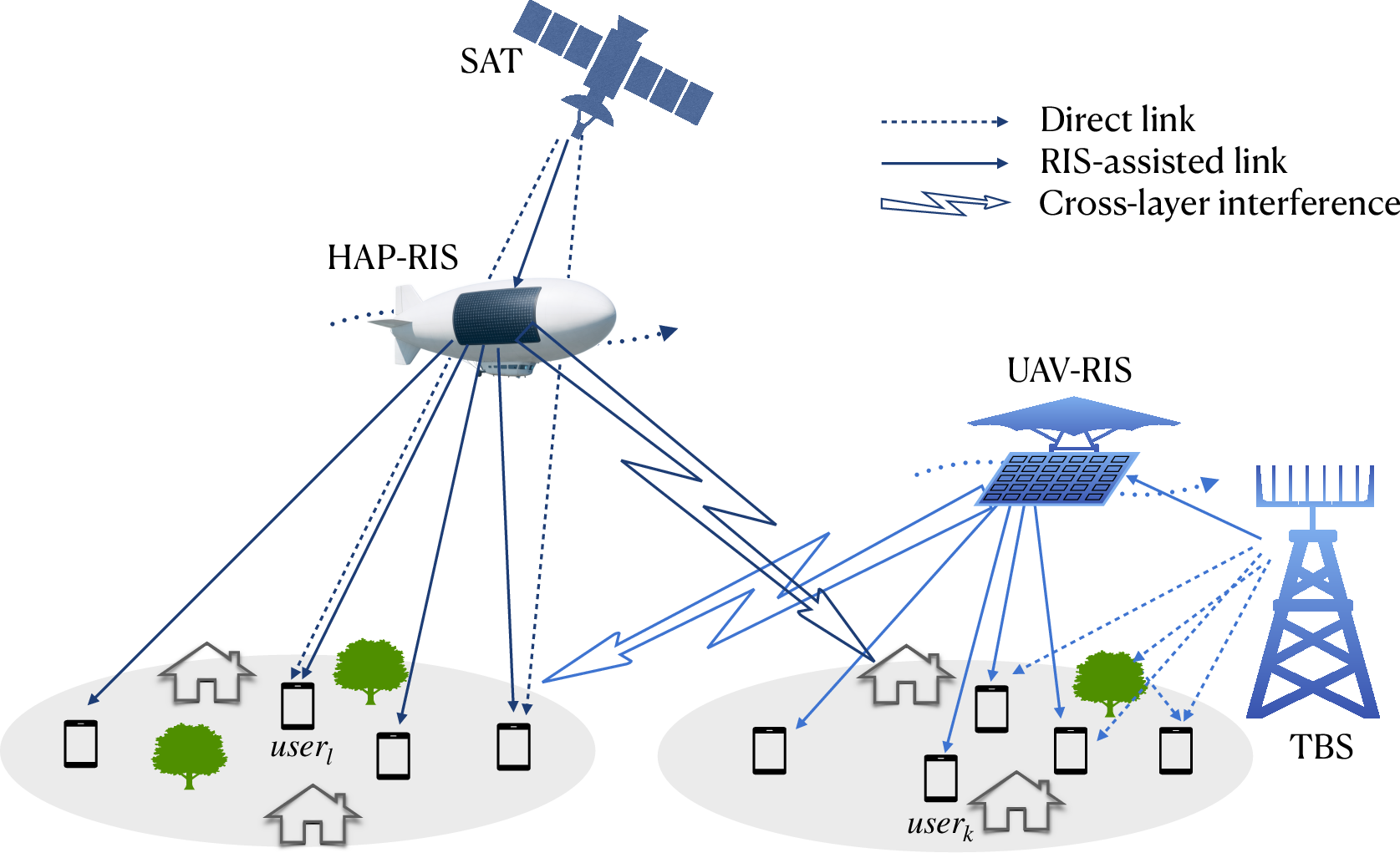
Figure 1: System Model of Aerial RIS-assisted Integrated Terrestrial and Non-terrestrial Network.
The considered ITNTN scenario features two distinct user populations: terrestrial users served primarily by the TBS and satellite users addressed by the SAT, both populations spatially distributed in non-overlapping ground regions. Communication enhancements are achieved via a UAV-RIS supporting the TBS-user links and a HAP-RIS improving the SAT-user links. All major communication channels—including direct and RIS-assisted links—are modeled using Rician fading and explicit geometric relationships, encapsulating realistic path loss, array steering, and Doppler effects.
The main system design variables include:
- Active transmit precoders for TBS (with a ULA) and SAT (with a UPA).
- Unit-modulus phase shift matrices for both the UAV-RIS and HAP-RIS.
- 3D time-varying trajectories for the UAV and HAP, discretized over a finite time horizon.
The key performance metric is the average sum-rate across all users and time slots, incorporating SINR computations that account for intra-tier and cross-tier interference, as well as mobility-aware changes in channel state.
The resulting problem is a non-convex, coupled optimization subject to power budgets, RIS hardware constraints, and strict mobility constraints on aerial platforms, including velocity and altitude limits as well as initial/final positioning.
Algorithmic Solution
The proposed approach leverages a block coordinate descent (BCD) framework, partitioning the high-dimensional joint optimization into three interleaved subproblems:
- Transmit Precoder Optimization: With fixed RIS phase and trajectories, transmit precoders are designed using weighted minimum mean square error (WMMSE), which reformulates the sum-rate maximization into an equivalent WMMSE minimization amenable to efficient solution via iterative closed-form updates.
- RIS Phase Shift Optimization: With fixed precoders and trajectories, the dual RIS unit-modulus vector design is handled via a manifold optimization approach. Specifically, the problem is recast as a quadratic minimization over the complex oblique manifold, solved using a Riemannian conjugate gradient (RCG) method, ensuring convergence to a critical point under unit-modulus constraints.
- Trajectory Optimization: With communication parameters fixed, UAV and HAP trajectories are optimized using a successive convex approximation (SCA) strategy. Distance-dependent nonconvex terms in the objective are lower-bounded using affine first-order expansions, yielding a sequence of convex trajectory subproblems solvable via standard convex optimization toolkits.
The BCD outer loop cyclically solves these three subproblems until sum-rate convergence. The authors establish monotonic convergence of the sum-rate sequence and empirical convergence within a small number of iterations.
Numerical Results and Analysis
Extensive simulations corroborate the efficacy and robustness of the proposed framework under parameter-rich, realistic system configurations:
- Convergence: The algorithm consistently converges within six BCD iterations. The achieved average sum-rate is approximately 7.05% higher than that of the random RIS benchmark, and delivers monotonic improvements at each step. The convergence properties persist across variations in the numbers of users and RIS elements.
- Transmit Power Scaling: As TBS and SAT transmit powers increase, the average sum-rate improves monotonically for all schemes, with the proposed method maintaining its advantage due to superior signal/RIS alignment. Notably, the sum-rate gains do not saturate quickly, underscoring effective interference suppression through joint design.
- RIS Size and User Density: Larger RISs (more elements) and higher user counts yield substantial, scalable sum-rate improvements, demonstrating the indispensable role of adequate passive aperture and aggressive spatial multiplexing in ITNTN architectures.
- Mobility Optimization: The optimized UAV and HAP trajectories are strongly nontrivial. The UAV adapts both its lateral position and altitude to serve clusters of ground users, while the HAP optimizes its flight path and height for persistent, global coverage of satellite users, outperforming fixed or naive initial trajectories.
- Flight Period and Noise Sensitivity: Extended flight periods for UAV/HAP allow more opportunistic serving of users, up to a saturation point. The framework is robust to increased AWGN noise, maintaining significant benefits over baseline transmission policies.
These empirical trends are consistent under a variety of system settings, further reinforcing the architectural relevance and practical applicability of the joint communication-mobility optimization paradigm.
Implications and Future Directions
This research provides a foundational, formalized approach for resource allocation in dual-aerial RIS-enabled ITNTNs, synthesizing advanced techniques—WMMSE, Riemannian optimization, and SCA—under a single convergent BCD umbrella. It establishes the following technical claims and insights:
- Dual-aerial (UAV + HAP) RIS architectures, jointly optimized with communication resources and mobility, provide robust, scalable improvements in network sum-rate and coverage compared to single-aerial or static RIS deployments.
- The performance improvements are persistent across practical design regimes: high user density, large-scale MIMO/RIS, and diverse spectral resources.
- Mobility constraints and physical channel variations can be effectively incorporated through first-order surrogates and manifold-based optimization, delivering solutions feasible in real-time or near-real-time network management scenarios.
Theoretical and practical research directions stemming from this work include:
- Extension to multi-UAV or multi-HAP scenarios, where fleet-level optimization poses large-scale combinatorial and continuous challenges.
- Integration of imperfect or delayed channel state information, necessitating robust or partially observable control policies.
- Joint design for alternate performance objectives, such as latency minimization, energy efficiency, or reliability under ultra-high-mobility and non-stationary user distributions.
- Incorporation of additional multi-access and cross-layer paradigms (e.g., NOMA, slicing, learning-based scheduling) consistent with emerging 6G service demands.
Conclusion
The paper rigorously demonstrates that the joint optimization of transmit precoding, RIS phase configuration, and 3D mobility in dual-aerial RIS-assisted ITNTN architectures yields significant, consistent performance benefits under realistic constraints. The proposed BCD-WMMSE/RCG/SCA framework achieves reliable convergence and is validated to provide superior sum-rate performance compared to state-of-the-art alternatives, marking a substantial advancement in practical ITNTN design methodology (2604.12283).

