- The paper introduces a joint resource and trajectory optimization framework that integrates beamforming, ARIS phase/amplification, and 3D aerial trajectory control in a dual-aerial setup.
- It employs a tailored BCD algorithm combining WMMSE, Riemannian conjugate gradient, and SCA methods to achieve convergence in about 15 iterations and improve sum-rate by up to 8.44% over passive RIS benchmarks.
- The study highlights the scalability and robustness of dual-aerial ARIS in ITNTN, enhancing coverage and capacity while effectively mitigating double-fading effects in multi-layer communications.
Introduction and Background
The investigated architecture leverages a dual-aerial active reconfigurable intelligent surface (ARIS)-assisted non-orthogonal multiple access (NOMA)-based integrated terrestrial and non-terrestrial network (ITNTN), comprising a terrestrial base station (TBS), a satellite base station (SAT), and two aerial ARIS platforms: a UAV-mounted ARIS (UAV-ARIS) and a high-altitude platform-mounted ARIS (HAP-ARIS). This setup extends beyond conventional passive RIS and single-aerial RIS paradigms, targeting enhanced spectral efficiency, coverage, and adaptivity in 6G infrastructures with highly heterogeneous propagation and inter-layer coupling.
Active RIS enables direct signal amplification at each element, compensating for double-fading loss typical of long cascaded links in multi-hop or dual-aerial scenarios, a critical shortcoming in passive RIS deployments [9998527, 9377648]. Prior to this work, ARIS research primarily focused on terrestrial scenarios or isolated aerial layers, often neglecting the highly-coupled cross-layer resource allocation, phase/amplitude, and aerial trajectory optimization—key for ITNTN performance under NOMA operation [10538458, 11408296].
The proposed model (Figure 1) incorporates TBS–UAV–User and SAT–HAP–User cascaded links, both employing uniform linear (TBS) or planar (UAV, HAP, SAT) arrays. Each ARIS element applies a complex coefficient with jointly optimized phase shift and amplification factor. The system supports multiple terrestrial users and satellite users, multiplexed via power-domain NOMA with fixed SIC decoding orders based on effective channel conditions.
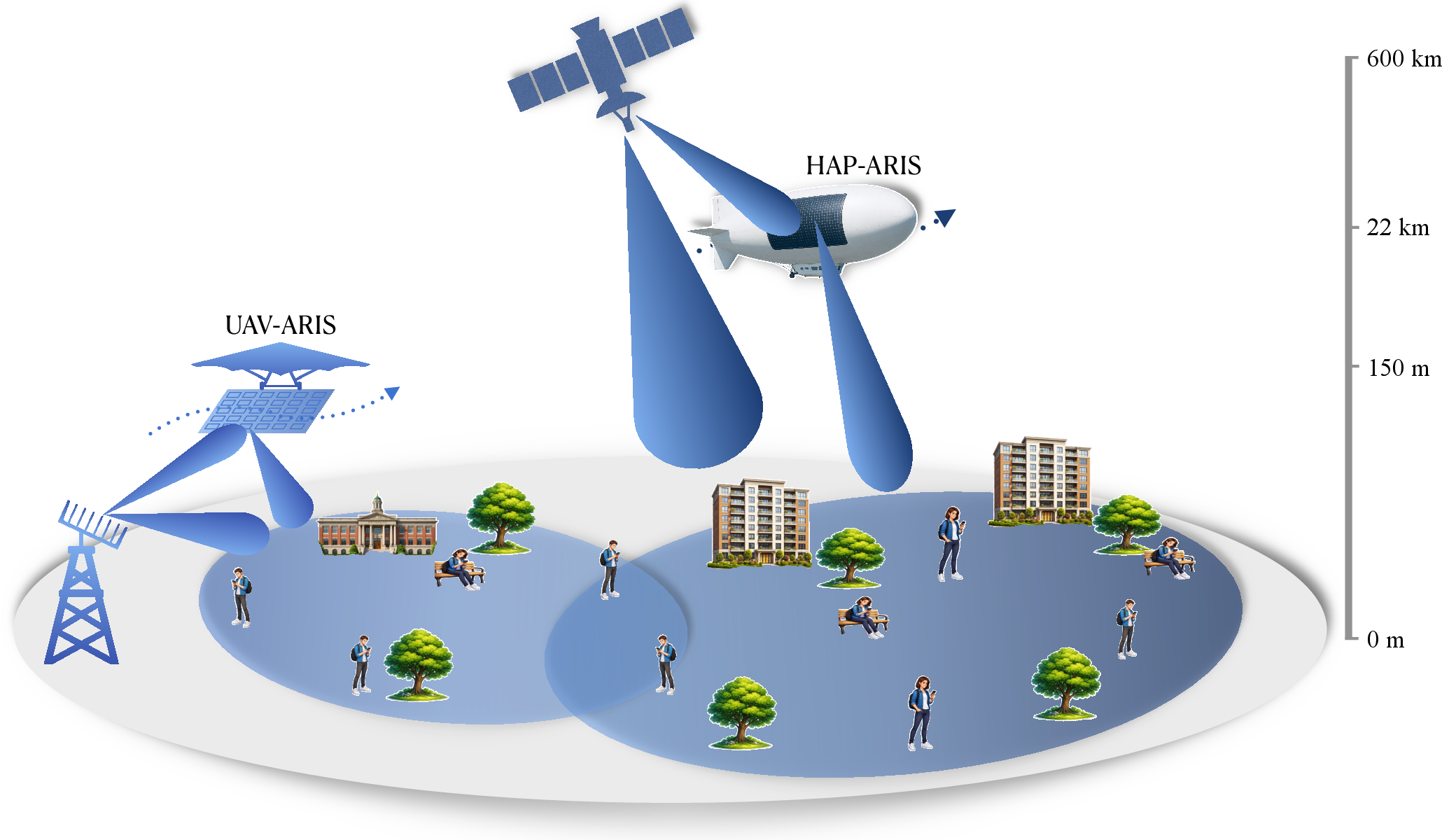
Figure 1: System model of dual aerial ARIS-assisted NOMA-based ITNTN.
Time is slotted, trajectories are discretized, and resource optimization spans beamforming vectors at TBS/SAT, ARIS coefficients (phase/amplitude), as well as 3D aerial trajectories for UAV and HAP—subject to transmit and amplification power, unit-modulus, mobility, and boundary constraints.
The sum-rate maximization objective is highly non-convex, with substantial interdependencies:
- SINR expressions are nonlinear in both transmission and reflection coefficients.
- Cross-tier interference between TBS and SAT is explicitly modeled, preserving ITNTN realism.
- Mobility constraints enforce feasible and practical flight trajectories for both UAV and HAP.
Joint Resource and Trajectory Optimization Algorithm
To address the challenging non-convex optimization, a tailored block coordinate descent (BCD) algorithm is constructed, decomposing the problem into four tractable subproblems:
- Transmit Beamforming (TBS, SAT): Employs a WMMSE (Weighted Minimum Mean Square Error) iterative solver, allowing for closed-form receiver and MSE weight updates, while transmit vectors are updated using Lagrange dual decomposition per slot.
- ARIS Phase-Shift Optimization (UAV-ARIS, HAP-ARIS): Tackled via complex manifold (unit-modulus) Riemannian conjugate gradient methods [AbsilMahonySepulchre+2008], exploiting differentiability and the geometry of the coefficient space.
- ARIS Amplification Factor Optimization: Solved using first-order SCA (Successive Convex Approximation), generating convex surrogates for the inherently coupled quadratic forms present in ARIS reflection power constraints.
- Aerial Trajectory Optimization: Enforced via SCA as well, constructing tight affine lower bounds on the cascade path-loss dependent terms using first-order Taylor expansions with respect to position, enabling an efficient convex trajectory update per BCD iteration.
The solution exhibits strong convergence properties, attaining stationary points with monotonic sum-rate improvement per outer iteration. The full integration of resource and mobility control is only tractable via such hybrid algorithmic decomposition, as the alternative (e.g., SDP relaxations) would not scale in this multi-layer, multi-user context [11030800, 9656117].
Numerical Results and Strong Claims
Extensive simulations are performed with a parameterization drawn from current and next-generation system capabilities, including practical channel and noise models for each component.
Key findings:
- Convergence: The total system sum-rate converges within 15 BCD iterations. Both TBS and SAT user clusters benefit from dual-ARIS gain, and the designed BCD optimization ensures stable and predictable performance improvements over sequential iterations.
- Performance Gains: For ρUmax=2, ρHmax=5, the dual-aerial ARIS joint optimization achieves an average sum-rate improvement of 8.44% over passive RIS benchmarks—an explicit validation of ARIS' ability to overcome the double-fading effect and enhance both directivity and SNR in multi-hop aerial-aided settings.
- Scalability: Increasing the number of ARIS elements (NU, NH) leads to super-linear improvements in achievable rates, and higher amplification factors proportionally increase the sum-rate up to practical noise amplification and power constraints.
- NOMA Superiority: The combined ARIS–NOMA system outperforms SDMA (by up to 47.75% in sum-rate); also, the benefit of ARIS (active vs passive RIS) is more pronounced in NOMA versus SDMA, validating the claim that NOMA is more suitable for complex ITNTN with highly dynamic channel conditions [9316920, 11408296].
- Mobility and Trajectory Control: Optimized 3D UAV/HAP trajectories adaptively exploit the spatial distribution of users, deviating from naïve straight-line paths and flexibly adjusting altitudes to match time-varying user densities and channel conditions. This spatial adaptivity results in up to 16.2% sum-rate gain over fixed-trajectory architectures.
Practical and Theoretical Implications
This work substantiates that:
- Active RIS is indispensable for practical multi-layer aerial or ITNTN deployments, where classical passive RIS is fundamentally limited by power loss over cascaded hops [9998527].
- Multi-tier aerial ARIS architectures (UAV + HAP) enable flexible, scalable coverage, and robust cross-layer control, resilient to terrain and urban blockages, extending high-rate communication to challenging environments (disaster, maritime, rural).
- Joint resource–mobility optimization (beam, phase, amplitude, trajectory) is mandatory for achieving near-theoretical sum-rate bounds under coupled, interference-limited, and power-constrained ITNTN.
- Full-stack optimization algorithms (BCD with manifold and SCA updates) provide a blueprint for next-generation real-time adaptive control for aerial communication platforms.
- Scaling of ARIS size and amplification must be carefully balanced with increased thermal noise, with diminishing returns at extreme amplification due to noise correlation at the RIS.
Prospective Research Directions
Several future avenues are identified:
- Incorporation of imperfect CSI and robust resource adaptation, extending from idealized models to real-world link uncertainties and tracking errors.
- Energy efficiency analysis of dual-aerial ARIS, with potential integration of green power management and HAP/UAV battery constraints.
- Multi-agent learning for real-time trajectory and resource allocation in stochastic and adversarial environments, leveraging distributed RL for non-convex control.
- Expansion to integrated sensing-communication frameworks and communication under co-existent HAP/SAT/terrestrial cognitive paradigms [11390054, 11456053].
Conclusion
"Joint Trajectory and Resource Optimization for Dual-aerial ARIS-assisted NOMA-TNT Networks" (2604.12266) delivers a comprehensive blueprint for exploiting cooperative dual-layer ARIS in ITNTN under a power-domain NOMA regime. By precisely formulating and efficiently solving the joint resource and mobility problem, it is shown that substantial rate and coverage gains are achievable versus existing benchmarks. The algorithmic constructs are sufficiently general to serve as the foundation for future integrated sensing, real-time control, and adaptive aerial resource management in 6G and beyond.