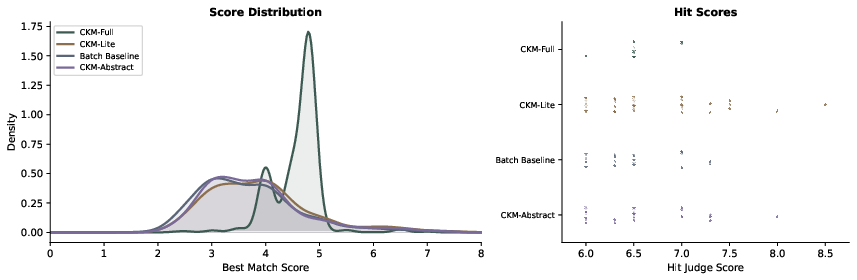
- The paper introduces CKM, a framework that models knowledge evolution through incremental, sliding-window processing to generate dynamic hypotheses.
- It demonstrates that change-aware mechanisms like diff categorization yield greater conceptual originality, albeit with reduced predictive coverage.
- Empirical results show CKM-Lite achieves 2.8% higher hit rates and substantial efficiency gains, highlighting a trade-off between quality and coverage.
Introduction
"Continuous Knowledge Metabolism: Generating Scientific Hypotheses from Evolving Literature" (2604.12243) introduces Continuous Knowledge Metabolism (CKM), a systematic framework for hypothesis generation from scientific literature that directly models the temporal and dynamic structure of evolving research fields. CKM processes new findings in a sequential, sliding-window manner, explicitly organizing and labeling knowledge evolution events. The central thesis is that tracking not only the accumulation but also the transformation of knowledge—such as convergence, contradiction, or bridging—is critical for generating hypotheses that are both novel and anticipatory of future research outcomes.
CKM Framework Overview
CKM is operationalized in three phases: initialization from historical literature to create a structured baseline knowledge base K0, incremental metabolism as new papers are published, and predictive validation against future literature. Two core system variants are studied: CKM-Lite, which focuses on efficient, incremental accumulation of knowledge, and CKM-Full, which instruments the metabolism process with explicit diff-based categorization and trajectory-aware hypothesis generation, including change-type detection (e.g., convergence or contradiction).
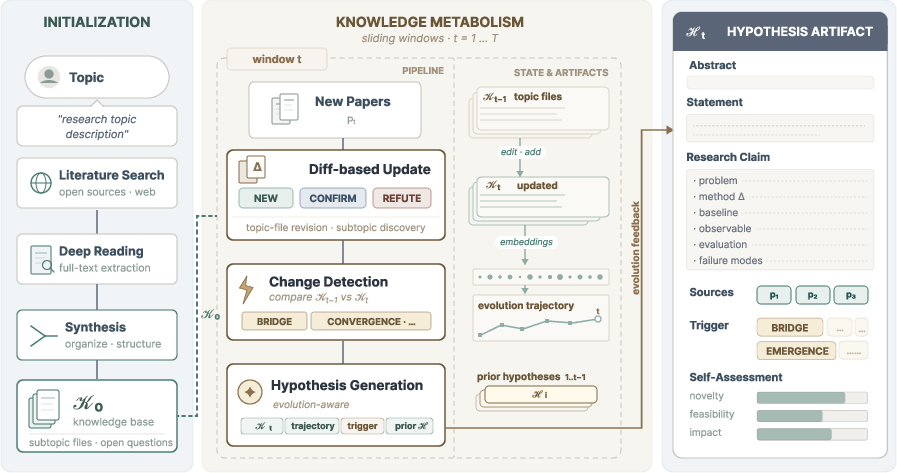
Figure 1: The CKM framework includes initialization of a knowledge base, incremental metabolism across sliding windows, and trajectory-aware generation and evaluation functionality.
In CKM-Lite, each newly arriving batch of papers is merged into the evolving knowledge base and used to condition LLM-based hypothesis generation. CKM-Full augments this with explicit change-type detection at each window, categorizing updates as novel, confirming, or contradicting, and routing this signal to the hypothesis generator.
Empirical Results
A large-scale benchmark spanning 50 diverse AI and NLP research topics and over 800 generated hypotheses demonstrates several strong empirical findings.
Hypotheses Evolution and Embeddings
CKM enables trajectory analysis of hypothesis generation, representing how thematic focuses in a field shift over time. Trajectories are computed via embedding centroids for each window, and overall drift quantifies predictability.
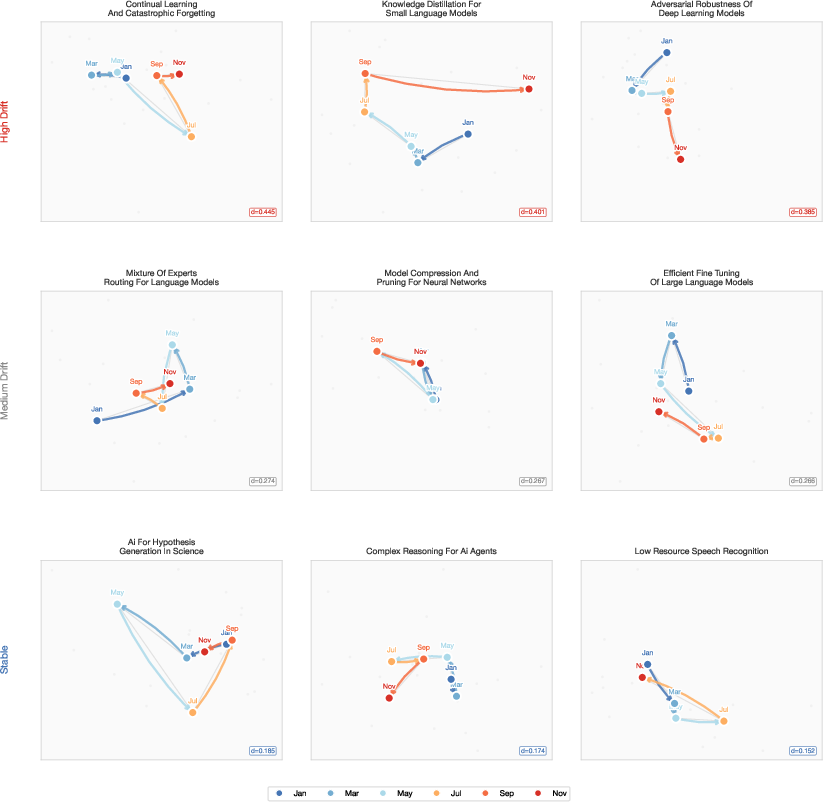
Figure 3: Hypothesis evolution trajectories for nine topics illustrate that high-drift fields produce erratic movement over time, whereas low-drift fields maintain coherent developmental paths.
CKM-Full’s hypotheses exhibit higher intra-topic semantic diversity, and peripheral hypotheses—those furthest from the centroid—typically align better with future research. Hits cluster at the boundaries of hypothesis embedding space, indicating that frontier-exploring (but structurally motivated) hypotheses are more likely to anticipate new literature.
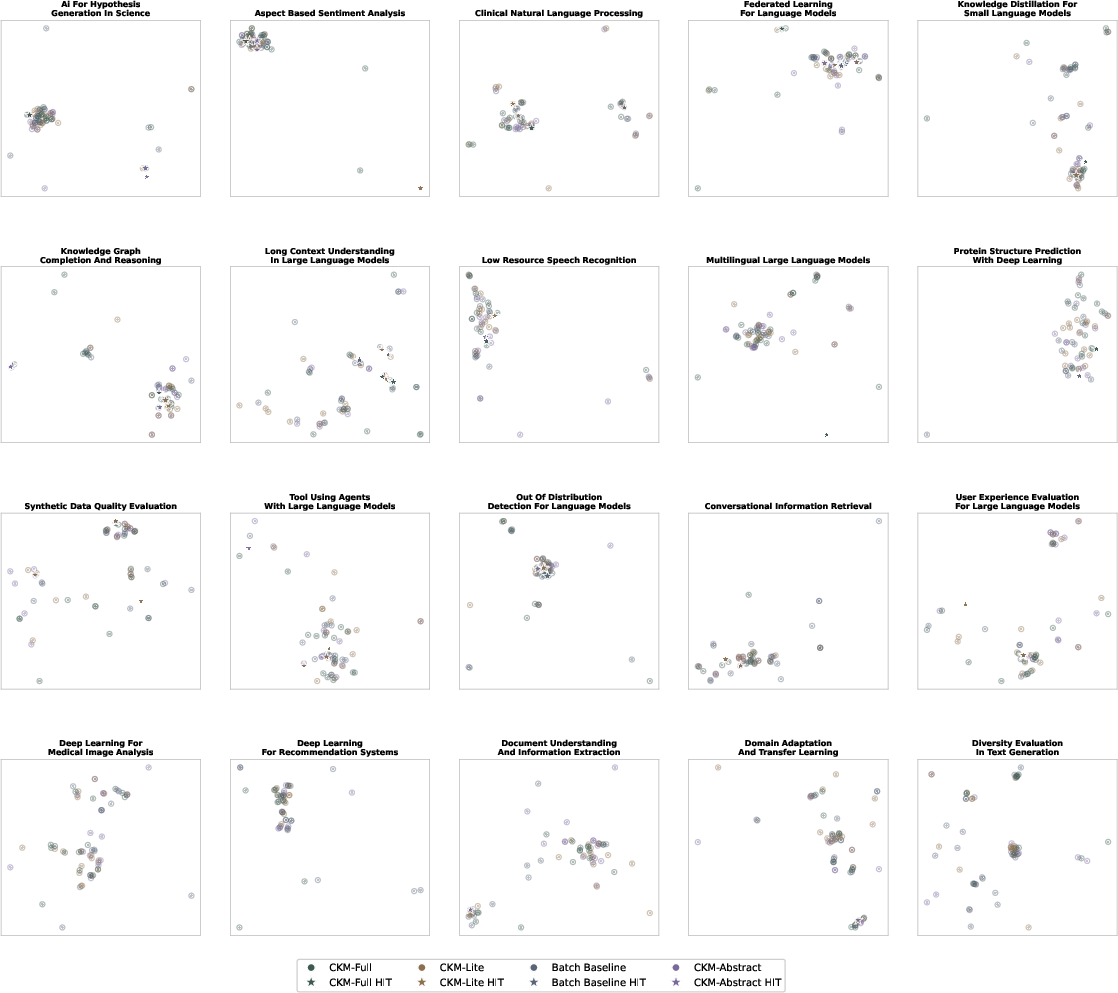
Figure 4: Embedding visualizations for 20 topics show that successful hypotheses (stars) are generally peripheral, supporting the notion of frontier-hitting predictions.
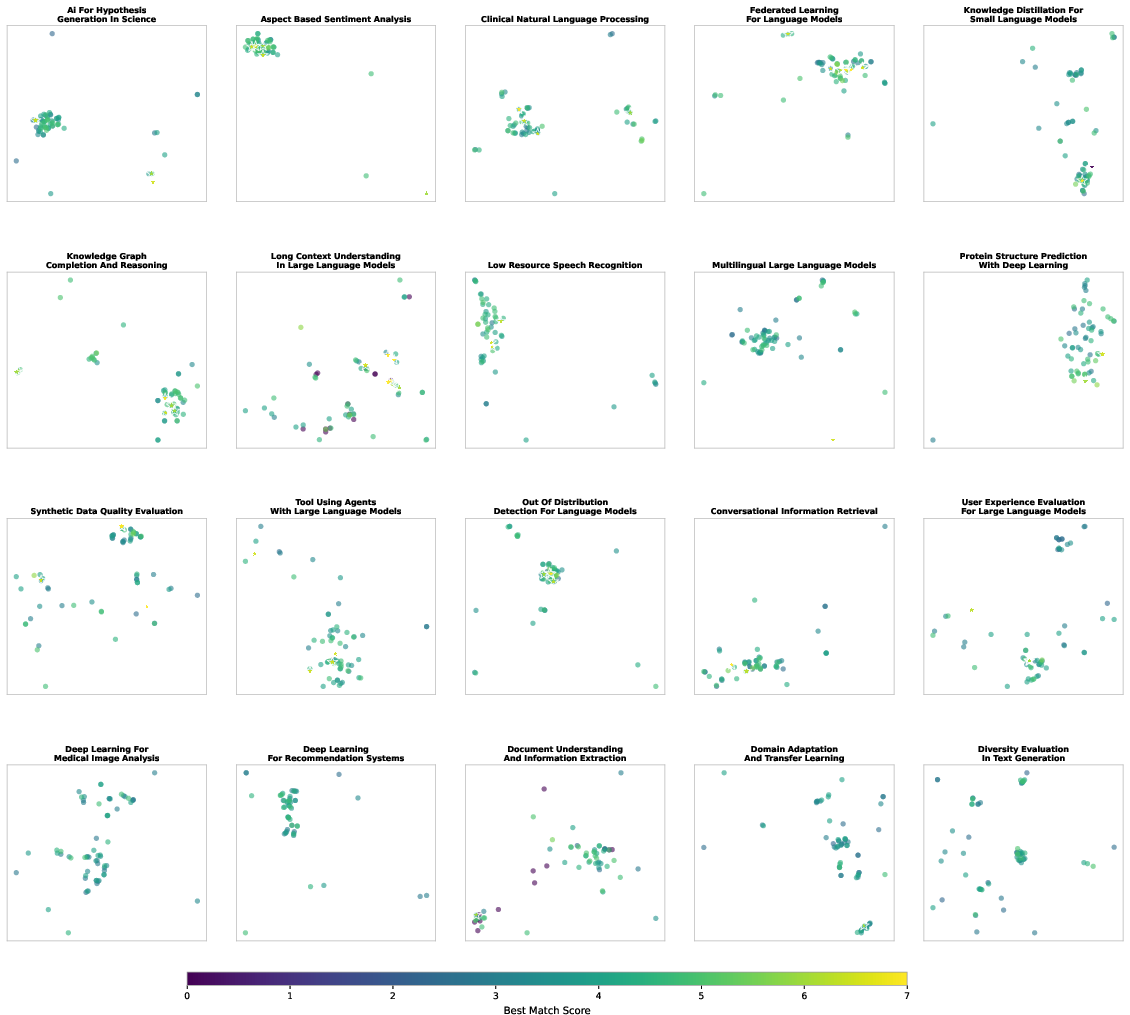
Figure 5: Best-match scores are not spatially clustered, indicating that alignment with future papers is strongly influenced by specific content, not general topic proximity.
Analysis of Change-Aware Instrumentation
Granular breakdowns of novelty scores across dimensions clarify the specific contribution of change-aware instrumentation:
- CKM-Full exhibits a substantial gain in conceptual originality and cross-field synthesis, corresponding to richer, more creative, and more precisely articulated predictions.
- However, its increased specificity and focus comes at a consistent cost to practical coverage and hit rate—detailed, precise hypotheses are less likely, in aggregate, to be validated by future papers, given the stochastic nature of research development.
Theoretical and Practical Implications
CKM’s experimental results have direct implications for both research methodology and practical deployment:
- Incremental, metabolism-style knowledge processing is not only more efficient but produces hypotheses with stronger empirical validation rates, especially for broad, practical discovery tasks. This has practical consequences for continuous, low-cost literature monitoring in AI and related fields.
- Change-aware, trajectory-conditioned generation shapes the 'character' of hypotheses—making them more novel, cross-domain, and longer-range—but at a predictable cost in hit rate. This trade-off highlights the limitations of current automated evaluation methodologies, which often conflate quality and coverage.
- Topic trajectory drift and change-type signals offer actionable heuristics: Practitioners are better served by focusing system outputs in coherent, low-drift domains with strong convergence signals, where the likelihood of correct prediction is maximized.
Methodological Limitations and Future Directions
While the CKM framework robustly quantifies how different design choices alter hypothesis generation behavior, several limitations are noted:
- All evaluation relies on LLM judges for alignment metrics; direct human expert validation is not conducted.
- The CKM-Full condition bundles multiple mechanisms (diff categorization, change detection, trajectory conditioning), precluding per-ablative component analysis.
- Generalization beyond arXiv-centric, high-velocity fields (NLP, AI) is untested.
- The quality–coverage tension observed is expected to generalize to other generative systems, paralleling trade-offs in information retrieval and scientific creativity.
Addressing these limitations—via expert-in-the-loop evaluation, expansion to new scientific domains, and systemic ablation—will be critical for translating automated, temporally-aware hypothesis generation into actionable scientific practice.
Conclusion
The CKM framework empirically establishes that explicit, incremental modeling of dynamic knowledge evolution changes both the predictive success and the qualitative nature of machine-generated scientific hypotheses. CKM-Lite offers a cost-efficient, high-coverage baseline for continuous discovery, while CKM-Full lays the groundwork for interpretable, creativity-oriented generation and diagnostic analysis. The results emphasize the necessity for multi-metric evaluation protocols that do not conflate novelty and predictive accuracy, and illustrate that the method of literature processing—not simply its volume—materially alters the outputs of AI-driven hypothesis generation. Translating these empirical findings into increased scientific value will require the integration of expert validation and rigorous, longitudinal deployment in rapid-discovery scientific communities.