Towards Autonomous Mechanistic Reasoning in Virtual Cells
Abstract: LLMs have recently gained significant attention as a promising approach to accelerate scientific discovery. However, their application in open-ended scientific domains such as biology remains limited, primarily due to the lack of factually grounded and actionable explanations. To address this, we introduce a structured explanation formalism for virtual cells that represents biological reasoning as mechanistic action graphs, enabling systematic verification and falsification. Building upon this, we propose VCR-Agent, a multi-agent framework that integrates biologically grounded knowledge retrieval with a verifier-based filtering approach to generate and validate mechanistic reasoning autonomously. Using this framework, we release VC-TRACES dataset, which consists of verified mechanistic explanations derived from the Tahoe-100M atlas. Empirically, we demonstrate that training with these explanations improves factual precision and provides a more effective supervision signal for downstream gene expression prediction. These results underscore the importance of reliable mechanistic reasoning for virtual cells, achieved through the synergy of multi-agent and rigorous verification.
Paper Prompts
Sign up for free to create and run prompts on this paper using GPT-5.
Top Community Prompts
Explain it Like I'm 14
What this paper is about (big-picture overview)
This paper is about building “virtual cells” — computer models that try to predict how real cells will react when you change something, like adding a drug or turning a gene off. The authors argue that it’s not enough for an AI to guess the outcome; it also needs to explain the “how and why” in a way scientists can check. So they design a new way for AI to explain its reasoning using step-by-step, fact-checked “action maps” instead of vague paragraphs. They then build an AI system, called VCR-Agent, to automatically create these explanations and check them for mistakes.
The main questions the paper asks
- How can we make AI explanations about biology clear, concrete, and easy to verify?
- Can we force AI to use a structured “action-by-action” format (like a flowchart) so its logic is testable?
- If we train AI models using these verified explanations, do they make better predictions about what genes will do after a drug is added?
How they did it (simple explanation of the approach)
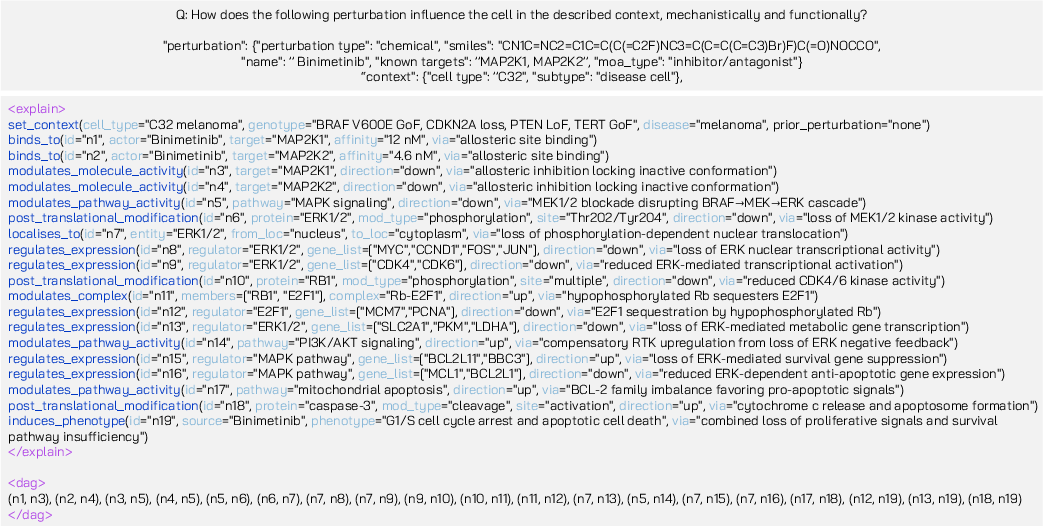
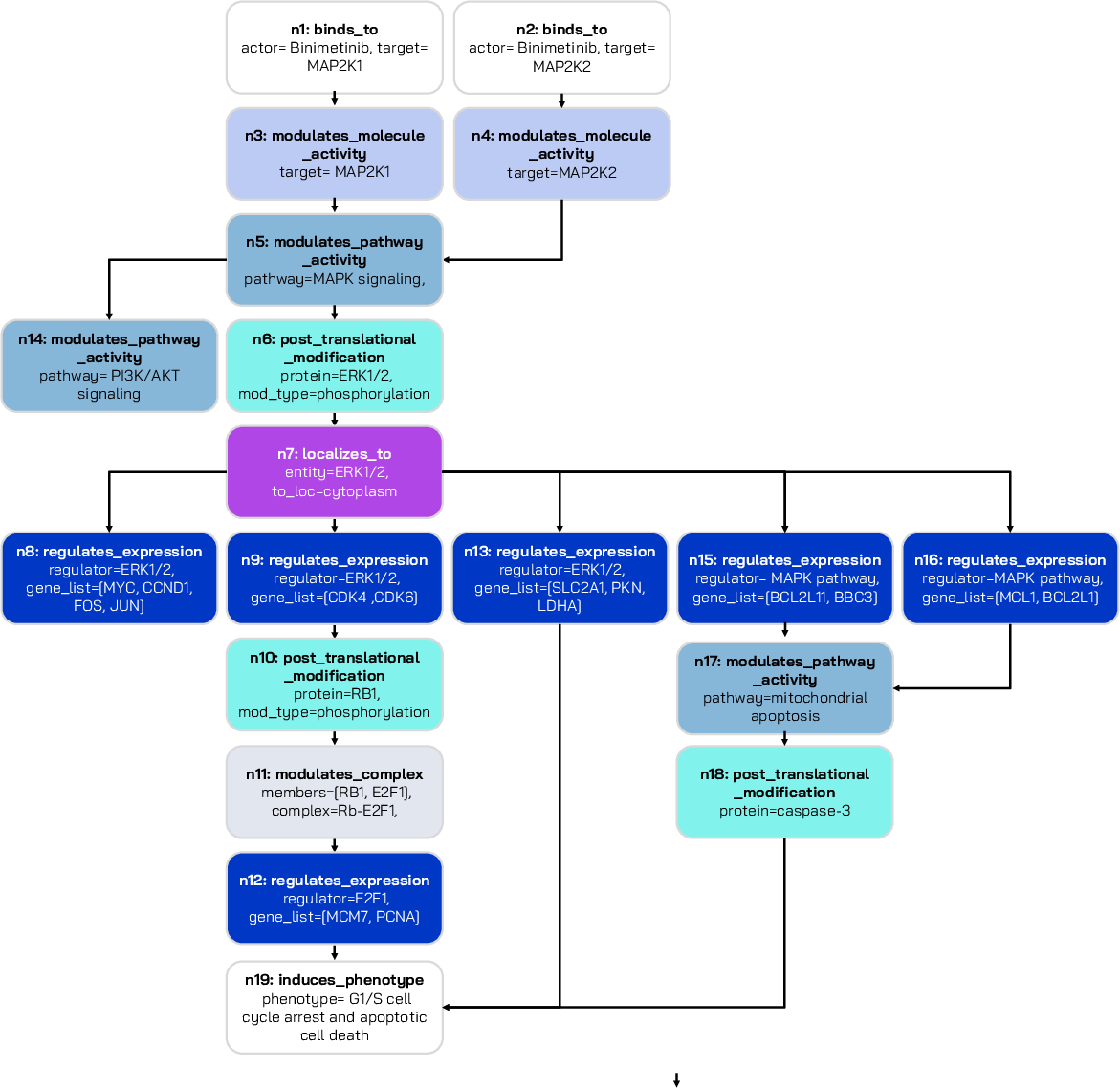
The authors turn free-form explanations into a kind of flowchart, called a directed acyclic graph (DAG). Think of it like a recipe or a domino chain: each step (action) leads logically to the next, with arrows showing the direction of cause and effect. Each action uses a small set of “allowed moves” (like verbs), for example:
- “binds_to” (a drug sticks to a protein)
- “regulates_expression” (a gene is turned up or down)
- “modulates_pathway_activity” (a signal in the cell gets stronger or weaker)
By limiting the “verbs” and requiring specific “who/what” details (which drug, which gene, which direction), the explanations become much easier to check.
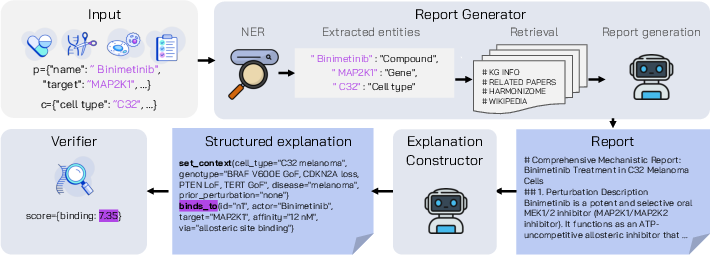
They build a team-like AI system, VCR-Agent, with three jobs:
- Reporter: Finds facts from trusted sources (scientific databases and papers) about the drug, the cell type, and relevant genes, then writes a short report.
- Builder: Turns the report into a structured, step-by-step action map (the flowchart of what happens inside the cell).
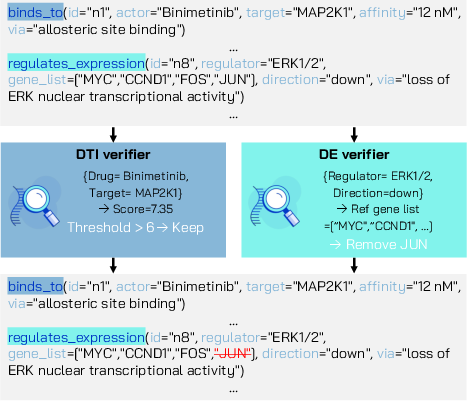
- Checker (Verifier): Acts like a fact-checker that tests key steps. For example:
- Does this drug likely bind that protein? (checked with a protein–drug binding model)
- Do the genes really go up or down as claimed? (checked against a giant real-world dataset of cell responses)
If parts fail the checks, they get removed or fixed. This creates a cleaner set of explanations called VC-Traces.
Finally, they use a huge dataset (Tahoe-100M), which is like a giant library showing how many different drugs affect cells, to both build and test their system.
What they found (main results and why they matter)
- Their structured format makes explanations more “checkable.” Instead of fuzzy sentences, each step has a precise action and specific players (like a drug and a gene), so it can be verified.
- VCR-Agent produced higher-quality, more accurate explanations than several strong AI baselines. The fact-checking stage removed many wrong claims (for example, many incorrect drug–target links) and cleaned up mistaken gene-up/down claims.
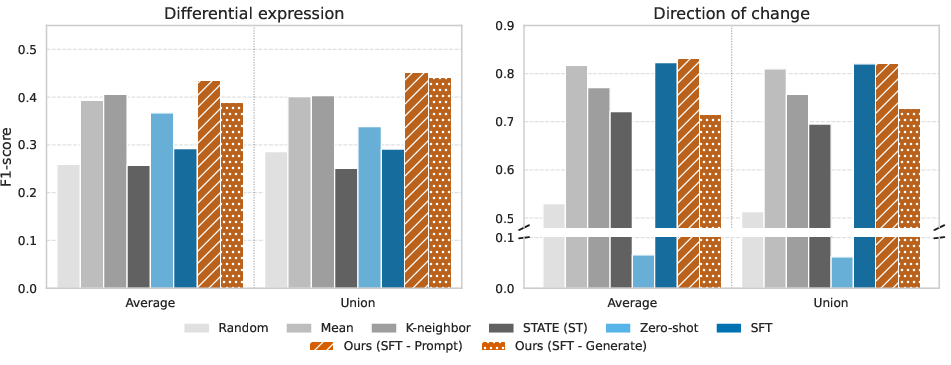
- Training AI models with these verified, step-by-step explanations helped the models do better at a real task: predicting which genes will change, and in what direction (up or down), when a drug is added. In their tests (a benchmark they call TahoeQA), models that used structured explanations outperformed those that didn’t.
- They released VC-Traces (their collection of checked explanations) so other researchers can use it.
Why it matters: Biology is full of complex chains of events. If AI can explain those chains clearly and honestly — and those explanations can be checked — scientists can trust the predictions more and use them to design better experiments or find promising drug targets faster.
What this could change in the future (implications)
- More trustworthy AI in biology: By forcing explanations into clear, testable steps and adding automatic fact-checking, this approach reduces “AI hallucinations” (made-up facts).
- Faster discovery: Clear “action maps” help scientists see how a drug might work in a specific cell type, suggest testable ideas, and avoid dead ends.
- Better generalization: Models trained to reason mechanistically (not just memorize) can handle new drugs and new situations more reliably.
- A growing toolbox: Today’s verifiers check things like drug–protein binding and gene changes. Over time, more verifiers (for other cell behaviors) can be added to cover even more biology.
In short, this paper shows a practical way to make AI explanations in biology more like a reliable blueprint: structured, checkable, and useful for real scientific work.
Knowledge Gaps
Unresolved Knowledge Gaps, Limitations, and Open Questions
Below is a concise list of specific gaps and open problems that remain unaddressed and could guide follow-up research.
- Action space coverage: The 20 primitives omit key biological mechanisms (e.g., epigenetic regulation, RNA splicing/editing, miRNA-mediated repression, protein post-translational modifications beyond generic “proteostasis,” chromatin remodeling). Specify additional primitives and schemas and assess coverage against pathway ontologies (Reactome/GO/KEGG).
- Cycles and dynamics: The DAG constraint excludes feedback loops and oscillatory/dynamic behavior common in signaling. Investigate representations that support cycles and temporal dependencies (e.g., dynamic Bayesian networks, time-indexed actions, state-update operators).
- Temporal and dose effects: Explanations ignore microenvironment, dose, exposure duration, and time-resolved responses. Extend arguments to include dose/time and add verifiers using time-course transcriptomics/phospho-proteomics.
- Context specificity: Verification does not condition on cell-type-specific expression, allele status, or pathway rewiring. Add context-aware constraints (e.g., require co-expression of actor/target, mutation-aware rule checks, subcellular co-localization gating) and evaluate impact.
- Global mechanistic consistency: Current checks are per-action; no end-to-end validation that signs and dependencies are coherent across the graph. Develop graph-level verifiers enforcing monotonicity/sign consistency, stoichiometric constraints, and pathway compatibility.
- Limited verifier coverage: Only DTI and DE are used for filtering. Build and benchmark additional verifiers (e.g., phosphorylation/PTM, pathway activation, gene regulatory interactions/TF binding, metabolic flux feasibility, protein complex formation) with clear precision–recall trade-offs.
- Verifier calibration and sensitivity: Threshold selection for DTI and DE (e.g., ) lacks calibration/sensitivity analysis. Quantify robustness to threshold choice, model calibration (e.g., reliability diagrams), and false-negative impacts on trace recall.
- Reliance on in silico DTI (Boltz-2): Binding plausibility depends on a predictive model; generalization to novel chemotypes/targets is uncertain. Validate against experimental binding assays and benchmark across chemotype/target novelty bins.
- Evidence strength and provenance: Explanations lack explicit evidence grading (e.g., curated database vs. single paper) and provenance tracking per node/edge. Incorporate evidence levels, citations, and confidence propagation into a trace-level trust score.
- Conflict resolution: The pipeline does not specify how it handles contradictory sources (literature vs. knowledge graph vs. assay data). Develop conflict detection, adjudication strategies, and uncertainty quantification for disputed claims.
- Retrieval fidelity and disambiguation: No quantitative evaluation of NER/EL accuracy, synonym handling, species disambiguation, or cell-line mapping. Measure and improve entity linking errors and their downstream impact on explanations.
- Retrieval breadth: Limiting StarkPrimeKG to 1-hop neighbors risks missing mediating mechanisms. Study performance vs. hop-depth and implement relevance-guided multi-hop expansion with redundancy control.
- Cell-line and modality scope: Experiments focus on five cancer cell lines and small-molecule perturbations. Evaluate generalization to other tissues, primary cells, non-cancer contexts, and genetic/CRISPR perturbations.
- Multi-omics integration: Verification is transcriptome-centric; non-transcriptional mechanisms (proteomics, phospho-proteomics, metabolomics, chromatin) remain unverified. Integrate multi-omics to validate non-DE actions and phenotype links.
- Phenotype grounding: PHENO and LOC verifiers are mentioned but not used for filtering. Quantify their precision/recall and assess how adding them affects trace quality and TahoeQA.
- Graph quality metrics: Evaluation lacks structural metrics (e.g., path overlap with Reactome/KEGG, graph edit distance to curated mechanisms). Define gold(ish) references and graph-level metrics to assess multi-step plausibility.
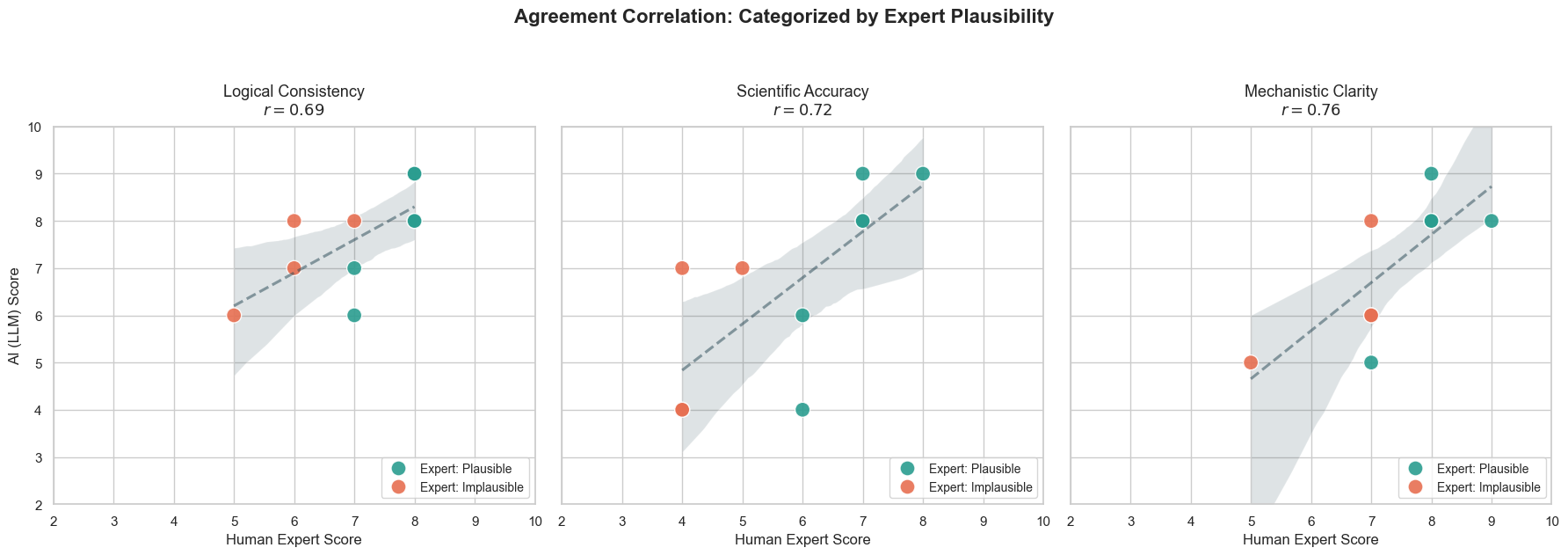
- Human expert evaluation: No blinded expert scoring of trace plausibility or utility. Conduct expert audits to assess correctness, novelty, and actionability, and to identify systematic failure modes.
- Downstream breadth: Only DE classification (yes/no, direction) is evaluated. Test effects on richer tasks (full expression profile prediction, pathway activation inference, mechanism-of-action classification, phenotype prediction).
- Error analysis: Missing granular analysis of common failure modes (e.g., wrong target selection, sign errors, off-target chains, context mismatches). Publish taxonomies and targeted fixes.
- Uncertainty propagation: Optional “confidence” fields are not operationalized. Formalize uncertainty aggregation from node-level verifiers to edge/graph-level trust and expose it to downstream models/users.
- RL for reasoning: RL is deferred; open questions remain about reward design using verifiers, avoiding reward hacking, and balancing exploration vs. factuality.
- Constrained decoding: Structural validity is checked post hoc. Explore grammar-constrained decoding or programmatic decoders to enforce schemas, acyclicity, and ontology compliance at generation time.
- Cost and scalability: No accounting of computational/monetary cost for multi-agent retrieval, LLM generation, and verification at scale. Provide cost/performance trade-offs and strategies for amortized or cached verification.
- Reproducibility with open models: The pipeline relies on Claude 4; it is unclear how performance translates to fully open-source stacks. Benchmark open alternatives and report degradation/improvement.
- Data leakage and independence: DE verification uses Tahoe-100M; although test leakage is claimed minimal, assess broader leakage risks (e.g., training explanations or prompts indirectly encoding labels) and define leakage-safe protocols.
- Combination perturbations: The framework targets single perturbations; real experiments often involve drug combinations. Extend action primitives and verifiers to capture synergy/antagonism and higher-order interactions.
- Counterfactual checks: No sanity tests using counterfactual contexts (e.g., swapping cell lines, knocking out the target) to verify trace specificity. Add counterfactual evaluations to quantify spurious generalization.
- Provenance-rich dataset release: VC-Traces lacks detailed, machine-readable provenance and verifier scores per node/edge in the public release (as implied). Release full metadata (sources, scores, thresholds, timestamps) to support reproducibility and meta-analyses.
Practical Applications
Overview
Based on the paper’s structured mechanistic action graphs, the VCR-Agent multi‑agent framework (retrieval + structured explanation + verifier filtering), and the released VC‑Traces dataset, the following are practical, real‑world applications spanning industry, academia, policy, and daily life. Each item notes sectors, prospective tools/workflows, and key assumptions/dependencies.
Immediate Applications
- Mechanism‑of‑Action (MoA) summarization and verification for compounds
- Sectors: healthcare/biotech/pharma, software tools
- What it is: “Mechanism-as-a-Service” that ingests a compound and cell context and outputs a verified mechanistic DAG (actions + dependencies) with DTI/DE scores. Useful for lead triage and portfolio review.
- Tools/workflows: API and UI for mechanistic DAGs, integration into cheminformatics platforms; internal dashboards showing verifier confidence per action.
- Assumptions/dependencies: Coverage and quality of StarkPrimeKG/Harmonizome/PubMed; accuracy of NER/entity linking; DTI verifier (Boltz‑2) is predictive (not experimental ground truth); focused on cancer lines and small molecules; not formal causal proof.
- High‑throughput screening annotation and triage
- Sectors: pharma/biotech (HTS, phenotypic screens)
- What it is: Auto‑attach structured explanations and predicted transcriptional responses (TahoeQA‑style DE directionality) to screening hits to prioritize follow‑ups and suggest pathway‑level hypotheses.
- Tools/workflows: Batch processing pipeline that ingests HTS hits and cell lines, returns DAGs + top DE genes with verifier scores; LIMS/ELN plugins.
- Assumptions/dependencies: Tahoe‑100M‑like contexts available or reasonably close; DE verifier requires matched context; thresholds for filtering calibrated per assay.
- Automated, literature‑grounded experiment briefs
- Sectors: academia, biotech R&D
- What it is: Report Generator produces consolidated, citation‑rich briefs; Explanation Constructor renders them into mechanistic DAGs, enabling transparent lab planning and hypothesis logging.
- Tools/workflows: “Experiment brief” generator integrated into ELNs; exports DAGs + references; versioning for preregistration of mechanistic claims.
- Assumptions/dependencies: Retrieval quality (PubMed/Wikipedia/knowledge graph); disambiguation in NER; institutional access to literature where needed.
- Drug–target interaction (DTI) triage and off‑target scouting
- Sectors: medicinal chemistry, computational chemistry
- What it is: Pre‑screen proposed targets/off‑targets with Boltz‑2‑backed DTI verification, linked into structured graphs to contextualize pathway impact.
- Tools/workflows: Medicinal chemistry triage dashboards; SAR iteration aided by per‑target binding confidence; alerts for low‑confidence edges.
- Assumptions/dependencies: Boltz‑2 generalization to target classes and chemotypes in scope; calibration of confidence thresholds.
- Biomarker nomination from mechanistic traces
- Sectors: translational medicine, diagnostics
- What it is: Use verified regulates_expression actions to surface candidate pharmacodynamic biomarkers and pathway nodes for assays (qPCR, proteomics).
- Tools/workflows: Biomarker panel builder that extracts and ranks gene candidates with supporting edges and evidence.
- Assumptions/dependencies: DE verifier relies on context‑appropriate data; transcript changes may not reflect protein/phenotype without additional verifiers.
- Training data generation for biology‑aware LLMs
- Sectors: AI/ML in life sciences, software
- What it is: Use VC‑Traces as high‑quality supervision for SFT of reasoning‑capable LLMs on biological tasks (e.g., TahoeQA‑like DE prediction).
- Tools/workflows: Data pipelines for continual SFT; evaluation harnesses with verifier scores; internal benchmarks.
- Assumptions/dependencies: Licensing/availability of VC‑Traces; backbone model choice; compute and cost constraints.
- Quality‑controlled knowledge management
- Sectors: pharma informatics, enterprise knowledge systems
- What it is: Ingest structured mechanistic claims into internal knowledge graphs with per‑edge verification metadata, enabling audit and de‑duplication.
- Tools/workflows: ETL from VCR‑Agent outputs into corporate KGs; SPARQL/graph queries by pathway or target with confidence filters.
- Assumptions/dependencies: Ontology harmonization; entity ID mapping across systems; governance for updates.
- Education and communication of pathway mechanisms
- Sectors: education, public health communication
- What it is: Translate complex drug/pathway behavior into interactive DAGs for teaching and patient‑facing explainers (with verification badges).
- Tools/workflows: Web viewers for action graphs; classroom modules that map perturbations to outcomes with sources.
- Assumptions/dependencies: Need simplified ontology for non‑experts; frequent updates to stay current.
- Investment and diligence support for MoA risk assessment
- Sectors: finance (biotech VC/public markets)
- What it is: Independent, structured view of MoA plausibility and evidence density per program, highlighting weak links and missing evidence.
- Tools/workflows: Diligence dashboards showing edge‑level verification, alternative pathways, and contradicted claims.
- Assumptions/dependencies: Not a substitute for experimental validation; coverage gaps can bias risk scores.
Long‑Term Applications
- Patient‑specific virtual cells and precision medicine decision support
- Sectors: healthcare (clinical), digital twins
- What it is: Condition structured reasoning on patient‑derived omics to predict drug responses and explain them mechanistically for tumor boards.
- Tools/workflows: Clinical CDSS integrating action graphs with EHR/omics; reportable mechanistic rationales for therapy selection.
- Assumptions/dependencies: Regulatory approval; privacy/consent; verifiers expanded beyond DTI/DE (e.g., phospho‑signaling, proteomics); generalization beyond cancer cell lines.
- Closed‑loop autonomous discovery with robotics
- Sectors: lab automation/robotics, biotech R&D
- What it is: Use uncertain or low‑confidence edges to prioritize experiments; robots validate predicted edges, feeding results back to update verifiers and data.
- Tools/workflows: Active‑learning scheduler that turns DAG uncertainty into experimental queues; integration with automated wet labs and LIMS.
- Assumptions/dependencies: Standardized protocols for rapid validation; APIs between VCR‑Agent and automation; robust RL/active‑learning policies.
- Regulatory‑grade standards for AI‑generated mechanistic evidence
- Sectors: policy/regulatory (FDA/EMA), pharma
- What it is: Define formats and minimum verification criteria for AI‑assisted MoA narratives in pre‑IND/IND submissions and safety assessments.
- Tools/workflows: Schema and ontology standards for action graphs; audit trails, verifier calibration reports.
- Assumptions/dependencies: Consensus on standards; clarity on how “mechanistic plausibility” complements causal evidence; validation studies.
- Multi‑omics, phenotype, and causal expansion of verifiers
- Sectors: systems biology, tool vendors
- What it is: Add verifiers for pathway activity, phospho‑sites, proteostasis, metabolomics, localization, phenotype readouts, and quasi‑causal criteria.
- Tools/workflows: Plugin architecture for verifiers; data adapters for proteomics/metabolomics/CRISPR screens; causal scoring modules.
- Assumptions/dependencies: Availability of robust public or proprietary datasets; standardized evidence grading; computational costs.
- Generative design guided by mechanistic objectives
- Sectors: drug discovery, AI for chemistry
- What it is: Couple small‑molecule generators with verifier‑scored mechanistic targets to design compounds that not only bind but drive desired downstream DAGs.
- Tools/workflows: Multi‑objective optimization combining Boltz‑2 affinity with pathway‑level goals; in silico triage that penalizes off‑target chains.
- Assumptions/dependencies: Calibrated link between binding, signaling, and phenotype; feedback from assays to close the loop.
- Safety and off‑target/adverse event prediction
- Sectors: pharmacovigilance, tox
- What it is: Predict mechanistic routes leading to adverse phenotypes (e.g., cardiotoxicity) and surface counter‑measures or alternative chemotypes.
- Tools/workflows: Risk dashboards that trace from off‑target bindings to phenotype verifiers; alerting in development and post‑marketing.
- Assumptions/dependencies: Phenotype verifiers with clinical relevance; mapping from cellular to organismal phenotypes; false positive/negative management.
- Self‑updating knowledge bases and continual learning
- Sectors: software, research infrastructure
- What it is: Use verified traces to propose KG updates; human‑in‑the‑loop curation; continual SFT of models on newly verified edges.
- Tools/workflows: Curation queues prioritized by verifier confidence and novelty; CI/CD for knowledge graphs and models.
- Assumptions/dependencies: Curator bandwidth; provenance tracking; conflict resolution and retraction mechanisms.
- Extension beyond oncology and small molecules
- Sectors: immunology, microbiome, gene therapy, agriculture
- What it is: New action primitives and verifiers for biologics, cell therapies, microbial communities, and plant systems.
- Tools/workflows: Domain‑specific ontologies and datasets; verifiers for cytokine signaling, antigen presentation, microbial metabolites, etc.
- Assumptions/dependencies: Data sparsity in some domains; need for community standards.
- Public‑facing, trustworthy drug information portals
- Sectors: public health, education
- What it is: Consumer‑oriented explainers that distill verified MoA DAGs into accessible narratives with clear confidence labels and sources.
- Tools/workflows: Web and mobile apps with interactive graphs; plain‑language layers over structured actions.
- Assumptions/dependencies: Careful UX and risk communication; regular content updates; oversight to prevent misuse.
Cross‑cutting assumptions and risks to feasibility
- The framework emphasizes mechanistic plausibility, not formal causality; experimental validation remains essential.
- Reliance on external knowledge bases introduces bias and coverage gaps; conclusions may shift as databases update.
- Current verifier set (DTI, DE, limited LOC/PHENO) constrains what can be filtered; broader biology needs more verifiers.
- Context matters: most evidence and evaluations center on cancer cell lines; transfer to primary tissues and in vivo settings is non‑trivial.
- LLM variability, cost, and closed‑source dependencies (e.g., Claude 4) can affect reproducibility and scalability; open alternatives may require additional tuning.
Glossary
- Action primitive: A predefined, biologically grounded operation type used to build mechanistic steps in the reasoning graph. "We define twenty action primitives grouped into seven categories"
- Binds_to: An action primitive denoting a direct molecular binding interaction between two entities (e.g., drug and protein). "consider an example action binds_to."
- Biomedical name entity recognition (NER): Domain-specific entity extraction that identifies biomedical concepts like genes and chemicals in text. "entity extraction with biomedical name entity recognition (NER)"
- Boltz-2: A structural biology foundation model used to predict the plausibility of protein–ligand binding. "It leverages Boltz-2 to model the protein-ligand interaction"
- DESeq2: A software package for differential expression analysis using statistical models for count data. "as implemented in DESeq2"
- Differential expression (DE): Changes in gene expression levels under a perturbation, often analyzed to find up- or down-regulated genes. "perform differential expression (DE) analysis"
- Directed acyclic graph (DAG): A graph with directed edges and no cycles; here, it encodes the causal/mechanistic flow of biological actions. "we formalize structured reasoning as the task of inferring a directed acyclic graph (DAG) of mechanistic interactions"
- Drug–target interaction (DTI): A molecular interaction where a drug binds to or affects a specific biological target (typically a protein). "a DTI verifier for the binds_to action"
- Extended-connectivity fingerprints (ECFP): Circular molecular fingerprints used to measure chemical similarity for tasks like nearest-neighbor retrieval. "computed using extended-connectivity fingerprints (ECFP)"
- Harmonizome: A gene-centric database aggregating information about gene functions and associations. "Harmonizome, a gene-related database"
- HunFlair2: A biomedical NER tool used to extract entities like chemicals and genes from text. "We employ HunFlair2"
- Interventional causal discovery: A formal approach to determining causal relationships by considering interventions; distinguished here from the paper’s mechanistic reasoning. "while remaining distinct from formal, interventional causal discovery."
- Ligand–receptor binding: A specific molecular interaction where a signaling molecule (ligand) binds its receptor to initiate downstream effects. "a ligandâreceptor binding (binds_to)"
- Mechanistic action graph: A structured representation of biological reasoning where nodes are mechanistic actions and edges encode dependencies. "represents biological reasoning as mechanistic action graphs"
- Negative binomial-based general linear model: A statistical model suited for overdispersed count data, used here for expression analysis. "by fitting a negative binomial-based general linear model to the pseudo-bulked counts"
- Ontology (biological ontology): A standardized vocabulary and schema for biological entities and relations used to structure arguments. "mapped to biological ontologies"
- Phenotype (PHENO): Observable cellular or organismal traits or behaviors; used here as a verifier category for explanations. "phenotype (PHENO) verifiers"
- Proteostasis: The cellular processes that maintain protein homeostasis, included as a category for action primitives. "and (7) proteostasis."
- Pseudo-bulked counts: Aggregated single-cell expression counts treated as bulk data to stabilize statistical analyses. "by fitting a negative binomial-based general linear model to the pseudo-bulked counts"
- PubMedBERT: A biomedical LLM used here to compute semantic similarity for entity matching. "the cosine similarity of PubMedBERT embeddings"
- Regulates_expression: An action primitive indicating that a perturbation up- or down-regulates the expression of a target gene. "a DE verifier for the regulates_expression action"
- StarkPrimeKG: A biomedical knowledge graph used for retrieval of entity relations and context. "StarkPrimeKG, a biomedical knowledge graph"
- STATE Transition (ST) model: A transcriptomic foundation model that learns state transitions in gene expression following perturbations. "include the STATE Transition (ST) model"
- Subcellular localization (LOC): The cellular compartment where a molecule resides; used as a verifier category. "subcellular localization (LOC)"
- Tahoe-100M: A large-scale single-cell perturbation atlas used as a source of ground-truth and training data. "Tahoe-100M atlas"
- TahoeQA: A downstream evaluation task for predicting gene expression responses to chemical perturbations. "evaluate the utility of our VC-Traces dataset on TahoeQA"
- Verifier-based filtering: A quality-control pipeline that validates and filters generated explanations using specialized verifiers. "a verifier-based filtering and quality control pipeline"
- Virtual cells: Computational models that simulate cellular behavior and responses to perturbations. "The development of virtual cells, computational models that simulate cellular behavior,"
- Wald's test: A statistical hypothesis test used here to assess whether gene expression changes (log fold change) are significantly different from zero. "and running a Wald's test"
Collections
Sign up for free to add this paper to one or more collections.