- The paper demonstrates that UDG microlensing can reveal individual extragalactic stars and constrain the initial mass function through high-magnification events.
- It employs calculations of Einstein radii and maximum magnifications to assess detectability using JWST and LSST, linking observable magnitudes with stellar physics.
- The study highlights that event durations and spatial variations in UDG stellar density offer practical insights into stellar multiplicity and dark object populations.
Introduction
This work investigates the feasibility and astrophysical utility of stellar microlensing in modest redshift galaxies viewed through Ultra Diffuse Galaxies (UDGs), focusing on the candidate NGC1052-DF2. UDGs are characterized by extremely low surface brightness (≳24 mag arcsec−2) and Milky Way-like size but with masses comparable to dwarf galaxies [Van_Dokkum_2015]. Disparate from typical galaxy lenses, some UDGs may lack significant dark matter [van_Dokkum_2018], providing a unique regime for microlensing studies where the foreground lens does not obscure background sources nor create significant macrolensing effects.
In the presented analysis, the authors examine the theoretical detectability of microlensing events through UDGs, critical magnification metrics, relevant observational timescales, and the expected event rates leveraging multiwavelength survey capabilities such as JWST and LSST. The practical implications include independent probing of the initial mass function (IMF) and stellar multiplicity in UDGs, with direct consequences for our understanding of UDG formation channels and stellar population characteristics.
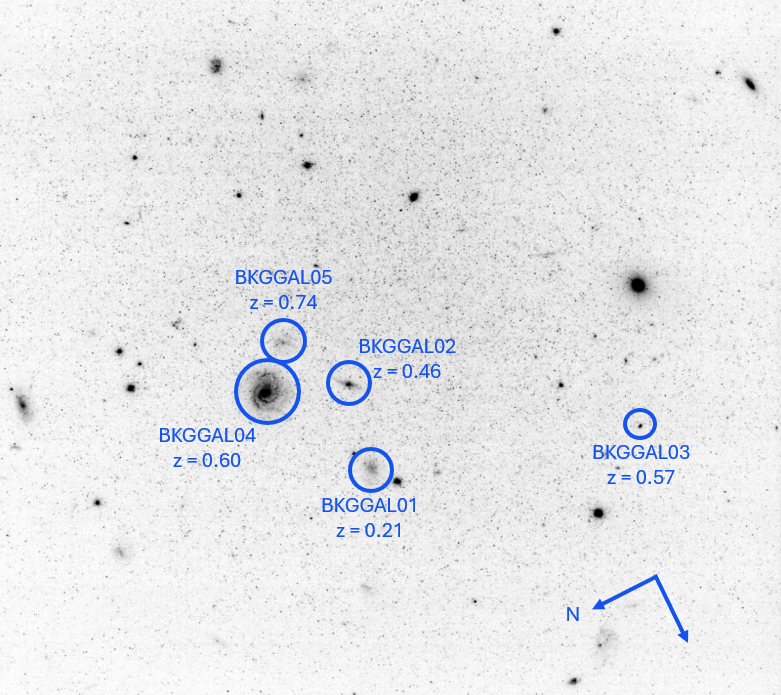
Figure 1: Negative JWST F090W image of NGC1052-DF2, identifying five spectroscopically confirmed background galaxies for microlensing event rate analysis.
Maximum Magnification and Lensing Geometry
The authors provide a rigorous calculation of the Einstein radius (RE) for point-like microlenses in UDGs and derive maximum achievable magnification (μmax) for background stars, parameterized by source radius and lens mass. For NGC1052-DF2, the surface stellar mass density is approximately 5M⊙pc−2. The mean stellar mass adopted is 0.3M⊙, consistent with a Kroupa IMF [Kroupa_2003].
For perfect geometric alignment, a 1R⊙ background star can reach magnifications up to 105 with a 1M⊙ microlens, a regime well outside typical Galactic microlensing events. However, actual detectability is constrained by the intrinsic brightness-radius relation governed by stellar physics.
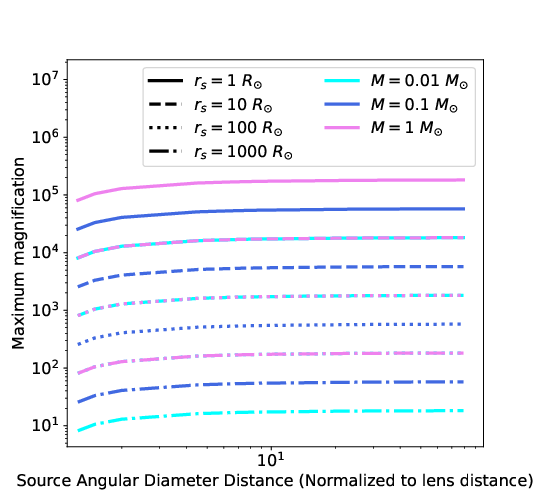
Figure 2: Theoretical maximum magnification as a function of source distance, source radius, and microlens mass.
To translate magnification into observability, MESA Isochrone and Stellar Tracks (MIST) isochrones are used to evaluate the brightest possible stars for each stellar radius. Under ideal conditions, UDG microlensing makes background stars detectable up to apparent magnitudes ∼18 for nearby sources, and up to −20 mag for distant sources via JWST, with LSST limited to −21 mag.
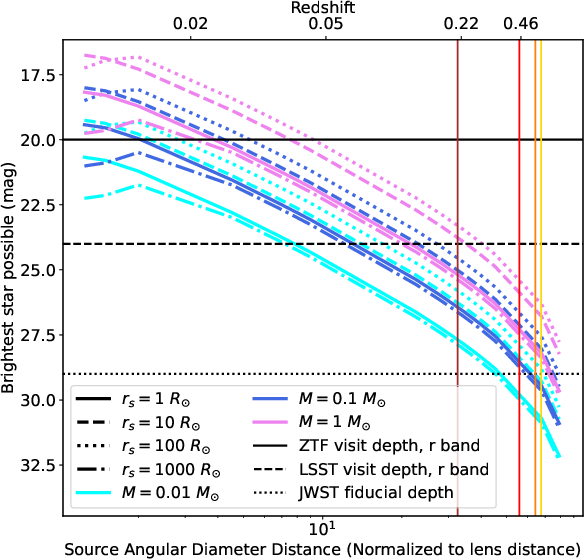
Figure 3: Observable apparent magnitudes for maximally magnified stars as a function of lens-source geometry, cross-referencing LSST and JWST detection thresholds.
Temporal Characteristics of UDG Microlensing Events
Event detectability is limited to periods when background stars attain sufficient magnification to be above survey thresholds. The duration of these microlensing peaks (−22) is primarily determined by the Einstein radius, detectable magnification, and transverse velocity—dominated by Hubble flow peculiar velocities (−23 km/s for NGC1052-DF2). For fiducial parameters, the duration is −24 days for a −25 lens and −26 source, amenable to LSST's three-day cadence and JWST follow-up.
Event Rate Estimation
The classic microlensing optical depth formalism [Paczynski_1986] is adapted for the thin-lens regime of UDGs. The predicted event rate per year is calculated by integrating the stellar luminosity function of the background galaxy over the attainable magnification probability density (−27), constrained by the minimum detectable magnification and source properties.
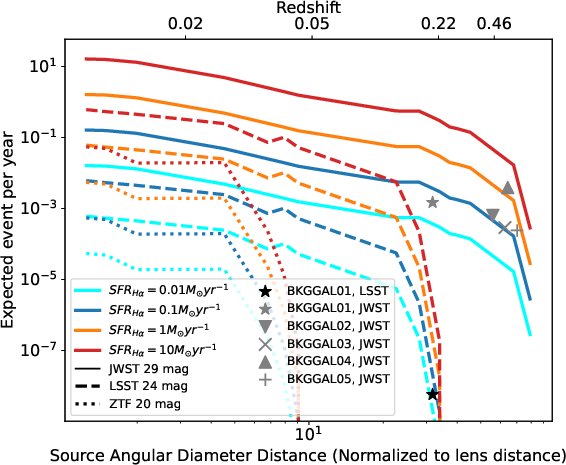
Figure 4: Expected UDG microlensing event rate per year for different background galaxy SFRs and survey depths (JWST, LSST, ZTF). Individual points indicate the five NGC1052-DF2 background galaxies.
When applied to NGC1052-DF2, the predicted LSST event rate is −28 yr−29, and JWST yields RE0 yrRE1 for the five background galaxies, highlighting the dependency on background SFR and redshift. Scaling to a full-sky census, an order-of-magnitude estimate suggests RE2 UDG microlensing events per year for LSST, contingent on background galaxy density and recent SFR.
Implications for Stellar Population Studies in UDGs
The coupling of microlensing event rate with RE3 provides a pathway to constrain the UDG IMF, with mass-to-light ratios sensitive to IMF variations (e.g., Salpeter vs. Kroupa). High-statistics microlensing can independently access field star IMF, complementing globular cluster-based measurements [Beasley_2025, Fahrion_2025].
Spatial event rate gradients probe radial variations in RE4, potentially revealing diffuse or dark matter-dominated outer regions. Outlying events could indicate compact dark object populations—a regime difficult to access via conventional imaging.
Light curve analysis is limited by infrequent detection and triggering challenges, especially for NGC1052-DF2 lacking low-RE5 background galaxies. Optimal configurations involve UDGs with low-redshift or high-SFR background galaxies, enabling pre-peak detection and more precise lens-extractable parameters.
Caustic Network Effects and Stellar Multiplicity
Although low optical depth justifies the isolated lens approximation, overlapping Einstein rings (caustic networks) and intrinsic stellar multiplicity can yield asymmetrical or complex microlensing light curves. Monte Carlo experiments show negligible probability for geometric caustic overlap in the considered parameter space, but a finite fraction of UDG stars are expected to be in binaries (RE6\%, [Raghavan_2010, Winters_2019]), increasing caustic crossing event fraction accessible via high-cadence monitoring. This directly informs stellar binary statistics in low-density UDG environments, providing constraints on star formation theory [Duchene_2013].
Conclusions
This technical analysis demonstrates that UDG microlensing is a viable method for detecting individual extragalactic stars and probing UDG stellar populations. JWST and LSST provide complementary survey depth and cadence, with event rates sensitive to UDG background geometry and SFR. While NGC1052-DF2 is not optimized for microlensing searches, ongoing and future surveys (Euclid, ARRAKIHS, Roman) will construct broader UDG samples suitable for systematic study. UDG microlensing enables independent IMF determination, compact dark object abundance sensing, and direct measurement of stellar multiplicity in UDGs. Anticipated advances in event statistics and light curve characterization will refine these probes and augment theoretical models of UDG formation and evolution.
References
For full citation details, refer to (2604.11368).