- The paper introduces the social-gradient flow, a hypergradient-free approach that aligns agent Nash equilibria with the social optimum using only observable gradients.
- It presents a two-timescale update mechanism that robustly manages incentive design despite agent adaptation delays and information asymmetry.
- Empirical results in aggregative and coupled oscillator games validate the method’s convergence and practical effectiveness.
Incentive Design without Hypergradients: The Social-Gradient Method
Overview
The paper "Incentive Design without Hypergradients: A Social-Gradient Method" (2604.11346) proposes a principled framework for incentive design in hierarchical games with information asymmetry, specifically eliminating dependence on the computation or estimation of Nash equilibrium (NE) sensitivities (hypergradients). The authors introduce the social-gradient flow—a hypergradient-free incentive update law that leverages only the observable gradient of the social objective with respect to agent actions, not requiring any agent cost or sensitivity information. They establish theoretical guarantees for global convergence of this law, both in idealized equilibrium-response settings and in realistic two-timescale agent adaptation scenarios, and support their claims with quantitative experiments.
The core scenario involves a system planner seeking to implement an incentive mechanism that induces a population of non-cooperative agents—each minimizing their private, unknown cost—towards a Nash equilibrium that is also socially optimal with respect to a known convex objective Φ(x). Typically, this is posed as a Mathematical Program with Equilibrium Constraints (MPEC):
pmin Φ(x∗(p)),where x∗(p) is the NE for incentive p.
Standard approaches optimize this bilevel program via hypergradient descent, i.e., adjusting incentives according to the total derivative of Φ with respect to p, which in turn depends on the Jacobian/sensitivity of equilibrium with respect to the incentive. However, in practical scenarios, the planner lacks access to agent cost gradients or equilibrium sensitivities due to information asymmetry.
Social-Gradient Flow: A Hypergradient-Free Method
Key Insight
The central insight is that, under standard regularity and monotonicity conditions, the plain gradient of the social cost with respect to the NE response, ∇Φ(x∗(p)), is always a valid descent direction for the overall objective Φ(x∗(p)) with respect to the incentive parameter p, independently of the underlying agent cost structure or the sensitivity Dx∗(p).
Flow Definition
The social-gradient flow is defined as
p˙(t)=∇Φ(x∗(p(t)))
where x∗(p(t)) is the NE reached by the agents under incentive pmin Φ(x∗(p)),where x∗(p) is the NE for incentive p.0. The main technical contribution is showing that this flow drives the incentive pmin Φ(x∗(p)),where x∗(p) is the NE for incentive p.1 towards the unique pmin Φ(x∗(p)),where x∗(p) is the NE for incentive p.2 that aligns the agent NE response with the social optimizer pmin Φ(x∗(p)),where x∗(p) is the NE for incentive p.3 for pmin Φ(x∗(p)),where x∗(p) is the NE for incentive p.4, from almost any feasible initialization.
Figure 1.
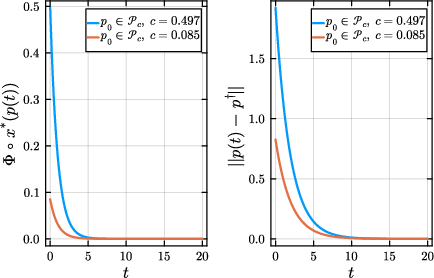
Figure 1: Trajectories of the social cost and incentive error under the social-gradient flow, showcasing convergence to the optimal incentive pmin Φ(x∗(p)),where x∗(p) is the NE for incentive p.5 for different sublevel set initializations.
Theoretical Properties
Global Convergence in Full-Observation Models
Under the assumption that the induced equilibrium pmin Φ(x∗(p)),where x∗(p) is the NE for incentive p.6 can be directly observed, and the objective pmin Φ(x∗(p)),where x∗(p) is the NE for incentive p.7 is strongly convex with a unique minimum in the interior of the agent action set, the analysis leverages the monotonicity and differentiability of the NE correspondence.
A Lyapunov function argument using pmin Φ(x∗(p)),where x∗(p) is the NE for incentive p.8 demonstrates that all sublevel sets of pmin Φ(x∗(p)),where x∗(p) is the NE for incentive p.9 within a well-defined, bounded region are forward invariant, and the flow asymptotically converges to Φ0, the incentive inducing the social optimum. The result holds globally in the relevant interior domain.
Two-Timescale Incentive Learning with Agent Adaptation
Setting
In realistic systems, agents do not immediately compute NE in reaction to updated incentives; instead, their strategies adapt via a learning rule that tracks the NE over time. The planner thus observes possibly non-equilibrium joint actions evolving according to an unknown but convergent agent update process.
Two-Timescale Dynamics
The authors propose a timescale-separated adaptation:
Φ1
where Φ2 is the agent learning rule, and Φ3 ensures that agent adaptation is much faster than incentive updates. The planner applies the social gradient evaluated at the current (possibly suboptimal) joint actions.
Figure 2.
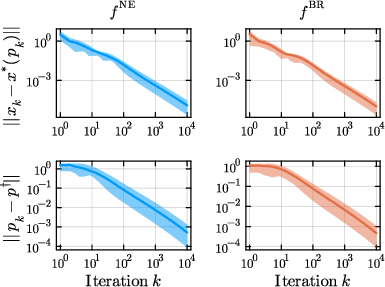
Figure 2: Median and min–max envelopes of agent tracking and incentive error under two-timescale iteration, demonstrating eventual convergence even under adaptation delay.
Main Result
The sequence Φ4 generated by this procedure converges to Φ5 from any initialization within a large invariant set, provided the agent adaptation rule is globally stable (asymptotically tracks NE for fixed incentive). This is proved using tools from stochastic approximation and Lyapunov theory, extending convergence guarantees to nonconvex (but forward-invariant) sublevel domains.
Figure 3.
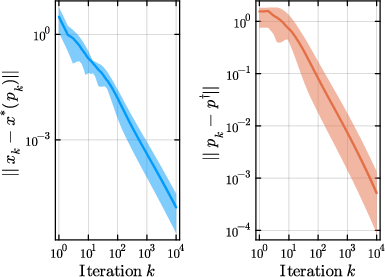
Figure 3: Two-timescale discretization and incentive error for adaptive agents; the error decays to zero as both timescales advance, validating theoretical guarantees.
Figure 4.
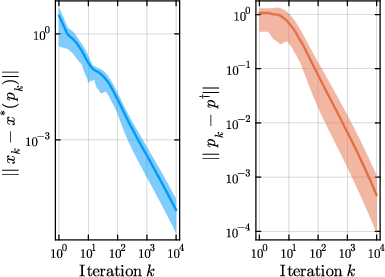
Figure 4: Performance envelope under alternative agent dynamics, confirming robustness to the choice of agent learning rule.
Empirical Validation
Illustrative numerical experiments are provided for:
- Aggregative games with linear and nonlinear cost structures over interaction networks.
- Coupled oscillator games with nonlinear coupling, where equilibrium computation is nontrivial and best-response adaptation is used.
In all cases, the social-gradient law achieves convergence to the social optimum, with both equilibrium error and incentive error decaying, and the results show alignment between theory and practice. The effect of different agent learning rules and timescale separation parameters is also analyzed.
Figure 5.
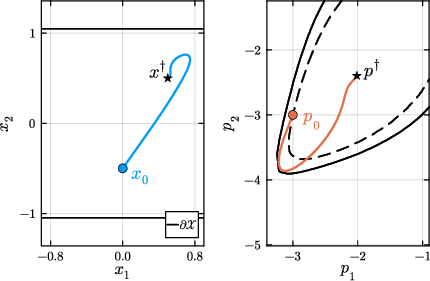
Figure 5: Trajectories of both agent actions and planner incentives in strategy and parameter space over time, highlighting convergence geometry.
Figure 6.
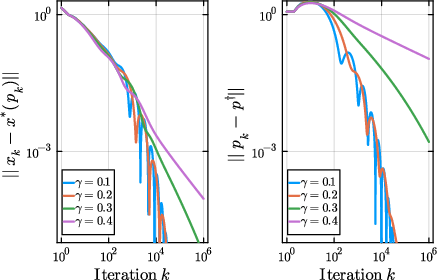
Figure 6: Evolution of equilibrium tracking and incentive error for different timescale separation rates, illustrating trade-offs in practical algorithm tuning.
Implications and Future Directions
Practical Impact
The social-gradient flow obviates the need for hypergradient computation or estimation, drastically reducing information requirements for the planner. This is particularly consequential in large-scale multi-agent systems (e.g., energy, traffic, or data markets) where agent utility functions cannot be directly elicited. The framework is robust to general (possibly nonlinear) agent adaptation rules and operates with only minimal feedback—the current joint action profiles and the social cost gradient.
Theoretical Significance
This work exposes a structural property of incentive design problems where, under monotonicity and convexity, the social objective gradient itself fundamentally encodes a descent direction in the space of incentive parameters, regardless of the unobservable complexities of the agents' best-response landscape. The global stability guarantees are nontrivial due to nonconvex feasible sets and the two-timescale adaptation interplay.
Open Problems
The framework as presented assumes knowledge of the forward-invariant sublevel set Φ6 for safe updates. One extension would be to develop adaptive procedures that do not require ex ante knowledge of feasible incentive sets, or that can learn them incrementally. Further, extending analysis to general games with multiple/plural equilibria, or strategic agents with non-convergent/no-regret learning, remains an open direction.
Conclusion
The social-gradient method provides a robust, hypergradient-free approach for incentive design under information asymmetry. By leveraging only the observable social cost gradient and not requiring equilibrium sensitivity information, the method guarantees global convergence to the socially optimal incentive, both in idealized and adaptive agent models. The theoretical contributions are validated by numerical analysis, highlighting the method's promise for practical incentive engineering in complex multi-agent systems.

