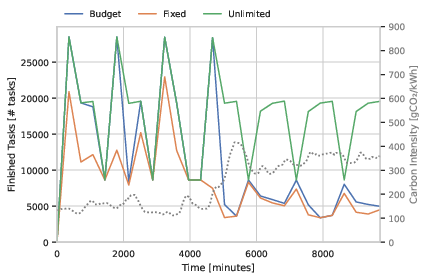
- The paper introduces emissions budgets as a dynamic alternative to fixed-rate constraints, achieving up to 36% higher task completion in volatile grid conditions.
- The study employs a MAPE-K control loop to allocate cumulative emissions, allowing quota saving during low-intensity periods for later use.
- Empirical results show that budget-based adaptation offers predictable hard limits and significant cost reductions even in highly variable carbon intensity grids.
Emissions Budgets for Application-Level Carbon Constraint: A Technical Analysis of Adaptive Resource Management
Introduction and Motivation
Rising carbon pricing and regulatory frameworks such as the EU Emissions Trading System (EU ETS) necessitate that application operators architect solutions capable of predictable, hard-constrained emissions compliance. Existing software adaptation approaches predominantly enforce rigid per-interval emission rate caps, which prove suboptimal in electrical grids characterized by high carbon intensity variability—an outcome of increasing renewable penetration. The examined paper introduces a paradigm shift by advocating the use of emissions budgets as opposed to fixed emission rates. Budgets provide cumulative, time-scoped emissions allowances, facilitating dynamic emissions allocation in alignment with grid conditions, thereby maximizing utility under hard constraints (2604.11341).
Architecture: Emissions-Aware Self-Adaptation with MAPE-K and Budgets
A MAPE-K (Monitor, Analyze, Plan, Execute, Knowledge) control loop structures emissions-aware self-adaptive applications, embedding the emissions budget B as a first-class adaptation constraint across a planning horizon T. In this architecture, monitoring captures real-time application energy consumption and grid carbon intensity. The analysis phase assesses the instantaneous budget state (bt), evaluates migration targets (Mt) for potential emissions savings, and quantifies resource utilization (rt). Planning invokes policies π that orchestrate adaptation actions (vertical scaling, migration, inaction) subject to the cumulative hard budget ∑0tet≤B. Execution realizes the adaptation, and all process knowledge is archived for continuous control improvement.
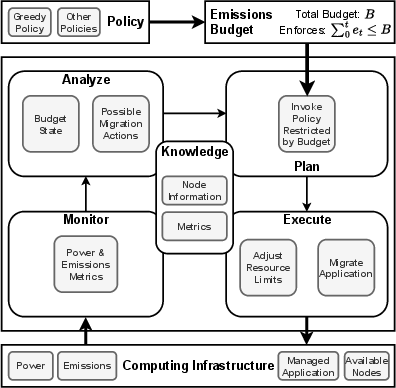
Figure 1: MAPE-K-based emissions-aware self-adaptation architecture using budgets as hard constraints.
Runtime deviation from the average allocation (B/T) is explicitly permitted. This feature enables the system to save unused emissions quotas during periods of low intensity (or usage) for subsequent deployment during spikes, providing temporal flexibility absent in fixed-rate designs.
Workload and Simulation Framework
Experimental validation employs a discrete-event simulation environment (SimPy-based, adapted from LEAF), modeling a heterogeneous cluster with static and dynamic power characteristics. The workload is defined by synthetic traces reflecting variable task intensities and deadlines, simulating diurnal demand with pronounced peaks and valleys.
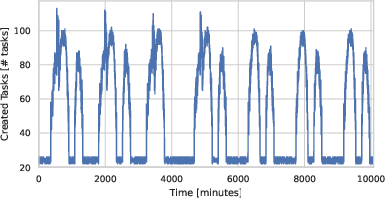
Figure 2: Synthetic workload trace with diurnal cycles used for empirical evaluation.
Three emission/cost policy baselines are considered:
- Unlimited: No emission constraint (performance upper bound).
- Fixed Rate: Strict per-second emissions rate.
- Greedy Budget: Cumulative budget equivalent in average rate, dynamically expending/saving allowance.
Empirical grid carbon intensity profiles are drawn from Germany (high-variability), France (stable, low-intensity), and Poland (stable, high-intensity) datasets.
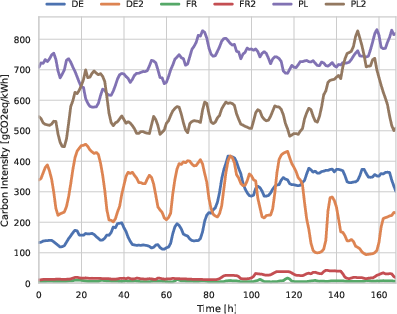
Figure 3: Grid carbon intensity data (hourly) for Germany, France, and Poland—highlighting variability crucial to policy efficacy.
Numerical and Comparative Results
Task fulfillment and emissions minimization are evaluated under equivalent average emissions limits (fixed rate vs. greedy budget). In highly variable grids, such as Germany, the budget-centric approach demonstrates significant improvements.
Cost analyses under projected high ETS carbon prices (700 €/tCO2e) reveal both constrained policies yield fourfold cost reductions compared to the unconstrained baseline. Most critically, even in high-variability scenarios, budgets prevent unexpected overruns, keeping operational expenditures predictable and bounded.
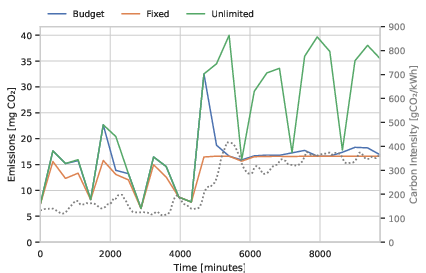
Figure 5: Emissions per six-hour interval for DE1—visualizing how budgets allow flexible spikes without violating hard limits, unlike fixed-rate capping.
Theoretical and Practical Implications
The extension from instantaneous rate-based to budget-based emissions control fundamentally resituates system adaptation from myopic to foresightful temporal planning. Budgets allow systems to front-load or conserve emissions allowances consistent with application utility curves, service quality objectives, and temporal grid conditions. This paradigm is notably robust to grid decarbonization trajectories, which are expected to increase intensity volatility as renewables expand.
Practically, budget-based adaptation is essential for operators required to conform to financial emissions allocations amidst volatile electricity and carbon cost regimes. Integrating such policies within orchestrators (e.g., container runtime) will be necessary to realize the operational benefits, with potential expansion to infrastructure-level coordination/scaling.
Limitations and Open Research Problems
The evaluated system abstracts away latency, migration costs, and multi-tenant contention—factors that, in production, may diminish the apparent gains. Further, static power overheads constitute a nontrivial fraction of energy use under constrained operation; future optimizations should address node consolidation and enhanced idle management.
Advanced policies leveraging forecasting (e.g., predictive allocation, strategic front-loading) or hybridizing budgets with spatio-temporal workload shifting remain open research frontiers. Rigorous integration within real-world orchestrators, extension to cross-application budget allocation, and coupling with multi-objective optimization (balancing service-level objectives, emissions, and costs) will be vital.
Conclusion
Emissions budgets are superior to fixed-rate strategies for achieving hard emissions constraints in volatile, renewables-dominated electrical grids, substantiated by up to 36% increases in task fulfillment without violating cumulative limits. Budgets offer equal (or superior) utility in stable grids, positioning them as the practical mechanism for operators facing ETS-driven cost exposure. The fundamental trade-off between emissions predictability and resource/economic efficiency demands judicious architectural choices, especially as carbon pricing scales.
Future directions will require production-level evaluation, integration of temporal emissions forecasting, and enhanced orchestration strategies to realize the full promise of budget-centric emissions management for sustainable software operation.