- The paper presents ArtiCAD, a multi-agent system that decouples joint planning from geometric synthesis via a novel connector-centric contract.
- It employs specialized agents to parse multimodal input, generate parametric parts, assemble joints deterministically, and validate outcomes using rollback mechanisms.
- The approach achieves superior results on diverse benchmarks, ensuring high-fidelity, simulation-ready CAD assemblies for design and fabrication applications.
ArtiCAD: Multi-Agent System for Articulated CAD Assembly Generation
Despite substantive advances in text- and image-driven single-part parametric CAD generation, the computational synthesis of complex, articulated assemblies from high-level specifications remains unsolved in both vision and design automation literature. Existing approaches either focus solely on static single-part codes or reconstruct non-parametric, category-bound articulated shapes, typically as non-editable mesh or Gaussian representations. These approaches fundamentally lack the flexibility and explicit construction history required for downstream design, engineering, and simulation applications, where explicit joints and editable hierarchies are essential.
ArtiCAD introduces a training-free, multi-agent architecture designed to fill this critical gap. It enables the direct generation of editable multi-part CAD assemblies—complete with parametric, articulated joints—from text or image specifications. The system is uniquely structured around four specialized agents: Design, Generation, Assembly, and Review. A principal insight is to shift assembly relationship prediction to the initial design phase, leveraging explicit connector abstractions. This decouples joint planning from geometric synthesis and thus overcomes LLM/VLM spatial reasoning limitations.
Methodology
Multi-Agent Pipeline
ArtiCAD’s architecture (see Figure 1) divides the overall problem hierarchically:
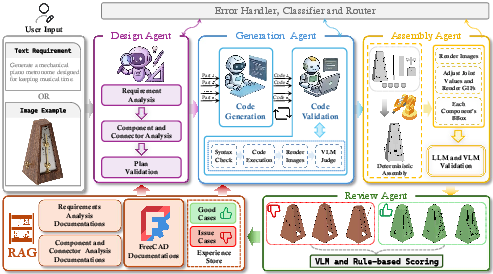
Figure 1: Schematic of the ArtiCAD pipeline, with Design, Generation, Assembly, and Review Agents operating via a cross-stage validation and experience store.
- Design Agent: Parses multimodal input into a declarative assembly plan. This includes a comprehensive part list and, crucially, all pairwise connection specifications via connectors, each represented as a local coordinate frame enriched with semantic and kinematic metadata.
- Generation Agents: Independently synthesize parametric part geometry (as FreeCAD Python scripts), enforcing connector realization for each planned attachment. All generation is conducted in a sandboxed execution environment with generate--execute--repair loops, employing VLM-based part validation.
- Assembly Agent: Deterministically resolves the assembly by aligning connector pairs and instantiating joint constraints in FreeCAD, exploiting the acyclic kinematic tree structure to guarantee consistency.
- Review Agent: Validates the global output with multi-view and motion-keyframe renderings, invoking both VLM and LLM-based scorers, and archives visual/trace summaries into a partitioned experience store for retrieval augmentation.
Connector Contract
The core novel mechanism is the connector-centric contract formalism. By enforcing that each planned joint references explicitly named local frames rather than implicit geometry, ArtiCAD avoids the combinatorial complexity and topological fragility of deferred connection inference—a fundamental pitfall in prior works (see Figure 2).
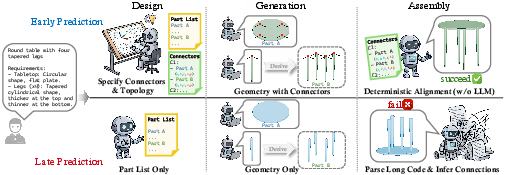
Figure 2: Early connector prediction in the design stage (top) makes assembly a deterministic process, in contrast to the uncertain, error-prone deferred inference (bottom).
The connector carries a semantic label, axis hints, attach origin, and reference directions, explicitly capturing intent. This allows subsequent component generation and assembly steps to operate conditionally independent of each other when conditioned on the contract, collapsing global error propagation to localized fixable failures. Error localization is handled by a cross-stage rollback mechanism that precisely routes error feedback for targeted regeneration or plan revision.
Kinematic Joint Parameterization
The system instantiates five foundational kinematic joint types—Fixed, Revolute, Slider, Cylindrical, and Ball—each parametrized within the connector at the design stage (see Figure 3). The resulting assembly is restricted to a kinematic tree, ensuring acyclic, tractable constraint resolution.
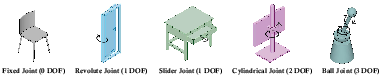
Figure 3: Supported kinematic joint types in ArtiCAD; each encapsulates a connector pair with specific DOF constraints for deterministic assembly.
Cross-Stage Rollback and Self-Evolution
Validation is performed both locally (per-part, at code execution and via vision-language checks) and globally (assembly verification and motion validation). Error detection triggers a rollback pipeline that classifies failures as either CODE (local geometry) or DESIGN (logical plan) errors, invoking only the necessary sub-agent to regenerate or revise, thus minimizing redundant computation.
Experience from both successful and failed runs (design choices, code corrections, reviewer traces) is indexed in an efficient FAISS-based vector store, augmenting subsequent agent queries for retrieval-generation, promoting continual improvement without explicit fine-tuning.
Experimental Results
Evaluation Benchmarks and Protocol
Evaluation is carried out on three fronts:
- ArtiCAD-Bench: A newly proposed 120-task multi-modality benchmark with diverse, open-ended static and articulated product assemblies.
- CADPrompt: Standard text-to-CAD dataset for single-part synthesis, ensuring assembly extensions do not regress part-level quality.
- ACD: Articulated Container Dataset, for joint/geometry/motion accuracy in direct comparison to state-of-the-art articulated mesh generation pipelines.
The primary metrics for assemblies include Geometry, Detail, and Motion Likert scores across three VLM judges, plus compilation success; for single-part and ACD evaluations, standard point-cloud and joint-type accuracy metrics are used.
Main Results and Ablations
ArtiCAD achieves superior results to all tested baselines, including configured rollouts with leading VLMs (Gemini-3, GPT-5.2, Claude-Opus-4.6):
- ArtiCAD (Gemini-3-Pro): 3.57/3.14/3.91 mean scores for Geometry/Detail/Motion, 100% compilation on ArtiCAD-Bench.
- Single-Agent VLM Best: 3.31/2.82/3.67, with notably lower reliability and consistency for non-trivial assemblies.
Ablation studies highlight both the connector contract and the cross-stage rollback as critical contributors: removing early assembly relationship prediction or validation/rollback significantly degrades scores and success rates (see Table 1 in the paper).
On CADPrompt, ArtiCAD is competitive with or outperforms leading dedicated part-generation systems with a median IoGT of 0.986, verifying that multi-agent decomposition does not hinder part synthesis quality.
On ACD, ArtiCAD demonstrates superior joint prediction fidelity—with 0.934 type accuracy and 0.841 joint F1—exceeding methods like SINGAPO, Articulate-Anything, and PAct both in topology and geometric fidelity.
Qualitative Analysis
The qualitative comparisons reveal that ArtiCAD maintains structure-aware geometric detail, especially under complex or articulated design prompts (see Figure 4 and Figure 5). In contrast, monolithic VLM/VLM baselines frequently lose functional structure and alignment, simplifying or misconnecting components.
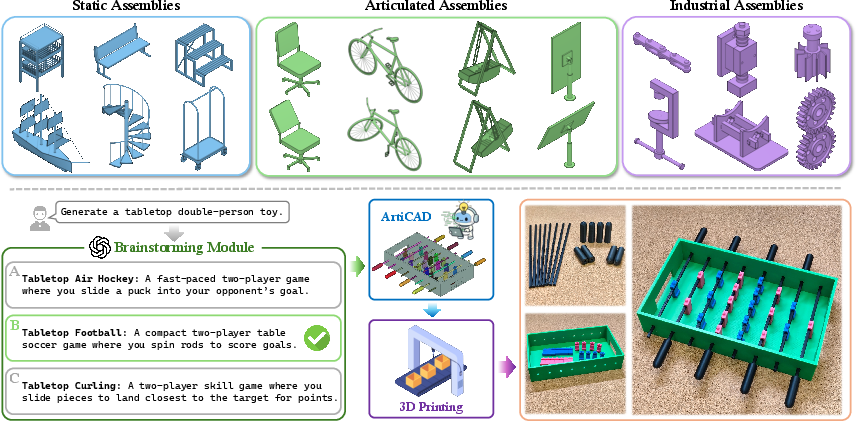
Figure 6: ArtiCAD-generated assemblies display high fidelity across static, articulated, and industrial categories; physical prototype results confirm end-to-end functional transfer from design prompt to tangible artifact.
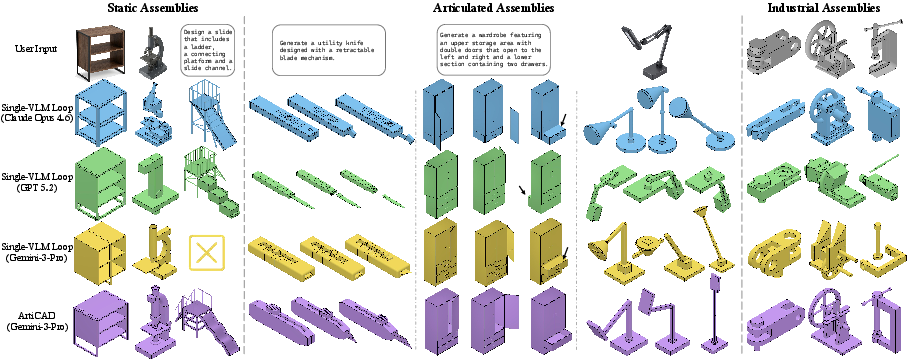
Figure 4: Comparison with Single-VLM Loop demonstrates that ArtiCAD maintains geometric detail and consistent articulation, even in complex spatial arrangements.
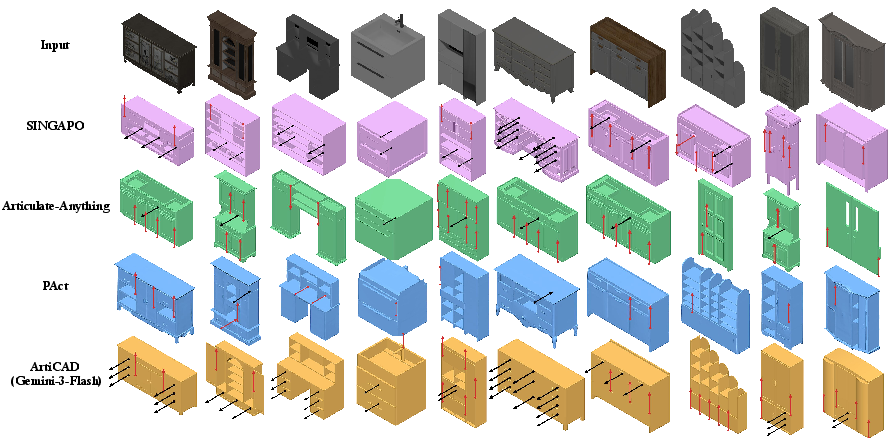
Figure 5: Head-to-head on ACD cases: ArtiCAD produces more accurate joints and actionable articulated design, with black (prismatic) and red (revolute) joint distinctions clearly reflected.
ArtiCAD’s outputs are parametric and functionally organized, supporting physical fabrication and direct export into simulation assets, e.g. as URDF files for robotics toolchains (Figure 7).
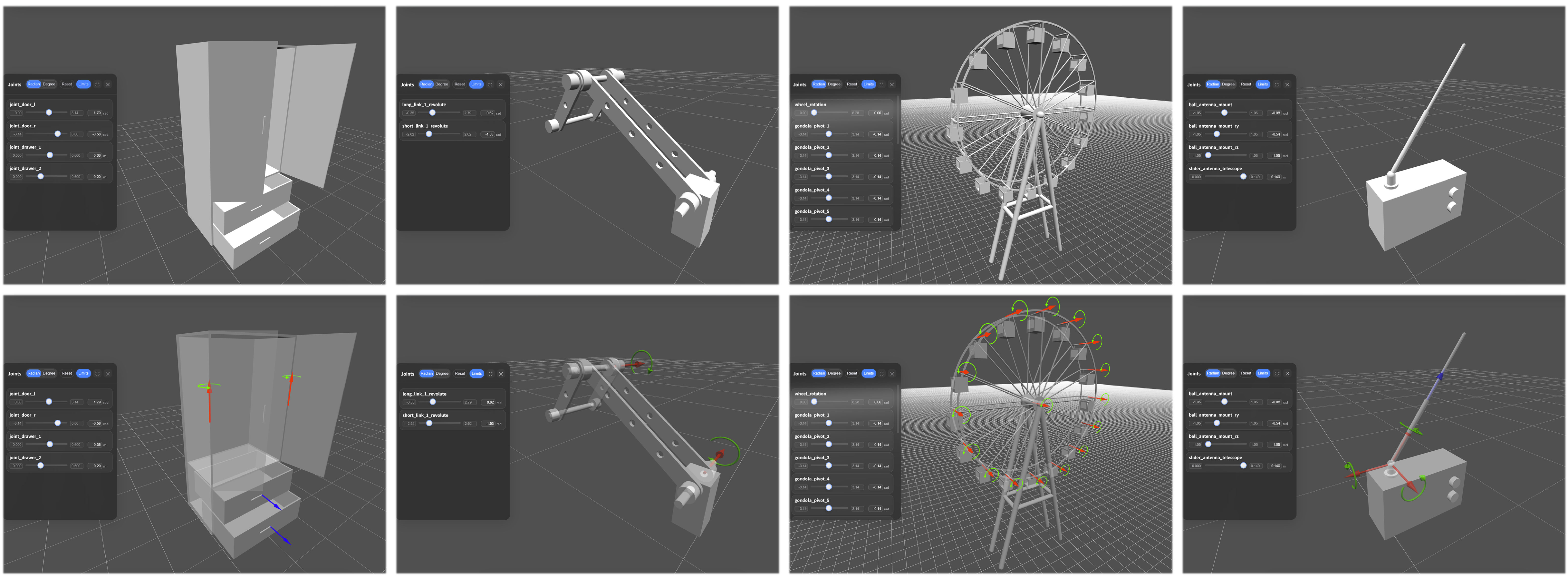
Figure 7: URDF-verified assemblies synthesized by ArtiCAD imported into Robot Viewer, with preserved coordinate frames and motion constraints, ready for embodied AI use cases.
Theoretical and Practical Implications
ArtiCAD provides a scalable template for decomposed LLM/VLM-driven code generation workflows in complex spatial-dynamic tasks. Methodologically, its connector contract provides a robust solution to the topological volatility and combinatorial infeasibility of late-stage assembly inference, suggesting broad applicability in any hierarchically composed, constraint-driven design task.
Practically, ArtiCAD enables:
- Automated requirement-to-fabrication pipelines, bridging high-level intention capture with physical instantiation.
- Direct sourcing of articulated simulation assets for embodied AI, robotics, and reinforcement learning, unconstrained by template categories.
- Extension of assembly knowledge via in-situ self-supervision in retrieval-augmented pipelines, supporting continual improvement.
Limitations and Future Directions
The current restriction to tree-structured (acyclic) assemblies precludes representation of mechanisms with closed loops (e.g., four-bar linkages, complex robotics). Addressing this would require fundamentally enhanced reasoning and constraint-solving in both the planning and assembly agents. Additionally, the system’s generative ceiling is bounded by the innate reasoning and code synthesis power of the selected LLM/VLM backbone. These limitations are explicit trade-offs for reliability and zero-hallucination assembly resolution.
Future trajectories include integrating fine-tuning or reinforcement learning on curated synthetic assembly tasks, extending to cyclic kinematic structures, and exploiting richer semantic retrieval and reasoning strategies.
Conclusion
ArtiCAD constitutes a robust training-free multi-agent system for articulated CAD assembly design. By defining a connector-centric contract and leveraging distributed agent specialization, ArtiCAD decouples spatial reasoning from geometric synthesis, achieving deterministic, high-fidelity, and functionally consistent articulated CAD assemblies from high-level prompts. The architecture yields qualitative and quantitative performance gains over monolithic and prior-arts approaches, positioning it as a rigorous baseline and extensible platform for further work in AI-driven design automation and embodied simulation asset generation.

