- The paper introduces a logarithmic Klein-Gordon framework for Bose-Einstein condensates that models self-bound quantum droplets with both cubic interactions and logarithmic saturation effects.
- The methodology rigorously derives a non-relativistic limit, yielding an extended Gross-Pitaevskii equation and employs a Gaussian variational ansatz to capture dynamical behavior.
- Numerical simulations across multiple atomic species confirm stable, oscillatory dynamics, linking droplet behavior to broader applications in condensed matter and cosmology.
Emergent Quantum Droplets in Logarithmic Klein-Gordon Models of Bose-Einstein Condensates
Introduction
The paper "Emergent Quantum Droplets in Logarithmic Klein-Gordon Models of Bose-Einstein Condensates" (2604.10839) explores a relativistic scalar field formalism for self-bound Bose-Einstein condensates (BECs) via a nonlinear Klein-Gordon equation incorporating cubic and logarithmic interactions. This approach allows for an elegant field-theoretic framework to capture quantum droplet phenomena—self-bound, liquid-like states stabilized by quantum fluctuations and subtle interplay of repulsive and attractive nonlinearities. The work rigorously derives the non-relativistic limit, yielding an extended Gross-Pitaevskii equation with logarithmic corrections, and analyzes conserved quantities, energy-momentum tensors, and equilibrium/dynamical regimes relevant for ultracold atomic gases. Numerical simulations are performed across 87Rb, 23Na, and 7Li condensates.
The study generalizes the $3+1$ Klein-Gordon equation by incorporating both cubic and logarithmic nonlinearities,
(□+ℏ2m2c2)Ψ=λ∣Ψ∣2Ψ−βln(α∣Ψ∣2)Ψ,
where the cubic term encodes mean-field interactions and the logarithmic term provides a non-polynomial saturation effect, yielding self-limiting behavior. Lorentz invariance is maintained when Ψ is a scalar field.
Translating to the non-relativistic regime via the usual fast oscillation approximation yields a generalized nonlinear Schrödinger equation of the form,
iℏ∂t∂ψ=−2mℏ2∇2ψ+(G∣ψ∣2+Bln(α∣ψ∣2))ψ,
where G and B encode rescaled interaction strengths.
This reduction provides a direct connection between relativistic droplet physics and established Gross-Pitaevskii theory, while allowing access to relativistic corrections relevant, for example, in astrophysical or cosmological contexts.
Field-Theoretic Lagrangian and Conserved Quantities
The paper constructs the Lagrangian density incorporating the nonlinearities,
L=∂μΨ∗∂μΨ−ℏ2m2c2∣Ψ∣2+2λ∣Ψ∣4−β∣Ψ∣2ln(α∣Ψ∣2)+β∣Ψ∣2,
and systematically derives conserved currents and the energy-momentum tensor via Noether's theorem. Phase invariance yields particle number conservation, while spacetime invariance assures energy-momentum conservation. The canonical energy-momentum tensor and explicit expressions for local energy/momentum densities are presented. Stationary-state solutions are obtained, showing the total energy functional depends on ground-state chemical potential and nonlinear interactions.
Stability, Self-Confinement, and Chemical Potential Analysis
The equilibrium and stability of the quantum droplet emerge from analysis of the chemical potential,
230
The non-relativistic correction shows that the equilibrium droplet width is determined by the competition between cubic attraction and logarithmic repulsion, yielding
231
consistent with self-bound quantum droplets. This equilibrium is robust across parameter variation, allowing tuning via the logarithmic coupling.
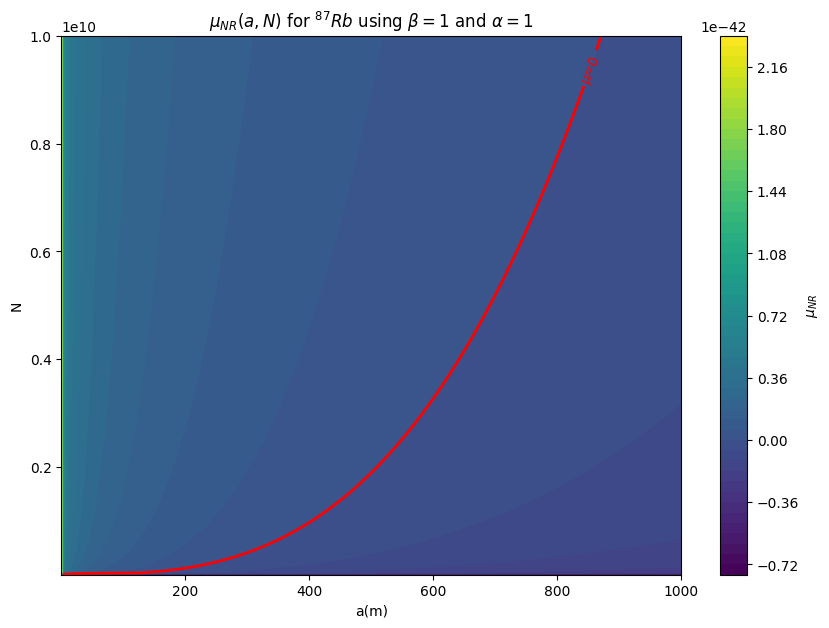
Figure 1: Contour plot of the non-relativistic chemical potential for 232Rb, highlighting the region of self-bound states.
Variational Dynamics and Gaussian Ansatz
To access the collective droplet behavior and time evolution, the authors employ a Gaussian variational ansatz, reducing the complex field equations to a single ODE for the condensate width. The effective Lagrangian encodes quantum pressure, relativistic mass, cubic and logarithmic interactions. Conservation laws are maintained in the reduced description, and the dynamical equation for the width embodies essential physical forces:
- 233: quantum kinetic pressure (Heisenberg prevention of collapse)
- 234: relativistic mass term (harmonic trapping)
- 235: cubic mean-field interaction (collapse channel)
- 236: logarithmic nonlinearity (self-stabilizing pressure)
- additional 237-dependent phase term.
The equilibrium width obtained from this variational profile matches analytic predictions, demonstrating that logarithmic nonlinearities stabilize droplets against collapse even with attractive interactions—a result not accessible in cubic-only models.
Numerical Simulations and Oscillatory Dynamics
Dimensionless rescaling is critical for numerical stability across disparate atomic parameters. The evolution equation is solved for several atomic species and parameter regimes, revealing:
- Regular oscillatory dynamics of the condensate width, indicative of dynamical self-confinement.
- The dominant frequency and amplitude are regulated by the harmonic restoring term, but deviation is observed as nonlinear coefficients grow.
- Collapse or runaway expansion is suppressed under realistic (experimental) parameters, validating the model's predictions for self-bound regimes.
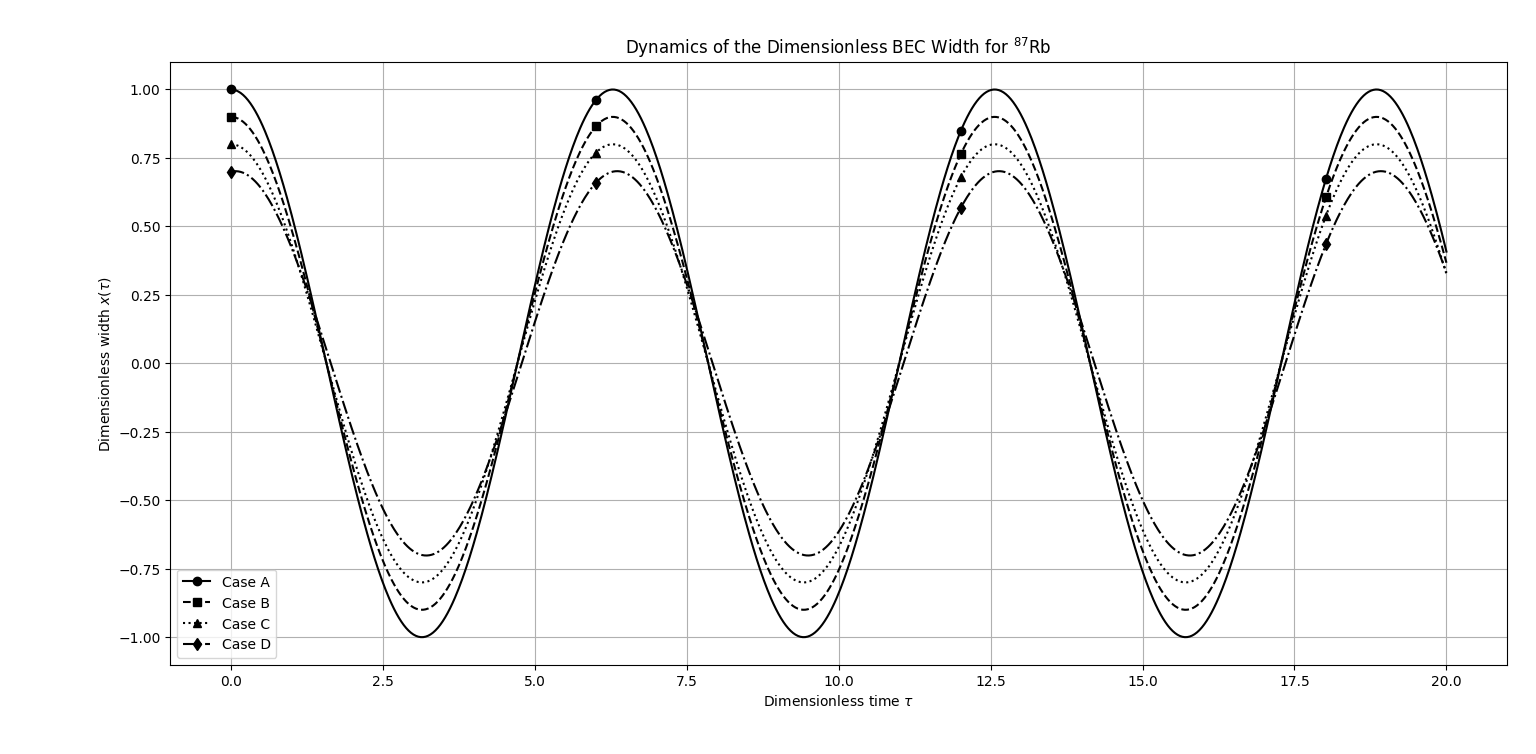
Figure 2: Numerical solutions of the dimensionless condensate width equation showcasing robust oscillatory dynamics for 238Rb, 239Na, and 70Li.
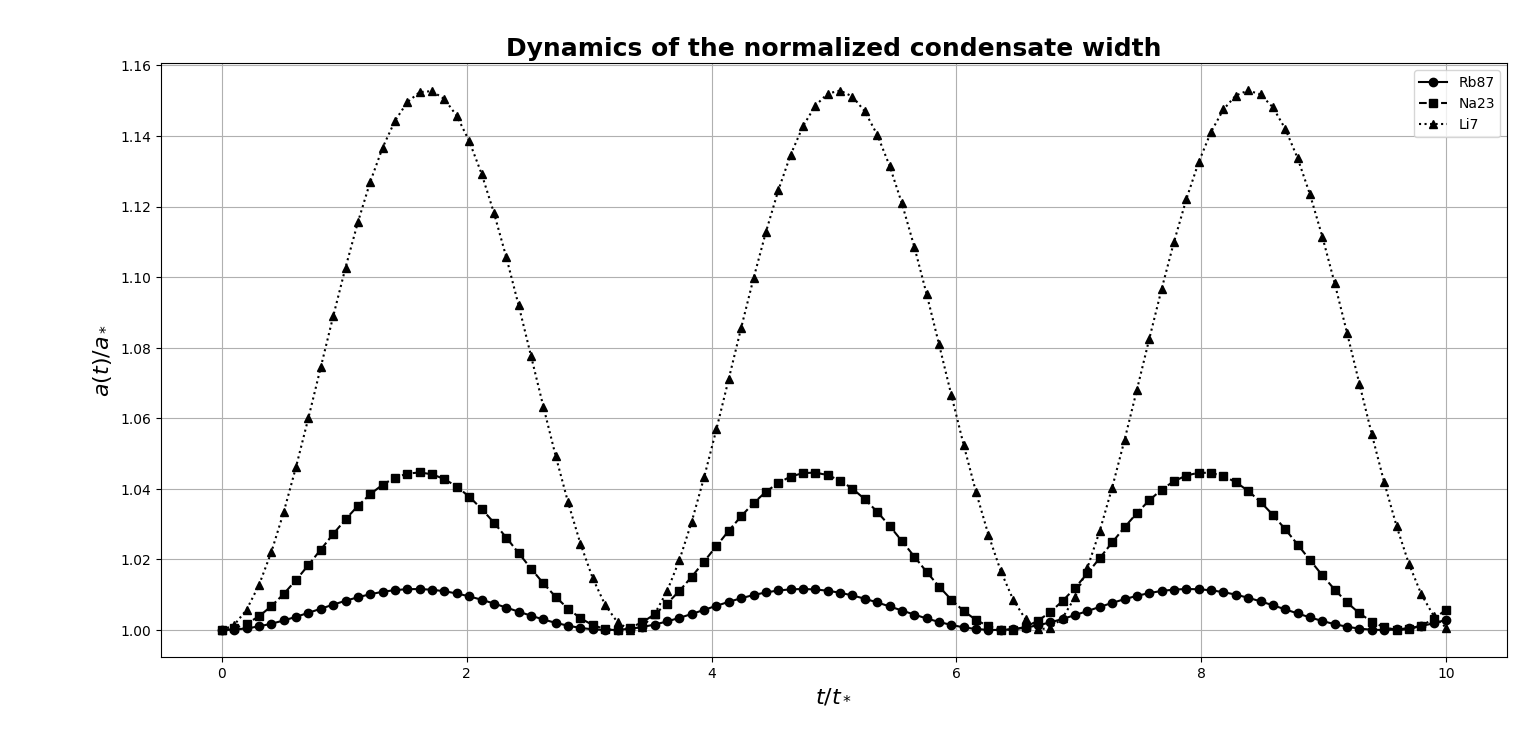
Figure 3: Oscillatory condensate dynamics for different atomic species and interaction strengths.
Strong claims are made regarding the robustness of the oscillatory, self-bound regime, which persists across atomic mass and nonlinear parameter variation. Bounded oscillations imply the condensate neither collapses nor undergoes indefinite expansion.
Physical Regimes and Parameter Sensitivity
The interplay between cubic attraction (71), logarithmic repulsion (72), and phase pressure (73) yields distinct dynamical regimes:
- Collapse under dominant negative 74.
- Dispersive expansion when 75 or 76 grows.
- Self-confined oscillations for intermediate parameter values.
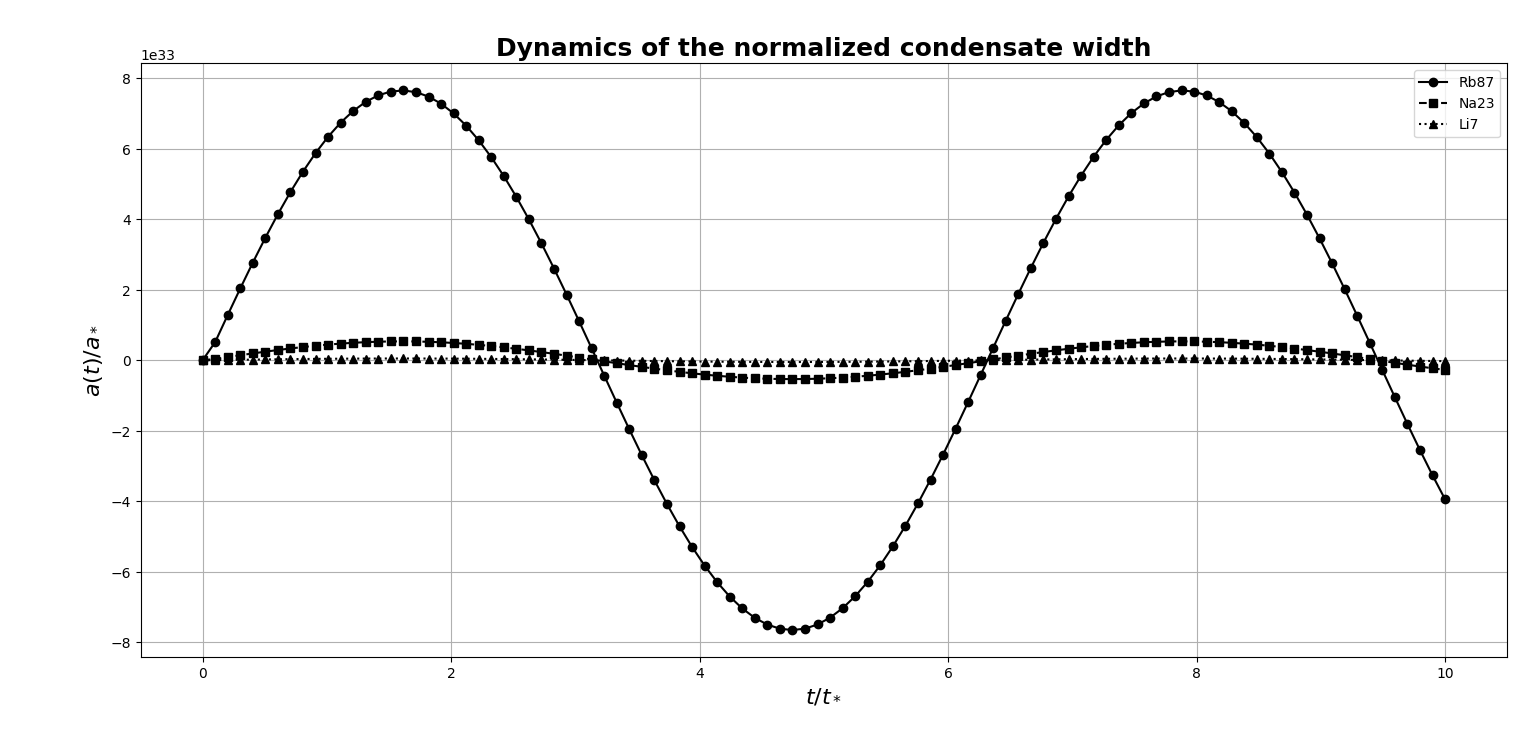
Figure 4: Numerical exploration of phase (77), cubic (78), and logarithmic (79) parameter regimes and their effect on condensate stability.
Quantitative details are provided for $3+1$0Rb, $3+1$1Na, and $3+1$2Li, using fully realistic atomic masses and interaction strengths. The consistent results across species confirm the model’s generality.
Implications and Future Directions
Theoretical implications are substantial:
- Unified field-theoretic treatment connects droplet physics in BECs, cosmology, and nonlinear field theory.
- Logarithmic nonlinearities are minimal yet quantitatively essential beyond mean-field descriptions.
- Dynamical confinement and finite energy configurations can be achieved without external trapping, matching recent droplet experiments.
Practically, this model provides a compact framework for exploring extensions (rotation, external potentials, multi-component mixtures) and tuning stability regimes experimentally. It offers a controlled pathway to investigate relativistic corrections relevant in gravitational condensation or dark matter analogues.
Speculative future directions include:
- Exploration of stationary solutions in large nonlinear regimes.
- Inclusion of finite-temperature corrections, dissipation, or vortex dynamics.
- Application in astrophysical contexts (bosonic stars, dark energy condensation).
- Experimental constraints on logarithmic interaction strength via BEC expansion and droplet stability measurements.
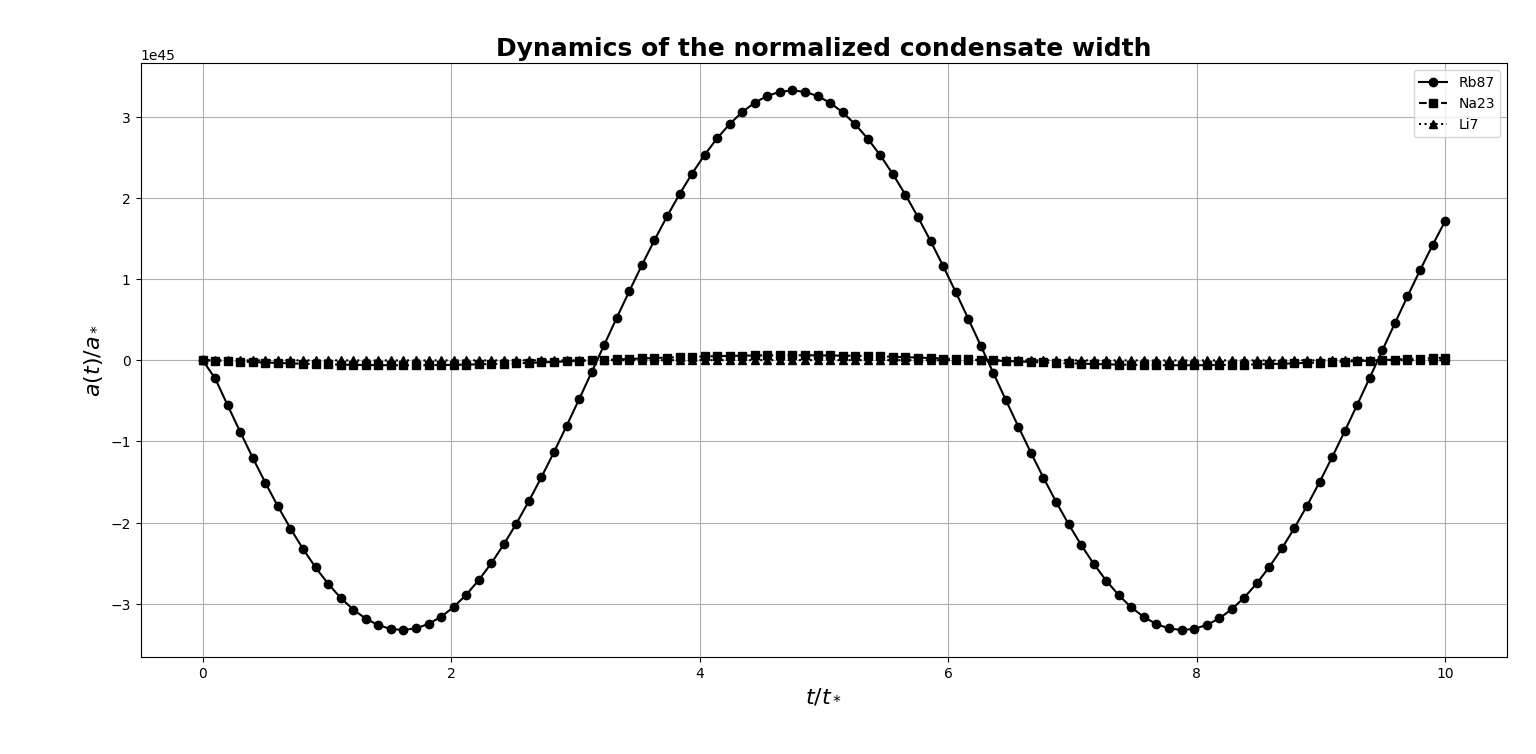
Figure 5: Free expansion velocity for various parameter regimes, demonstrating suppression and stabilization of droplet expansion.
Conclusion
This study establishes a rigorous relativistic scalar field model for quantum droplets in Bose-Einstein condensates, with cubic and logarithmic interactions central to emergent self-bound, oscillatory regimes. Through variational reduction and numerical integration, the authors demonstrate stable dynamical confinement across atomic species and parameter sets. Logarithmic nonlinearities provide an essential stabilizing mechanism and facilitate a flexible theoretical framework for non-standard droplet physics. The generality and robustness of the model open avenues for both experimental investigation and theoretical generalization into cosmological scalar field condensation and quantum matter analogues.