Ground-state solution of quantum droplets in Bose-Bose mixtures
Published 1 Apr 2026 in cond-mat.quant-gas and quant-ph | (2604.00889v1)
Abstract: In this paper, we present a systematic study on the ground state computation of quantum droplets in homonuclear Bose-Bose mixtures, governed by the extended Gross-Pitaevskii equations (eGPEs) with Lee-Huang-Yang (LHY) corrections. This model captures the formation of self-bound droplets stabilized by the delicate balance between the attractive mean-field interaction and the repulsive quantum fluctuations. We formulate dimensionless energy functionals for both the general two-component system and the reduced single-component density-locked model. To compute the ground states efficiently, we adapt and benchmark various gradient flow discretization schemes, identifying a backward-forward sine-pseudospectral scheme based on the gradient flow with Lagrange multiplier method (GFLM-BFSP) as the robust solver for our simulations. Utilizing this method, we report three main numerical observations: (i) the density-locked model is quantitatively validated as a reliable approximation for ground state properties; (ii) the dimension-dependent convergence rates of the Thomas-Fermi approximation are established in the strong-coupling regime; and (iii) the critical particle number for self-binding in free space is numerically determined, providing a precise correction to the analytical prediction by Petrov [Phys. Rev. Lett. 115, 155302 (2015)].
The paper introduces a refined computational model using the extended Gross-Pitaevskii equation with LHY corrections to capture the ground-state of quantum droplets.
It benchmarks advanced gradient flow methods, notably the GFLM-BFSP scheme, ensuring rapid convergence and high accuracy in energy minimization.
The study validates effective dimensional reductions and precisely determines the critical particle number for droplet formation with errors below 1%.
Ground-State Computation of Quantum Droplets in Bose-Bose Mixtures
Theoretical Framework and Model Reduction
The paper presents a rigorous numerical and theoretical analysis of self-bound quantum droplets in homonuclear Bose-Bose mixtures governed by the extended Gross-Pitaevskii equation (eGPE) with leading-order Lee-Huang-Yang (LHY) corrections. The eGPE system studied incorporates competing attractive (mean-field) and repulsive (quantum fluctuation) effects, which stabilize droplets even in the absence of external confinement.
A detailed dimensional reduction analysis explains how the full three-dimensional two-component eGPE reduces consistently to effective 1D and 2D models under strong anisotropic confinement. The authors also rigorously derive the density-locked (DL) single-component reduction valid in the regime where the component density ratio is fixed by interaction strengths. The scaling analysis relates all relevant coupling constants, trapping frequencies, and particle numbers in dimensionless form, with the critical rescaled particle number N playing a central role.
Numerical Approaches for Ground-State Solutions
To address the computational challenges of competing nonlinearities and conservation constraints, the work benchmarks several gradient flow-based minimization schemes. A critical methodological contribution is the identification and evaluation of the gradient flow with Lagrange multiplier enforced (GFLM) using a backward-forward sine-pseudospectral (BFSP) discretization. The explicit enforcement of the Lagrange multiplier ensures energy diminishments and spectral convergence even for large time steps, unlike standard projection-based gradient flows, which suffer from splitting errors and potential instability for moderate discretization ([Section 3]).
The GFLM-BFSP scheme is empirically shown to outperform standard GFDN (gradient flow with discrete normalization) with both full backward Euler spectral and backward-forward semi-implicit discretization, in terms of both convergence speed and the precision of the final ground-state energy (see summary below).
Validation of Model Reductions
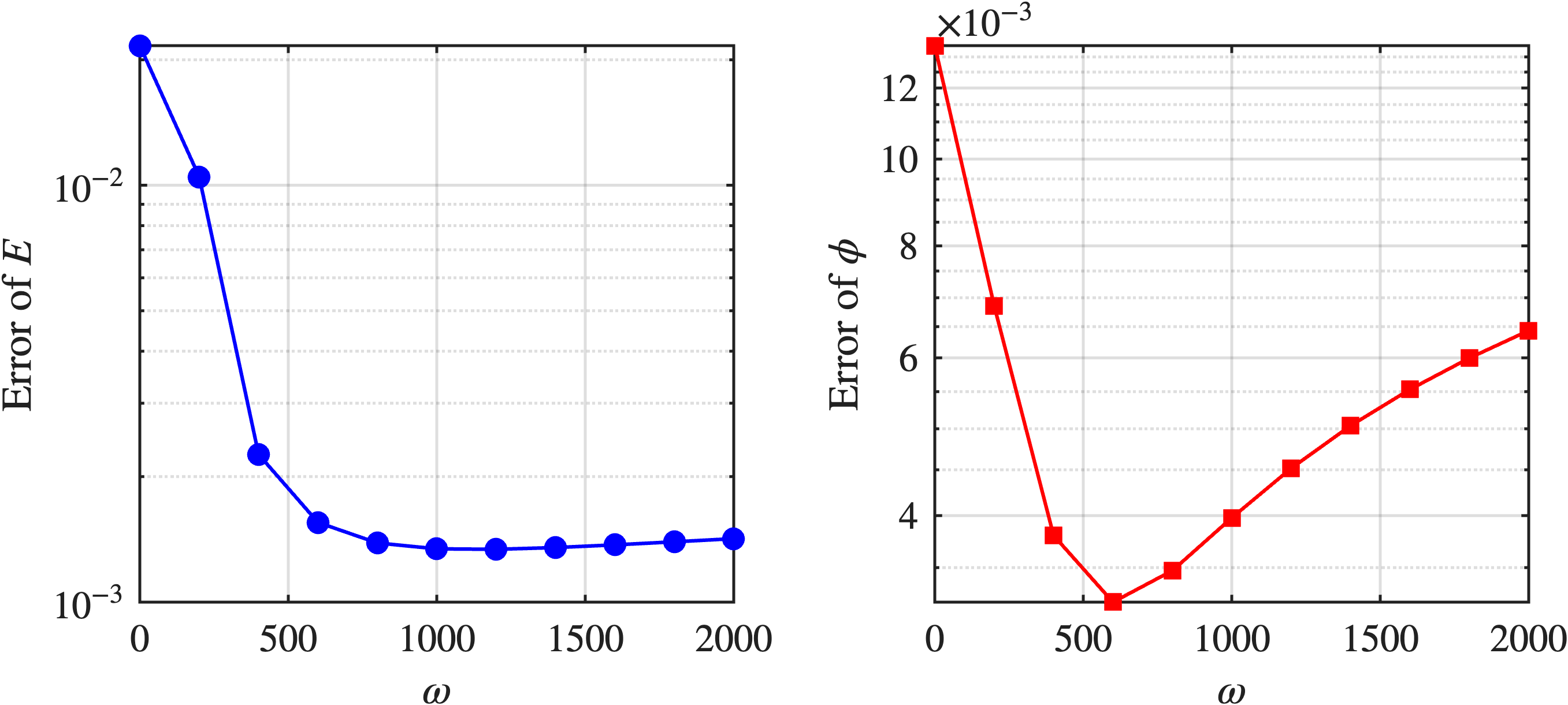
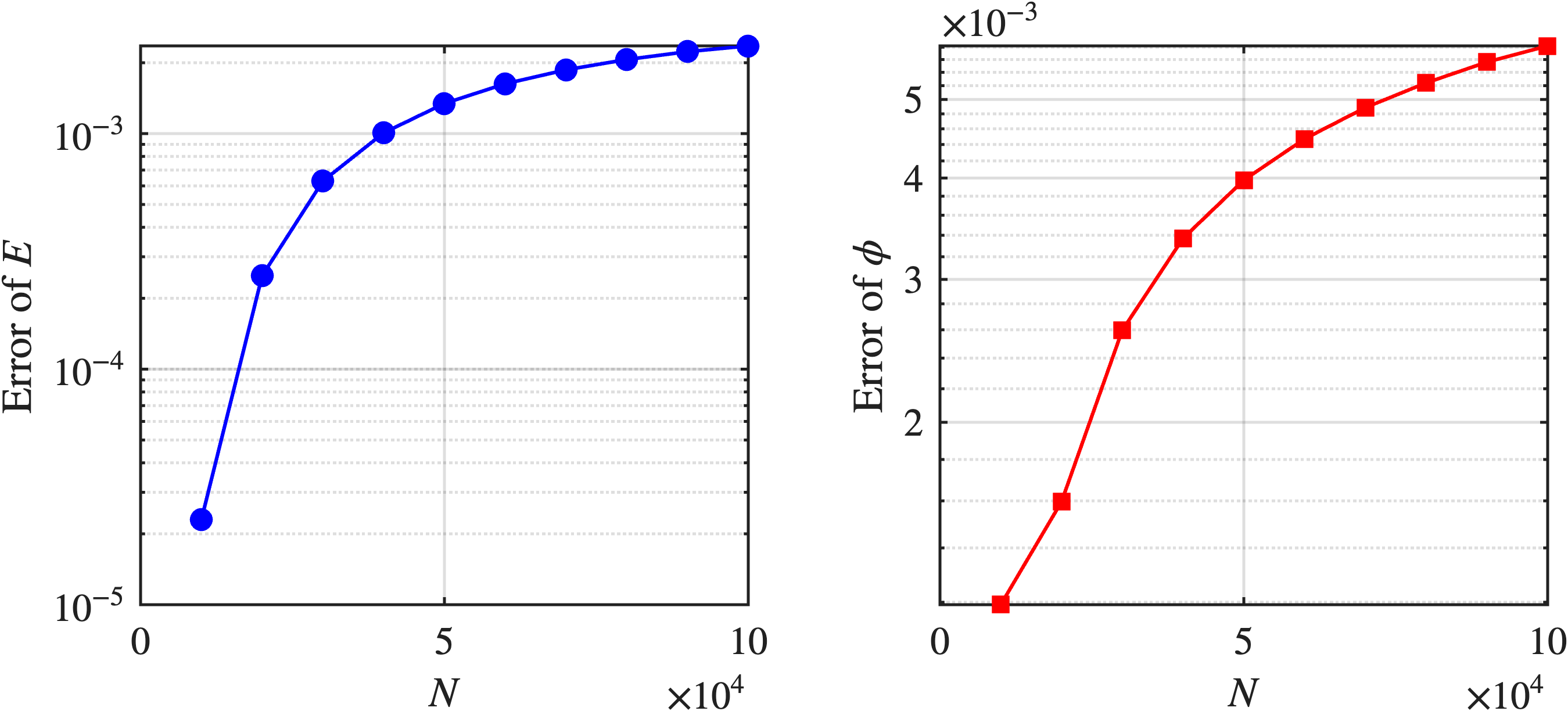
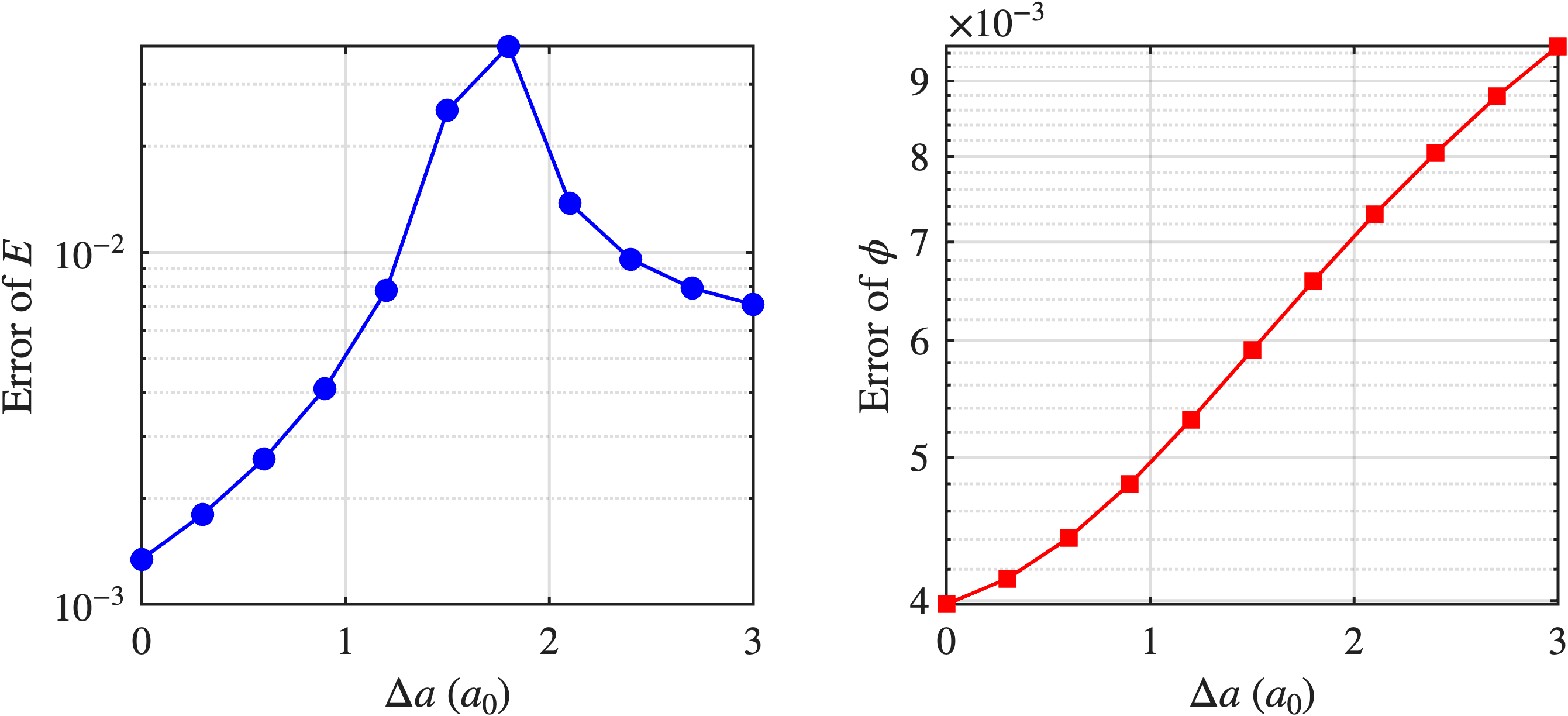
A systematic quantitative validation confirms that the density-locked single-component model accurately reproduces the ground state energy and wavefunction profiles of the full two-component eGPE in experimentally relevant regimes. Errors remain below 1% for a broad range of trapping strengths, particle numbers, and interaction parameters.
Figure 1: The relative error between the ground-state solution of the single-component density-locked model and the full two-component eGPE as a function of confinement strength ω for N=5×10⁴ and Δa=0.
Ground-State Properties and Thomas-Fermi Limit
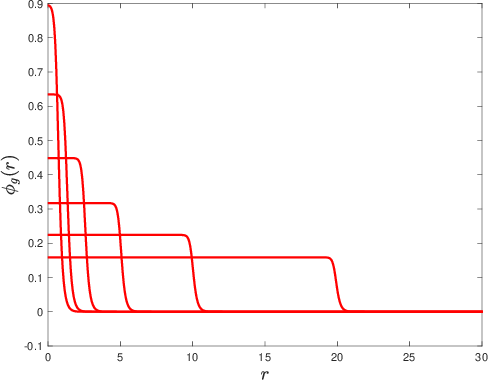
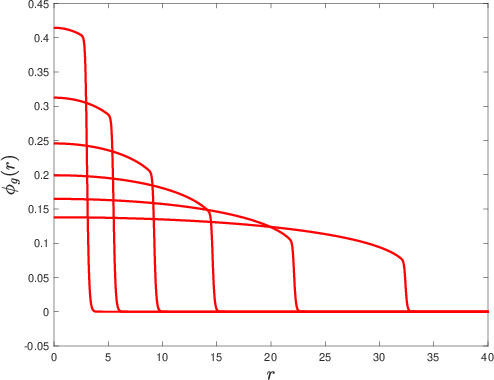
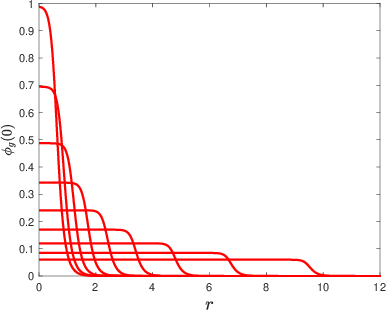
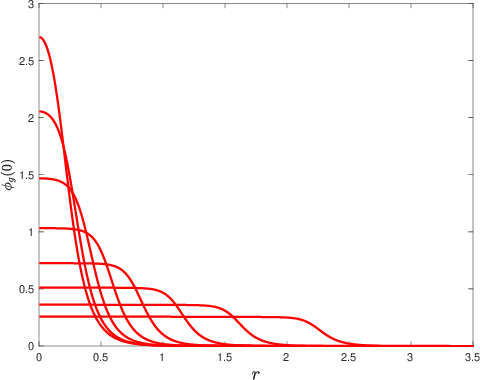
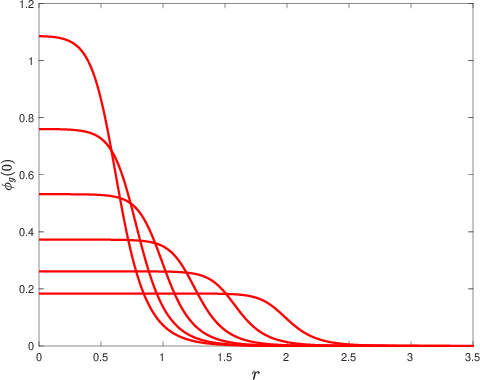
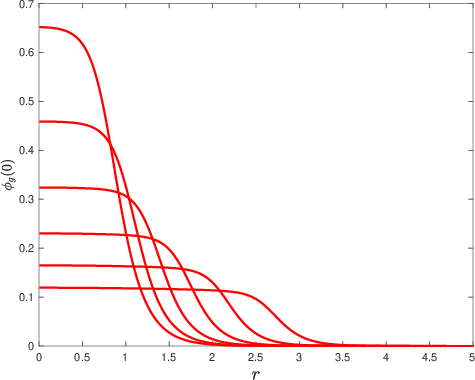
The ground-state solutions exhibit a crossover from finite-size, kinetic-energy-dominated states to bulk liquid-like "flat-top" droplets as N increases. The chemical potential and energy profiles quantitatively approach the Thomas-Fermi approximation (TFA) in the macroscopic limit, with dimension-dependent convergence rates. The convergence analysis demonstrates that the chemical potential error scales as O(N−1/d) and the L2 norm error of the wavefunction as O(N−1/(2d)) (with d the effective dimension). These power laws are consistent with the surface-volume scaling in the sharp-interface limit.
Figure 2: Radial ground-state profile for the density-locked droplet in free space (V(x)=0), illustrating the emergence of a flat-top density for large ω0.
Figure 3: Ground-state profile for the spherically symmetric droplet in 2D free space (ω1), showing the approach to the TFA limit for increasing ω2.
Figure 4: Analogous ground-state profile for the 3D case in free space (ω3), with profiles saturating to a uniform bulk density for large particle number.
Determination of the Critical Particle Number
A robust numerical continuation approach is used to determine the sharp threshold ω4 for self-binding of droplets in free space. The critical value ω5 is found to be significantly larger than the analytic Gaussian variational prediction (ω6), reflecting the inadequacy of the Gaussian ansatz in capturing the flat-top structure of the true ground state near the collapse threshold. This establishes the precise parameter regime for droplet formation and provides a corrected universal criterion for experimental and theoretical investigations.
Practical and Theoretical Implications
The combination of high-order spectral accuracy, robust constraint treatment, and systematic parameter space scanning establishes a definitive computational protocol for ground-state calculations in strongly correlated quantum droplet systems. The validation of the density-locked reduction justifies its use for large-scale or time-dependent studies where full two-component simulations are prohibitive.
The dimension-dependent quantification of the TFA convergence elucidates finite-size and surface effects, laying the groundwork for further studies on collective modes, dynamical instabilities, and topological excitations (e.g., vortices).
The corrected threshold for droplet formation will guide both the design and interpretation of ultra-dilute quantum droplet experiments and the modeling of mixed-species BECs and related quantum fluids.
Conclusions
This study provides a mathematically and numerically precise treatment of the ground states of quantum droplets in Bose-Bose mixtures. The authors establish the dimensionless modeling framework, validate model reductions, and identify the optimal numerical methodology for energy minimization with strong constraints and non-standard nonlinearities. The determination of the exact critical particle number for self-binding addresses a long-standing gap in the quantitative theory of quantum droplets. The methods and results serve as a reference for future investigations into the static and dynamic properties of droplets in ultracold quantum gases.