- The paper presents a tri-channel OECT system that integrates aptamer functionalization and a control channel to suppress drift and enhance neuromodulator detection.
- It employs detailed Monte Carlo simulations and mechanistic noise modeling to achieve low symbol error rates and improved amplitude decoding under drift.
- Results indicate that optimizing device parameters and organoid–gate separation expands the feasible operational range for hybrid molecular communication interfaces.
Control-Referenced Tri-Channel OECT Receivers for Hybrid Molecular Communication at Brain Organoid Interfaces
Introduction
This paper develops a comprehensive theoretical study and simulation analysis of a tri-channel organic electrochemical transistor (OECT) receiver for brain organoid molecular communication, targeting neuromodulator (dopamine/serotonin) readout with high specificity and robust tolerance to low-frequency drift and correlated noise (2604.10798). The receiver architecture uniquely combines two selective aptamer-gated OECT channels (dopamine, 5-HT) with a hydrogel-matched control channel, integrating this with a shared Ag/AgCl gate bias. Control referencing is leveraged explicitly for drift and baseline fluctuation suppression during amplitude detection. The approach is analyzed using a mechanistic channel and noise model, supporting Monte Carlo evaluation of multi-bit modulation schemes (MoSK, CSK-4, and Hybrid) under organoid-adjacent parameters.
Tri-Channel OECT Receiver Architecture and Detection Modality
The device layout includes three co-planar gold micro-gates, each linked to a PEDOT:PSS OECT and drain readout, positioned beneath a brain organoid suspended in an ACSF-filled PDMS well (Figure 1).
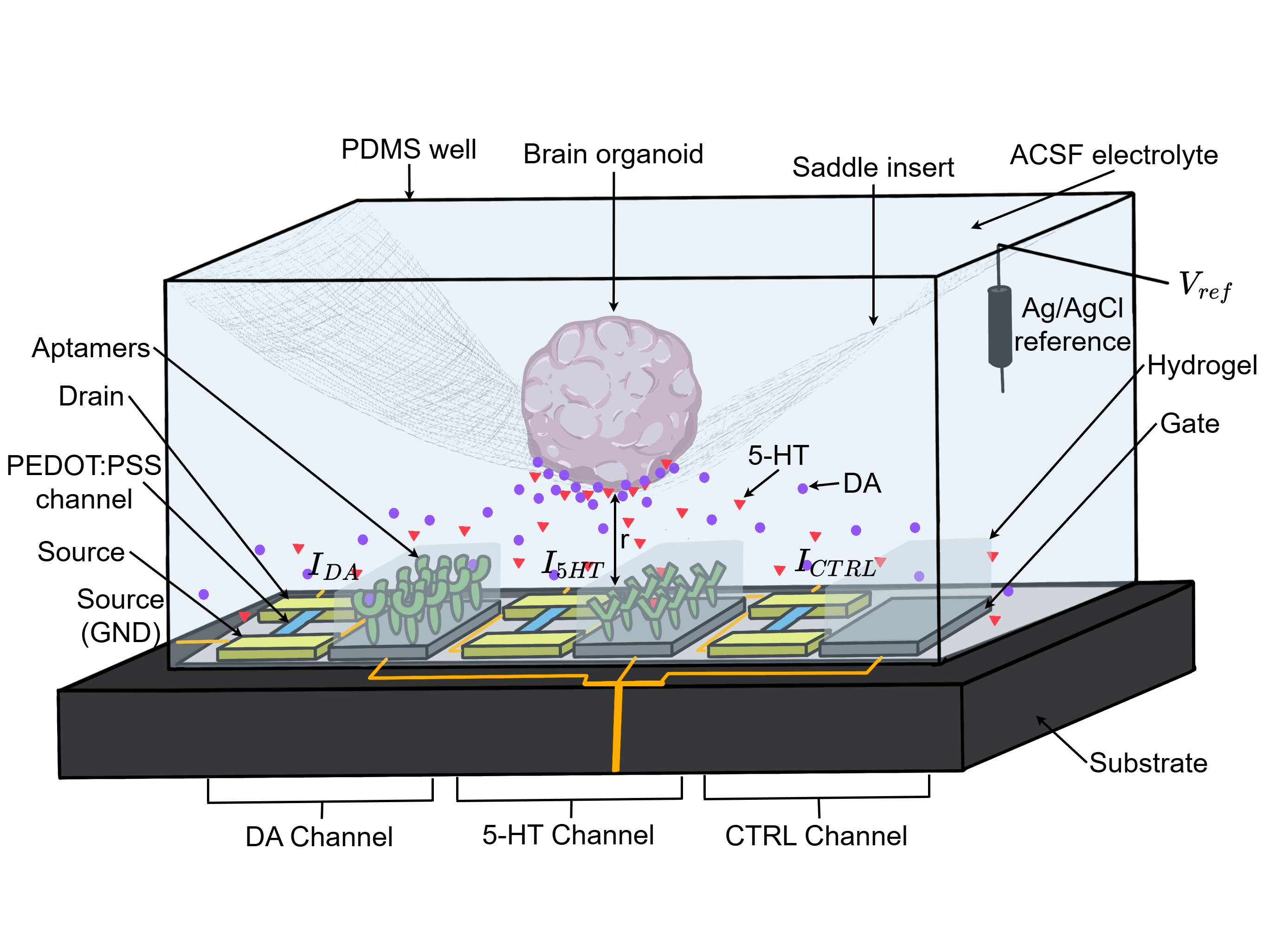
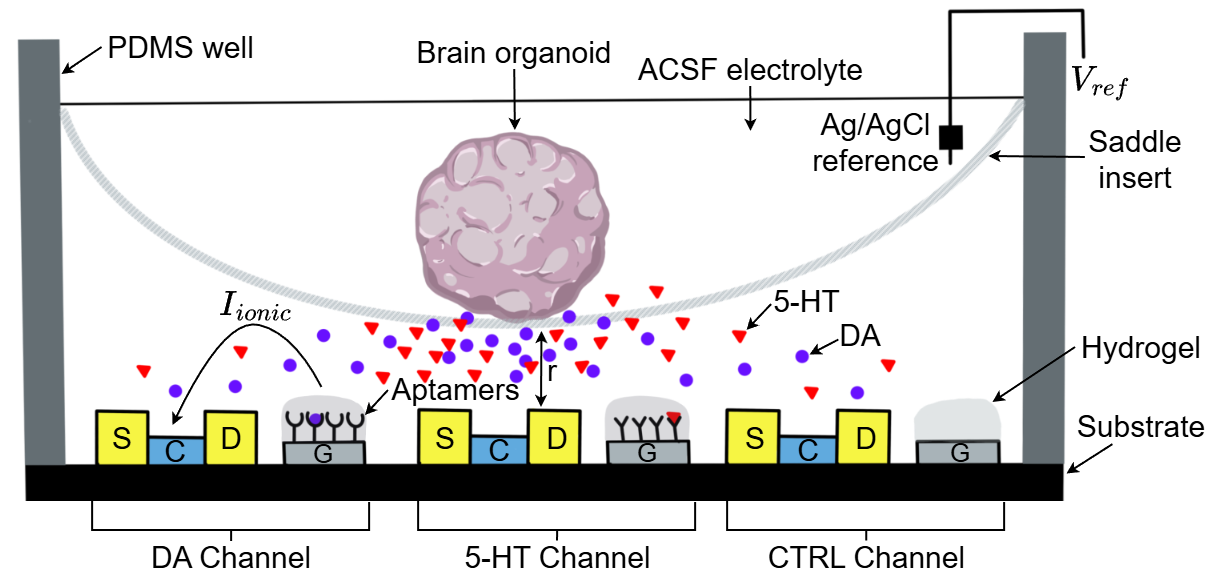
Figure 1: Tri-channel OECT receiver concept for brain organoid molecular communication, showing orthogonal layout, hydrogel/aptamer functionalization, and control channel for common-mode referencing.
Aptamers on the dopamine and serotonin channels enable molecular specificity through binding-induced effective gate charge modulation. The control channel, identically hydrogel-coated but aptamer-free, acts as a genuine background reference—capturing all drift and correlated device/electrolyte fluctuations not originating from selective chemical binding. The shared gate bias via Ag/AgCl further promotes low-frequency common-mode noise.
Electronic readout synchronously acquires all three channels, and digital processing integrates tail-anchored charge traces for symbol decision statistics (Figure 2).
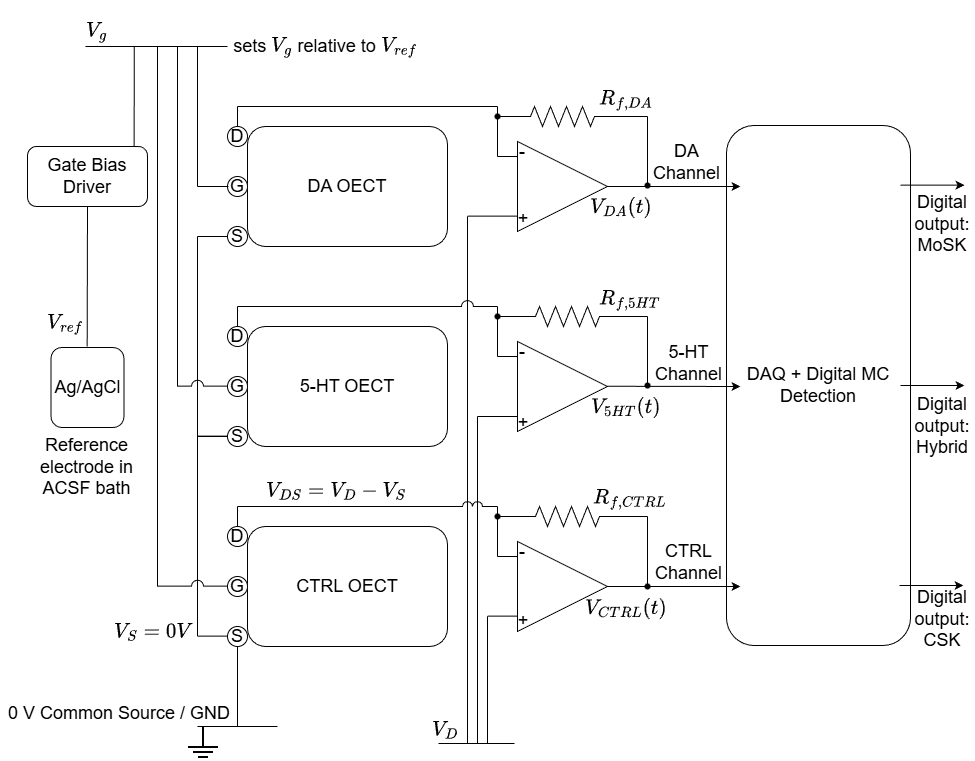
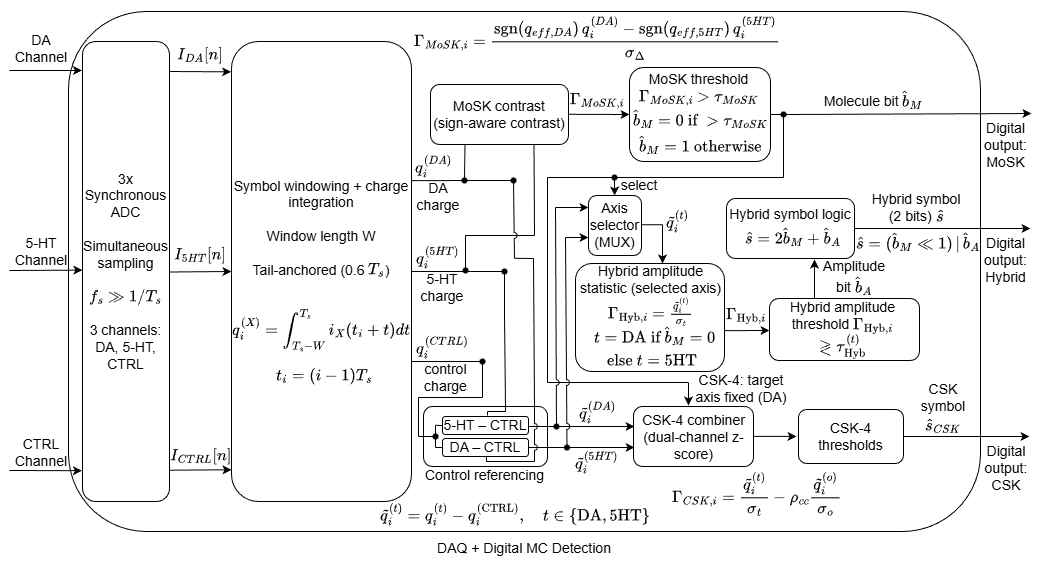
Figure 2: Tri-channel acquisition and detection: analog front-end and synchronous drain-current readout, with digital block for modality-specific detection.
The detection logic supports three operation modes:
- MoSK: Discriminates dopamine vs. serotonin by sign-aware contrast of the two selective channels, exploiting the aptamer-induced polarity inversion between DA and 5-HT responses.
- CSK-4: Uses amplitude on a target channel; combines control referencing with a variance-normalized dual-channel detector to suppress common-mode disturbances.
- Hybrid (2-bit): Decodes molecule identity via MoSK, then uses control-referenced amplitude thresholding for the second bit—partitioning signaling into identity-plus-amplitude.
Ample attention is given to binding kinetics (Langmuir model with optional Damköhler correction), restricted extracellular diffusion (volume fraction/tortuosity), Poissonian emission shot noise, and multi-component electrical noise (thermal, flicker, drift with explicit cross-channel correlation). This feeds into variance-normalized (z-score) decision statistics, enabling efficient Monte Carlo validation.
Molecular Communication Operating Points and Modulation
Monte Carlo simulations are performed across a range of organoid-to-gate separations (25–130 μm), molecule budgets, and device configurations, with parameterization directly reflecting biophysical constraints of brain-like extracellular space, realistic OECT operation, and aptamer-gated interfaces.
Key findings:
- The control-referenced Hybrid receiver achieves a 1% SER threshold (LoD) at 11,866 molecules/symbol for a 45 μm organoid-gate gap, outperforming conventional CSK-4+CTRL, and requiring only 32% more molecules than MoSK while doubling symbol payload.
- Control referencing is specifically advantageous for the amplitude-decoding branch of the Hybrid modality under common-mode drift, substantially lowering the amplitude-bit error rate (Figure 3).
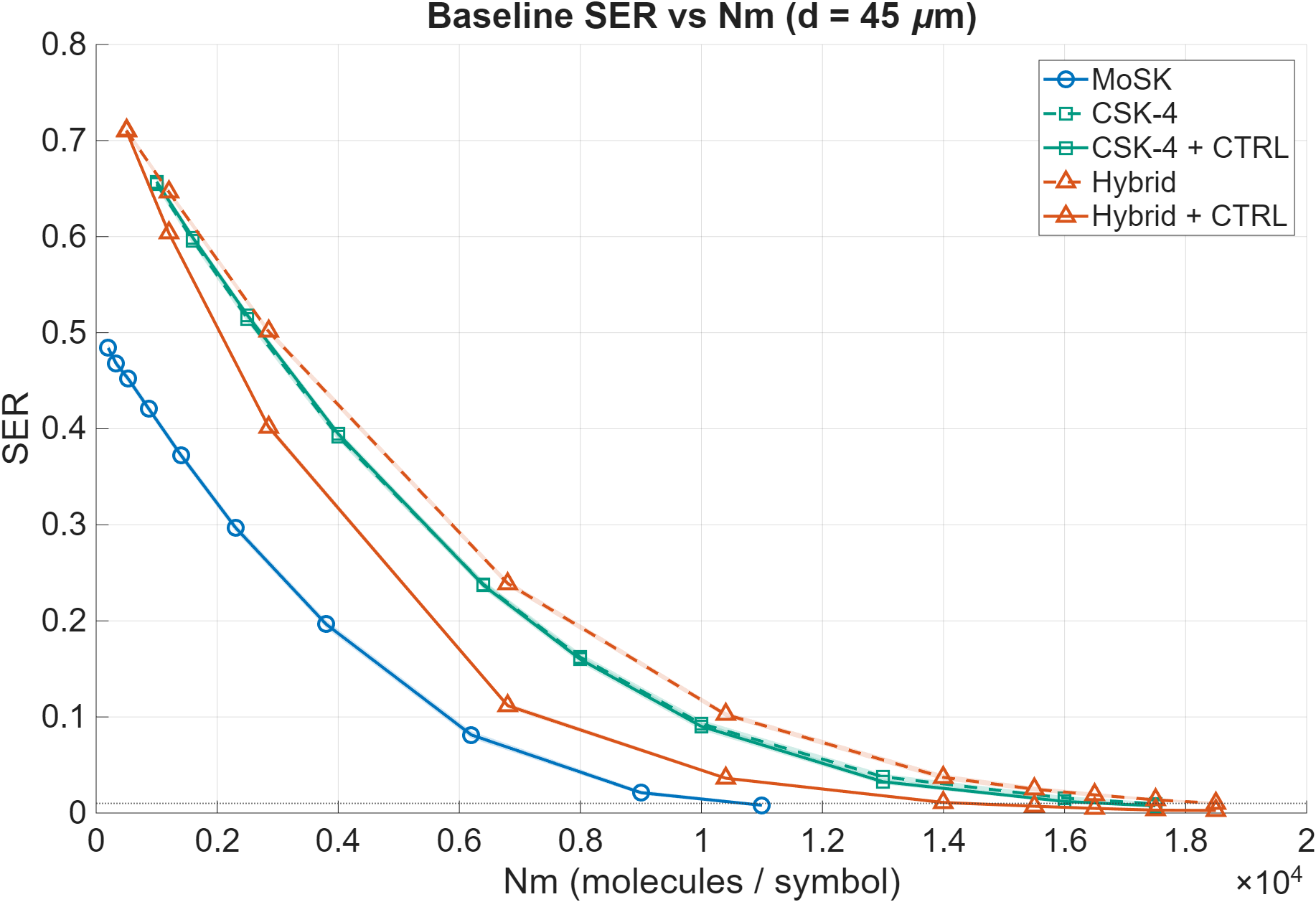

Figure 3: Nominal-spacing receiver error rates: control referencing yields a decisive reduction in amplitude-bit SER, accounting for the overall superiority of Hybrid+CTRL under drift-limited operation.
Distance dependence reveals a regime transition: at small gaps, plain amplitude detection suffices and referencing degrades SNR (due to added uncorrelated reference noise), but at larger distances—even modest increases—control referencing expands the feasible operation region (Figure 4).

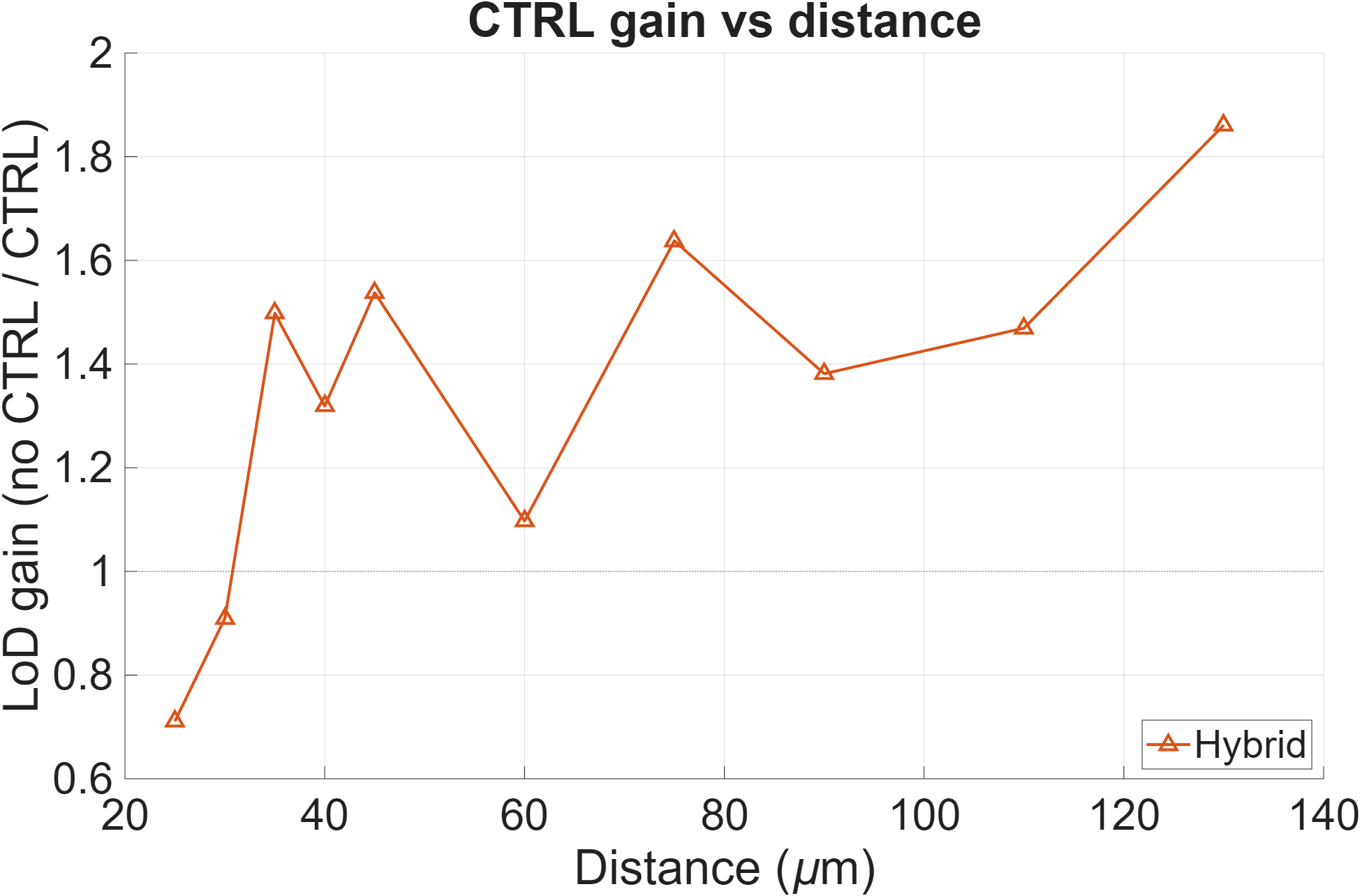
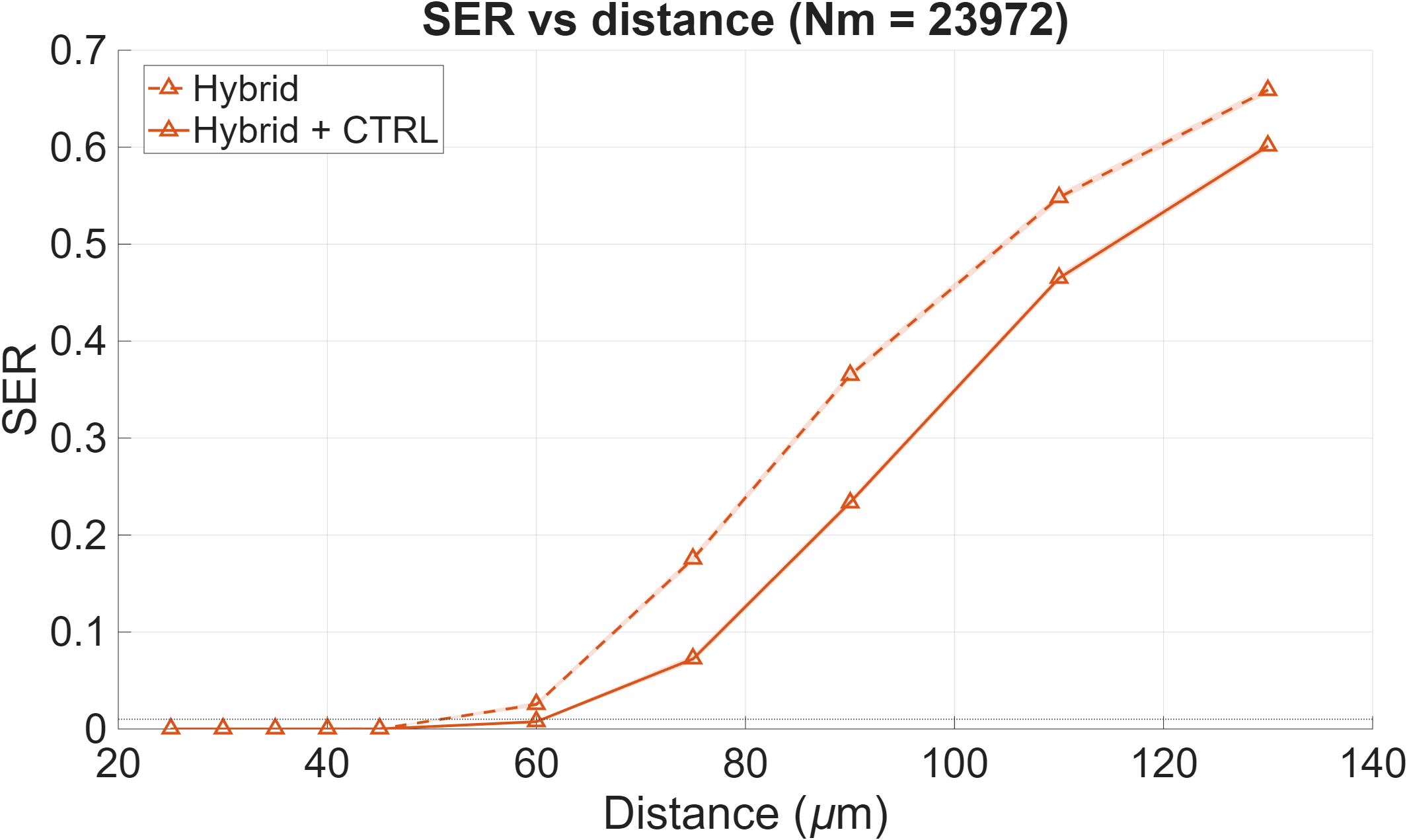
Figure 4: Control referencing lowers LoD at medium and long distances, with benefit ratio peaking as organoid-gate separation increases.
ISI-robust symbol timing shows that intermediate symbol periods balance molecular memory and signal dilution, with optimal windows for Hybrid signaling at ~2–3 minutes per symbol—consistent with slow-state neuromodulator readout, not high-throughput links (Figure 5).
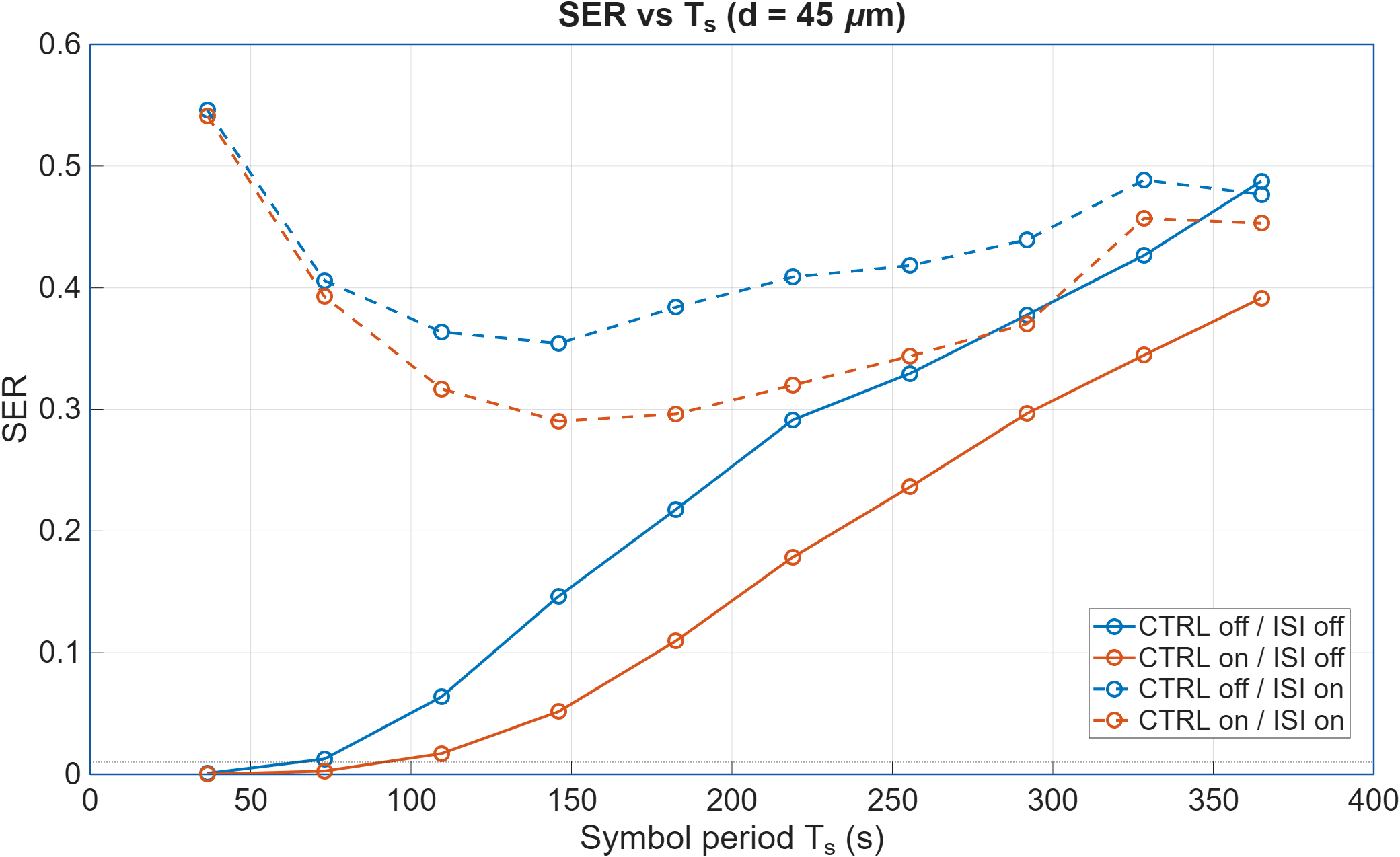
Figure 5: Symbol period analysis: ISI-optimal Ts results in minimum Hybrid SER, confirming necessity of timing co-design.
Device Parameter Sweep and Robustness
A joint sweep over OECT transconductance (gm) and capacitance (Ctot) reveals that higher gm and lower Ctot expand the region of sub-1% SER achievable with Hybrid+CTRL, with referencing providing the largest benefit near the SNR boundary (Figure 6).
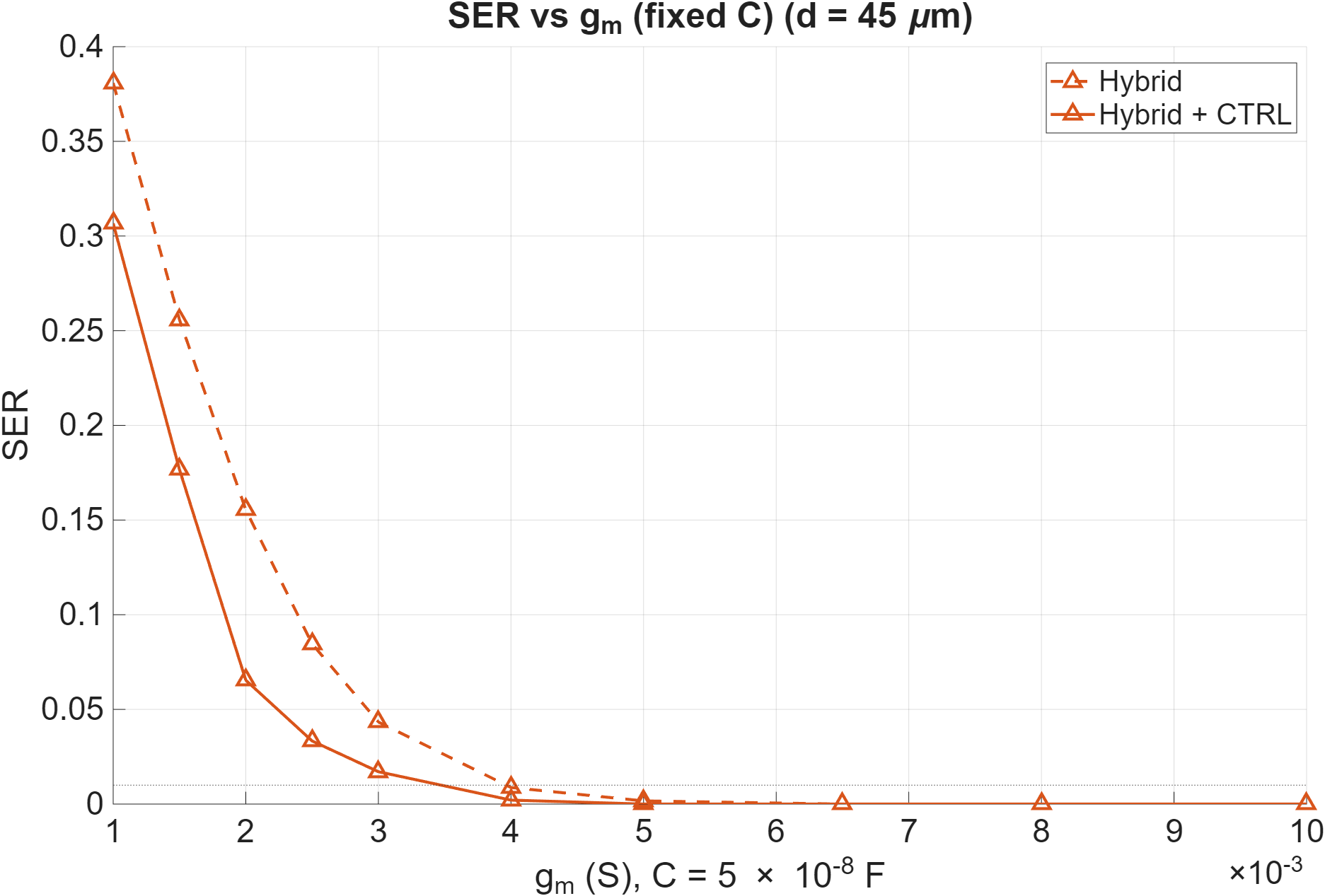
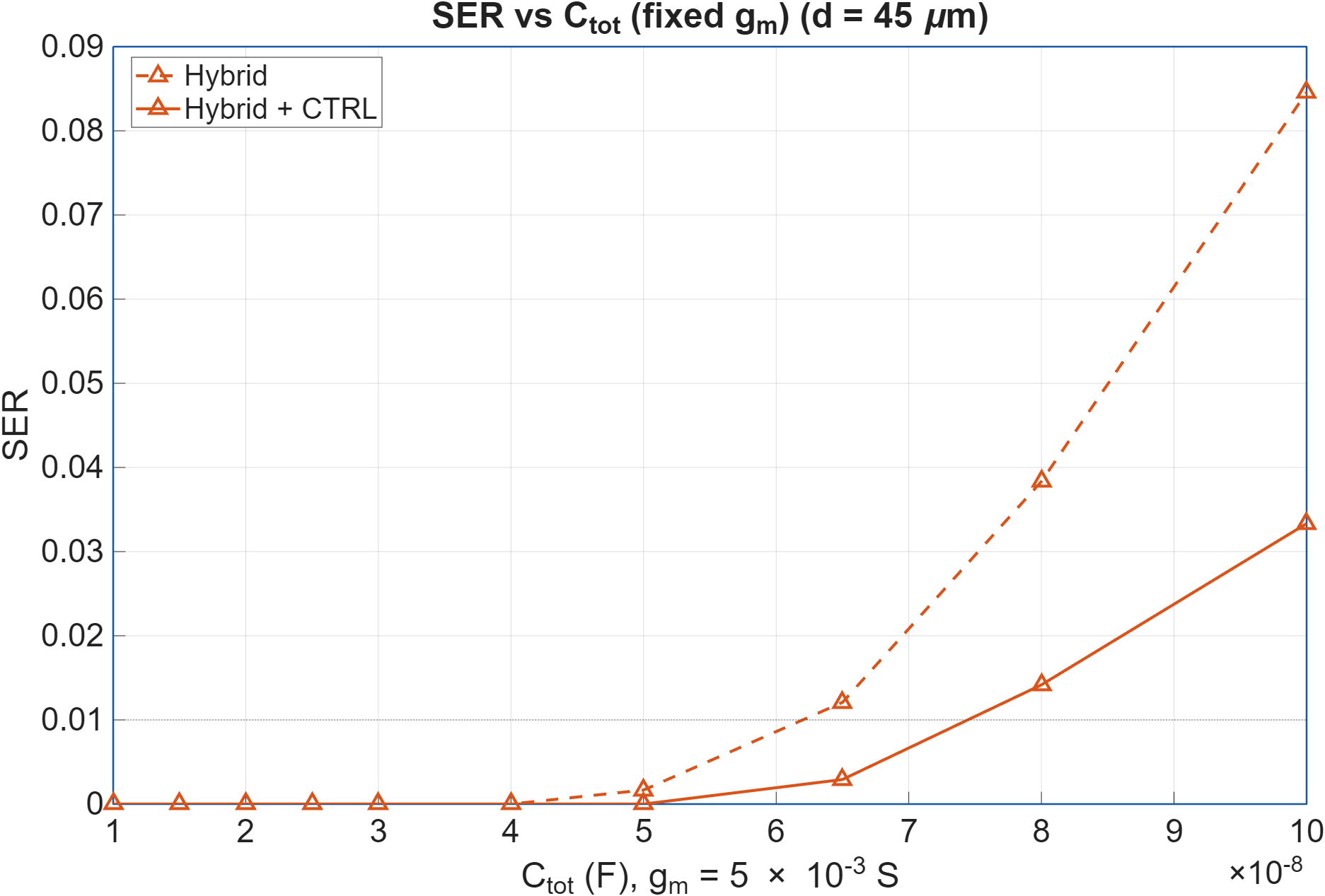
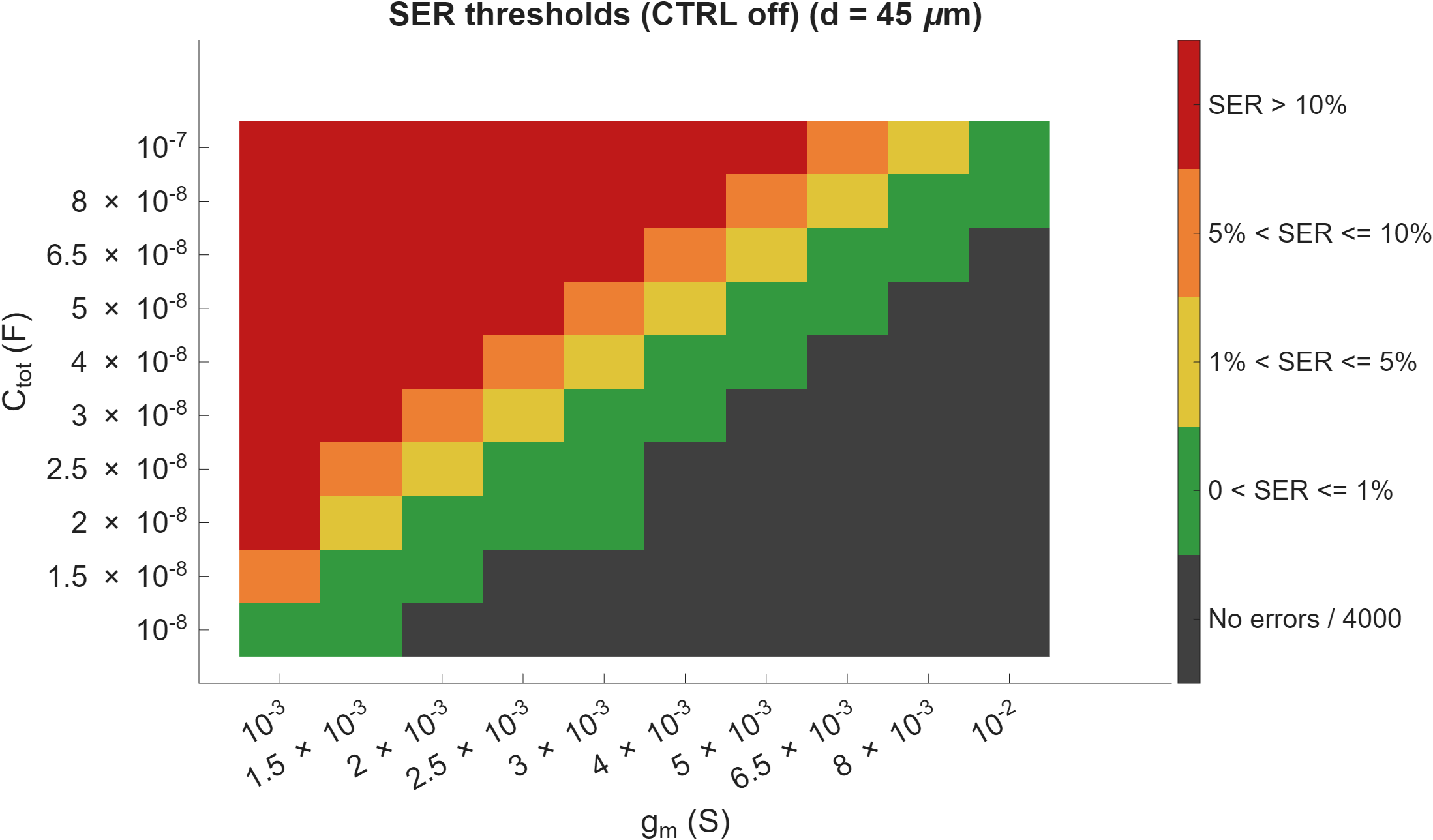
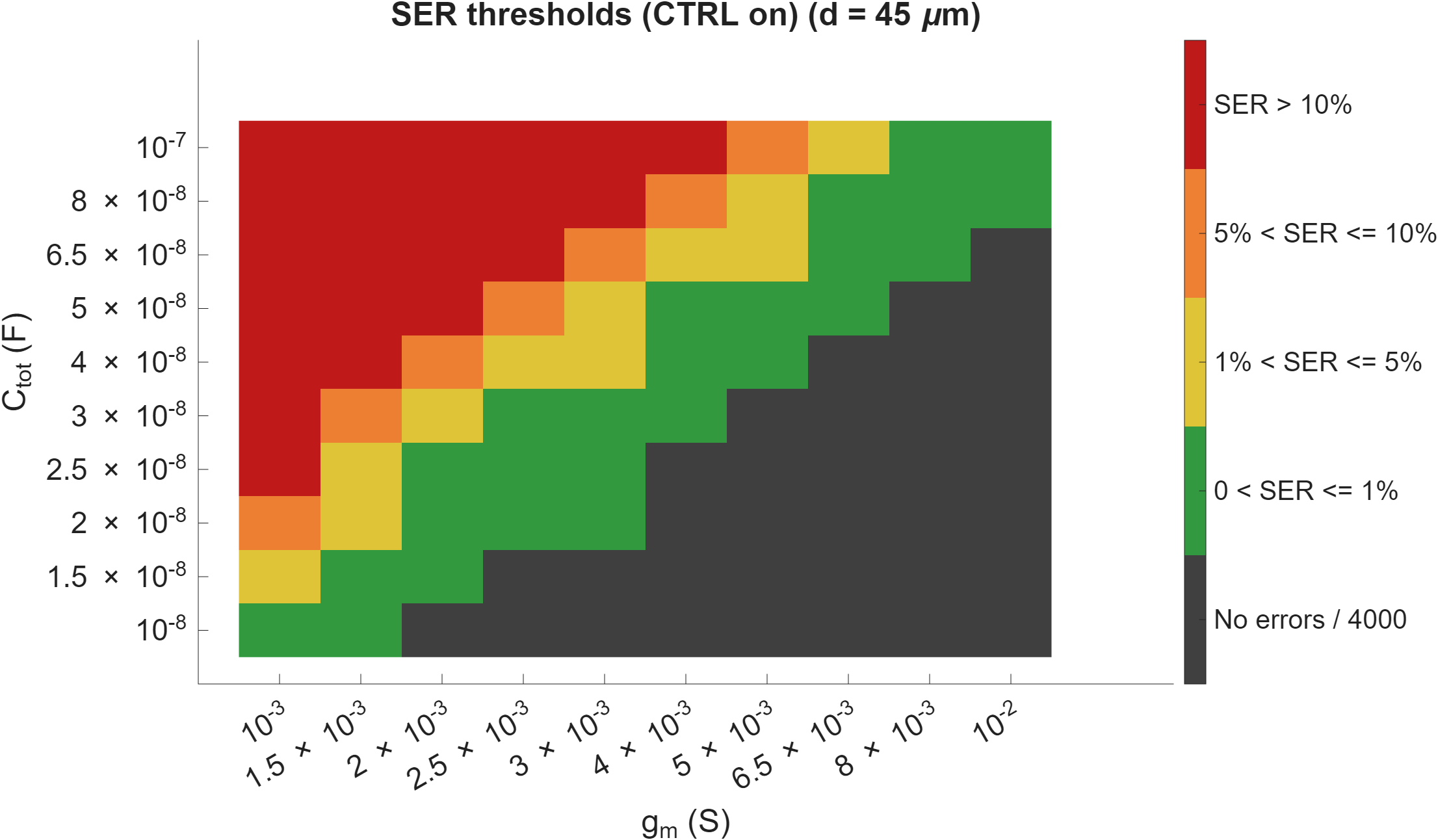
Figure 6: Device-level envelope for Hybrid: control referencing expands the region of feasible SER performance, especially at high Ctot or low gm.
Robustness testing under varying drift correlation, transport rates, and temperature demonstrates control referencing only yields a net benefit when pre-subtraction correlation exceeds a well-defined threshold, consistent with analytical predictions. In low-correlation or drift-weak regimes, the reference channel's uncorrelated noise dominates and reduces SNR (Figure 7).
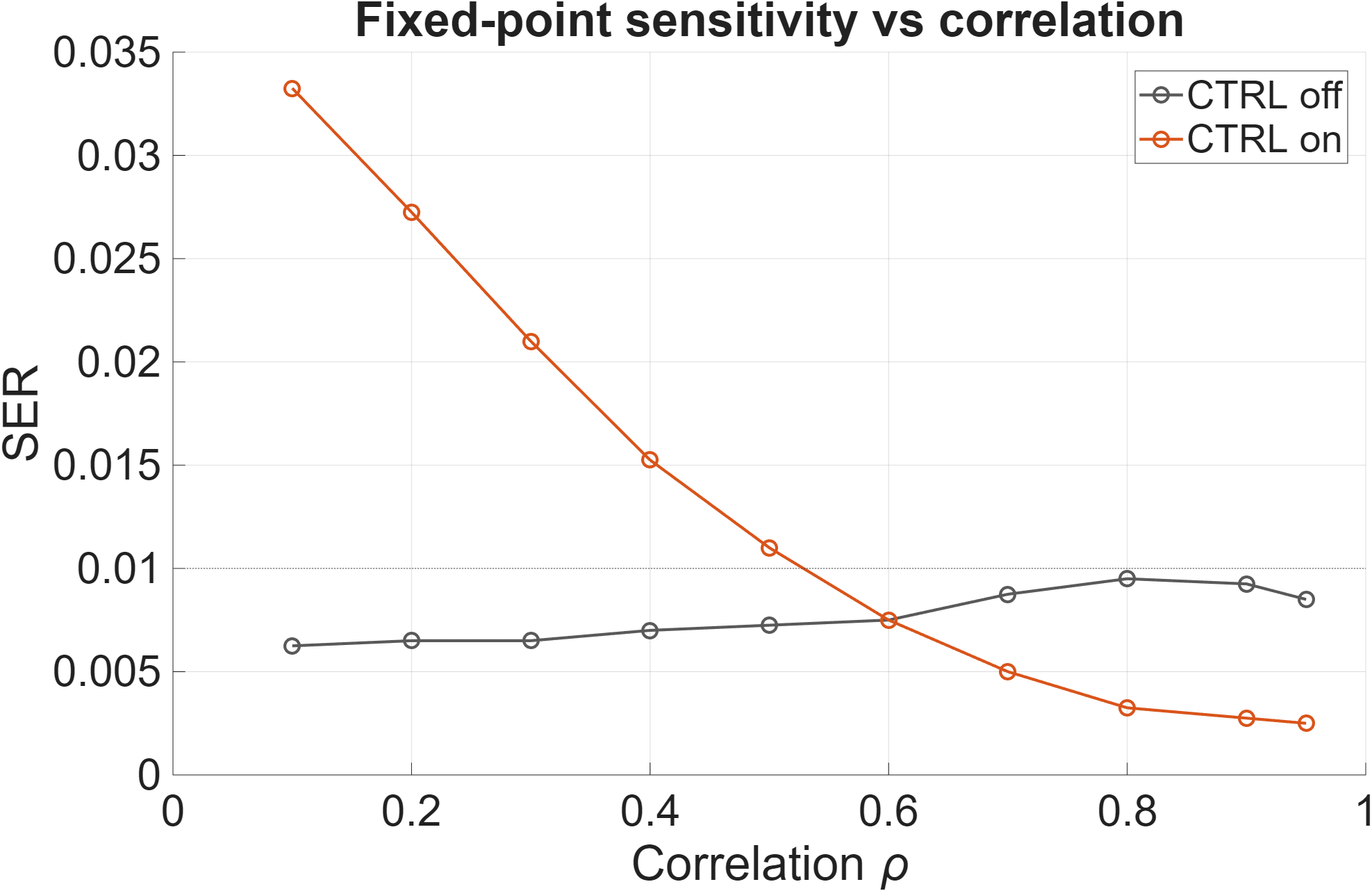
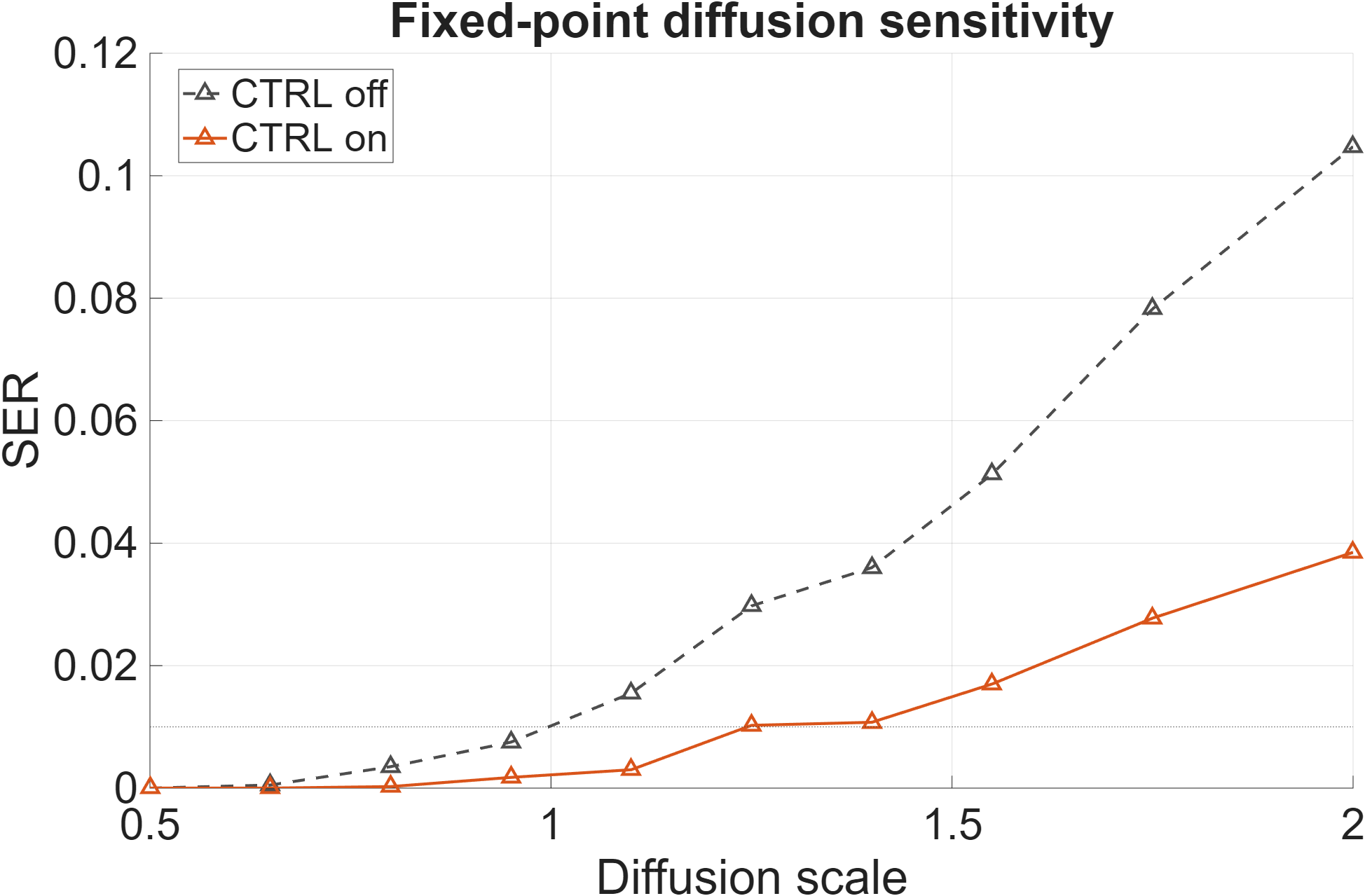
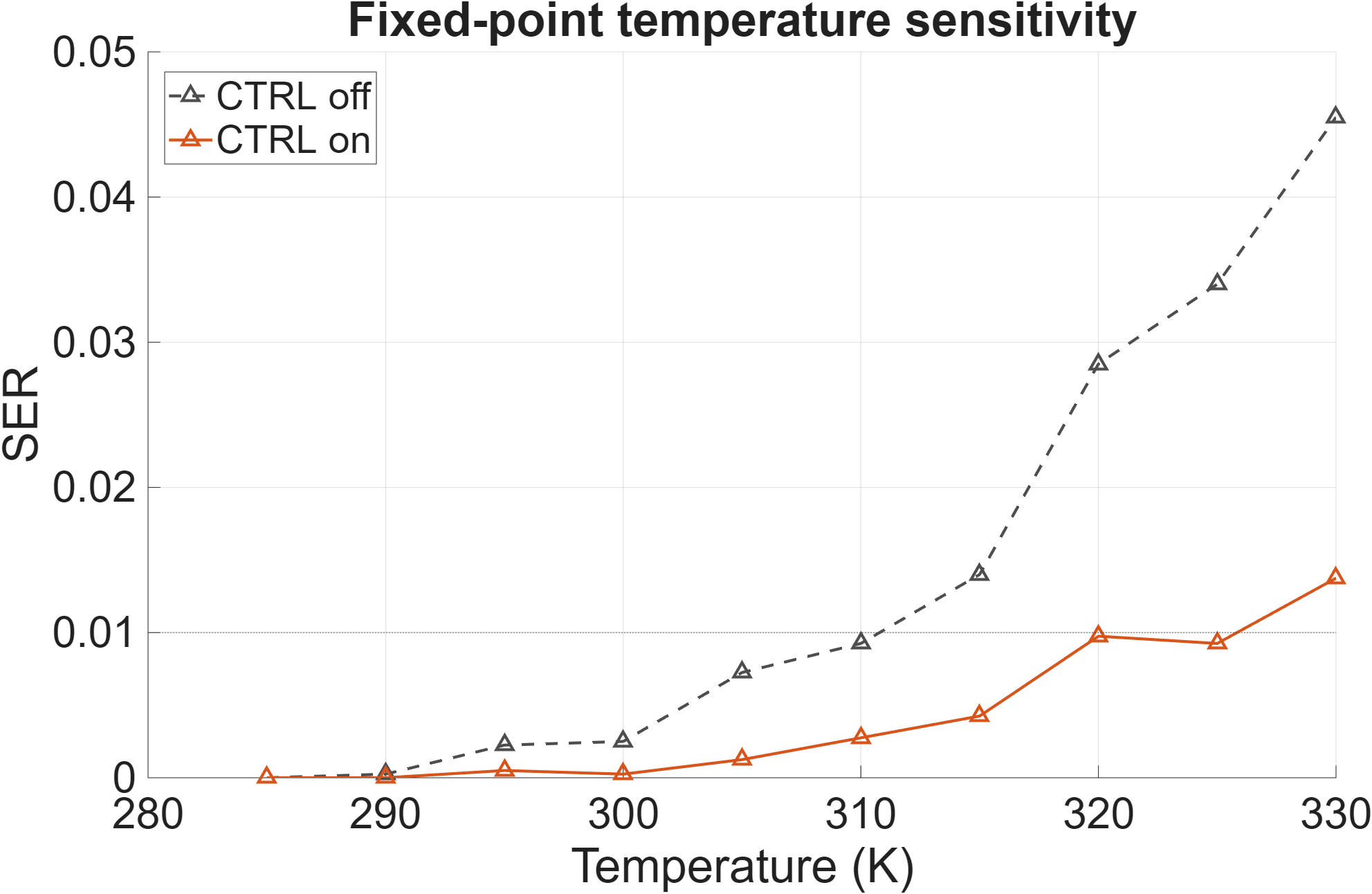
Figure 7: Hybrid robustness: referencing benefit sharply increases as common-mode drift dominates (high ρ), but is detrimental if correlation is weak or uncorrelated noise is major.
Theoretical Implications and Comparison to Prior Work
This receiver architecture advances the field in several essential ways:
- It explicitly quantifies when matched control referencing outperforms conventional single/multi-axis receptor arrays—grounded in SNR/correlation analysis, not ad hoc heuristics. The derived crossover for referencing benefit aligns closely with simulation results, generalizing to other correlated-noise-limited OECT or BioFET receivers.
- The multi-modality (Hybrid) detection architecture exposes distinct physical limits associated with identity and amplitude branches—elucidating for the first time the error budget allocation in a tri-channel OECT biosensor context.
- Comparison to prior MC receiver works confirms that while Hybrid MC is established, no prior platform combines a hydrogel-matched control axis with identity-amplitude two-bit detection under brain organoid-like biophysical constraints. Existing literature limits generally to either single-species BioFET/OECT receivers or to unreferenced cross-reactive arrays [kuscu2016physical, kuscu2021graphene, zhang2025organoid3d].
Practical Implications and Future Work
This analysis establishes that control-referenced, tri-channel OECT receivers provide a practical route to robust, scalable neuromodulator readout in developing organoid interfaces—specifically for architectures constrained by shared-gate drift and limited molecular budgets typical of long-term, low-bias organodic systems.
Design recommendations:
- Minimize organoid-gate separation to maximize SNR before referencing becomes mandatory.
- Implement matched, hydrogel-coated (but unfunctionalized) control references to suppress correlated baseline motion.
- Engineer higher gm and lower Ctot for maximal operational envelope, but include referencing to relax hard device constraints in SNR-limited operation.
- Co-optimize symbol duration and decision windowing in tandem with chemical/transport timescales to balance ISI and amplitude signal loss.
Limitations are acknowledged: the model assumes equal channel depths, no explicit chemical cross-reactivity in the control, and focuses on receiver architecture, not device fabrication; experimental validation and adaptation to more complex cross-coupled organoid environments remain for future research.
Conclusion
The presented framework and results evidence that incorporating a hydrogel-matched, control-referenced pixel fundamentally shifts the practical and theoretical feasibility for Hybrid molecular communication in brain organoid interfaces. This approach targets the amplitude-decoding bottleneck under correlated drift, enlarges the feasible design space for two-bit chemical symbol detection, and clarifies under what measurable physical circumstances control referencing provides net communication advantage. The tri-channel OECT paradigm thus outlines a robust, quantifiable path toward next-generation brain organoid bioelectronic readout platforms and informs future collaborative device and systems-level development in the molecular communications field.
Reference: "A Control-Referenced Tri-Channel OECT Receiver for Hybrid Molecular Communication Toward Brain Organoid Interfaces" (2604.10798).