- The paper demonstrates that vacancy-induced structural reconstruction in VX2 monolayers yields d‑wave altermagnetism with compensated zero net magnetization.
- Phonon dispersion and AIMD simulations confirm the dynamical and thermal stability of the reconstructed V2X2 inverse Lieb lattice.
- Momentum-dependent spin splitting with d₍x²–y²₎ anisotropy suggests promising applications in spintronic devices.
Structural Reconstruction Induced d-wave Altermagnetism in V2X2 (X=S,Se) Monolayer
Introduction
The paper "Structural Reconstruction Induced d-wave Altermagnetism in V2X2 (X=S,Se) monolayer" (2604.10768) investigates a symmetry-engineered route to realizing two-dimensional (2D) d-wave altermagnetism. By employing targeted chalcogen-cluster vacancies in trigonal VX2 monolayers, the authors drive a structural reconstruction leading to a monoclinic V2X2 inverse Lieb lattice. The resulting phase exhibits compensated magnetic order with zero net magnetization, momentum-dependent spin splitting, and strong dx2−y2 anisotropy without relying on relativistic effects.
Structural Engineering and Symmetry Analysis
Engineered removal of chalcogen chains in the VX2 monolayer induces a pronounced structural reconstruction. The system relaxes to a stable monoclinic phase (space group P2/m, C2h point group), distinct from the parent trigonal phase. The monoclinic X=S,Se0 forms an inverse Lieb lattice—a motif well known for supporting unconventional electronic and magnetic phenomena. The vacancy-induced reconstruction results in two inequivalent vanadium sites, X=S,Se1 and X=S,Se2, with distinct local coordination.
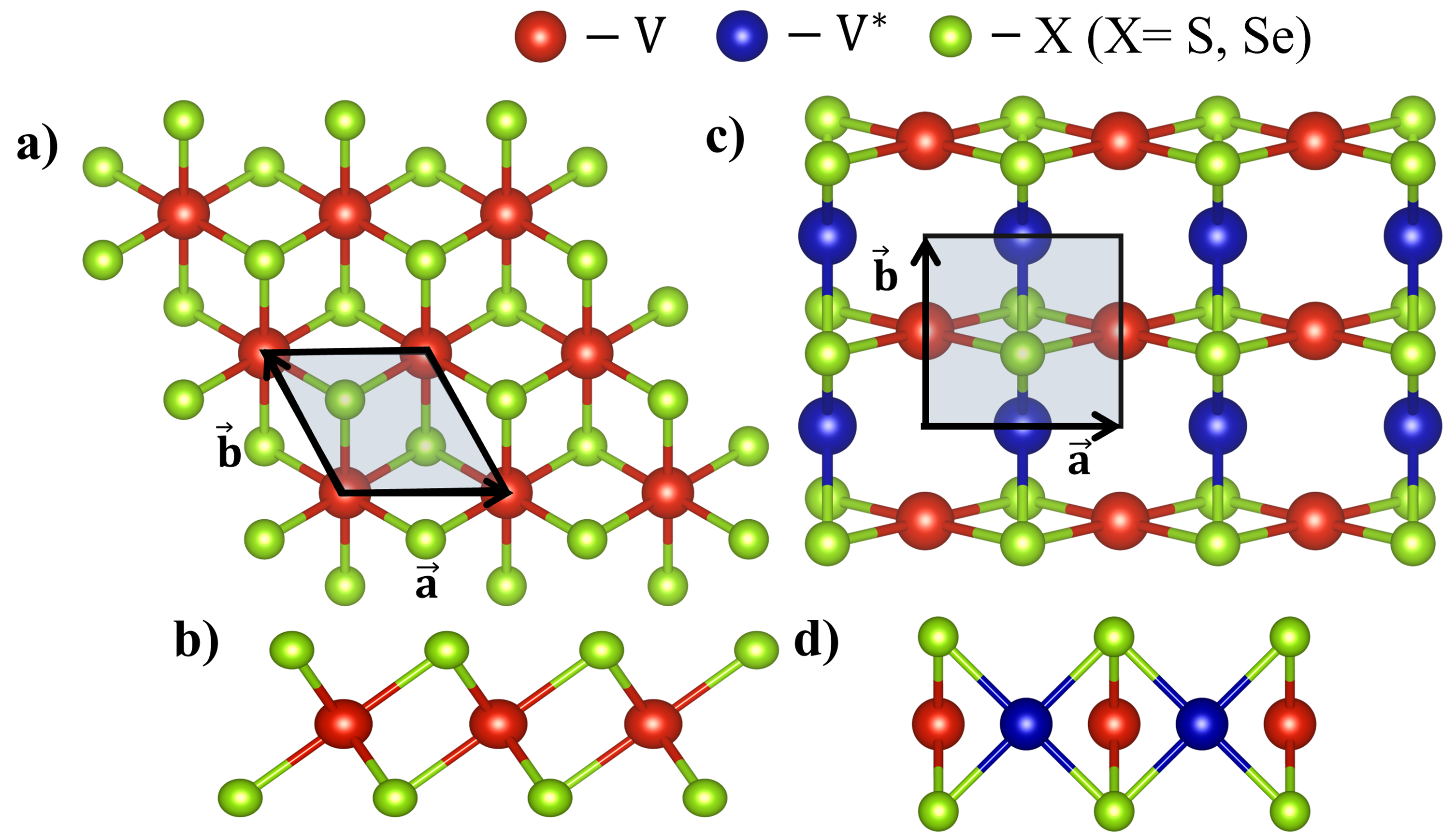
Figure 1: Top and side views of pristine X=S,Se3 and reconstructed X=S,Se4, showing the formation of eight-membered ring vacancies and the emergence of the inverse Lieb lattice with inequivalent vanadium sublattices.
Stability is corroborated through phonon dispersion analysis showing absence of imaginary frequencies and ab initio molecular dynamics (AIMD) simulations at 300 K, both supporting the experimental viability of the reconstructed phases.
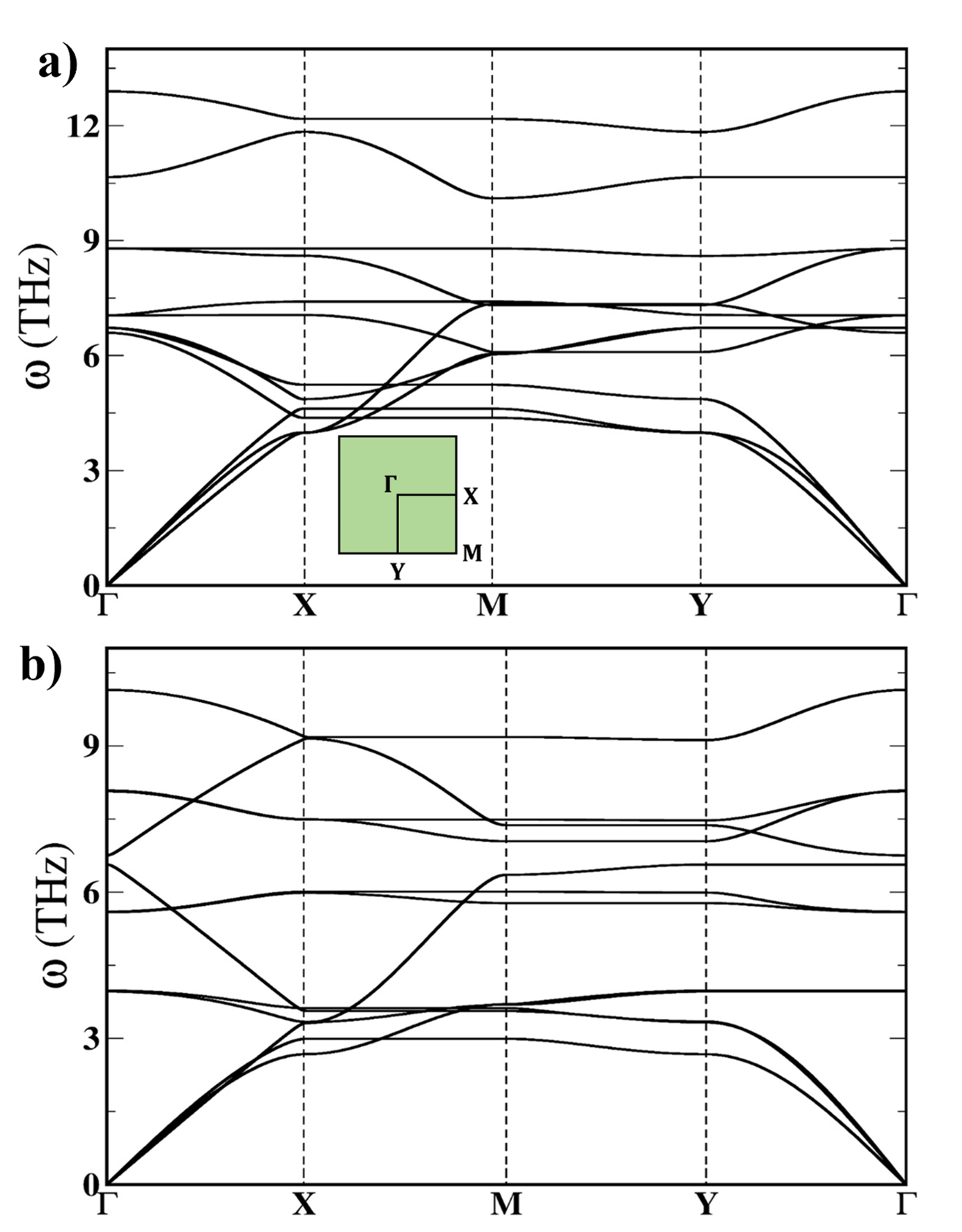
Figure 2: Phonon dispersions for X=S,Se5 and X=S,Se6, demonstrating dynamical stability due to the lack of imaginary modes.
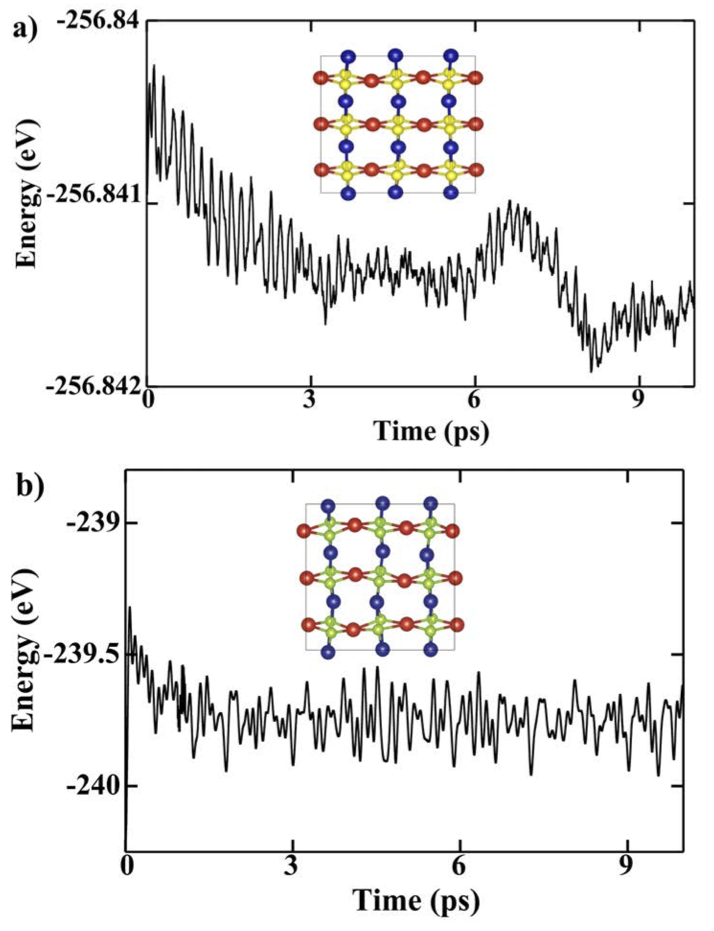
Figure 3: AIMD simulations at 300 K indicate thermal stability for both systems over 10 ps with no major structural distortions.
Magnetic Order and Symmetry-Enforced Features
Despite strong local moments localized on X=S,Se7 and X=S,Se8 sites, the system exhibits zero net magnetization—a key signature of compensated magnetic order in altermagnets. The two sublattices are related by X=S,Se9 rotational and V2X20 magnetic symmetry, rather than translation or inversion. This configuration breaks both time-reversal (V2X21) and combined inversion-time-reversal (V2X22) symmetries. Consequently, Kramers degeneracy is lifted not via relativistic effects, but through crystal symmetry engineering—yielding pronounced non-relativistic, momentum-dependent spin splitting.
Electronic Structure and d-wave Altermagnetism
First-principles calculations exhibit metallic band structures with band crossing near the Fermi level for both V2X23 and V2X24. The projected density of states confirms the dominant contribution from vanadium V2X25 orbitals, with negligible chalcogen V2X26-state weight. Most critically, pronounced spin splitting appears along the V2X27–V2X28 and V2X29–X=S,Se0 directions, alternating in sign and vanishing at the X=S,Se1 point, thus enforcing symmetry-protected nodes.
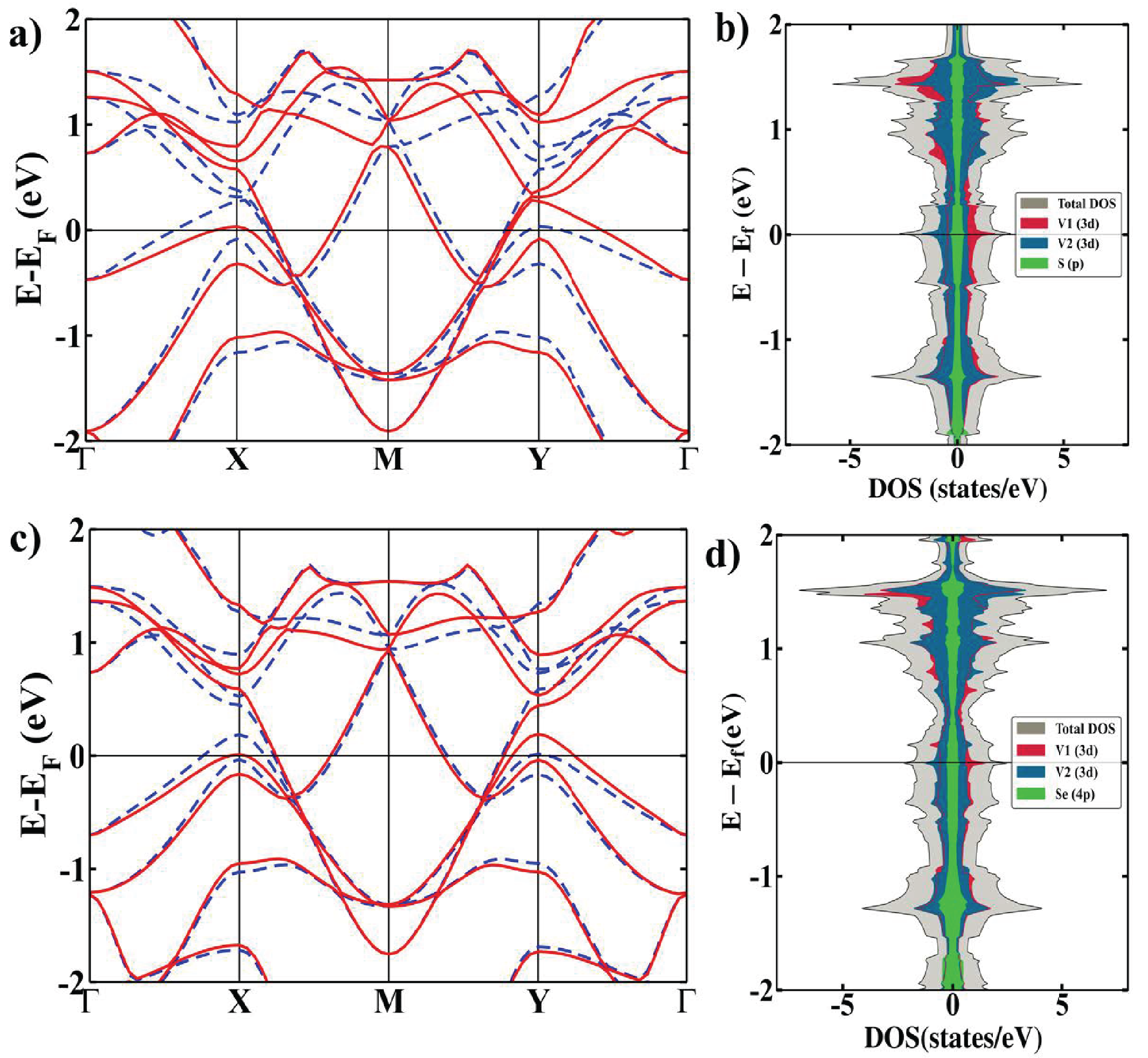
Figure 4: Spin-polarized band structures for X=S,Se2 showing anisotropic spin splitting and sign alternation, with PDOS underscoring vanadium X=S,Se3 orbital character.
Momentum-resolved Fermi surface analysis reveals two-dimensional spin-split contours with strong fourfold angular modulation, consistent with a X=S,Se4 symmetry. The spin splitting can be modeled as
X=S,Se5
which is characteristic of d-wave-type altermagnetism. The splitting is maximal along high-symmetry directions and vanishes at specific nodal points.
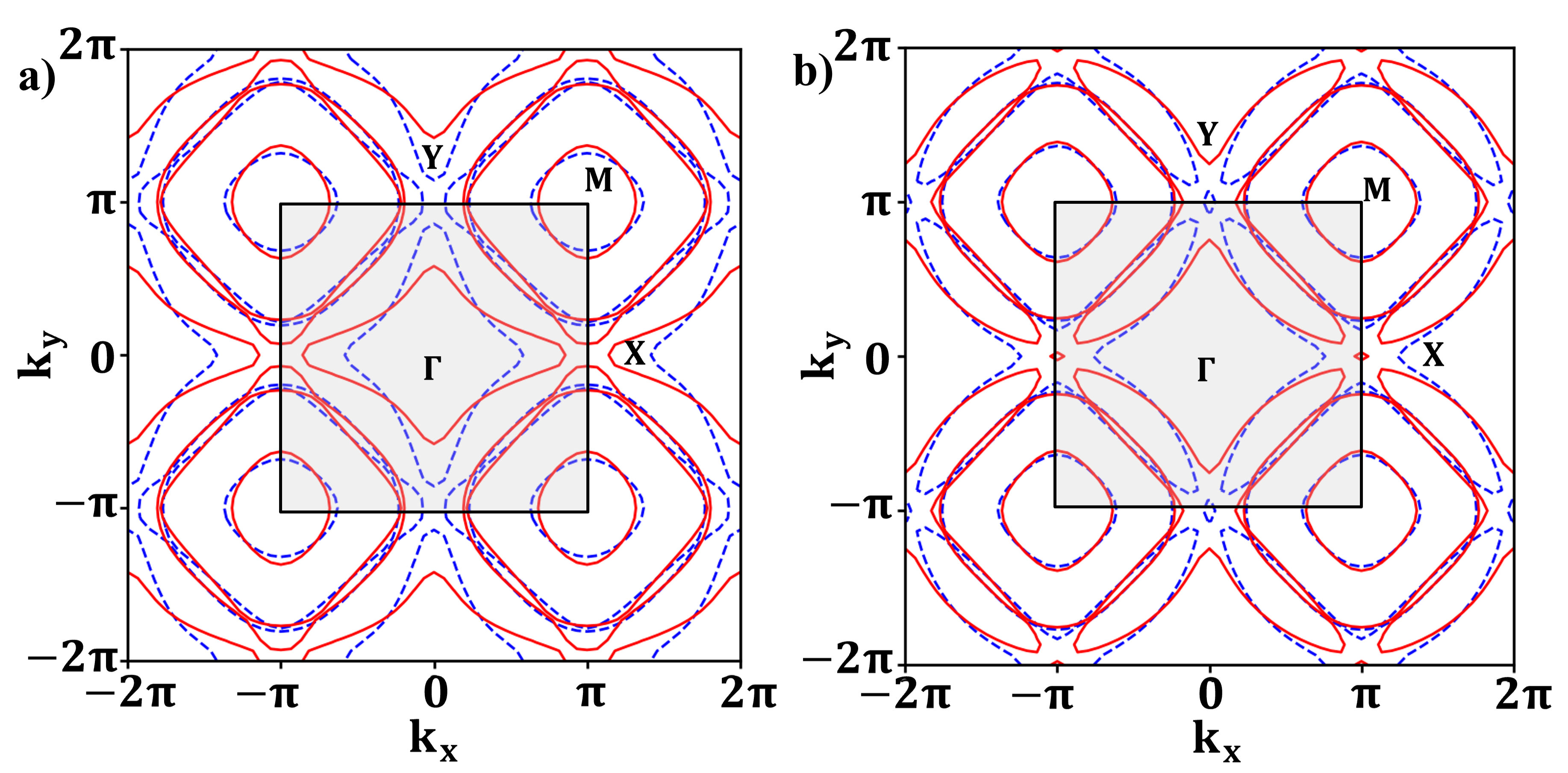
Figure 5: Spin-resolved 2D Fermi surface contours for X=S,Se6 and X=S,Se7, demonstrating momentum-dependent d-wave anisotropy and symmetry-enforced nodes at X=S,Se8.
The real-space spin density reveals antiferromagnetic-like spin texture, with opposite and localized spin polarization on X=S,Se9 and VX20. The two-lobed, anisotropic spin density reflects the VX21-orbital character and confirms real-space realization of d-wave altermagnetic order.
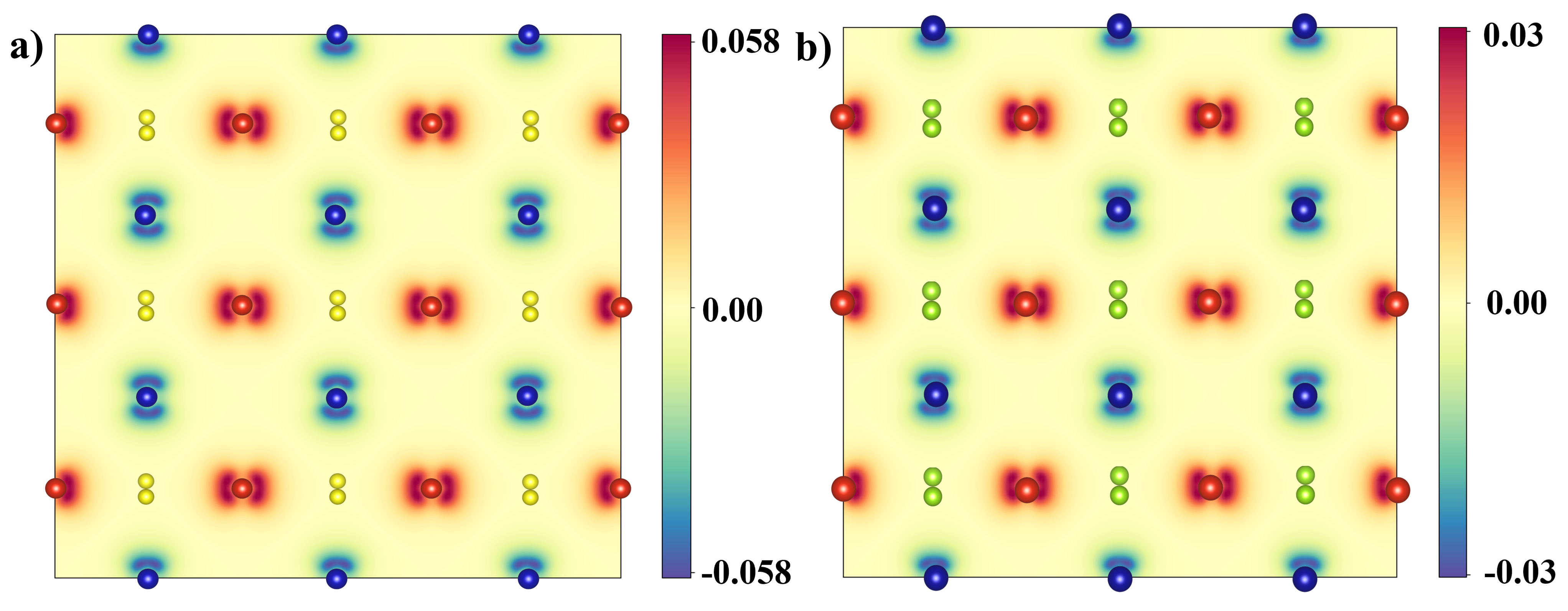
Figure 6: Real-space spin-density in VX22 and VX23, highlighting the antiparallel spin polarization on two nonequivalent vanadium sublattices.
Numerical Results and Contradictory Claims
- Negative formation energies (VX24) for both VX25 and VX26 underpin their energetic and potential synthetic feasibility.
- Complete absence of imaginary phonon modes in both cases establishes robust dynamical stability.
- Thermal stability at room temperature is confirmed via AIMD, further supporting practical realization.
- Zero net magnetization exists despite strong spin-polarization, consistent with altermagnetic order and in contrast to conventional antiferromagnets or ferrimagnets.
- Momentum-dependent spin splitting without spin-orbit coupling constitutes a strong, symmetry-driven deviation from conventional magnetism, directly supporting the non-relativistic altermagnetic mechanism.
Implications and Outlook
The demonstration of vacancy-induced, VX27-wave altermagnetism in VX28 monolayers opens a direct pathway to engineer and stabilize altermagnetic phases in 2D materials. Symmetry control via atomic-scale reconstruction enables tunable, compensated magnetic states with highly anisotropic spin-polarization locked in momentum space—a regime unattainable in ferromagnets or conventional antiferromagnets. Practical implications include:
- Integration in spintronic devices requiring dissipationless spin transport, protection against stray fields, and ultrafast terahertz spin dynamics.
- Potential to support anomalous Hall and spin Hall effects in the absence of net magnetization or strong spin-orbit coupling, enhancing design space for topological spin phenomena.
- Facilitation of experimentally-driven search for 2D altermagnets, as the underlying engineering principle (cluster-vacancy driven reconstruction) is broadly accessible to material synthesis.
This framework further suggests that other 2D systems with similar lattice versatility and the capacity for controlled vacancy engineering (e.g., Janus platforms, transition metal dichalcogenides, inverse Lieb lattices) may harbor tunable altermagnetic and topological order [9wcm-pmr2].
Conclusion
The study establishes that chalcogen cluster vacancy engineering in VX29 monolayers enables stabilization of d-wave altermagnetism in V2X20, characterized by compensated magnetic order, V2X21-type, strongly anisotropic momentum-dependent spin splitting, and robust structural, dynamical, and thermal stability. The approach facilitates symmetry-selective design of 2D altermagnets suitable for next-generation spintronic applications without reliance on relativistic effects. Future theoretical and experimental investigations into transport, magneto-optical response, and topological phenomena in these systems are warranted.