- The paper establishes RbCr₂Se₂O as a robust d-wave altermagnet by revealing a significant energy gap between C-type and G-type AFM configurations.
- It employs DFT calculations with Hubbard U corrections and van der Waals interactions to uncover strain-tunable piezomagnetic effects and distinct spin-resolved band structures.
- The study extends these findings to the XCr₂Y₂O family, indicating potential spintronic applications through symmetry-protected spin splitting.
Robust d-Wave Altermagnetism in RbCr2Se2O
Introduction
This paper investigates RbCr2Se2O as a model system for robust d-wave altermagnetism, a class of magnetism that supports spin-split electronic bands without net magnetization or spin-orbit coupling, yet permits compensated collinear order. The work distinguishes the material from earlier quasi-two-dimensional candidates such as KV2Se2O, Rb1−δV2Te2O, and Cs1−δV2Te2O, which display near-degeneracy between C-type and G-type AFM configurations. In contrast, RbCr2Se2O exhibits a substantial energy gap between these configurations, conferring robust, unambiguous d-wave altermagnetic order. This distinction is validated across a family of isostructural compounds XCr2Y2O (X=K, Rb, Cs; Y=S, Se, Te), extending the relevance of the findings.
Materials, Magnetic Structures, and Methodology
RbCr2Se2O0 is crystallographically analogous to other known RbCr2Se2O1-wave altermagnetic materials, adopting the RbCr2Se2O2 space group and a layered structure of Rb and RbCr2Se2O3 stacks.
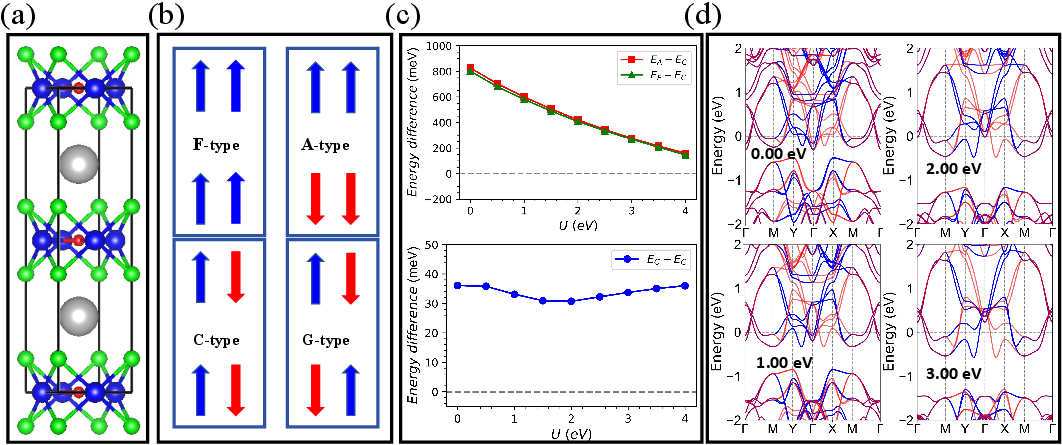
Figure 1: The crystal structure, four magnetic configurations (F-, A-, C-, G-type), relative energies versus RbCr2Se2O4, and C-type AFM band structures for RbCr2Se2O5.
The paper considers four primary magnetic configurations:
- F-type: FM intralayer, FM interlayer,
- A-type: FM intralayer, AFM interlayer,
- C-type: AFM intralayer, FM interlayer (apparent altermagnetic),
- G-type: AFM intralayer, AFM interlayer (hidden altermagnetic).
The interplay of crystal and spin symmetries (RbCr2Se2O6 with RbCr2Se2O7) dictates distinct electronic characteristics. Density functional theory calculations are performed with Hubbard RbCr2Se2O8 corrections and van der Waals interactions, ensuring robust determination of the electronic and magnetic ground state.
Ground-State Magnetism and Electronic Structure
The C-type configuration emerges as the ground state of RbCr2Se2O9, with a pronounced energy separation from G-type—an essential result, as in prior vanadium-based systems these energies are nearly degenerate. This large energy difference, maintained across all reasonable RbCr2Se2O0 values and when including van der Waals corrections, eliminates ambiguity in experimental assignments of the microscopic magnetic order.
The calculated electronic band structure in the C-type phase manifests RbCr2Se2O1-wave altermagnetism, characterized by spin degeneracy along the RbCr2Se2O2-M line and alternating spin splittings along the M-Y-RbCr2Se2O3 and M-X-RbCr2Se2O4 directions.
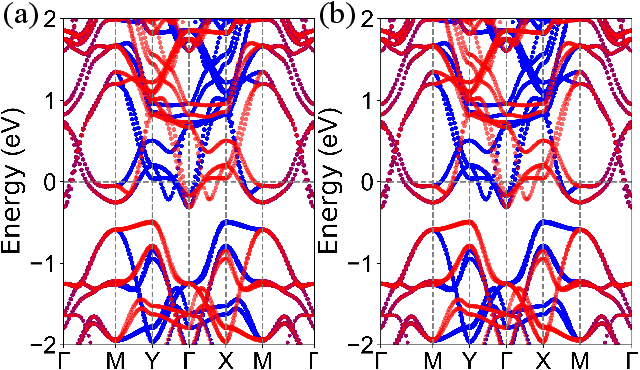
Figure 2: Spin-resolved band projections onto sectors A and B of the RbCr2Se2O5 layers in the C-type configuration, without uniaxial strain.
Projections onto individual layers (sectors A and B) confirm equivalent spin textures, validating that net moments are absent but local spin-polarized transport is symmetry-allowed. In contrast, the G-type configuration retains RbCr2Se2O6 symmetry with compensated and locally split states.
Strain-Tunable Magnetoelectronic Response
A key result is the direct piezomagnetic effect realized under in-plane uniaxial strain. Application of strain along the RbCr2Se2O7-axis induces a net magnetic moment exclusively in the C-type configuration, transitioning the system from altermagnetic to ferrimagnetic with an RbCr2Se2O8-wave symmetry component in the spin-split bands.
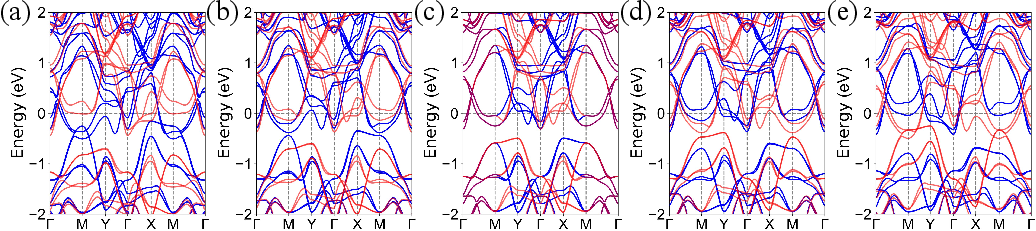
Figure 3: Energy band structure evolution in C-type RbCr2Se2O9 for varying uniaxial strain (d0).
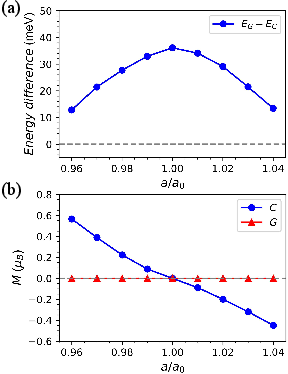
Figure 4: G-type energy relative to C-type as function of d1 and the total magnetic moment versus strain for both C- and G-types.
The system supports a measurable magnetic moment up to d2 per formula unit at d3, with a nearly linear strain response. In contrast, the G-type configuration remains robustly compensated with zero net moment for all strains, demonstrating the discriminative power of combined transport and magnetization measurements under strain.
Extension to the d4 Family
Comprehensive calculations are repeated for isostructural compounds d5, d6, d7, d8, d9, KV2Se2O0, KV2Se2O1, and KV2Se2O2. Across this series, the C-type phase maintains the lowest energy, and the corresponding KV2Se2O3-wave spin-splitting patterns in the band structures are consistently observed.
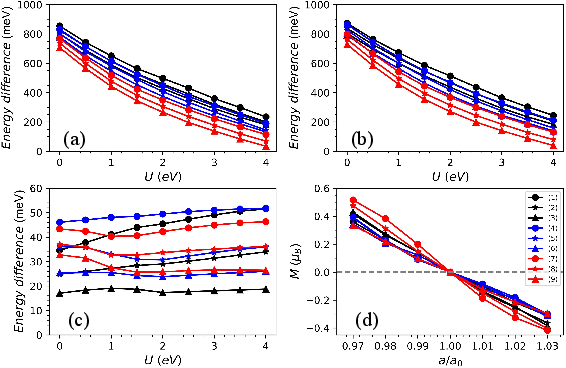
Figure 5: Magnetic energies versus KV2Se2O4 and strain dependence of net magnetic moment for the broader KV2Se2O5 series.
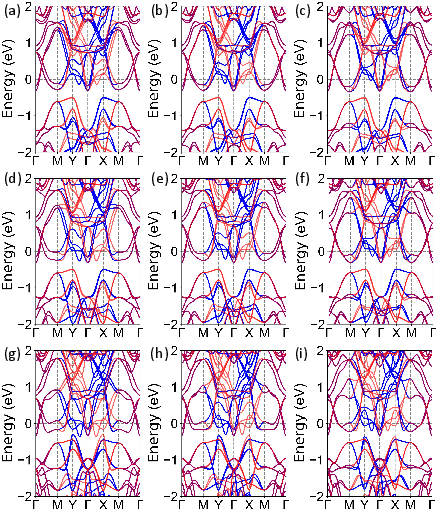
Figure 6: Band structures with C-type configuration for the nine KV2Se2O6 compounds, consistently exhibiting KV2Se2O7-wave spin splitting.
All variants display significant net piezomagnetic moments under in-plane strain, suggesting experimental generality of these responses.
Experimental and Theoretical Implications
The existence of a robust energy gap between C-type and G-type configurations in KV2Se2O8 enables unambiguous assignment of magnetic ground states in experimental settings, overcoming the difficulties of near degenerate states and domain averaging. The direct piezomagnetic effect does not require carrier doping, in contrast to semiconductor piezomagnetism, facilitating clear discrimination between apparent and hidden altermagnetic orders. The KV2Se2O9-wave altermagnetic states offer symmetry-protected spin splitting ideal for spintronic application, and strain engineering provides a viable route for tunable spin transport phenomena.
Theoretically, the findings reinforce the generality of altermagnetic order beyond vanadium-based compounds and delineate the symmetry constraints that enable observable, controllable spin physics even in net-compensated antiferromagnets.
Conclusion
The paper establishes Rb1−δV2Te2O0 as a robust Rb1−δV2Te2O1-wave altermagnet, distinguished by a sizable and Rb1−δV2Te2O2-independent energetic preference for the C-type AFM configuration, strong symmetry-protected spin splitting, and a strain-tunable piezomagnetic response. The extension to the Rb1−δV2Te2O3 class points to a broad family of materials poised for experimental exploration and exploitation in spintronic technology. The approach for distinguishing apparent and hidden altermagnetic states via strain-induced magnetization provides a practical diagnostic tool relevant to both fundamental magnetism and device applications. Future research may focus on the experimental realization of predicted phenomena, interface engineering for device integration, and investigation of coupled electronic and lattice dynamics in the altermagnetic state.