- The paper establishes that affective coupling, with a critical threshold (λ* ≈ 0.91), is essential to switch agent behavior from self-serving to prosocial.
- It employs a minimal recurrent controller and targeted lesion studies to disentangle the impacts of regulatory coupling versus cognitive observation.
- Experimental results reveal that only agents with affective coupling exhibit helping behaviors across one-step and sequential tasks under varied metabolic loads.
Prosociality by Regulatory Coupling: Mechanistic Dissection in a Minimal Recurrent Artificial Life Agent
Introduction
This study addresses the architectural basis for prosocial behavior in artificial agents, focusing on the distinction between enabling prosociality via direct observation of another agent's internal state versus affective coupling—routing another's distress into one's own homeostatic regulation. Building on recent demonstrations in learned multi-agent scenarios, this work implements and analytically decomposes the same dissociation within a minimal, directly inspectable recurrent controller, augmenting the ReCoN-Ipsundrum framework with a scalar homeostat and a tunable coupling channel. The design ensures that all planning is strictly self-directed, with no explicit social reward. This architectural parsimony allows for rigorous causal lesion studies, exact solvability in single-step tasks, and transparent attribution of mechanisms, providing methodological clarity for artificial life experiments on social behavior.
Mechanistic Framework and Experimental Design
The base agent architecture is a recurrent controller with a persistence loop and an explicit affective proxy, extended by an internal homeostatic state and a coupling channel. The agent estimates both its own and a partner's energy levels, with homeostatic error for self and partner combined by a coupling strength parameter λ. Only the agent's own future internal state is used for planning—no explicit partner-welfare objective is present. Four conditions are tested: no social access, cognitive state access without coupling, affective coupling, and full access with coupling. Tasks include a one-step deterministic food-sharing scenario (FoodShareToy) and a sequential plan-rescue scenario (SocialCorridorWorld). Causal control is exerted through three lesion conditions (sham, coupling-off, partner-signal-shuffled), and λ is systematically varied under different metabolic loads.
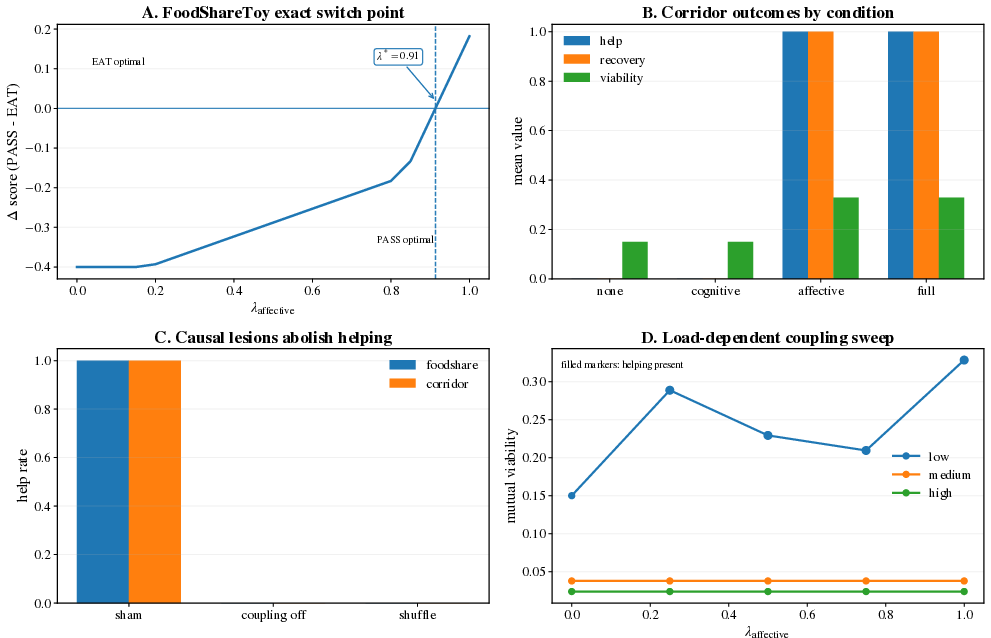
Figure 1: Mechanism-linked summary outlining analytic threshold, behavioral effects by condition, lesion impacts, and the coupling-load feasibility boundary.
Results
Analytic Threshold and One-Step Task
The FoodShareToy analysis establishes a precise behavioral switch: for λ∗≈0.91 in the default initial state, the planner's preference shifts from self-serving (Eat) to prosocial (Pass). Empirical runs confirm that, across all seeds and runs, agents with only state observation (social_none, social_cognitive_direct) never help, whereas affectively coupled agents (social_affective_direct, social_full_direct) always help. The energetic cost-benefit trade-off is explicit: only coupling prompts costly prosocial action, with no hidden incentives or reward shaping.
Sequential Rescue and Trajectory Analysis
The multi-step SocialCorridorWorld task demonstrates the same mechanistic pattern in a temporally extended setting. Only in the presence of affective coupling does the agent perform a fetch–carry–pass sequence to deliver food to a partner. All behavior metrics—help rate, partner recovery, rescue latency, and mutual viability—shift discretely between non-coupled (no help, no recovery) and coupled (full help, recovery in minimal steps) conditions.
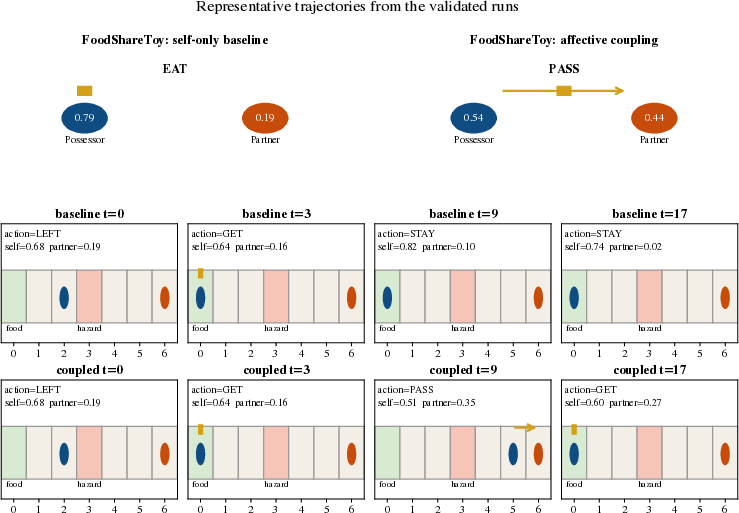
Figure 2: Representative trajectory samples; only the coupled agent executes food-sharing in both the one-step and sequential tasks.
Causal Lesion Evidence
Selective removal or corruption of the coupling channel (while leaving all other mechanisms intact) abolishes prosocial actions. Sham lesions have no effect, confirming specificity. Partner-signal shuffling is as effective at eliminating helping as direct coupling-off, showing that the pathway's informational integrity, not mere scalar augmentation, is critical.
Coupling-Load Feasibility Boundary
Systematic sweeps of λ across metabolic loads reveal a non-monotonic feasibility relation: under low load, helping emerges at λ≥0.25; under higher loads, even maximal coupling fails to elicit prosocial rescue within the agent's planning horizon. The critical coupling threshold thus co-varies with ecological constraints, not only architectural parameters. This boundary condition demonstrates that affective coupling is necessary but not always sufficient; ecological factors can limit the expression of prosociality even under maximal regulatory integration.
Theoretical and Methodological Significance
This research formalizes a strict mechanistic separation between two social information routes: passive observation and active regulatory coupling. It shows that direct access to another's internal state does not suffice to induce helping unless that information is explicitly routed into the agent's control objective. This strengthens prior empirical claims with analytic assurance, full introspectability, and direct causal manipulations. The methodology leverages minimization and maximal transparency, eschewing performance-centric optimization in favor of architectural clarity. The findings have implications for the interpretation of agent behavior in synthetic systems: apparent prosociality is not robust evidence of social cognition or empathy when basic control architectures can achieve it under carefully constrained conditions.
Practically, these results constrain the design space for artificial agents in multi-agent environments. They suggest that to engineer agents capable of context-appropriate prosocial action without extrinsic partner reward, regulatory coupling is essential—while observation alone is inert unless converted into endogenous control error. Theoretically, the work provides a tool for investigating the minimal sufficient conditions for the emergence of social interaction motifs, allowing targeted "mechanistic opening" of architectures to test which behaviors persist under introspection and lesion.
Future Directions
Although the current system forgoes adaptation, learning, and interactive partners, its mechanistic legibility makes it an ideal platform for probing the development and stability of social control architectures. Future work could explore gradient-based training atop this mechanistic core, richer partner modeling, non-deterministic environments, and the integration of explicit autobiographical memory for agent- and partner-based prediction.
Conclusion
This study delivers a precise architectural test: affective coupling, not mere observation, is necessary for prosocial helping in a minimal recurrent agent. The regulatory route from partner state into homeostatic error is both necessary and sufficient in this framework; this claim holds robustly across analytic solution, trajectory inspection, and targeted lesions. For artificial life and multi-agent AI, such mechanistic clarity is foundational for distinguishing genuinely emergent social interactions from trivial reward shaping or architectural artifacts.