- The paper identifies magnetic reconnection at a hyperbolic flux tube (HFT) as the primary mechanism driving the confined flare.
- It employs data-driven non-force-free field extrapolation and 3D MHD simulations to capture current sheet formation and complex field line dynamics.
- Observations confirm that slipping reconnection in quasi-separatrix layers (QSLs) shapes the flare's multi-ribbon morphology and energy release.
Magnetic Reconnection at Hyperbolic Flux Tubes and Confined Flares in NOAA AR 12268
Introduction
This work presents a comprehensive analysis of a confined M2.1-class solar flare in NOAA Active Region 12268 (AR 12268), utilizing data-driven non-force-free magnetic field (NFFF) extrapolation and 3D MHD simulations. The core contribution is the identification of magnetic reconnection at a hyperbolic flux tube (HFT) as the primary mechanism, with significant auxiliary slipping reconnection in quasi-separatrix layers (QSLs). Crucially, the simulation uses photospheric vector magnetogram input eight minutes prior to flare onset, constraining the model closely to observational context.
Observational Overview and Magnetic Topology
The M2.1-class flare in AR 12268 exhibited a multi-ribbon morphology, with two primary, quasi-parallel ribbons followed by two fainter remote ribbons. The flare onset was characterized by central brightenings and subsequent expansion into a faint quasi-circular structure, detected across SDO/AIA 304 Å, 131 Å, and 1600 Å channels.
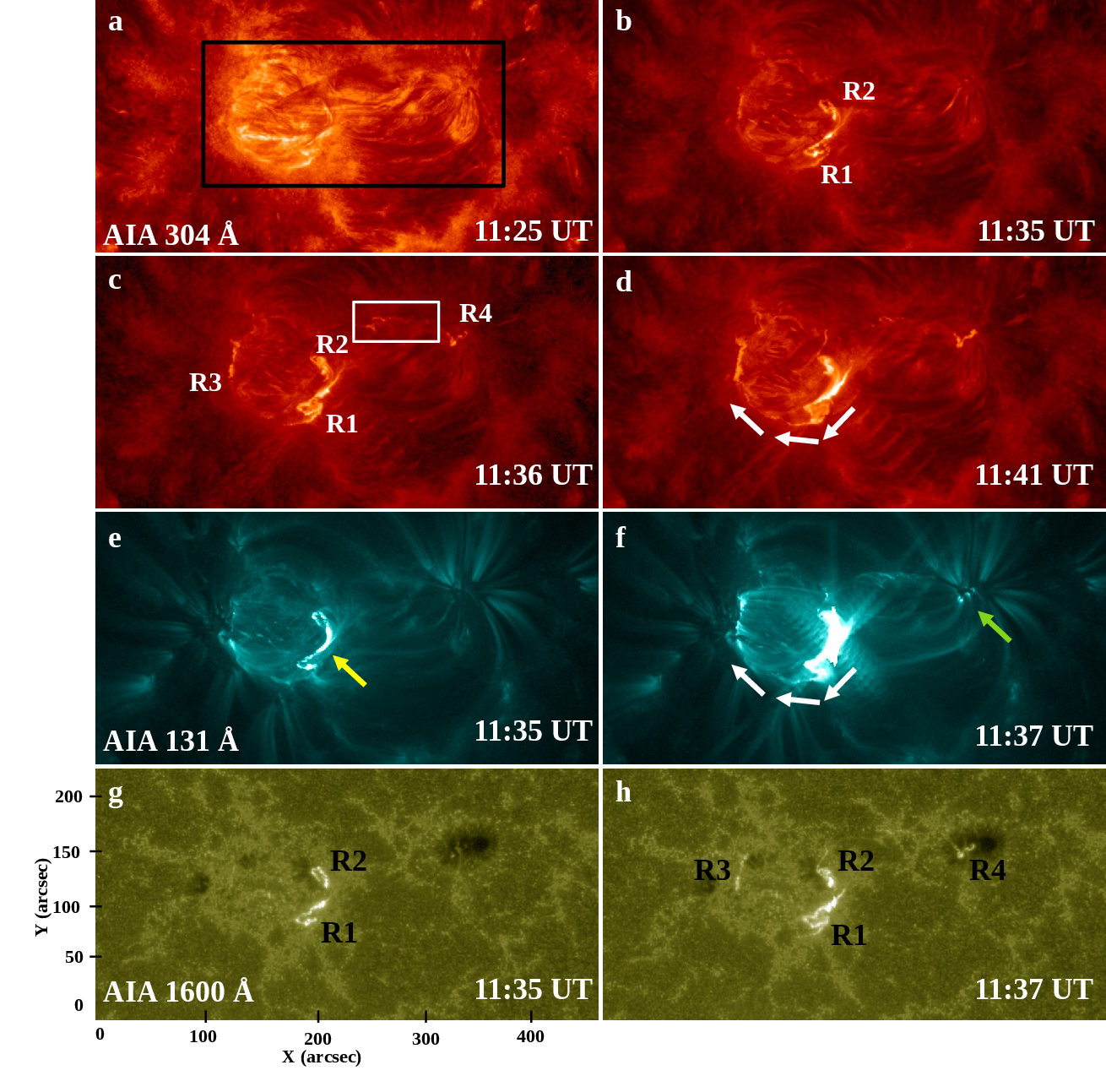
Figure 1: The flare observations in AIA 304 Å, 131 Å, and 1600 Å, displaying the spatiotemporal evolution of ribbon morphology.
Magnetic field mapping via NFFF extrapolation establishes a complex field topology consisting of two positive polarity concentrations (P1, P2) and a surrounding quasi-circular negative polarity (N). Field line tracing reveals two distinct connectivity domains, with footpoints organized in quasi-circular patches, and high squashing factor regions (LogQ > 8), indicating QSLs at the base.
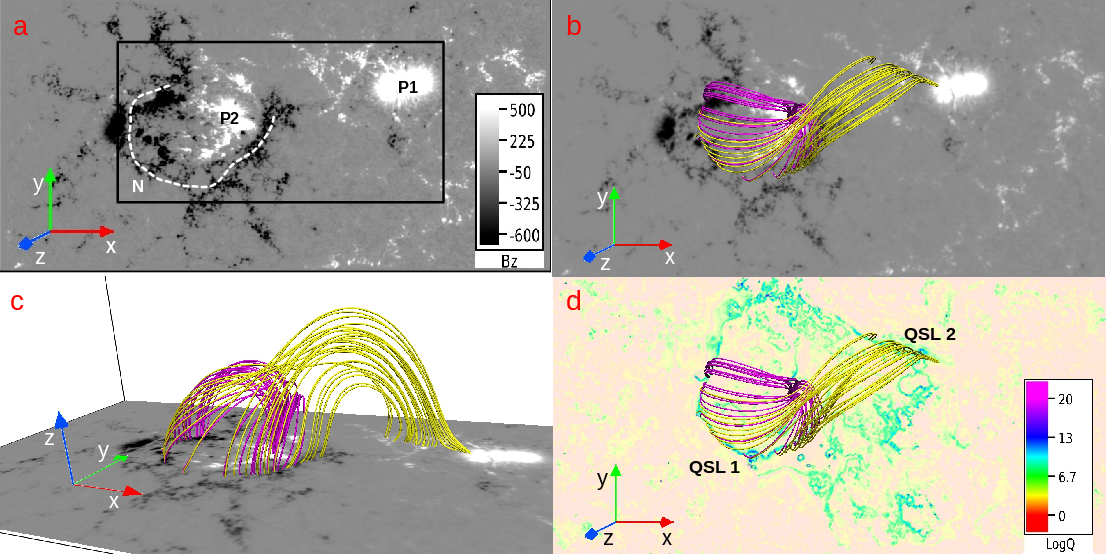
Figure 2: Panel (a) shows the Grayscale LOS B_z, highlighting the region topologically; (b)-(c) show 3D views of the extrapolated field lines; (d) overlays LogQ, quantifying QSL locations.
Inter-QSL intersections at higher altitudes form HFTs, manifested as elongated, X-type cross-sections. Null-finding algorithms confirm the absence of coronal nulls, thus excluding classic fan-spine configurations as drivers.
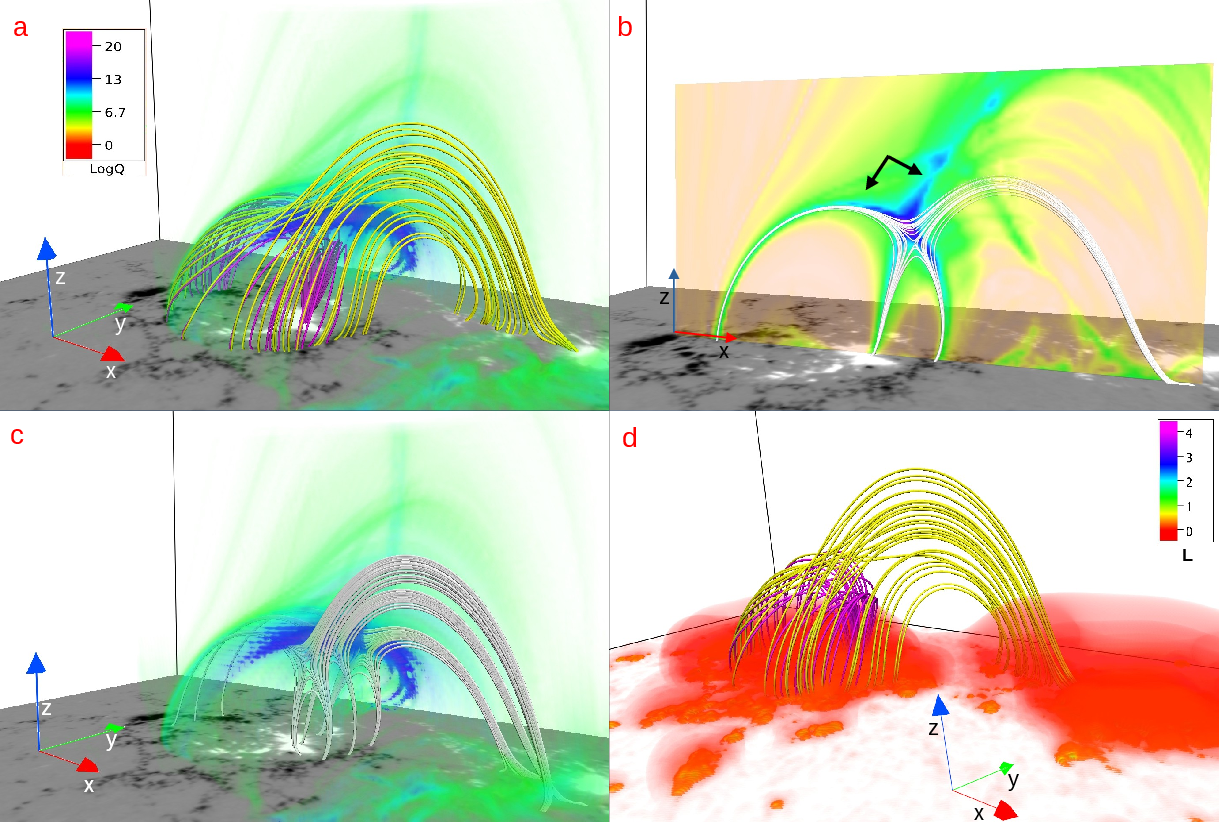
Figure 3: 3D distribution of LogQ and projected field lines across y-constant planes, with black arrows marking the QSL intersection (HFT). Panel (d) shows volumetric Lorentz force density.
Data-Constrained MHD Simulation Protocol
The EULAG-MHD code, incorporating the MPDATA ILES approach, is initialized with the NFFF field and inert (v=0) velocities. Boundary conditions enforce minimal flux emergence/decay during the flare, supporting the observed confined nature. Lorentz force concentrations at low heights provide the sole driver for coronal evolution.
Topological and Dynamical Evolution
The simulation demonstrates self-consistent buildup of current sheets at the HFT, captured by enhanced ∣J∣/∣B∣ localized at the QSL intersection. Under-resolved gradients at the HFT are regularized via implicit reconnection, in agreement with previous analytical and numerical predictions for HFT current concentration (∣J∣/∣B∣ amplification at quasi-topological X-sections).
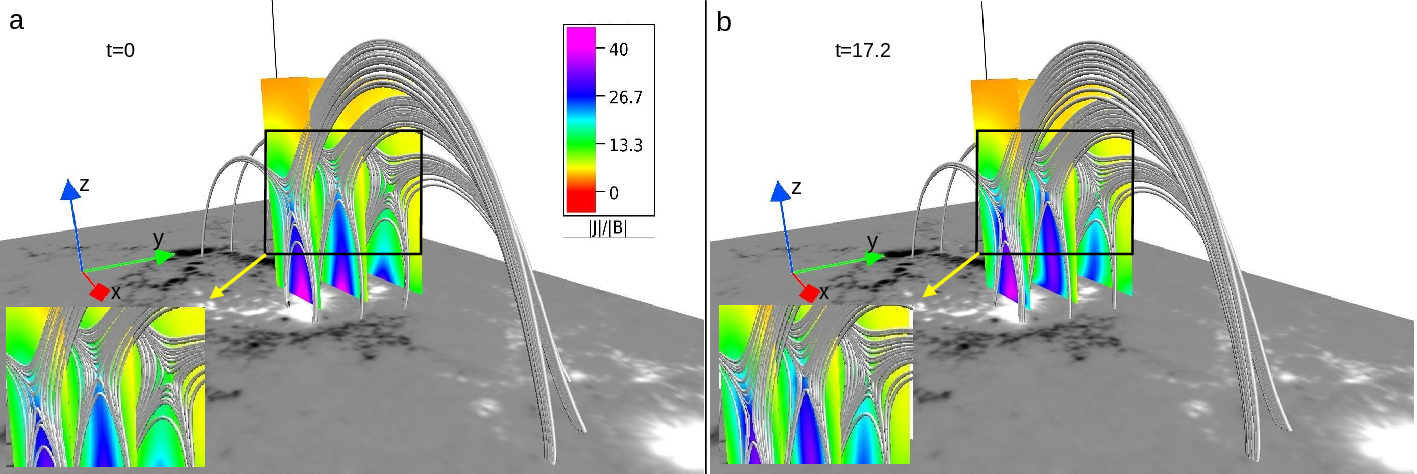
Figure 4: Time-sequence cross-section of the HFT vicinity showing projected field lines and ∣J∣/∣B∣ overlay at t=0 and t=17.2; strong current development is apparent at the HFT.
The reconnection at the HFT efficiently remaps magnetic connectivity: pink field lines initially linking N to P2 shift to connect N and a positive plage to the east of P1, directly altering the region's global linkage.
Spatiotemporal Correlation With Flare Signatures
The simulated footpoint evolution is overlain on AIA imagery, confirming that regions of field line footpoint motion coincide with the observed central and remote brightenings. The spatiotemporal sequence substantiates the hypothesis that accelerated particles from HFT reconnection generate flare ribbons and remote brightenings, with propagation delays reflecting field line geometry.
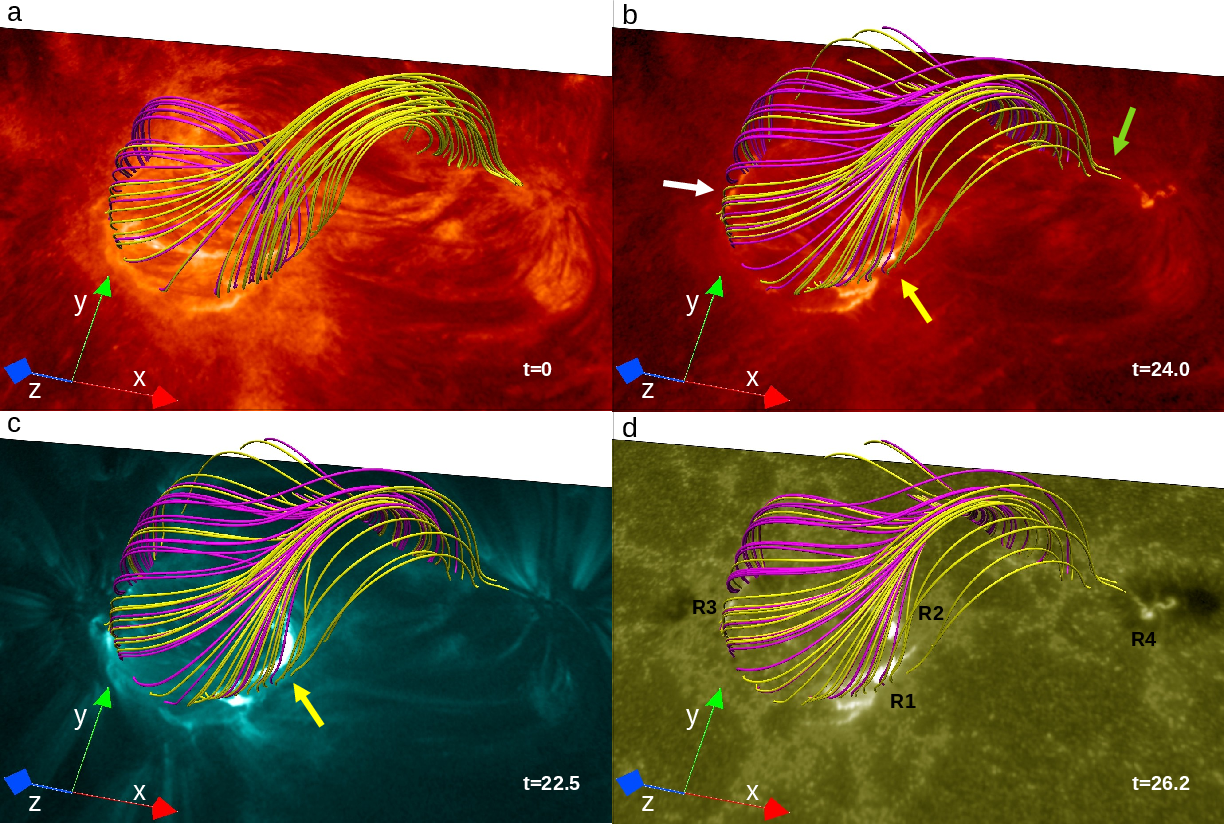
Figure 5: Magnetic field lines at different MHD times overlaid with AIA 304 Å, 131 Å, and 1600 Å, showing correlation between connectivity changes and brightenings (including ribbon labelling).
X-shaped intersections of 2D projected field lines across the HFT yield quasi-parallel and remote ribbon geometries, consistent with the observed elongated main ribbons (R1, R2) and later-appearing fainter ribbons (R3, R4).
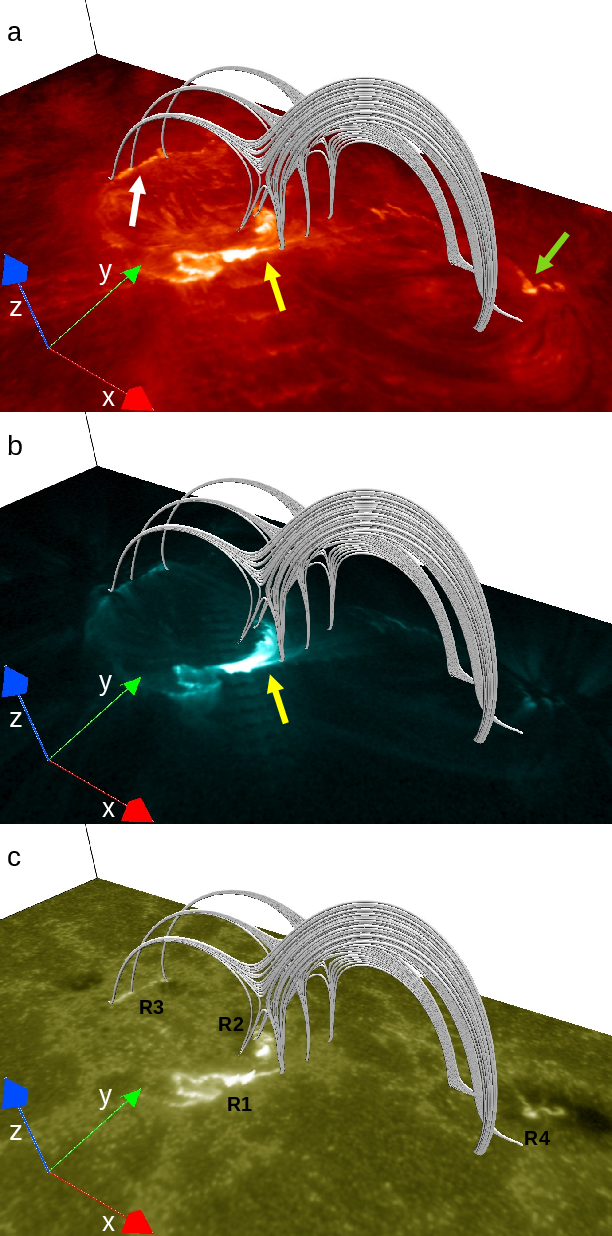
Figure 6: Projected field lines at three y-constant planes around the HFT at time t=26.2, with base overlays from AIA sequences delineating ribbon co-location.
Slipping Reconnection in QSLs
Field line footpoints within both QSL1 and QSL2 exhibit systematic slipping motion, constrained to regions of elevated LogQ, and predominantly tangential to QSL traces. This slipping motion is phenomenologically consistent with "slip-running" reconnection. The motions spatially align with the formation of both a faint quasi-circular ribbon (QSL1) and a secondary localized brightening trace (QSL2).
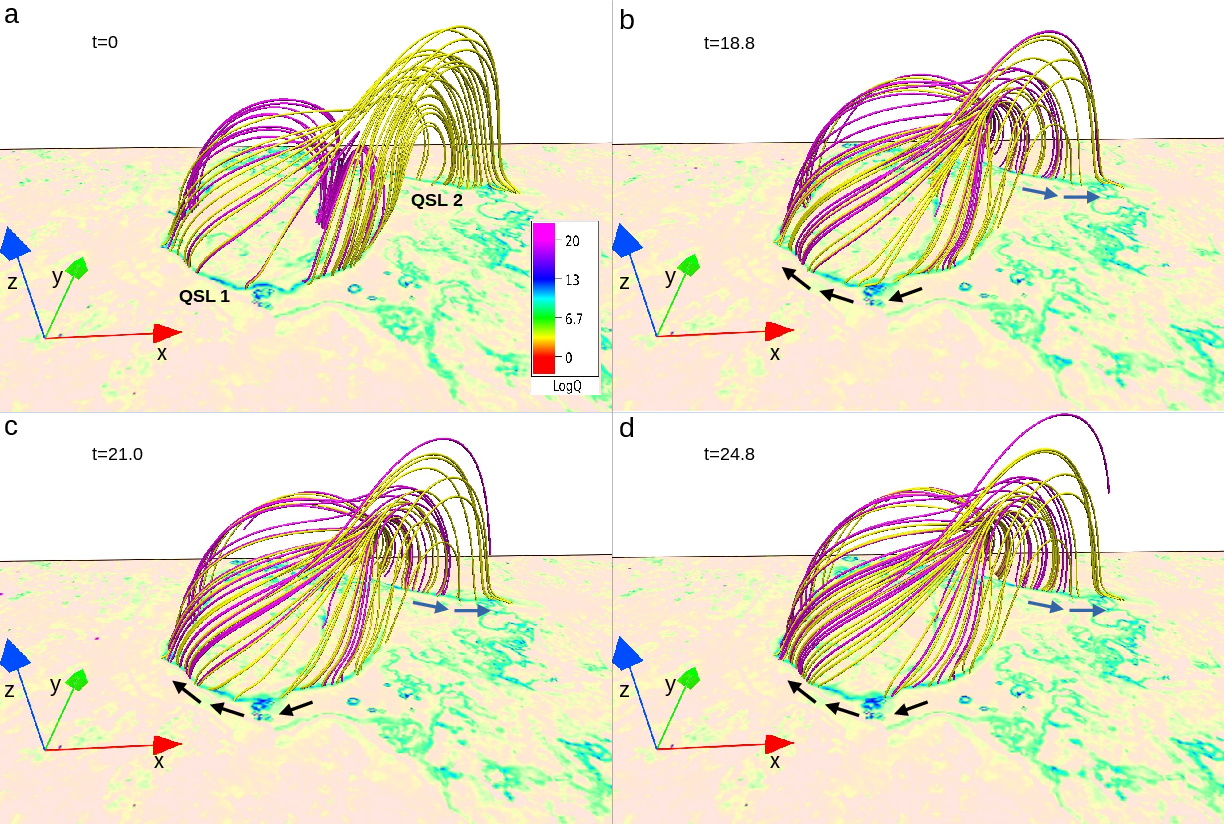
Figure 7: Detailed time evolution of field lines with Q overlays at the bottom boundary; black/blue arrows illustrate footpoint slipping within QSL1/QSL2.
Overlaying these directions on flare imagery reveals that the QSL1 footpoint slipping matches the angular extension of the quasi-circular brightening, confirming the role of slipping reconnection in producing morphologically complex, circular ribbon-like emission.
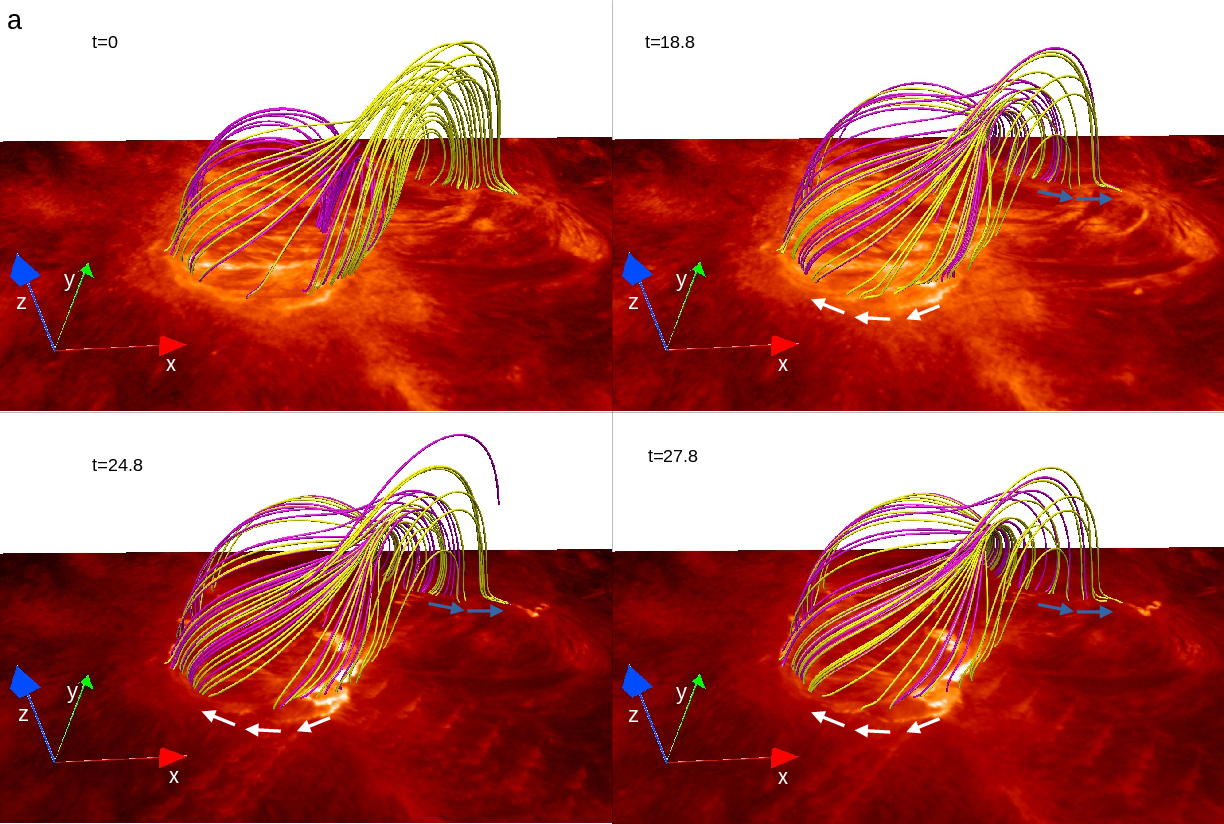
Figure 8: Evolution of the magnetic field line footpoints during slipping reconnection, over a sequence of 304 Å images; white and blue arrows reinforce the QSL-brightening correspondence.
Interpretation, Theoretical Consequences, and Prospects
These results reinforce the necessity of 3D reconnection models incorporating HFTs and QSLs for interpreting confined flare ribbon geometries not accounted for by canonical fan-spine (null-point) models. Specifically, HFTs serve as efficient sites for current sheet formation and subsequent reconnection in the absence of coronal nulls, directly mapping to observed primary and secondary ribbon structures in confined events. The direct role of QSL-localized slipping reconnection in producing faint quasi-circular brightenings and secondary ribbon traces is explicitly captured in both the magnetic field evolution and observational mapping.
From a practical perspective, the demonstrated synergy between NFFF-constrained MHD simulation and multiwavelength observation provides an effective pipeline for dissecting complex flare events, especially where NLFFF extrapolations and null-point models are inconclusive or misleading. The results also emphasize that topological analysis (squashing factor, QSL mapping, HFT identification) must be integral to the interpretation of coronal energy release and particle acceleration scenarios.
Theoretically, these findings suggest: (1) current sheet formation in HFTs is robust even in the absence of null points, (2) QSLs at the base modulate footpoint dynamics, and (3) complex ribbon morphologies can arise from topologically simple, but highly squashed, field intersections.
Future developments may include dropping the incompressibility constraint, introducing explicit resistivity, and comparative studies across eruptive/eruptive-less events to generalize the role of HFTs in confined flare dynamics and potential CME initiation. Convergence with high-cadence, high-resolution observations (e.g., DKIST, Solar Orbiter) and kinetic-scale modelling of reconnection exhausts and particle acceleration is a crucial next step.
Conclusion
The paper provides a compelling, data-driven demonstration that, in AR 12268, confined flare onset and complex ribbon morphology are governed by magnetic reconnection at HFTs, with slipping reconnections at QSLs essential for secondary features. These results shift emphasis from traditional null-point reconnection paradigms, highlighting the importance of more general topological constructs, and set the stage for more systematic MHD+data-constrained investigation of solar flare energetics and geometry (2604.10684).