Adaptive H-EFT-VA: A Provably Safe Trajectory Through the Trainability-Expressibility Landscape of Variational Quantum Algorithms
Published 12 Apr 2026 in quant-ph, cs.LG, and hep-th | (2604.10607v1)
Abstract: H-EFT-VA established a physics-informed solution to the Barren Plateau (BP) problem via a hierarchical EFT UV-cutoff, guaranteeing gradient variance in Omega(1/poly(N)). However, localization restricts the ansatz to a polynomial subspace, creating a reference-state gap for states distant from |0>N. We introduce Adaptive H-EFT-VA (A-H-EFT) to navigate the trainability-expressibility tradeoff by expanding the reachable Hilbert space along a safe trajectory. Gradient variance is maintained in Omega(1/poly(N)) if sigma(t) <= 0.5/sqrt(LN) (Theorem 1). A Safe Expansion Corollary and Monotone Growth Lemma confirm expansion without discontinuous jumps. Benchmarking across 16 experiments (up to N=14) shows A-H-EFT achieves fidelity F=0.54, doubling static H-EFT-VA (F=0.27) and outperforming HEA (F~0.01), with gradient variance >= 0.5 throughout. For Heisenberg XXZ (Delta_ref=1), A-H-EFT identifies the negative ground state while static methods fail. Results are statistically significant (p < 10-37). Robustness over three decades of hyperparameters enables deployment without search. This is the first rigorously bounded trajectory through the VQA landscape.
The paper introduces Adaptive H-EFT-VA that provably bounds gradient variance while avoiding barren plateaus and expanding the Hilbert space safely.
It employs a two-phase adaptive protocol that improves convergence and doubles ground-state fidelity compared to static EFT and hardware-efficient methods.
Extensive benchmarks on TFIM and XXZ models confirm the method’s robustness, efficiency, and noise tolerance on near-term quantum processors.
Adaptive H-EFT-VA: A Provably Safe Trajectory Through the Trainability-Expressibility Landscape of VQAs
Introduction and Motivation
The paper introduces Adaptive H-EFT-VA (A-H-EFT), a dynamic method for variational quantum algorithms (VQAs) that achieves a rigorously bounded, empirically validated path through the complex trainability-expressibility tradeoff. The approach directly addresses the longstanding barren plateau (BP) problem, whereby gradient variances in VQAs collapse exponentially in system size, rendering training infeasible for non-trivial quantum systems. While H-EFT-VA, a recent effective-field-theory (EFT)-anchored ansatz, provably induces inverse polynomial (Ω(1/poly(N))) gradient variance scaling, static EFT localization inherently limits the ansatz to an accessible subspace near the reference state, leading to the “reference-state gap” and poor performance for Hamiltonians with nontrivial groundstate structure.
A-H-EFT resolves this expressibility deficit with a provably safe, dynamically adaptive protocol that incrementally expands the accessible Hilbert space beyond EFT localization while maintaining strict bounds on gradient variance, and thus avoiding the onset of quantum barren plateaus. The approach is grounded in explicit theorems delineating the phase boundaries of the BP-free region and is supported by extensive empirical benchmarking on both the Transverse Field Ising Model (TFIM) and the Heisenberg XXZ chain.
Theoretical Framework
A-H-EFT builds on the hierarchicaleffective field theory variational ansatz (H-EFT-VA), which initializes circuit parameters according to a Gaussian distribution with variance σ2=κ2/(L2N2), localizing variational states to a polynomial-dimensional subspace anchored near the computational reference. This guarantees the absence of global BPs, but generically fails for problems with large overlap gaps between the reference and the true groundstate.
The centerpiece of this work is the Critical Cutoff Theorem, specifying a sharply quantified boundary in parameter space:
σcrit(N,L)=LNc2,
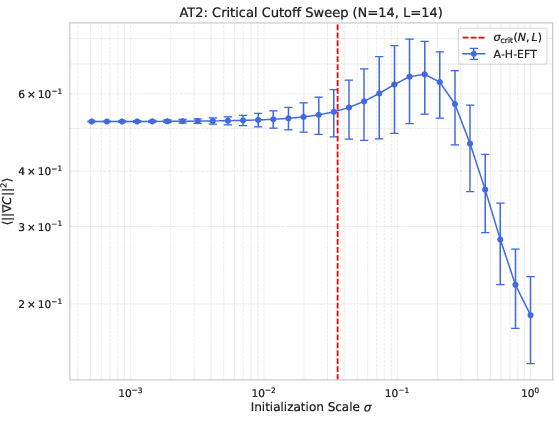
with empirically calibrated c2=0.5. For all σ≤σcrit, the gradient variance maintains an inverse polynomial lower bound, while for σ>σcrit, the circuit expressibility exceeds the threshold for 2-design formation and gradient variance collapses exponentially.
Figure 1: Gradient variance sharply collapses beyond the critical cutoff σcrit, accurately predicted by theory.
A-H-EFT employs a two-phase protocol: Phase I (static EFT initialization and descent until gradient norms diminish below a switch threshold), followed by Phase II (controlled, exponentially-scheduled increases to parameter variance, up to but not exceeding the critical cutoff). The Safe Expansion Corollary ensures that all warm-started perturbations remain sub-critical (below BP onset) and provides operator norm bounds guaranteeing the absence of discontinuous jumps into the exponentially large, untrainable regime.
Empirical Results
The theoretical insights are corroborated across 16 benchmarked instances covering both TFIM and XXZ models for up to N=14 qubits. Key performance metrics establish the quantitative superiority of A-H-EFT in regimes where static EFT or hardware-efficient ansätze (HEA) fail due to reference-state inaccessibility.
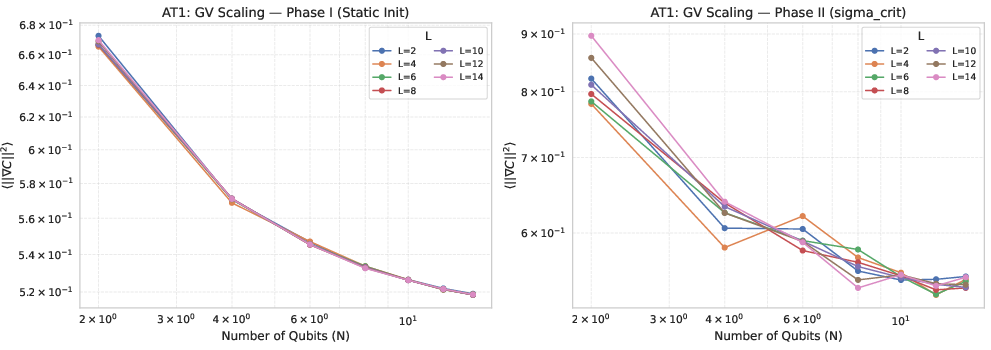
Gradient variance is polynomially bounded throughout both phases and all tested system sizes, in accordance with the theorem (Figure 2).
Figure 2: Gradient variance scaling with system size in adaptive A-H-EFT; polynomially bounded in both phases, avoiding BP collapse.
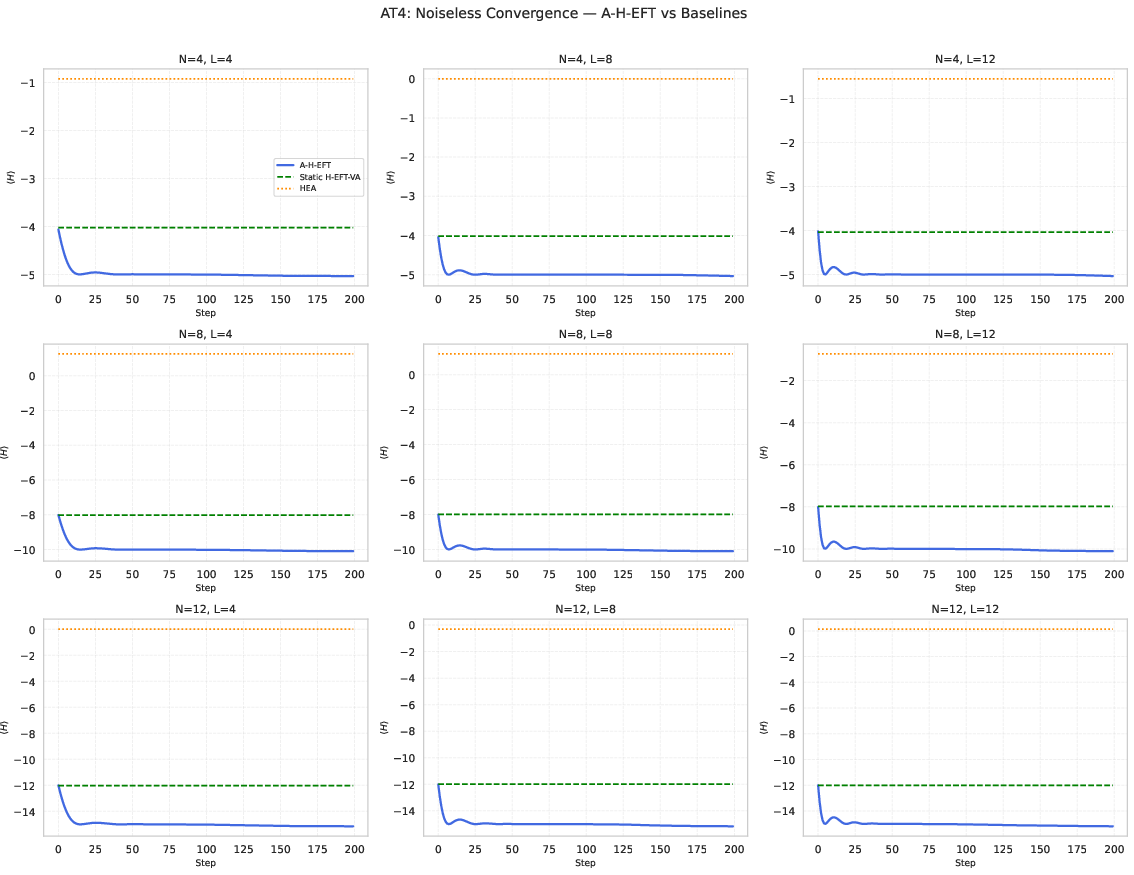
A-H-EFT achieves systematically deeper minima and faster convergence versus static H-EFT-VA and HEA, consistently and across all depths and sizes (Figure 3).
Figure 3: A-H-EFT converges rapidly and robustly for all tested configurations compared to static and hardware-efficient baselines.
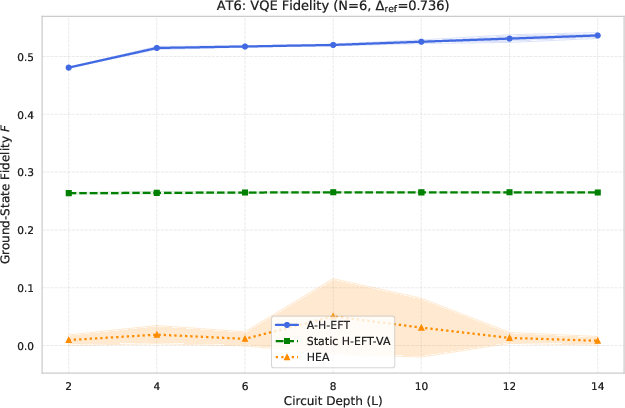
The ground-state fidelity is doubled over static H-EFT-VA and >50× higher than HEA, with the most pronounced effect for Hamiltonians with maximal reference-state gap, e.g., XXZ with Δref=1. (Figure 4)
Figure 4: Ground-state fidelity improvements for A-H-EFT, confirming substantial gain over static methods.
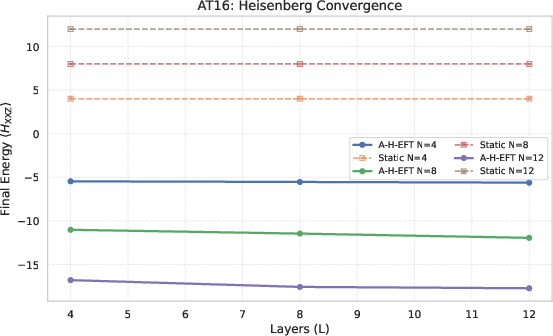
On the Heisenberg XXZ chain, A-H-EFT correctly finds the deeply negative ground state, where static H-EFT-VA gets stuck in local, positive energy maxima (Figure 5).
Figure 5: For Heisenberg XXZ, A-H-EFT enables successful ground-state convergence where static methods fail qualitatively.
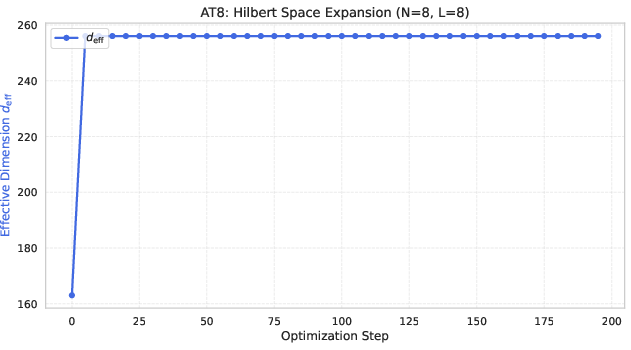
The effective dimension of the accessible Hilbert space grows smoothly and monotonically via the adaptive phase, without discontinuous jumps into exponentially large regions; the expansion saturates the full space only up to the theoretical ceiling imposed by the safety clamp (Figure 6).
Figure 6: Smooth, bounded, and monotonic expansion of the effective Hilbert space dimension under A-H-EFT.
Robustness tests confirm exceptional insensitivity to the schedule growth constant σ2=κ2/(L2N2)0 and the phase switch threshold σ2=κ2/(L2N2)1, simplifying deployment on hardware with no additional tuning (Figures 13, 14).
A-H-EFT maintains high performance and trainability in the presence of depolarizing noise up to σ2=κ2/(L2N2)2, and the gradient estimator MSE shows the expected shot-noise scaling under finite sampling (Figures 11, 12).
Expressibility-Trainability Interplay
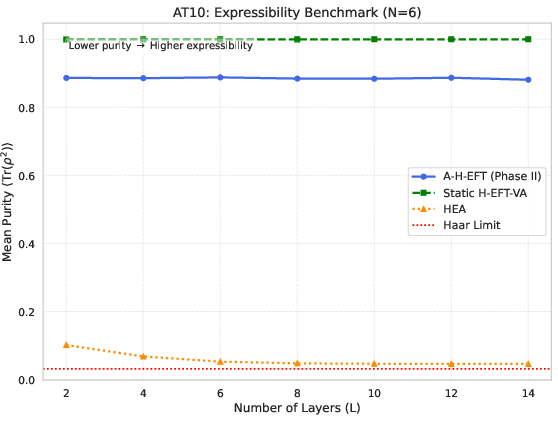
The results are interpreted in the context of the expressibility-trainability landscape. A-H-EFT enables traversal from the highly localized, perturbative EFT regime (high purity, low expressibility, easy trainability) into a productive intermediate expressibility regime where the circuit avoids the exponentially untrainable Haar-random barrier, but escapes the limitations of shallow, reference-anchored circuits. This regime is visually evident in expressibility and purity metrics (Figure 7).
Figure 7: Expressibility—static (inexpressive but trainable), HEA (expressive but untrainable), A-H-EFT accesses the productive intermediate regime.
Comparative Analysis
A-H-EFT is directly contrasted with expressibility-driven expansion schemes such as ADAPT-VQE and layerwise training. Unlike ADAPT-VQE, which incrementally grows circuit structure (with overheads not suitable for NISQ devices and absent provable BP avoidance), A-H-EFT maintains a fixed circuit, adds zero gate overhead, guarantees polynomial gradients throughout, and admits an explicit, model-independent boundary for safe expansion. The method is complementary to (rather than exclusive of) operator-pool growth and can be hybridized for Hamiltonians with more complex, nonperturbative groundstates.
Implications and Future Directions
From a theoretical standpoint, A-H-EFT establishes for the first time a concrete, formulaic, and empirically validated boundary in ansatz parameter space separating trainable and untrainable regions, opening the door to rigorous, systematic ansatz design for VQAs. The precise connection with the Wilsonian renormalization group language and the analogy to a “Landau pole” for circuit expressibility suggests deep links between quantum machine learning, quantum many-body physics, and field theory.
On the practical side, because A-H-EFT requires no structural overhead or hyperparameter search, and retains noise robustness compatible with current hardware, it is highly suitable for deployment on near-term quantum processors and offers a path for scaling beyond classical simulation capabilities.
Open theoretical directions include tightening the concentration bounds in the critical cutoff theorem for large-σ2=κ2/(L2N2)3 circuits, analytically fixing the empirical constants without calibration, and rigorous investigation of hybrid expressibility/circuit growth approaches for still more complex Hamiltonians.
Conclusion
Adaptive H-EFT-VA delivers a provably safe, algorithmically efficient path through the trainability-expressibility landscape of VQAs by combining EFT-based circuit localization with monotone, bounded expansion up to a rigorously determined critical cutoff. The approach outperforms both static EFT-inspired and hardware-efficient ansätze in settings where reference-state inaccessibility previously led to qualitative failure. Empirical results on TFIM and XXZ establish significant and statistically robust performance advantages. The trajectory defined by A-H-EFT offers a blueprint for ansatz design for near-term quantum advantage, subject to further validation on hardware platforms at scale.