- The paper establishes the circular law for uniform {0,1} matrices with fixed row sums by extending spectral and invertibility methods.
- It derives quantitative lower bounds for the smallest singular value to ensure convergence of the empirical spectral distribution.
- The work broadens random matrix theory to sparse, dependent models, impacting the study of random graphs and network structures.
The Circular Law for Sparse Random Combinatorial Matrices: Technical Overview
This paper establishes the circular law for a broad class of sparse random combinatorial matrices, specifically, uniform {0,1} matrices with each row containing exactly d ones, under the regime log2+n≤d≤n/2 and d=o(n). The work also provides quantitative lower bounds for the smallest singular value in this uniform model, pushing invertibility and spectral techniques for matrix ensembles far beyond the i.i.d. setting and classical dense cases.
Problem Setting and Main Results
Consider an n×n matrix Mn sampled uniformly from matrices with precisely d ones per row. This model has dependent entries and can be seen as the adjacency matrix of a random d-out digraph or a d-left-regular bipartite graph. The paper's principal result is:
Theorem (Circular Law for Combinatorial Matrices):
For d=d(n) with d0, d1 as d2, and proper normalization, the empirical spectral distribution (ESD) of d3 converges in probability to the uniform law on the unit disk (d4).
This extends the circular law from the i.i.d. to uniform fixed-row-sum models in the extremely sparse regime, resolving a long-standing gap in universality understanding for non-Hermitian and highly dependent matrices.
Numerical evidence illustrates the transition to the circular law with growing d5, aligning with theoretical predictions.
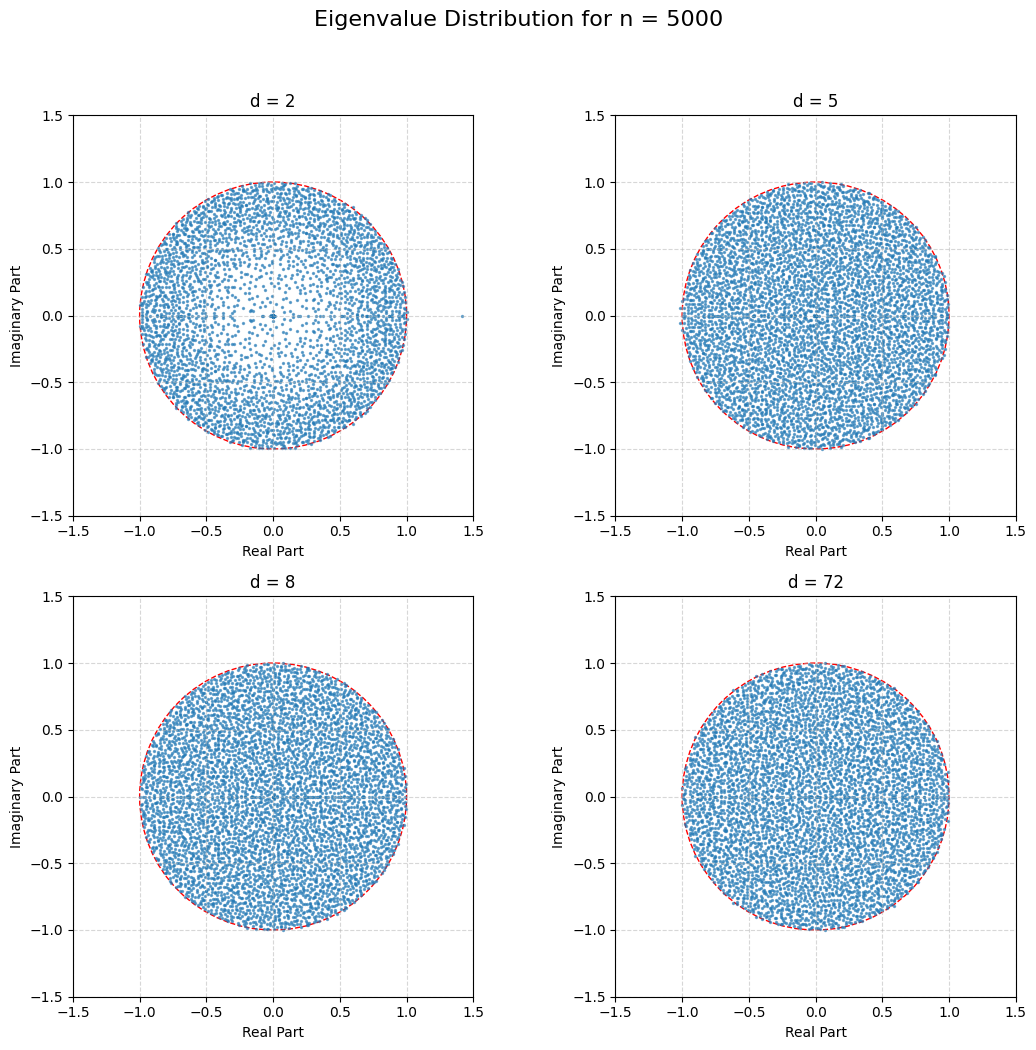
Figure 1: Empirical spectra of four independent random 5000d65000 combinatorial matrices with row sum d7, exhibiting uniformity convergence toward the unit disk as d8 increases.
Technical Approach — From Hermitization to Smallest Singular Values
To establish the circular law, the authors build on the Girko Hermitization method combined with a replacement principle comparing the ESD of the combinatorial model to that of Bernoulli(d9) i.i.d., leveraging Tao-Vu's universality theorem. The challenge is controlling the smallest singular value for shifted ensembles log2+n≤d≤n/20, required for both ESD convergence and logarithmic potential control.
Replacement Principle
Let log2+n≤d≤n/21 be the uniform-row-sum matrix, and log2+n≤d≤n/22 the i.i.d. Bernoulli(log2+n≤d≤n/23) analogue log2+n≤d≤n/24.
Two conditions must be checked:
- (Hilbert-Schmidt) log2+n≤d≤n/25 and log2+n≤d≤n/26 are of order log2+n≤d≤n/27.
- (Log-determinant proximity) For almost all log2+n≤d≤n/28, the normalized difference of log determinants vanishes in probability.
The first is elementary. The second, pivotal, requires new singular value lower bounds and delicate decomposition of the determinant via the base-times-height (volume-determinant) formula, controlling the distribution of distances from rows to subspaces determined by previous rows.
The Invertibility Barrier: Smallest Singular Value Estimates
The core technical contribution is a quantitative lower-tail bound for the smallest singular value of log2+n≤d≤n/29:
Theorem (Quantitative Invertibility):
For d=o(n)0 and d=o(n)1,
d=o(n)2
for some d=o(n)3 with explicit improvements as d=o(n)4 increases.
This result greatly extends prior invertibility results for dense and i.i.d. models to the sparse and dependent setting, and is nearly sharp—demonstrating that, up to polylogarithmic factors, the non-singularity threshold is optimal for these matrix ensembles.
Methods: Nets, Vector Decomposition, and Expansion
To overcome the strong dependencies among matrix entries, the proof employs several advanced ingredients:
- Spherical decomposition: The unit sphere is partitioned into vector classes—almost-constant vectors ("Cons"), steep-jump vectors (d=o(n)5), and non-almost-constant vectors—adapting compressible/incompressible dichotomy to the row-sum-constrained combinatorial context.
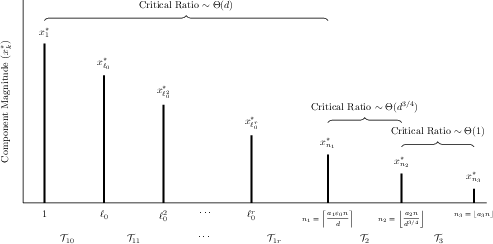
Figure 2: Classification of steep vectors (by sorted modulus d=o(n)6) into sets d=o(n)7, d=o(n)8, and d=o(n)9, depending on location/magnitude of jumps in their components.
- Expansion and Negative Association:
The work proves expansion properties for the random digraphs underlying n×n0 using negative association to simulate independence and facilitate concentration, crucial for controlling the support of large coordinates and events such as isolated columns.
- Net arguments and combinatorial covering:
For each vector class, carefully designed n×n1-nets are constructed, and small-ball probabilities are analyzed meticulously, using anti-concentration and combinatorial switching in the non-i.i.d. left-multiplication cases.
Comparative Analysis: Limiting Spectra Across Models
The authors contextualize their main result by reviewing and sharply contrasting it with spectral laws for:
- Sparse i.i.d. Bernoulli: Circular law is known for n×n2 [BRudcirclawsparse, AJMcirclawrev].
- Random regular graphs: Known to converge to (oriented) Kesten-McKay law for fixed n×n3 [BHHlocalKM].
- Random fixed-row-sum n×n4 matrices: Partial results, and for dense (n×n5) similar laws.
The circular law transition is not universal in the ultrasharp sparse regime; below the invertibility threshold (when n×n6 is n×n7), the limiting spectral measure is radically different, as confirmed by demonstrable non-circularity at small n×n8 (as seen in Figure 1).
Singularity Thresholds and Combinatorial Implications
The work rigorously establishes that for n×n9, Mn0 almost surely has singularities caused by zero columns; at Mn1, the probability of singularity drops rapidly, aligning with recent sharp results [ferber2022singularity] for the non-singularity threshold.
Moreover, the authors conjecture that the asymptotic singularity probability is determined by the union of zeros/identical columns, paralleling results for binomial random matrices.
Implications and Future Directions
- Universality for Sparse Dependent Ensembles:
The sharp extension of the circular law to this combinatorial, locally dependent model with minimal Mn2 growth highlights a new level of universality, with techniques likely to generalize to broader random regular and constrained ensembles.
- Sharp Invertibility for Non-i.i.d. Models:
The quantitative singular value lower bounds set a new standard for analyzing invertibility in graph-structured random matrices, with importance for random graph theory, coding, and network science.
The identification of limiting spectral measures in the ultra-sparse regime, and the possible extension to models with strict degree constraints (random regular digraphs with both row/column degrees fixed), as well as precise estimates for singularity probabilities and local spectral statistics.
Conclusion
This paper delivers conclusive universality results for the limiting spectrum of sparse random combinatorial matrices with fixed row sums, matching the circular law in the normalized domain. The techniques extend state-of-the-art methods for invertibility and spectral analysis to models with local dependency and sparsity on the non-Hermitian regime. Through blend of combinatorial probability, net constructions, and expansion arguments, it both broadens the applicability of random matrix theory and contributes sharp new estimates crucial for future developments in random discrete structures and spectral graph theory.