- The paper establishes that sₙ(M) = O(n⁻¹ᐟ²) with high probability in the dense regime, matching known lower bounds.
- It employs sphere decomposition, anti-concentration techniques, and biorthogonal system analysis to overcome dependencies in 0/1 matrices.
- Simulation results indicate that the √d/n scaling may persist in the sparse regime, influencing condition numbers and algorithmic stability.
Upper Bound on the Smallest Singular Value of Dense Random Combinatorial Matrices
Introduction and Context
The analysis of the smallest singular value, sn(M), of random matrices is foundational in random matrix theory due to its direct relationship with invertibility, condition numbers, and spectral universality phenomena. While sharp lower bounds for sn(M) in matrices with independent entries, such as Gaussian or Bernoulli, have been established over several decades, understanding sn(M) for matrices with combinatorially constrained dependencies (e.g., fixed row sums) remains highly nontrivial. Recent research has focused on random combinatorial matrices—specifically, n×n matrices with each row being a uniformly random $0/1$ vector of fixed weight d=pn, where p∈(0,1/2] and n is large.
Prior works have established that sn(M) is at least cpn−1/2 with high probability (Tran [tran2020smallest]) but left open the matching upper bound, thus preventing a complete characterization of the asymptotic order of sn(M)0. The paper "An upper bound on the smallest singular value of dense random combinatorial matrices" (2604.12233) addresses this gap by proving that, with high probability, sn(M)1 in the dense regime, matching the known lower bound and fully characterizing the scaling of the least singular value in this setting.
Problem Statement and Main Result
Let sn(M)2 be an sn(M)3 random sn(M)4 matrix where each row independently has exactly sn(M)5 ones for fixed sn(M)6. The main theorem establishes a high-probability upper bound: sn(M)7
for every sn(M)8 and some constant sn(M)9 depending only on sn(M)0. The bound confirms that sn(M)1 for dense random combinatorial matrices, tightly matching the probabilistic lower bound in [tran2020smallest] and [jain2020sharp].
Techniques and Proof Structure
The argument leverages the interplay of several advanced probabilistic and geometric techniques adapted to account for the strong dependencies among matrix entries:
- Sphere Decomposition: The unit sphere is decomposed into almost constant and genuinely non-almost-constant vectors. This is crucial since almost constant directions behave differently in combinatorial models with row-sum constraints.
- Invertibility on Almost Constant Vectors: A net construction together with matrix concentration inequalities yields uniform invertibility on the set of almost constant vectors. This step ensures that pathological directions (e.g., aligned with the all-ones vector) do not contribute small singular values.
- Anti-Concentration for Non-Almost-Constant Directions: The combinatorial LCD (least common denominator) machinery (Tran [tran2020smallest]) is extended to control small ball probabilities for linear forms sn(M)2, where sn(M)3 is a random sn(M)4-sparse sn(M)5 vector. This enables the derivation of small ball probability bounds despite the lack of independence among coordinates.
- Biorthogonal System Structure: The analysis exploits the structure of adjoints and biorthogonal systems formed by the columns of sn(M)6 and those of sn(M)7, paralleling approaches used effectively in the i.i.d. and subgaussian settings (Rudelson & Vershynin [rudelson2008least]).
- Chebyshev’s Inequality and Condition Number Estimates: The mean square computations and Chebyshev’s bound are used to further restrict the event that sn(M)8 is small through upper tail estimates for the relevant Rayleigh quotients.
These ingredients collectively adapt the sharp geometric and probabilistic tools from the classical i.i.d. theory to the constrained combinatorial ensemble. Importantly, the constants in the resulting bound depend only on the density parameter sn(M)9, enabling asymptotic statements uniform in n×n0.
Numerical Evidence in the Sparse Regime
Although the main theorem is for the dense regime (n×n1 with constant n×n2), the authors also investigate the sparse regime via simulation. Empirical evidence suggests that the order n×n3 persists for smaller n×n4, in particular for n×n5 and n×n6, as demonstrated in the log-log plots.
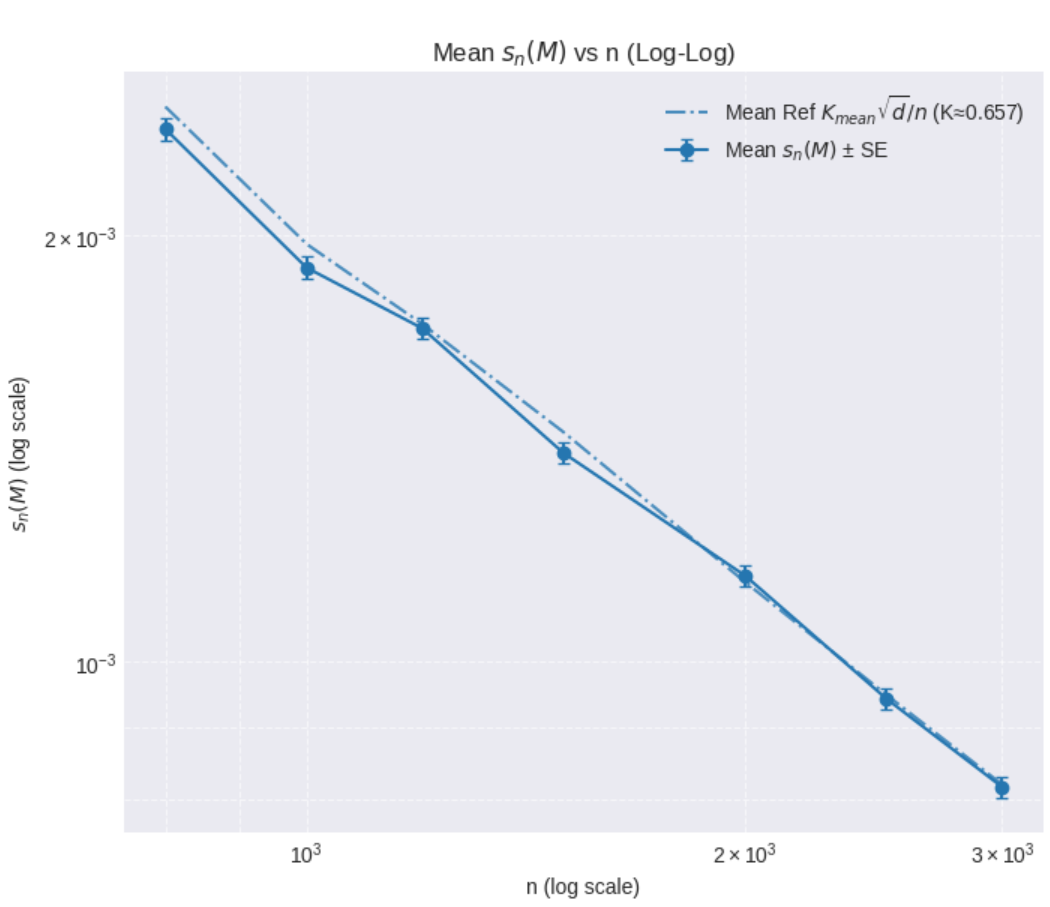
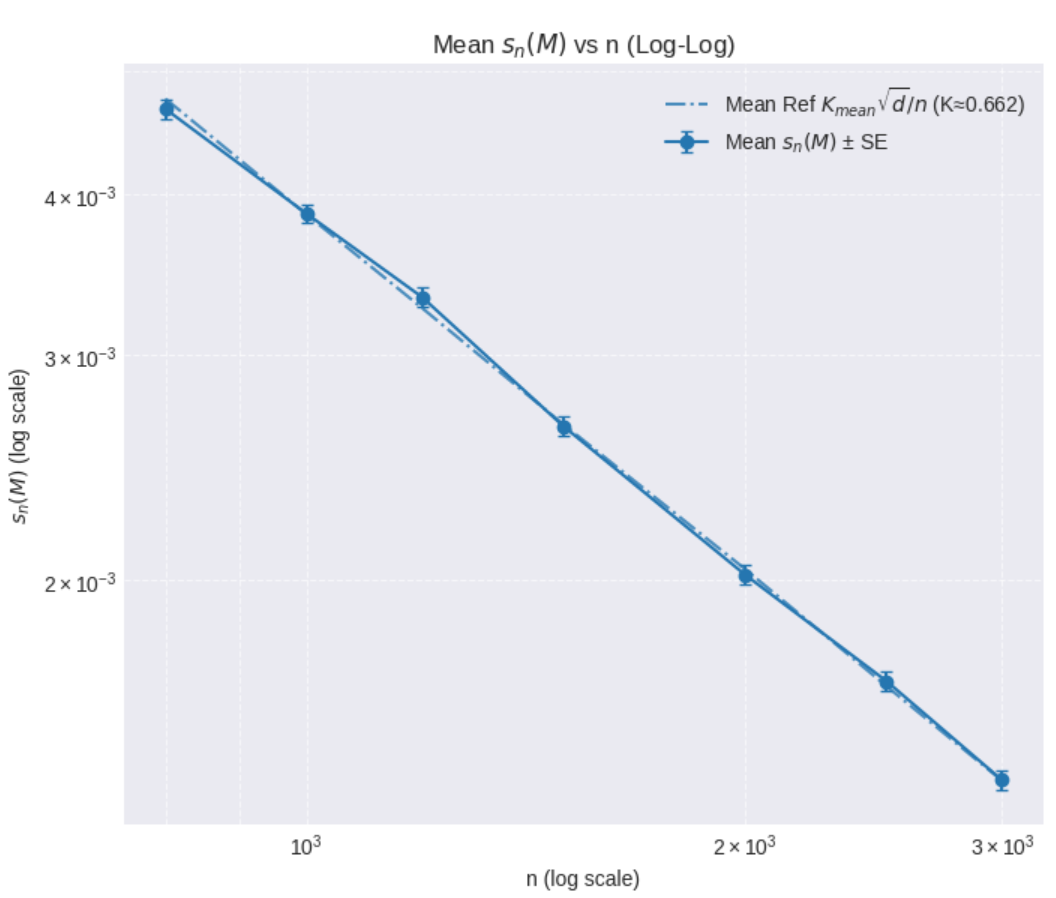
Figure 1: Log-log plots of n×n7 against n×n8 for n×n9 (left) and $0/1$0 (right), with dashed lines indicating the order $0/1$1.
These simulations provide substantial evidence supporting the conjecture that $0/1$2 remains the correct scaling for the least singular value even when $0/1$3. However, the sharp order for $0/1$4 in the truly sparse regime has not yet been rigorously established, and remains a prominent open question.
Theoretical and Practical Implications
The results cement the analogy between dense random combinatorial matrices and matrices with i.i.d. subgaussian or Bernoulli entries, at least regarding the least singular value. This sharp characterization has several notable consequences:
- Condition Number Estimates: Since the operator norm is of order $0/1$5, the results show that the typical condition number $0/1$6 in the dense regime, providing detailed information on numerical stability for algorithms operating on such matrices.
- Invertibility and Random Graphs: Since such $0/1$7 matrices represent adjacency matrices of random regular (or regular bipartite) graphs, the result refines our understanding of spectral extremal properties in discrete random structures, with spillover effects in theoretical CS, combinatorics, and complexity theory.
- Extension to Sparse and General Combinatorial Ensembles: The techniques clarify where the main bottlenecks lie in pushing results to the sparse regime ($0/1$8), highlighting anti-concentration as the central technical hurdle.
- Algorithmic Relevance: For algorithms relying on invertibility or robust rank guarantees for random sparse designs (e.g., compressed sensing, randomized linear solvers), these bounds yield strong worst-case guarantees.
Future Directions
Open problems highlighted directly or implicitly in the work include:
- Establishing the $0/1$9 scaling for the least singular value in the general sparse regime d=pn0, possibly by extending combinatorial LCD techniques, improving anti-concentration, or leveraging alternative probabilistic structures.
- Understanding the limiting spectral properties (circular law, local laws) for these constrained ensembles, with a focus on edge universality in the presence of strong dependencies.
- Applying these singular value bounds to analyze the performance and typical-case complexity of randomized algorithms involving combinatorially generated random matrices.
Conclusion
This work resolves the outstanding question of the typical order of the least singular value for dense random combinatorial matrices, demonstrating that d=pn1 with high probability in the dense regime. The result places these structured ensembles on par with their i.i.d. counterparts regarding invertibility, unlocks precise condition number estimates, and sets the stage for a deeper exploration of sparsity and dependency effects in random matrix theory.