- The paper introduces a novel, training-free, multi-agent method (cognition, arranger, refiner) that optimizes for visual contrast and layout harmony in automated poster generation.
- It employs a two-stage hybrid denoising strategy using gradient consistency loss and joint regional blending to ensure seamless content transitions at region boundaries.
- Experimental results reveal substantial improvements over state-of-the-art methods on quantitative metrics like LAS, RSD, BGD, and OCR accuracy.
ReContraster: Training-Free Regional Contrast for Poster Generation
Introduction
The paper “ReContraster: Making Your Posters Stand Out with Regional Contrast” (2604.10442) addresses the persistent challenge of simultaneously achieving visual distinctiveness, compositional harmony, and coherent region transitions in automated poster generation. Prior generative approaches, especially those based on diffusion models and LLMs, have achieved advances in layout organization and textual integration but fall short in orchestrating visually compelling contrasts while maintaining overall aesthetic balance. The proposed method introduces a training-free, compositional multi-agent system that leverages regional contrast, inspired by perceptual principles, alongside a hybrid denoising strategy for generating posters from text prompts and region masks.
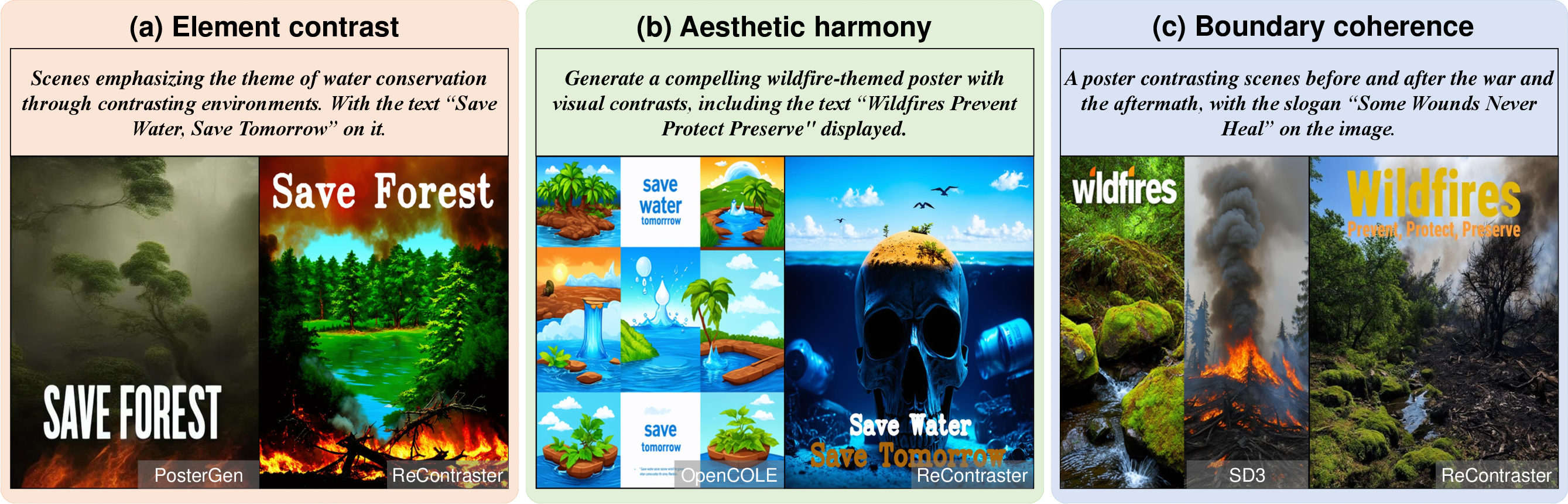
Figure 1: Illustration of ReContraster, highlighting improvements in contrast, compositional harmony, and boundary coherence over prior methods.
Methodological Framework
Compositional Multi-Agent System
The core architecture employs three specialized agents—cognition, arranger, and refiner—in an iterative optimization framework:
- Cognition Agent: Utilizes an LLM to extract highly contrastive semantic elements from the input theme, identifying conceptually and visually opposing element pairs and guiding complementary color assignment according to color theory.
- Arranger Agent: Structures these contrastive elements into a compositionally balanced layout, encoded in a structured format, optimizing for shape harmony, style consistency, semantic clustering, and typographic integration.
- Refiner Agent: Iteratively evaluates candidate generations for visual distinction and compositional quality, providing targeted feedback to the former agents to guide subsequent synthesis iterations. Termination is defined by the attainment of predefined quality thresholds or iteration limits.
This agent-based pipeline emulates human designer cognition and enables task decomposition often neglected by single-agent or monolithic approaches.
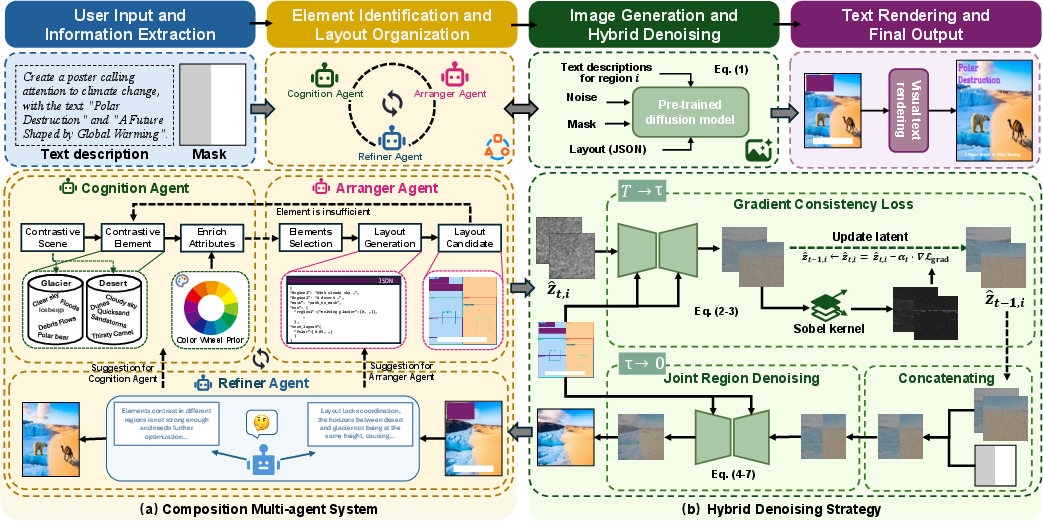
Figure 2: Architecture schematic, detailing LLM-based information extraction, iterative agent processing, and diffusion-based synthesis with regional guidance.
Hybrid Regional Denoising
Addressing visual discontinuities at region boundaries—a pervasive artifact in region-based generative models—the paper introduces a hybrid denoising procedure:
- Stage 1 (Gradient Consistency Loss): Each region’s latent code undergoes independent denoising to materialize its assigned content. A gradient consistency loss, calculated via Sobel kernel convolution, explicitly penalizes discontinuities in image gradients at region boundaries, promoting content continuity.
- Stage 2 (Joint Regional Denoising): Successfully denoised regions are fused and subsequently undergo joint denoising leveraging cross-region blending. Boundary pixels across adjacent regions blend predicted noise based on boundary proximity, with weights determined by distance, enforcing visually harmonious transitions.
By combining spatially localized content generation with explicitly regularized inter-region blending, this two-stage approach facilitates both high visual contrast and compositional smoothness.
Benchmark Dataset
Current datasets inadequately cover regional contrast compositions, commonly overrepresenting centralized or theme-uniform poster designs. The authors compile a new 643-image benchmark, annotating each poster with region masks and theme descriptions using both automated and manual processes. Four user studies validate the dataset’s coverage of element contrast, aesthetic harmony, annotation fidelity, and region division accuracy, each exceeding 90% satisfactory ratings.
Experimental Results
Evaluation Protocol
Seven quantitative metrics are employed: (i) LAION Aesthetic Score (LAS) for global appeal, (ii) Regional Style Difference (RSD) for quantifying visual contrast, (iii) Boundary Gradient Difference (BGD) for edge continuity, (iv) OCR accuracy for rendered text fidelity, and three VLM (GPT-4) based holistic quality scores.
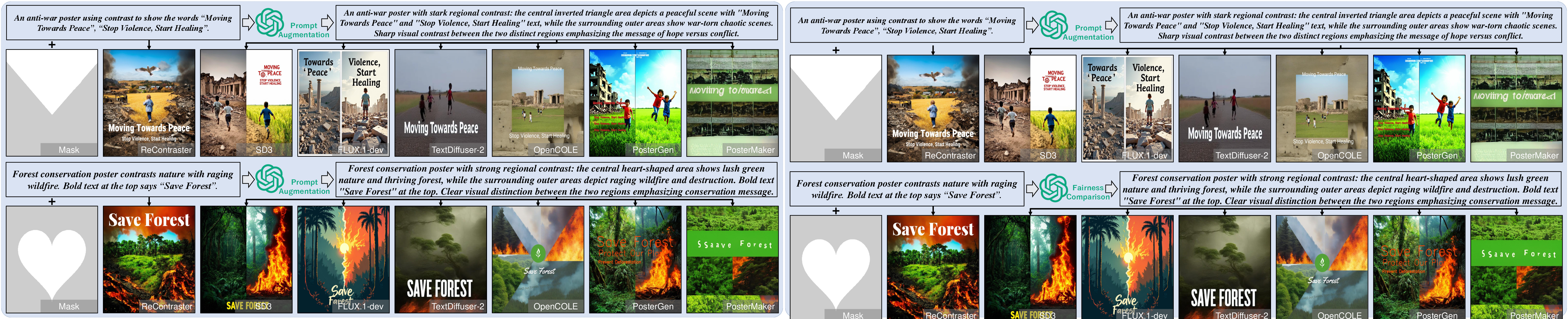
Figure 3: Exemplar visual comparisons versus SD3, Flux.1-dev, TextDiffuser-2, OpenCOLE, PosterGen, and PosterMaker.
Comparative Analysis
ReContraster decisively outperforms state-of-the-art text-to-image and poster-generation systems across all metrics. Notable scores include LAS = 5.0966, RSD = 842.60, BGD = 0.0375, and OCR accuracy = 0.65. The method shows strong gains in both quantitative and user study preferences:
- Existing diffusion-based methods fail to enforce visual contrast and often produce semantically blurred or region-disjoint results.
- Poster-specific models without regional agent-based control exhibit chaotic structure, low legibility, or poor contrast.
- ReContraster generates content with highly distinct regional contrast, seamless region integration, and well-organized text and graphics.
Ablation Analysis
Module removal reveals substantial performance degradation, confirming the necessity of each proposed innovation. Removing the cognition-arranger interaction, refiner agent, gradient consistency loss, or joint region denoising directly impacts respective metrics (contrast, harmony, continuity).
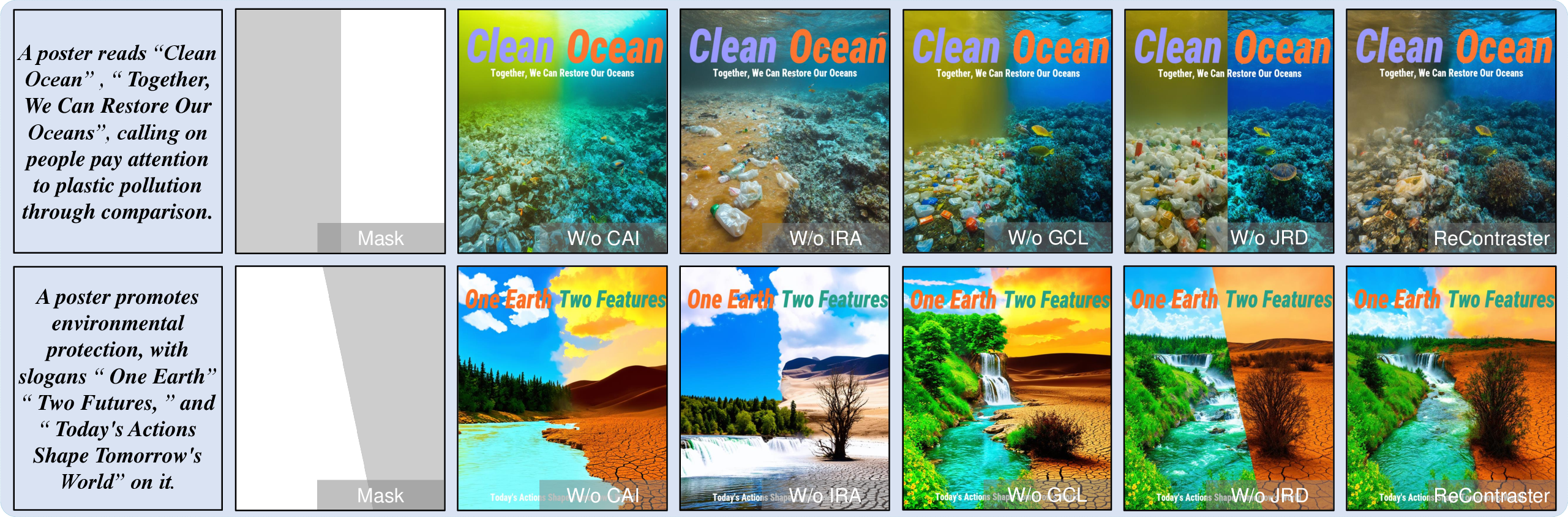
Figure 4: Ablation on core components, demonstrating their effect on contrast, boundary quality, and compositional harmony.
Application Scenarios
The method generalizes across multilingual prompts, arbitrary region semantics, and direct user control of region masks. It also supports iterative editing and flexible adaptation to custom image domains.
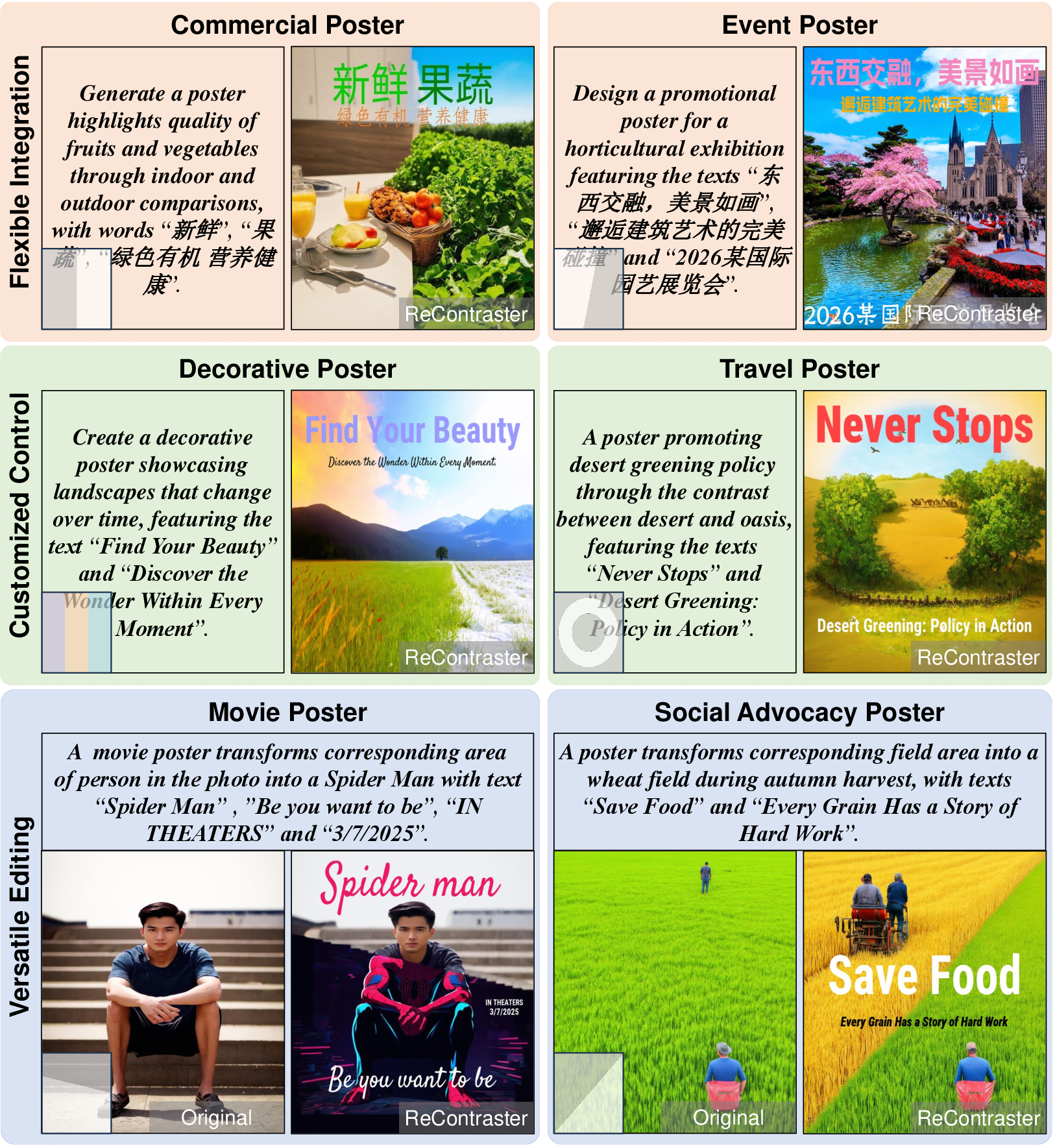
Figure 5: Demonstrated applications including multilingual, user-controlled, and domain-adaptive poster synthesis.
Implications and Future Directions
ReContraster’s training-free, agent-based protocol advances controllability and semantic sophistication in text-to-image synthesis, especially for design applications demanding high-level visual rhetoric (e.g., advertising, campaigns). The explicit handling of regional contrast and compositional transitions opens avenues for generalized region-aware generative modeling, adaptable to other document synthesis or creative tasks. However, performance is sensitive to granularity and structure of user-specified region masks. Automating or better guiding region division, as well as hierarchical or content-aware refinement, are promising future research directions.
Conclusion
ReContraster (2604.10442) introduces a new formalism for controlled poster generation, combining regional semantic contrast, agent-based compositional reasoning, and hybrid denoising for seamless transition. It establishes a new benchmark for regional contrast poster synthesis and provides a foundation for the next generation of layout-aware generative models. Quantitative superiority, validated human studies, and versatile application support establish it as a reference point for further research in structured and content-aware image synthesis.

