- The paper establishes robust lower limits on common envelope ejection efficiency, with α_CE values >1 across multiple energy prescriptions.
- It employs a hybrid framework using detailed MESA simulations and Monte Carlo natal kick models to reconstruct the full binary evolution.
- Results challenge canonical energy formalism assumptions, suggesting missing energy sources and impacting population synthesis and GW event predictions.
Constraining Common Envelope Ejection in Massive Binaries via Full Evolutionary Reconstruction of BH X-ray Binaries
Introduction and Motivation
The evolution of massive stellar binaries, particularly through the common envelope (CE) phase, is central to the formation of close compact object pairs such as black hole (BH) and neutron star (NS) binaries. However, the CE phase remains the least constrained aspect of binary evolution, and uncertainties in the CE ejection efficiency (αCE) directly impact predictions related to supernova progenitors, compact object mergers, and GW event rates. Unlike the population of low-mass post-CE binaries, for which modest αCE<1 are inferred, the massive regime is theoretically more ambiguous and observationally less accessible. This study (2604.10440) targets three dynamically confirmed Galactic BH X-ray binaries (BHXBs)—GRO J1655-40, SAX J1819.3-2525, and 4U 1543-47—to set robust limits on αCE by reconstructing their full evolutionary histories.
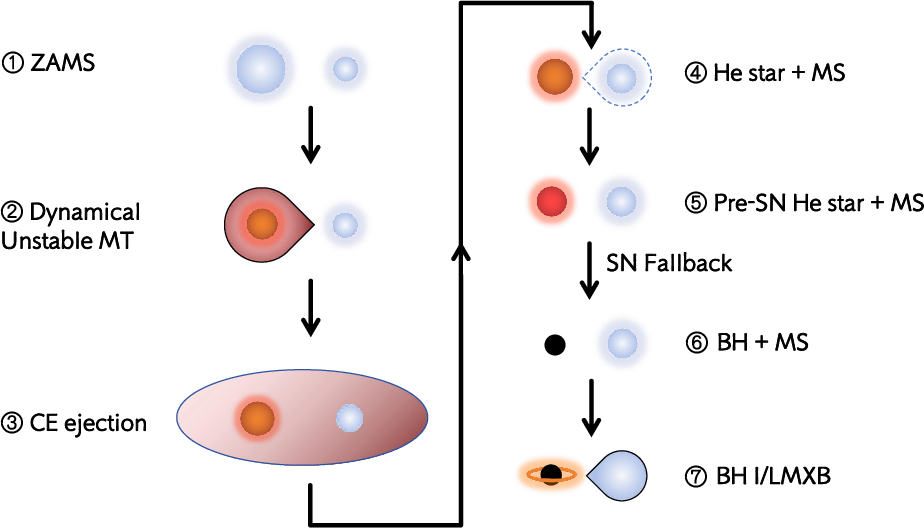
Figure 1: Schematic evolutionary sequence for BH I/LMXBs, highlighting the CE and mass transfer phases.
Modeling Approach
A hybrid framework is employed, utilizing detailed single and binary stellar evolution models (MESA, version 12115) and a parametric SN fallback prescription, to evolve initial massive binaries through the relevant evolutionary stages:
- Determination of pre-CE and post-CE binary parameters using stellar evolution grids.
- Three energy formalism variants for binding energy: α0.5U (half internal energy), αU (full internal energy), and αH (includes enthalpy).
- Natal kicks at BH formation are explicitly modeled via Monte Carlo realizations using the prescription from Hurley et al. (2002).
BH progenitor masses are mapped based on Schneider et al. (2021); grids cover 32−40M⊙ and 46−60M⊙ primaries to address the non-monotonic mapping between ZAMS and remnant mass in binary–stripped stars.
Reconstructing the Evolutionary Pathways
Self-consistent binary grids are generated for each of the three systems, matching all observed parameters within uncertainties.
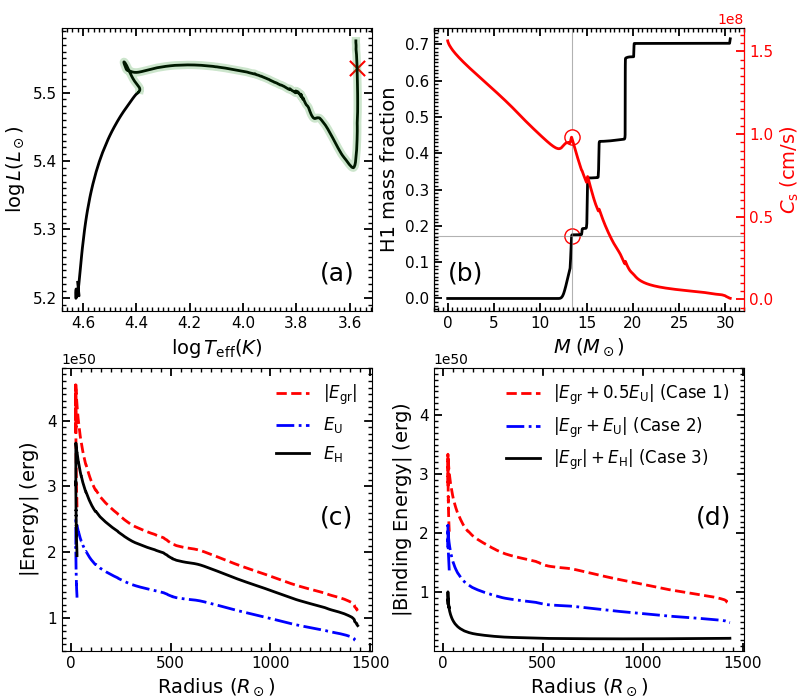
Figure 3: Representative binary evolutionary tracks for GRO J1655, distinguishing between physically viable and forbidden post-CE solutions.
For each allowed endpoint, the pre- and post-CE states yield the required αCE via the classical energy formalism:
Ebind=αCEΔEorb
Allowable and forbidden regions in parameter space are demarcated by evaluating Roche lobe overflow post-CE, with tight constraints on the masses and periods.
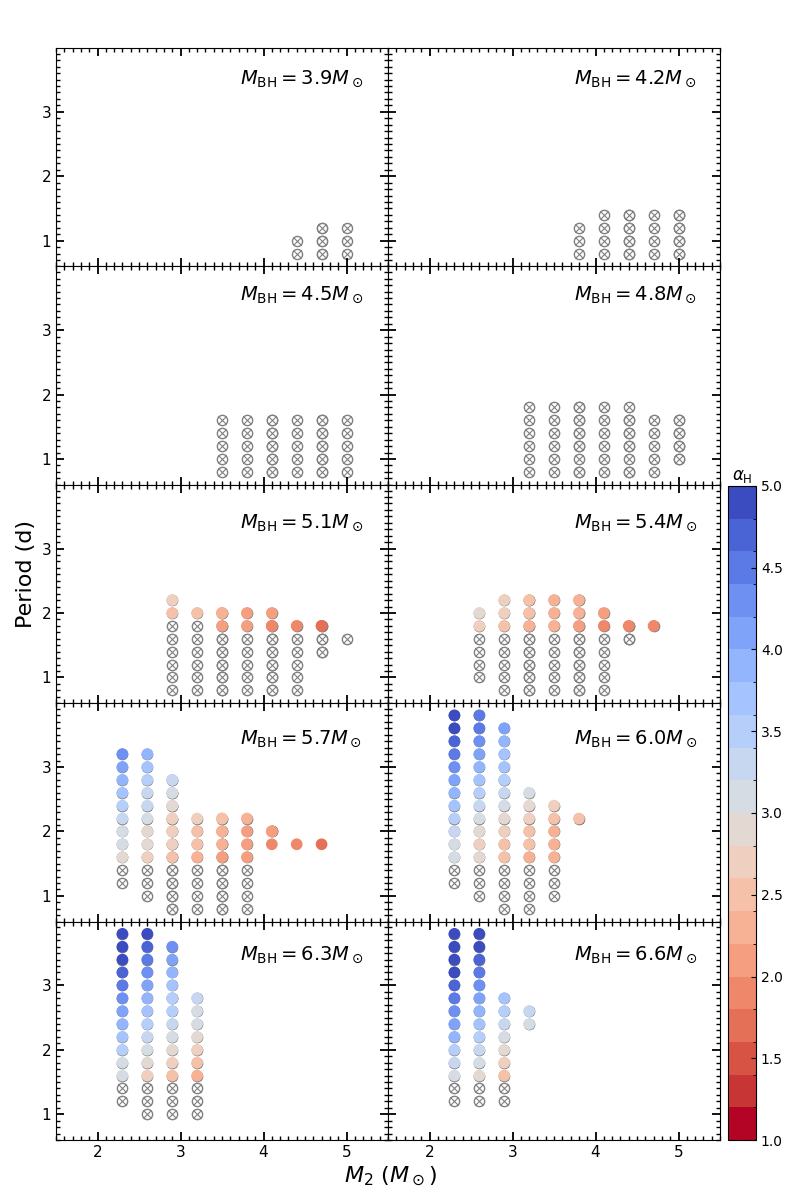
Figure 2: Detailed parameter mapping for GRO J1655, with colors indicating αCE<10 for viable grid points.
Effect of Binding Energy Treatment & Progenitor Structure
Binding energy calculations reveal significant sensitivity to (i) progenitor mass, (ii) envelope structure at CE onset, and (iii) adopted αCE<11 prescription.
Figure 4: Example binding energy analysis of a αCE<12 star, showing the impact of internal energy and enthalpy on the envelope's ejection ease.
The critical result is that, regardless of the adopted binding energy treatment, no solution exists with αCE<13: typically, αCE<14, αCE<15, and αCE<16, depending on system and BH progenitor mass.
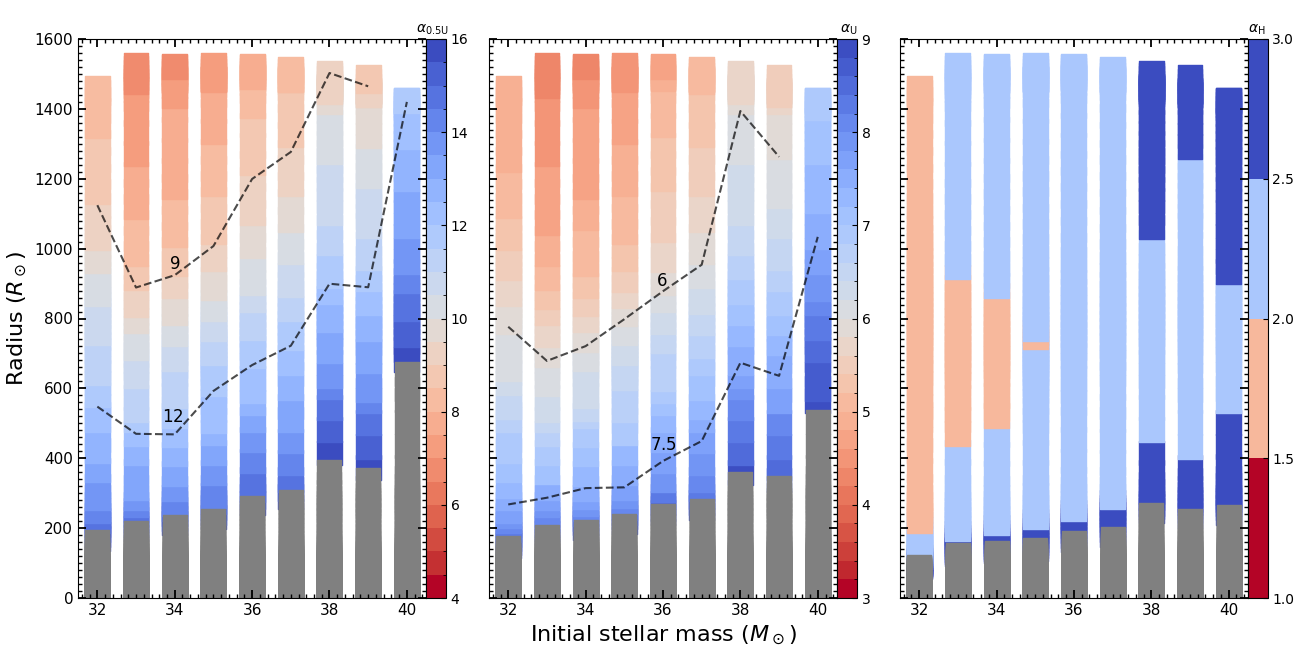
Figure 6: Minimum required αCE<17 for GRO J1655 as a function of progenitor mass and radius, showing only minor reduction with enthalpy.
This result is highly robust to the assumed evolutionary phase for envelope ejection, and is corroborated for all three analyzed targets.
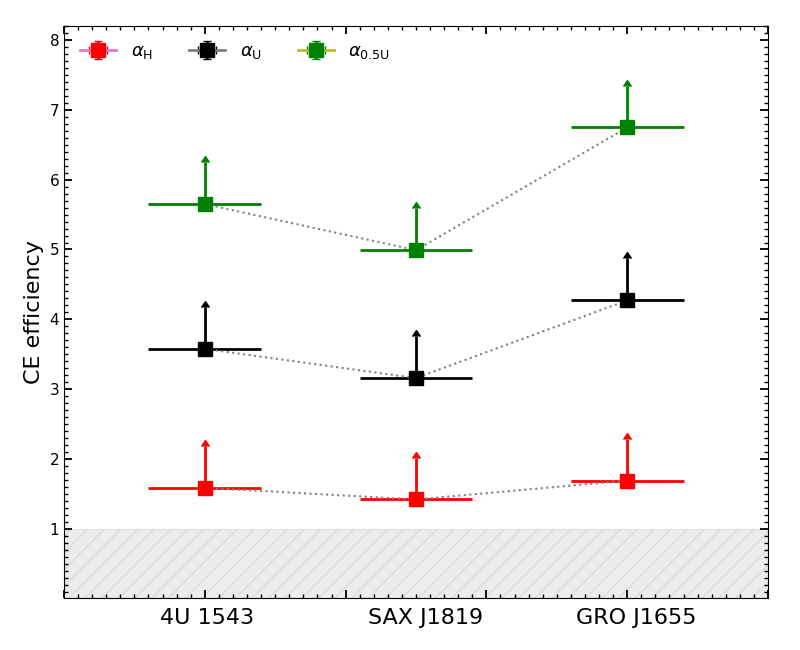
Figure 8: Comparison of minimum αCE<18 requirements among GRO J1655, SAX J1819, and 4U 1543 for three binding energy prescriptions.
The BH natal kick (velocity imparted at BH formation) is a critical parameter. For 4U 1543-47, no viable formation pathway exists for αCE<19 km/s; preferred configurations require αCE0 km/s.
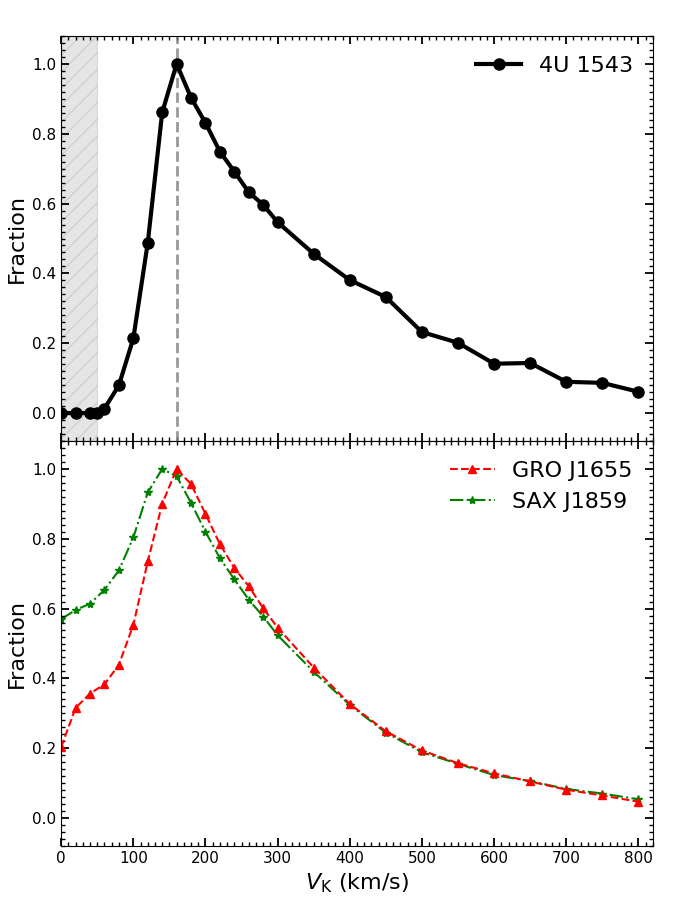
Figure 9: Fraction of synthetic binaries producing each target system as a function of natal kick, demonstrating sharp lower limits for 4U 1543.
For GRO J1655 and SAX J1819, non-zero kicks allow expansion into the so-called "mass gap" (αCE1). The effect of the kick on the required αCE2 is modest; even with increased mass loss, αCE3 remains αCE4 for all plausible initial conditions.
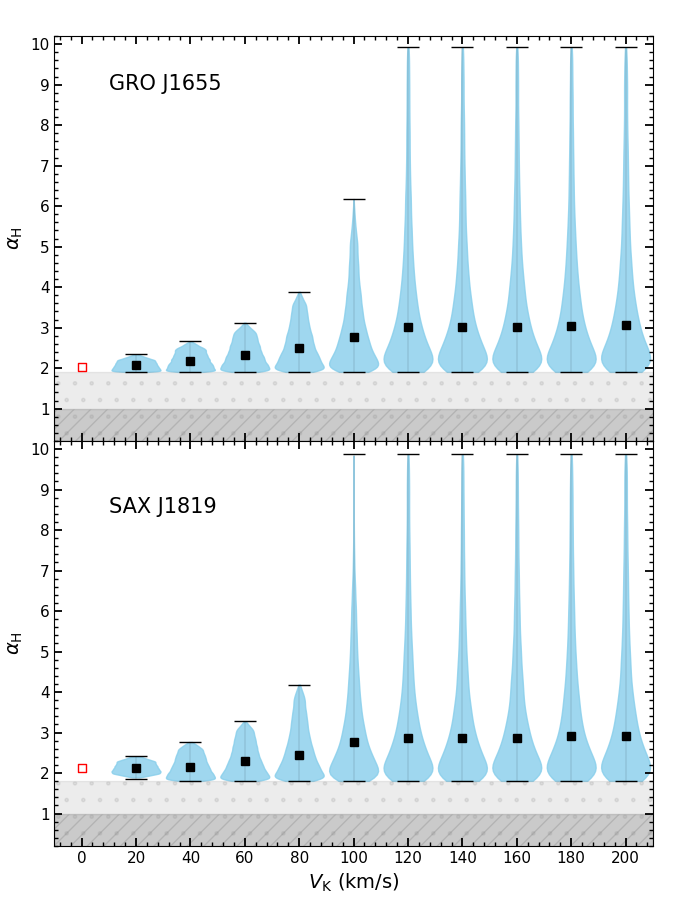
Figure 11: Distribution of αCE5 as a function of imposed natal kick velocity. Systems with kicks in the regime αCE6 are dynamically disfavored.
Theoretical and Practical Implications
The requirement for αCE7 in all scenarios, even with maximal binding energy reduction, is both numerically robust and theoretically significant. It directly contradicts the physical expectation that αCE8 should be αCE9 in a closed energy budget and echoes the high values employed ad hoc in BH population synthesis studies (e.g., Dominik et al. 2012; Grichener 2023).
This necessitates revisiting the classical CE paradigm:
- Missing Energy Sources: Additional ejection energy may originate from accretion-driven jets (Soker 2015; Shiber et al. 2019), nuclear energy injection (Podsiadlowski et al. 2010), or other mechanisms not encapsulated in current formalisms.
- Structure Evolution: Time-dependent changes in envelope structure during CE and the role of the radiative intershell (Hirai & Mandel 2022) could alter the energetics and post-CE outcomes.
- Population Synthesis: The high α0.5U0 solutions demanded by empirical reconstruction must now be incorporated as constraints in GW event rate predictions and merger channel modeling.
- Alternative Formation Scenarios: Where isolated binary evolution faces fundamental energetic inconsistencies, dynamical or triple-induced paths may gain relative plausibility.
Future Directions
Key unresolved issues include the self-consistent incorporation of jet and nuclear energy into envelope ejection prescriptions, and a more comprehensive observational sample of dynamically confirmed BHXBs that traverse the relevant parameter space. Time-dependent 3D hydrodynamic and radiation MHD simulations, coupled to detailed evolutionary codes, are essential for translating the empirical α0.5U1 requirements into physical mechanisms.
Conclusion
By reconstructing the full parameter space for three Galactic BHXBs, this work establishes authoritative lower limits on the CE ejection efficiency in the massive binary regime: α0.5U2, α0.5U3, α0.5U4—all strictly exceeding unity regardless of reasonable physical assumptions. Isolated binary formation of 4U 1543-47 requires substantial BH natal kicks (α0.5U5 km/s). The empirical necessity for α0.5U6 highlights either missing physics (e.g., jet/nuclear-driven unbinding) or a fundamental deficiency in the canonical energy formalism for massive binary common envelope evolution. This result sets new benchmarks for future population synthesis, supernova modeling, and gravitational wave astrophysics.