- The paper introduces the PRoID framework that compares current and predicted rates to optimize information relay.
- It integrates decentralized data fusion, map prediction, and frontier-based exploration to enhance coverage.
- PRoID-Safe extends this approach by incorporating survival probabilities to mitigate robot failure risks during missions.
Multi-Robot Exploration and Relaying (MRER) extends beyond classical exploration by requiring that spatial information, not merely collected by mobile agents, must be delivered to a centralized base before a mission deadline. This requirement introduces a fundamental trade-off between maximizing spatial coverage and minimizing the risk of losing acquired but undelivered data due to robot failure or communication restrictions. Existing strategies for data relay in MRER, such as fixed-interval returns or final-at-deadline relay, are non-adaptive, and cannot dynamically optimize performance based on the environment's structure, robot team composition, or real-time mission state.
The PRoID framework directly addresses this deficiency by posing the relay timing decision as an explicit comparison of current versus predicted rates of information delivery, integrating predicted map information gain, time-to-base, and coordination state. This approach produces adaptive, decentralized policies that can flexibly adjust to intra-mission contingencies, including robot failures and heterogeneous team states.
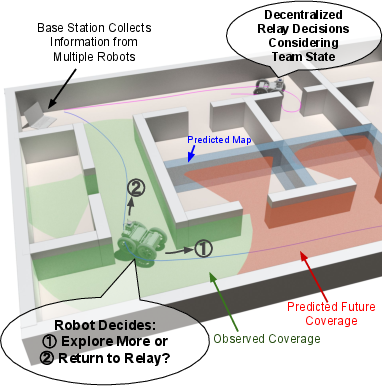
Figure 1: Multi-robot exploration must not only cover unknown environments but also deliver collected information to a base station in time. PRoID enables adaptive relay decisions by comparing each robot's current observed coverage against its predicted future sensor coverage along the planned path.
Methodology: PRoID and PRoID-Safe Frameworks
The PRoID pipeline builds atop a multi-robot frontier-based exploration backbone, integrating learned map prediction, decentralized information fusion, and dynamic relay handoff.
Baseline Exploration and Coordination
Each agent performs local frontier extraction, optimizing target selection with a map-prediction-based scoring function [baek2025pipe]. Decentralized map sharing occurs upon proximity, yielding consistent occupancy beliefs and enabling the identification of ‘unique, unreported’ map areas per agent, suppressed for overlaps delegated via handoff to other agents. Inter-agent trajectory and plan sharing penalize redundant commitments, improving holistic coverage efficiency.
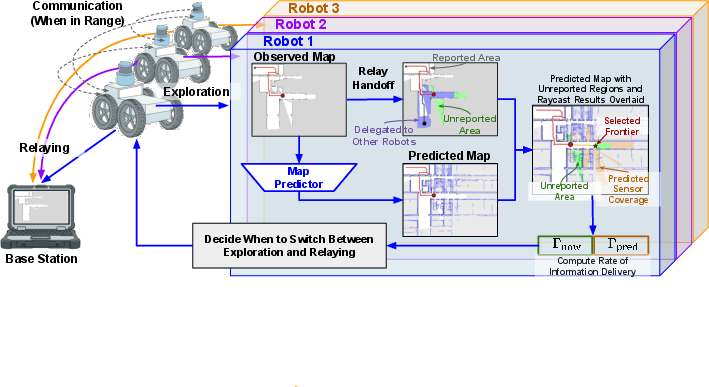
Figure 2: Overview of PRoID: robots explore unknown environments and share map data when in range. Each robot tracks its unique unreported information and continuously evaluates whether to continue exploring or relay to the base, based on comparing current and predicted future rates of information delivery.
The central innovation is the relay decision rule. For robot i at time t:
- The current Rate of Information Delivery (RoID) is:
Γnow=tcur→baseIunreported
where Iunreported is the information (map cells) uniquely observed by i, excluding delegated regions, and tcur→base is the forecasted travel time to the base.
- The Predicted Rate of Information Delivery (PRoID) is:
Γpred=tcur→front+tfront→baseIunreported+E[Ipred]
where Ipred is the expected incremental gain from following the planned path to the selected frontier, computed over learned map predictions.
Relay is triggered if:
Γnow>αΓpred
with α≥1 as a conservative slack parameter.
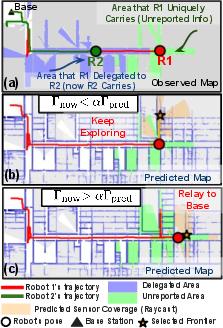
Figure 3: (a) Robot 1 shares its map with Robot 2, delegating overlapping coverage (blue) and retaining its unique unreported area (green). (b) Robot 1 estimates predicted sensor coverage along its planned path (orange) and compares current vs.~predicted rate of information delivery—deciding to continue exploring. (c) After further exploration, the current rate exceeds the predicted rate, triggering relay to the base station.
PRoID-Safe: Failure-Aware Adaptive Relaying
MRER often entails risk of robot failure, modeled as a Weibull process with a survival function t0. PRoID-Safe incorporates this risk directly:
- Current relay value: t1, survival to reach base immediately.
- Predicted relay value: t2, survival through exploration to relay.
Relay is triggered if:
t3
This shifts the relay threshold to earlier returns as failure risk grows, providing risk-adjusted adaptivity.
Experimental Results
Evaluation on real-world KTH indoor floorplan maps demonstrates that PRoID consistently outperforms fixed-schedule baselines (periodic and final-only relays), yielding higher proportion of delivered, non-redundant coverage over varied team sizes and multiple initial conditions.
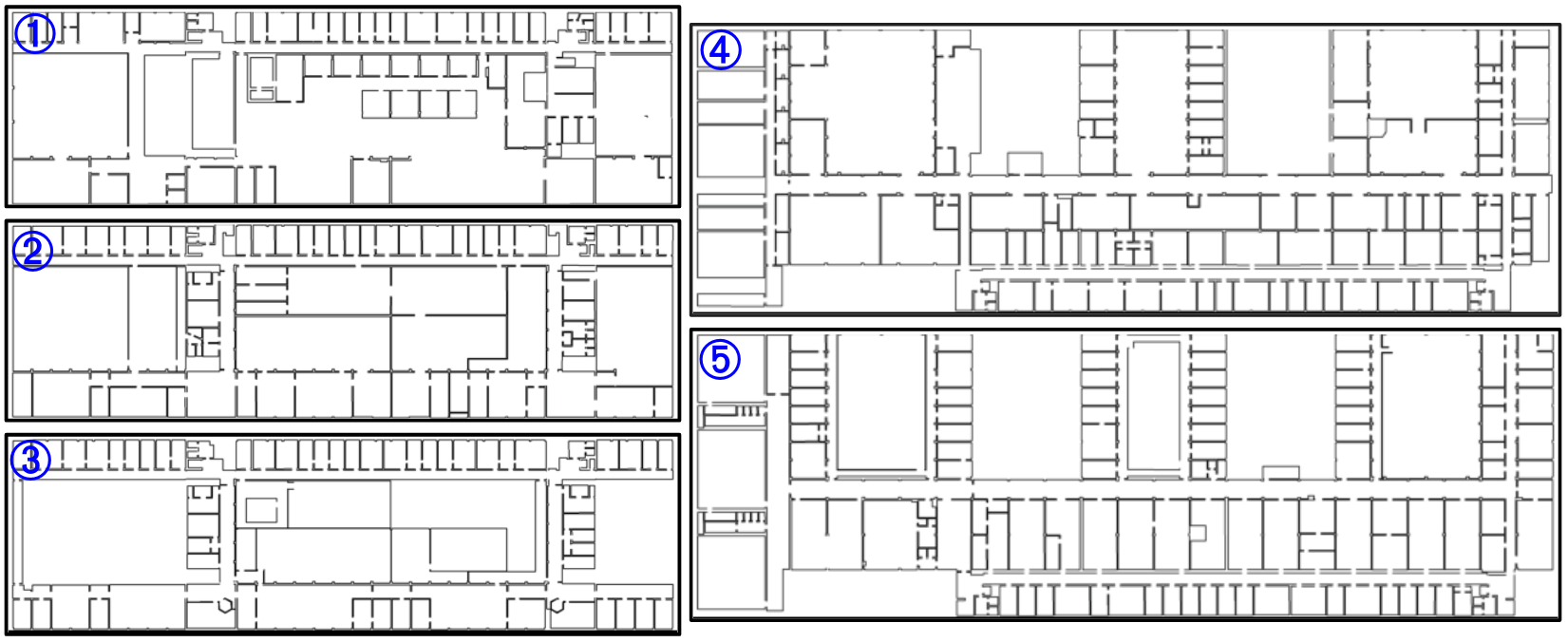
Figure 4: Five Test Maps from KTH Indoor Floorplan Dataset.
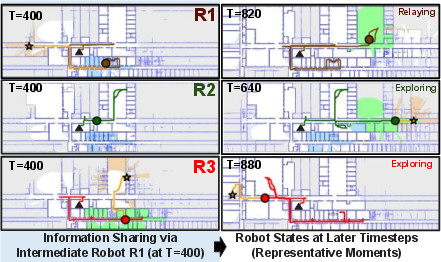
Figure 5: (Left) At t4, R1 delegates observed area (blue) to R3. R2, out of range of R3, still learns these areas are delegated via R1. (Right) Each robot compares unique unreported area (green) against predicted future coverage (orange). R1 relays (small predicted coverage); R2 explores; R3, having fully delivered all data, continues exploring.
- No-Failure Setting: PRoID yields 7.8–12.4 percentage points increase in mission coverage versus best periodic baseline, and 1.3–3.4 percentage points versus final-return at t5.
- Failure-Prone Setting: PRoID-Safe achieves 8.6–12.2 percentage points higher coverage than the best periodic baseline under high failure rates.
- Ablations: Disabling relay handoff or plan sharing degrades performance, confirming the utility of dynamic decentralized role delegation and information fusion.
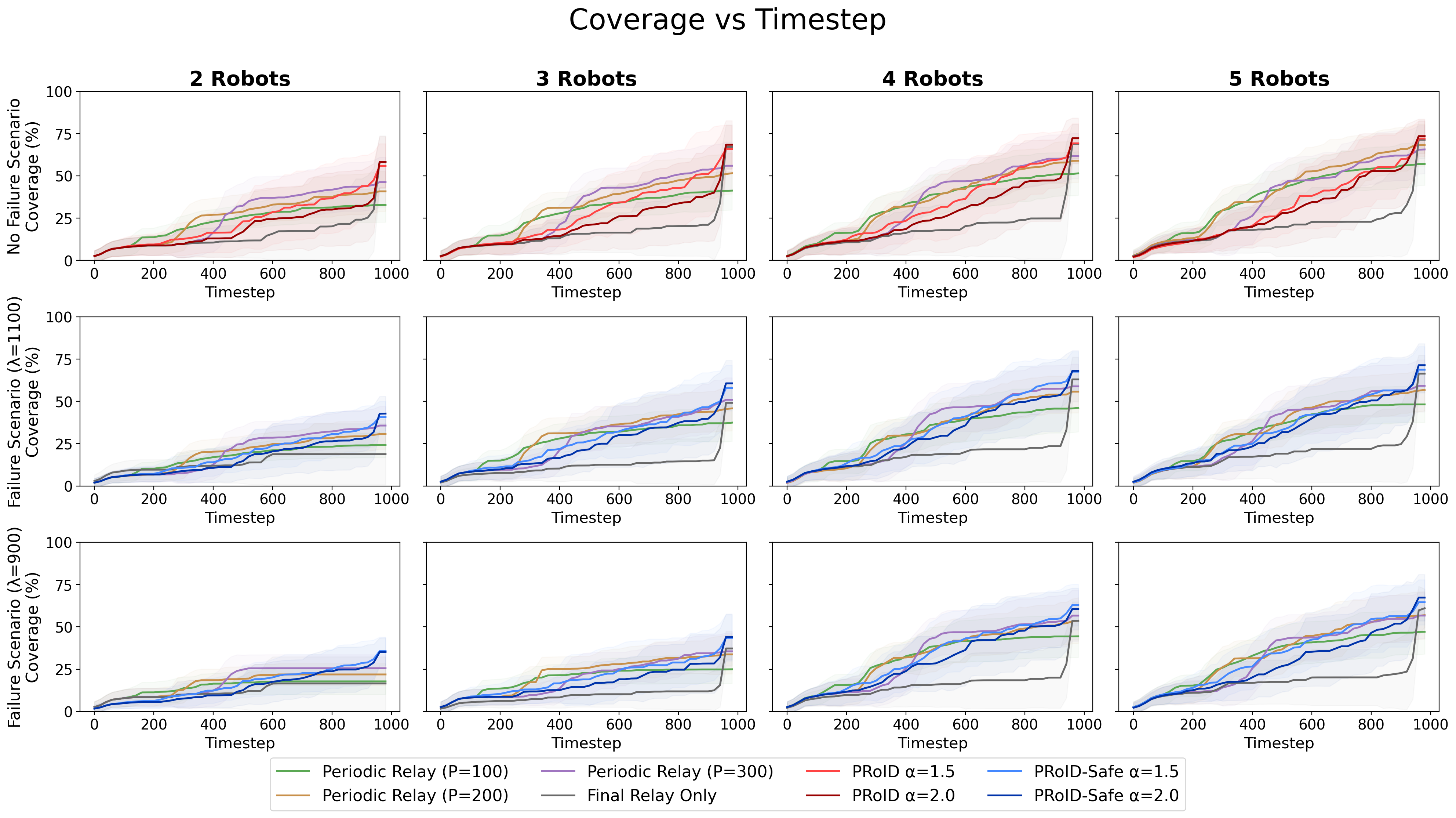
Figure 6: Quantitative comparison of PRoID against fixed-schedule baselines in the no-failure scenario, and PRoID-Safe in failure-prone scenarios (t6).
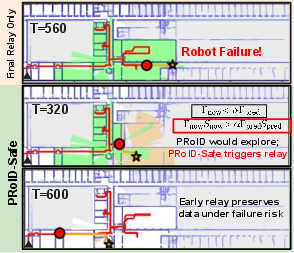
Figure 7: (Top) Final Relay Only robot fails at t7 before returning, losing all data. (Middle) At t8, PRoID-Safe triggers relay despite t9, as survival probability shifts the criterion (Γnow=tcur→baseIunreported0). (Bottom) Data already relayed; robot continues exploring safely.
Practical and Theoretical Implications
PRoID provides a principled, online mechanism for implicit multi-robot role assignment, integrating map-prediction-driven frontier selection, decentralized data fusion, and relay handoff in a theoretically grounded manner. It formalizes the relay decision as an optimal stopping problem over predicted delivery efficiency rather than fixed criteria, yielding strong empirical performance across a range of operational constraints.
PRoID-Safe generalizes this with direct risk-aware planning, enabling robust operation in real MRER deployments with significant failure risk—an essential criterion for safety-critical tasks (e.g., search and rescue, disaster response).
On a theoretical level, PRoID reframes multi-robot exploration as a rate- versus-expected-value optimization under belief updates, rather than simple coverage maximization, advancing the formalism in the field.
Future Developments
Extending PRoID to incorporate learned navigation policies could close the decision-action gap, automatically integrating uncertainty quantification from map predictors into path planning under information gain. Joint models for team belief over robot positions and intentions, leveraging predictive map information, could further increase efficiency by minimizing redundant effort even under partially observed team states. Empirical validation in real-world (non-simulated) robot hardware would facilitate transfer of theoretical guarantees to operational deployments and open further study on robustness under communication loss, dynamic environments, and hardware variability.
Conclusion
The PRoID and PRoID-Safe frameworks constitute a significant advance for adaptive, information-centric multi-robot exploration. By operationalizing the predicted rate of information delivery, this methodology enables decentralized, risk-aware, and efficient relay scheduling under varied team and failure conditions, outperforming fixed baselines both quantitatively and in coordination robustness (2604.10433).