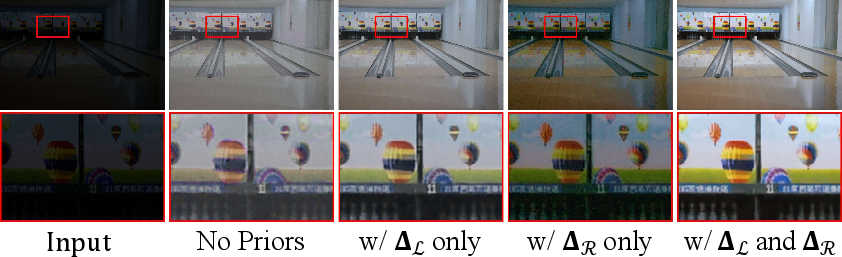
- The paper introduces a novel multi-prior Retinex framework that integrates luminance and chrominance guidance with lightweight fusion modules for robust low-light enhancement.
- It employs an additive enhancement delta strategy to decouple illumination and reflectance corrections, reducing parameters and avoiding common artifacts.
- Empirical benchmarks reveal significant PSNR/SSIM gains and effective downstream performance, enabling real-time deployment in edge devices.
Multinex: Lightweight Low-Light Image Enhancement via Multi-Prior Retinex
Introduction and Motivation
Low-light image enhancement (LLIE) remains a persistent challenge due to physical constraints in photonic capture and sensor nonlinearities. Standard LLIE techniques, dominated by heavy-weight deep neural networks and color-space confined architectures, suffer from computational inefficiency and frequent color/exposure artifacts when deployed to edge scenarios. Additionally, reliance on a single color space impairs robustness, leading to instability and visually displeasing exposures or chromatic distortions.
The Multinex framework presents a systematic advancement by injecting explicit, fine-grained analytic priors—both luminance and chrominance—within a residual Retinex-based decomposition, and utilizing efficient, lightweight neural modules for fusion. This architecture targets not only accuracy under severe parameter and FLOP constraints but also stability across diverse imaging conditions.
Unlike classic Retinex models that reconstruct images via explicit decomposition (illumination, reflectance) and subsequent multiplication, Multinex implements an additive enhancement delta. Specifically, it models image correction as:
I^=I+ΔI=I+ΔL⊙ΔR
where I is the low-light input, ΔL is the per-pixel luminance adjustment (shared for RGB), and ΔR is the per-pixel reflectance/chrominance correction (channel-wise adjustments). Importantly, the luminance and reflectance corrections are not learned blindly—they are guided by multi-prior stacks constructed analytically from the input.
Imposing this enhancement-over-reconstruction paradigm ensures retention of content structure and prevents overfitting to spurious data correlations. Notably, it also facilitates aggressive parameter reduction without catastrophic loss in output quality, an aspect substantiated by strong empirical results.
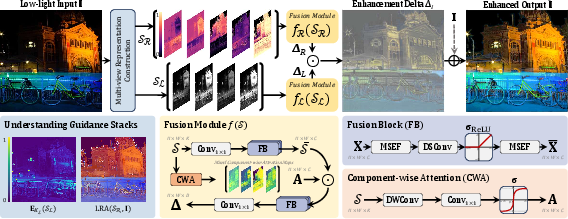
Figure 1: Illustration of Multinex Architecture. Fusion modules fL and fR use illumination and reflectance guidance stacks SL and SR to produce color and luminance correction terms ΔL and ΔR. Retinex-like fusion then yields the Enhancement Delta I0.
Multi-Prior Stacks
Luminance Guidance Stack I1
Four analytically derived feature maps are combined:
- I2: Human luminance based on ITU-R BT.709.
- I3: Channel-wise maximum (highlight energy).
- I4: HSL perceptual lightness.
- I5: RGB vector magnitude (energy).
These cover synergistic interpretations of brightness, constraining the network to reason in a physically interpretable, decorrelated luminance space.
Reflectance Guidance Stack I6
Five chrominance candidates:
- I7, I8: Blue/red chroma difference (YCbCr-based).
- I9, ΔL0: Per-channel chromaticity ratios, ensuring illumination invariance.
- ΔL1: Saturation (distance from gray axis).
Empirically, this set minimizes inter-feature redundancy and maximizes coverage of plausible color variations in low-light scenes.
Lightweight Fusion Modules
The fusion modules ΔL2 (for luminance) and ΔL3 (for reflectance) leverage:
- Stacked Fusion Blocks with depthwise separable convolution, multi-stage squeeze-and-excitation (MSEF), and ReLU.
- Component-Wise Attention: Lightweight (per-component) spatial and channel attention, avoiding entanglement across prior features.
Efficient masking and refinement hierarchies are central for propagating analytic guidance while consuming orders-of-magnitude fewer parameters (down to 0.7K for nano-variant). Ablation demonstrates that this architecture—especially the concurrent use of CWA and MSEF—offers superior selectivity and fusion compared to self-attention/module-mixed alternatives.
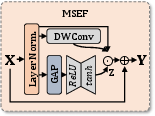
Figure 2: MSEF module architecture.
Ablation Studies on Priors and Architecture
Specific ablations reveal:
Numerical Results and Benchmarks
Quantitative Enhancement
Extensive benchmarking covers several regimes:
- Reference datasets (LOL-v1, LOL-v2, SDSD): At 44.7K parameters, Multinex achieves ΔL4 PSNR / ΔL5 SSIM on LOL-v1—significantly surpassing all other models ΔL61M parameters and rivaling mid-sized (ΔL71M) SOTA.
- No-reference sets (MEF, LIME, DICM, NPE): Multinex achieves a mean NIQE of ΔL8, outperforming CIDNet and LYT-Net, while using ΔL9 of the parameters.
Downstream Task Generalization
As a preprocessor for YOLOv3 in low-light object detection on ExDark, Multinex-Nano (0.7K params) ties with or surpasses models with ΔR0 larger capacity in mAP50, demonstrating the high fidelity of its corrections for downstream vision tasks.
Visual Evaluation
Qualitative results indicate Multinex preserves illumination gradients and chromatic consistency better than both parameter-heavy and parameter-frugal baselines.
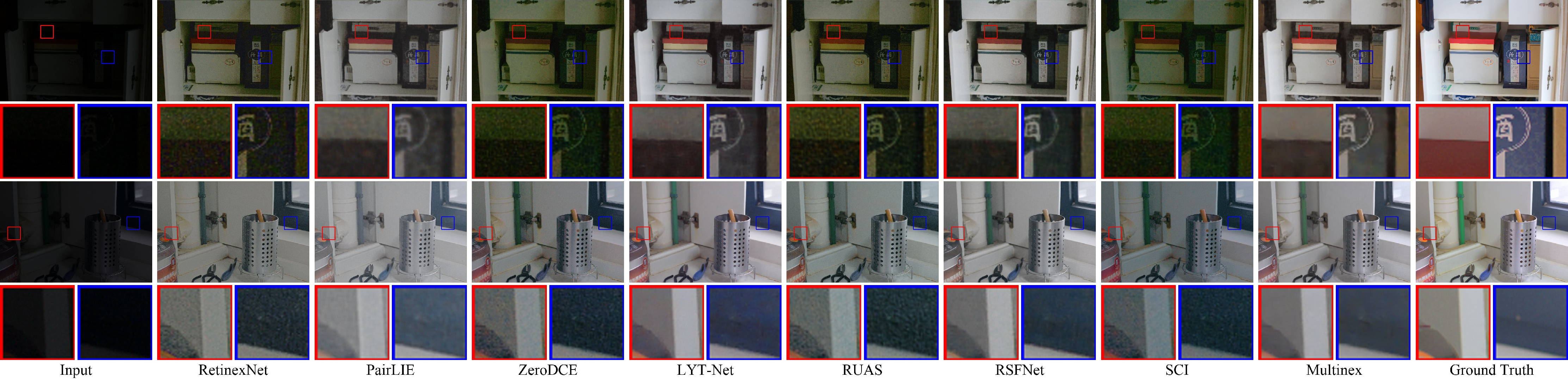
Figure 4: Qualitative comparison on reference dataset LOL-v1—Multinex closely matches the ground-truth in exposure and color, suppressing noise/artifacts seen in prior work.
For challenging cases from uncontrolled scenes (DICM, MEF), while overexposure or detail loss can occur due to extreme compression, Multinex artifacts are less severe or no more prominent than those of larger models.
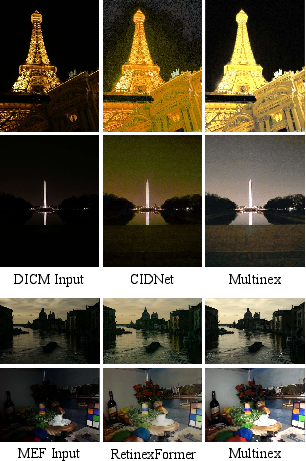
Figure 5: A few challenging cases from DICM and MEF datasets.
Theoretical and Practical Implications
The formalization of analytic multi-prior stacks addresses a long-standing bottleneck in physically motivated, low-parameter LLIE: instability from coupled color/illumination modeling. Multinex’s framework decouples these axes analytically, which could inspire further lightweight designs in other image restoration tasks (dehazing, color constancy, underwater enhancement) and even cross-modality transfer where robust initial priors are critical.
On the practical side, Multinex provides a solution for on-device, real-time LLIE, enabling robust deployment in edge and embedded systems for mobile imaging, surveillance, automotive, and robotics applications.
Future Directions
While Multinex achieves a highly favorable efficiency-performance tradeoff, limitations remain for cases of severe sensor noise, complex spectral distortions, and HDR or mixed lighting. Extensions could include:
- Hybridizing with lightweight transformers or conditional diffusion for extreme scenarios.
- Generalizing analytic residual principles for alternative inverse visual reasoning domains.
- Incorporating adaptive or learnable prior selection under distributional shift.
Conclusion
Multinex demonstrates that physically grounded, analytically decomposed multi-prior guidance, fused via targeted lightweight modules, enables efficient and robust low-light enhancement under extreme computational constraints. The framework bridges classical Retinex theory with contemporary learnable models, setting a benchmark for future edge-focused LLIE systems.
References: Brateanu et al., "Multinex: Lightweight Low-light Image Enhancement via Multi-prior Retinex" (2604.10359)