- The paper introduces a two-stage low-light image enhancement pipeline that decouples brightness correction from residual color restoration.
- It employs frozen distribution-normalizing preprocessing using CPGA-Net and CLAHE, paired with a parameter-efficient depthwise U-Net under a strict 1MB budget.
- The architecture achieves competitive LPIPS and PSNR metrics compared to heavier transformer-based models, demonstrating effective performance in resource-constrained settings.
Lightweight LLIE via Distribution-Normalizing Preprocessing and Depthwise U-Net
Introduction and Motivation
Low-light image enhancement (LLIE) is foundational for robust downstream vision tasks, as images captured under suboptimal illumination are plagued by noise, color attenuation, and local/global exposure imbalances. Traditional approaches rely on Retinex decomposition, learned color space projections, and, increasingly, transformer backbones. However, such advances come with a significant increase in parameter count and computational demands, restricting their deployment in resource-constrained environments. This work introduces an efficient two-stage LLIE pipeline that integrates frozen distribution-normalizing preprocessing with a compact, depthwise-separable convolutional U-Net, targeting a stringent 1MB parameter budget suitable for mobile and edge devices.
Methodological Framework
The key insight driving this architecture is the externalization of brightness correction to frozen preprocessors, positioning the core trainable model to focus exclusively on residual color correction. Algorithmic preprocessors reliably shift input distributions closer to ground truth, mitigating the excessive variance intrinsic to low-light datasets such as LOLv1 and NTIRE ELLIE 2026, which otherwise exacerbate learning difficulty for compact neural architectures.
The pipeline comprises:
- Stage 1 (Preprocessing): Two complementary algorithms—CPGA-Net and CLAHE—are applied alongside the original RGB input. CPGA-Net, a lightweight channel-prior and gamma correction network, is pre-trained and fixed. CLAHE operates on the L channel in CIE Lab space, enhancing local contrast. The resulting 9-channel tensor (CPGA, original RGB, CLAHE) provides complementary and partially normalized exposure profiles.
- Stage 2 (Trainable DWConv U-Net): A 3-level U-Net employs depthwise-separable convolutions with GroupNorm and global residual connections. The parameter-efficient structure enables effective learning of color and texture restoration under strict model size constraints.
The overall design is visualized below:
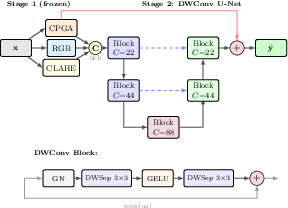
Figure 2: Overview of the two-stage LLIE pipeline; frozen preprocessors generate a 9-channel input, processed by a lightweight depthwise-separable U-Net for color correction.
Empirical Analysis and Results
Distribution Analysis
Empirical quantification of per-dataset variance demonstrates substantial improvement in distribution normalization post-preprocessing. On LOLv1, CPGA-Net aligns mean brightness to ground truth, while CLAHE provides effective local contrast normalization. On NTIRE, the high variance is only partially mitigated, underlining the pipeline’s robustness across challenging domains.
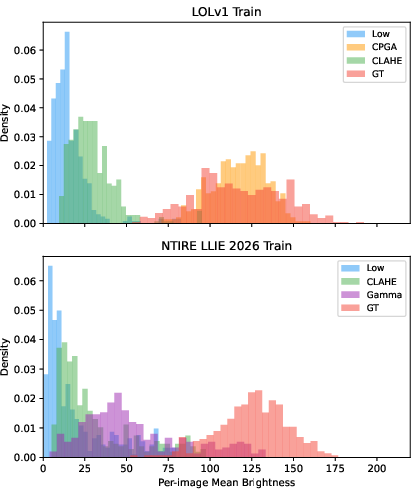
Figure 4: Preprocessing algorithms shift brightness distributions toward ground truth while balancing inter- and intra-image variance.
Quantitative and Qualitative Assessment
The proposed method shows superior parameter efficiency, delivering competitive or improved perceptual performance over parameter-intensive transformer-based models. Evaluated across LOLv1, LOLv2-Real, and LOLv2-Synthetic:
- LPIPS: The Mid variant (859K params) achieves 0.099, outperforming RetinexFormer (1.6M, 0.161) and closely paralleling HVI-CIDNet (2M, 0.086).
- Ablations: Performance improvements due to the inclusion of LPIPS loss are non-trivial, with LPIPS dropping from 0.224 (L1 only) to 0.099 (L1+LPIPS), highlighting the efficacy of combined reconstruction+perceptual objectives.
- Parameter-Matched Comparisons: The Tiny variant (338K) surpasses similarly sized RetinexFormer and HVI-CIDNet configurations, both in PSNR and perceptual metrics.
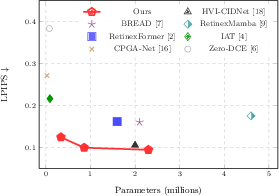
Figure 3: Comparative plot of parameter count versus LPIPS on LOLv1, with the proposed Mid model setting a new efficiency benchmark at sub-1M parameters.
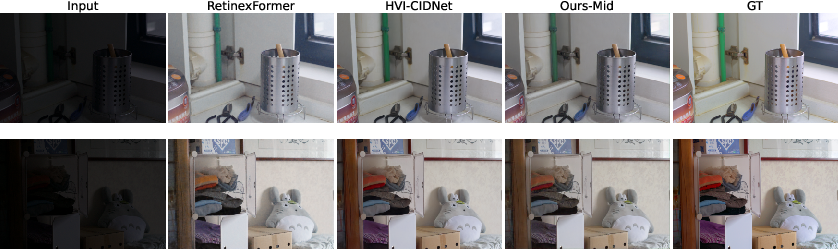
Figure 1: Qualitative results indicate reduced color distortion and comparable detail restoration versus transformer-based methods.
Preprocessing Robustness
The ablation study on preprocessing substantiates that the architecture’s strength is invariant to the specific algorithmic choices; gamma correction, histogram equalization, and CPGA-Net variations yield robust outputs provided that multi-view, brightness-normalized channels are furnished. This highlights the generality and extensibility of the framework.
Implications and Future Directions
The demonstrated architecture disrupts the trend of parameter scale escalation by strategically shifting normalization away from trainable parameters. This paradigm prioritizes efficient parameter allocation, advocating for distribution normalization as a modular pre-processing block within efficient all-convolutional pipelines. The implications extend beyond static image LLIE to video, where temporal consistency and preprocessor adaptation become critical.
The remaining performance gap in SSIM compared to large-scale transformer models identifies an avenue for further enhancing structural fidelity, possibly via more sophisticated channel attention or targeted loss functions. The main caveat is the system’s reliance on the quality of preprocessor outputs—catastrophic failure at this stage is irrecoverable within the presented architecture.
Conclusion
This work provides a formal demonstration that high-quality low-light image enhancement can be achieved with a sub-1M parameter budget via decoupled brightness correction and a depthwise-separable U-Net. With robust empirical performance across diverse benchmarks and strong ablation findings, the approach offers a theoretically justified and practically effective alternative to parameter-heavy transformer-based solutions. The generalization of the preprocessor ensemble, combined with efficient convolutional backbones, frames an extensible recipe for future resource-constrained LLIE research and applications.

