- The paper introduces a structure-preserving, trainable OFDM waveform (DBU-OFDM) that leverages recursive Householder reflections to enforce unitarity and protect resource allocations.
- It achieves over 3 dB PAPR reduction and enhances frequency diversity, yielding improved BER and BLER performance in various SNR conditions.
- The architecture supports integrated sensing with more accurate delay and velocity estimations, validated on both USRP and FPGA hardware setups.
Introduction and Motivation
The increasing demand for integrated sensing and communication (ISAC) in emerging wireless systems drives the need for waveforms that excel in both communication efficiency and sensing accuracy, while maintaining compatibility with practical hardware and protocol constraints. Orthogonal frequency-division multiplexing (OFDM) is well-established for its spectral efficiency and compatibility with low-complexity receiver architectures, yet its high peak-to-average power ratio (PAPR) and rigidity in transform structure limit its adaptability to the dual objectives of 6G ISAC. Deep learning (DL)-based solutions have shown promise in waveform optimization, but often disrupt the tractable structure and resource isolation fundamental to OFDM deployments. The work presented as "DBU-OFDM: A Trainable Deep Block-Unitary OFDM Waveform for Integrated Sensing and Communication" (2604.10296) proposes a structure-preserving, trainable OFDM architecture, leveraging recursive Householder parameterization to enforce strict unitarity while confining learnable mixing to the data subcarrier domain. This approach maintains pilot resource protection and DFT compatibility, achieving demonstrated improvements in PAPR, communication reliability, and direct sensing performance.
Structural Foundation: Constraints and Resource Partitioning in OFDM
Conventional OFDM systems utilize explicit allocations for data, pilot, and null subcarriers (including DC and guard bands) within each frequency-time resource grid. Resource partitioning is designed to balance channel estimation, spectral containment, and spectral efficiency.
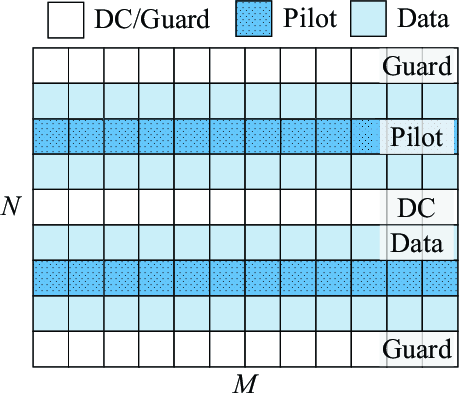
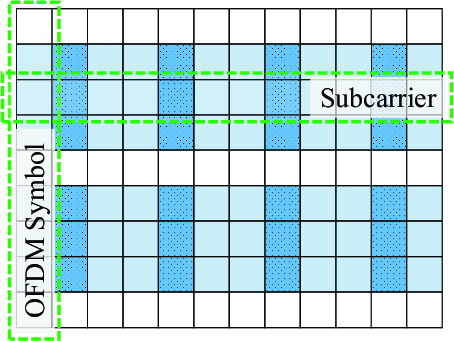
Figure 1: Two pilot insertion patterns in OFDM resource allocation—(a) comb-type pilots inserted across subcarriers, (b) block-type pilots clustered in dedicated symbols.
In typical OFDM, the DFT and cyclic-prefix insertion/stripping enable per-subcarrier diagonalization of the channel, allowing low-complexity frequency-domain equalization. Pilot subcarriers, which support channel estimation (via periodic comb-type or clustered block-type patterns), and strict nulling of guard/DC subcarriers must not be contaminated by any waveform adaptation.
DBU-OFDM enforces a block-diagonal unitary transformation over resource elements, with the only learnable block acting on the data subcarriers. Pilot and null subcarriers are strictly isolated through identity mapping within their respective blocks, effectively ensuring resource protection for channel estimation and spectral containment.
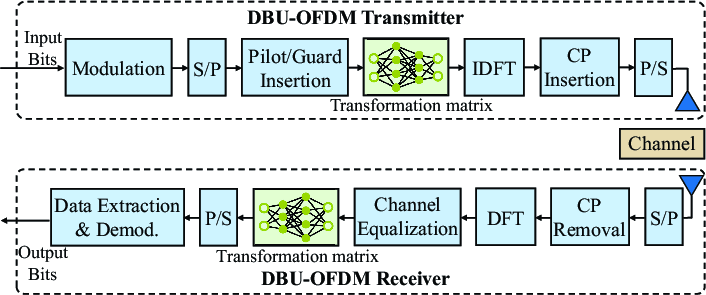
Figure 2: End-to-end transceiver pipeline of the DBU-OFDM system, highlighting the insertion of the unitary, trainable transformation matrix within conventional OFDM processing.
The construction is operationalized via a global transformation U=PU′PT, where U′ is block-diagonal and P implements the appropriate subcarrier/resource permutation, matching the system’s time-frequency resource allocation. This formulation preserves unitarity, maintains the DFT-diagonalization structure required for conventional single-tap equalization, and enables the embedding of learned frequency mixing solely within the data domain.
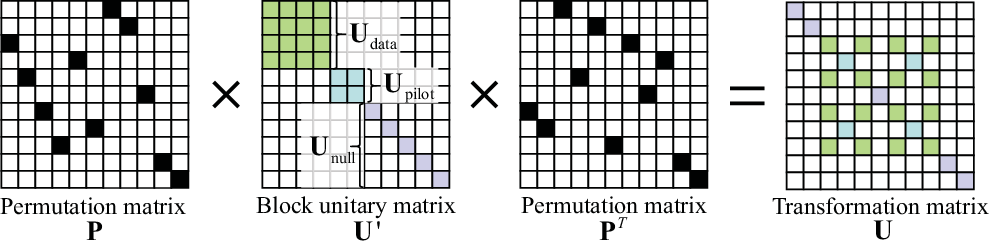
Figure 3: Construction of the DBU-OFDM transformation matrix, illustrating structured index remapping and blockwise unitary transformation across resource groups.
Parameterization via Householder Reflections: Differentiable Unitarity
The core technical design is the recursive Householder parameterization of the data-domain unitary matrix. Here, the matrix is composed as a product of K Householder reflections, each generated by an unconstrained trainable vector, and a final diagonal phase matrix, allowing for precise and differentiable representation of arbitrary unitary transformations.
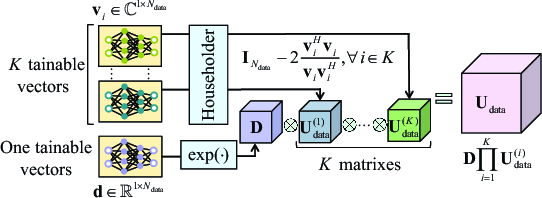
Figure 4: Recursive construction of the trainable unitary matrix via Householder reflections, enabling strict unitarity and complexity-performance tradeoff.
This method guarantees that the entire transformation is strictly unitary at every step of training, eliminating the need for explicit reorthogonalization and affording numerical stability. By varying K, the architecture allows for explicit control of both computational complexity and representational capacity.
PAPR Reduction Achievement
High PAPR is a critical hardware impairment in OFDM, leading to reduced efficiency and nonlinear distortion in practical transmitters. DBU-OFDM integrated a tailored, differentiable loss inspired by the CCDF of PAPR, directly targeting reduction of PAPR tail events in training.
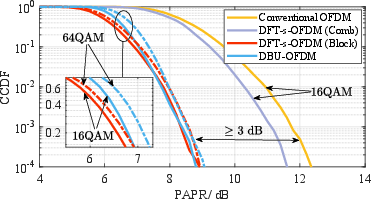
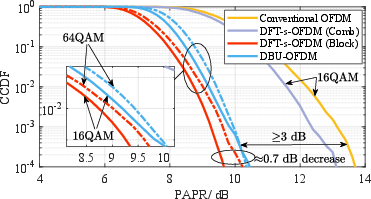
Figure 5: CCDFs for different waveforms, demonstrating that DBU-OFDM closely approaches the low PAPR achieved by block-pilot DFT-s-OFDM while retaining the comb-type pilot structure.
In empirical evaluations, DBU-OFDM achieves PAPR performance nearly identical to block-pilot DFT-s-OFDM in the tail region, while preserving comb-type pilot patterns, crucial for practical time-varying channels. Gains of over 3 dB in the CCDF tail relative to conventional OFDM were validated, and the architecture generalizes effectively across modulation orders.
Diversity and Blockwise Mixing
The unitary transformation introduces frequency diversity by spreading data symbols across multiple subcarriers, protecting against deep fades in frequency-selective channels. This is controllable via explicit blockwise partitioning of the data-domain transform.
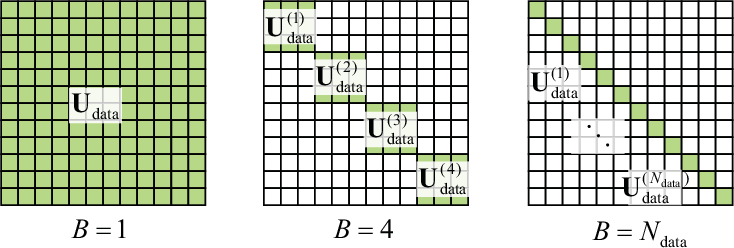
Figure 6: Block-wise structure of Udata for variable frequency-mixing span via block partitioning.
The BER and BLER analysis reveals that broader frequency-domain mixing (lower block count B) yields improved communication reliability, with the most pronounced benefits observed in high-SNR conditions and for block error rate—a critical metric in coded systems.
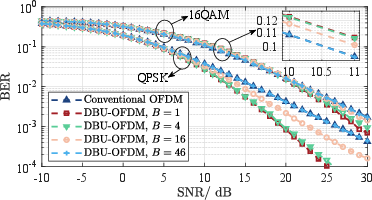
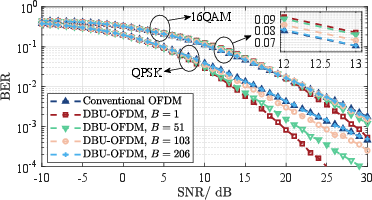
Figure 7: BER performance of conventional OFDM and DBU-OFDM for different block numbers, showing superior frequency-diversity gain for DBU-OFDM.
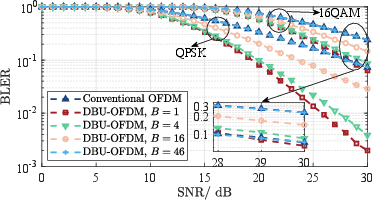
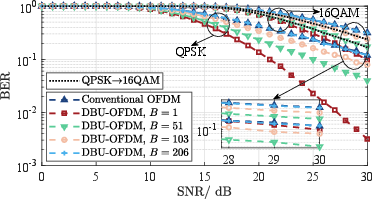
Figure 8: BLER performance demonstrating consistent block error protection with increasing block coupling in the unitary transform.
Sensing Enhancement and Differentiable Parameter Estimation
DBU-OFDM enables direct range and velocity estimation through structured waveform adaptation without sacrificing classical OFDM’s tractable matched filtering and delay-Doppler estimation pipeline. Differentiable softmax-based parameter estimators and successive interference cancellation (SIC) allow end-to-end differentiability, supporting learning in joint communication-sensing environments.
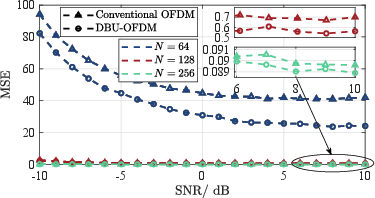
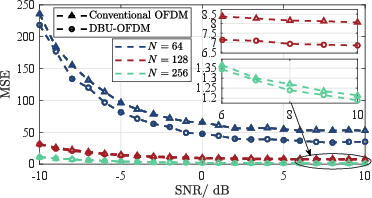
Figure 9: Sensing performance comparison in range and velocity estimation MSE, revealing that DBU-OFDM provides enhanced delay/velocity estimation, particularly in label-limited scenarios.
The improvement is most significant when the subcarrier dimension is limited (N=64), suggesting that the learnable waveform can compensate for limited observation apertures by improving the separability and identifiability of multipath returns.
Prototyping and Hardware Validation
DBU-OFDM is validated on both over-the-air USRP setups and custom FPGA hardware, demonstrating the practical feasibility of implementing the Householder-based unitary transformation within commercial hardware constraints.
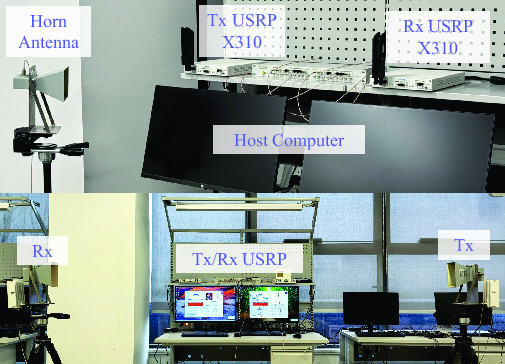
Figure 10: USRP-based over-the-air experimental setup for DBU-OFDM validation.
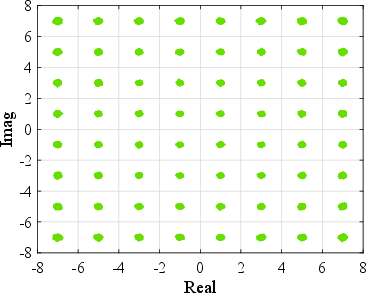
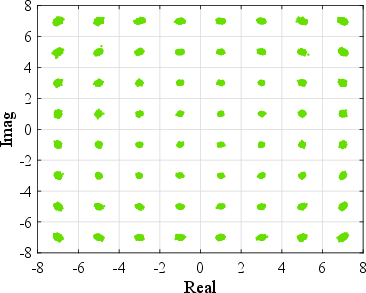
Figure 11: Received constellations in the USRP experiment, showing that communication quality (EVM) is preserved despite aggressive PAPR reduction.
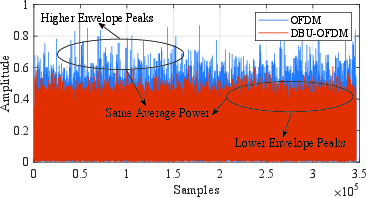
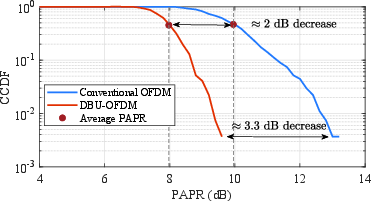
Figure 12: Experimental PAPR comparison in the USRP validation—DBU-OFDM reduces PAPR by approximately 2–3.3 dB in practice.
Resource-efficient FPGA implementation is achieved by exploiting recursive and merged Householder module parameterizations, enabling low-latency, high-throughput operation with resource usage scalable via the complexity parameter K.
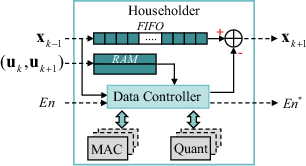
Figure 13: FPGA architecture of the merged Householder hardware module, supporting pipelined, parameterizable complexity control.
Conclusion
DBU-OFDM delivers a structure-preserving, trainable waveform design for integrated sensing and communication, unifying the strengths of OFDM with the adaptability of deep learning. By rigorously protecting resource allocations and OFDM signal structure, and parameterizing adaptation through recursive Householder reflections, DBU-OFDM achieves substantive PAPR reductions, enhanced frequency diversity, and improved sensing robustness. Unlike unconstrained neural transceivers, this architecture retains compatibility with legacy OFDM signal processing, allows explicit complexity-management, and is validated in both wireless and FPGA prototyping environments. The methodology paves the way for practical, hardware-aware AI-native waveform design—a critical component of 6G ISAC. Potential future extensions include joint pilot-data block learning, adaptive complexity schemes, and integration into multi-modal MIMO and massive access architectures.

