- The paper demonstrates that soft-mode degeneracies collapse intrinsic frequency scales, precluding the existence of normalizable equilibrium states.
- The study employs a quadratic Hamiltonian model to show that phase-space deconfinement causes divergent relaxation times and a loss of adiabaticity.
- The results reveal that structural instabilities in bounded systems invalidate the canonical partition function and challenge reversible thermodynamics.
Spectral Softening as a Structural Limitation on Thermodynamic Equilibrium
Introduction and Motivation
The longstanding foundation of thermodynamics asserts that sufficiently slow (quasistatic) driving ensures reversible evolution through a sequence of thermodynamic equilibrium states, underpinned by adiabatic principles and rapid thermalization. This work, "Spectral Softening and the Structural Breakdown of Thermodynamic Equilibrium" (2604.10216), identifies a previously unaddressed limitation: near soft-mode spectral degeneracies—even in bounded, quadratic Hamiltonian systems—thermodynamic equilibrium itself becomes structurally unattainable. This is not merely a dynamical failure of timescale separation but a fundamental breakdown in the existence of equilibrium states, driven by the collapse of intrinsic frequency scales and the resultant divergence of the canonical partition function.
Quadratic Hamiltonian Model and Soft-Mode Regime
The analysis centers on a driven quadratic Hamiltonian in two spatial dimensions incorporating isotropic harmonic confinement and angular momentum coupling, parameterized as:
H^1(t)=2m(p^x+pc(t))2+2m(p^y+pc(t))2+2mω12(x^2+y^2)+ω2L^z.
The system decouples into two normal modes with frequencies ω±=ω1±ω2. Of special interest is the soft-mode limit ω−→0+, where the restoring force in one mode vanishes, yielding a phase-space direction that is no longer quadratically confined.
Structural Breakdown of Dynamical Confinement
Conventional wisdom attributes adiabatic breakdown to gap closings or explicit unboundedness. However, this work demonstrates that as the soft-mode frequency collapses, the phase-space structure undergoes qualitative geometric change: energy contours associated with the “soft” direction evolve from closed ellipses (indicating confinement) to open trajectories (reflecting loss of confinement).
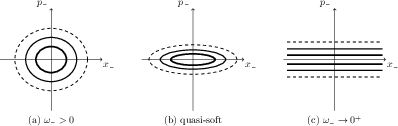
Figure 1: Phase-space structure of the (−) normal mode across the spectral softening regime, showing constant energy contours evolving from closed ellipses to open lines as ω−→0+, marking the loss of quadratic confinement.
This geometric deconfinement, intrinsic to the Hamiltonian’s spectral structure and unrelated to unboundedness or critical slowing down, signals the onset of ill-defined equilibrium regardless of the bounded nature of the original Hamiltonian.
Dynamical Consequences: Loss of Adiabaticity
A crucial technical result is the explicit, drive-dependent threshold for adiabatic breakdown. The standard adiabatic condition is rendered inoperative once
ω−≲ω−c(t):=∣p˙c(t)∣1/2(2mℏω1)1/4,
where ω− is the soft-mode frequency and ∣p˙c(t)∣ captures the drive rate. As ω− approaches this threshold, the dynamical system cannot maintain adiabatic following—no matter how slow the driving—since the divergence of the intrinsic timescale tied to the vanishing soft-mode frequency precludes timescale separation. This breakdown is already manifest at the ground state level and is not confined to the limit ω−→0+, but rather extends over a finite soft sector.
Thermodynamic Implications: Divergence of Relaxation and Partition Functions
Thermalization and Relaxation Time
Spectral softening cripples the system's relaxation to equilibrium by collapsing the inter-level spacing and, consequently, the energy transport channels. The global relaxation rate scales as ω±=ω1±ω20, where ω±=ω1±ω21 is the bath’s spectral density. For generic Ohmic or super-Ohmic baths (ω±=ω1±ω22, ω±=ω1±ω23), as ω±=ω1±ω24:
- The relaxation time diverges faster than the system’s intrinsic dynamical timescale.
- The separation between driving and thermalization timescales (ω±=ω1±ω25) can no longer be maintained.
- Quasistatic thermodynamic evolution ceases to be operationally realizable within this finite soft sector.
Equilibrium Ensemble Breakdown
The most fundamental implication is the divergence of the canonical partition function in the soft-mode regime. The ω±=ω1±ω26 sector’s contribution ω±=ω1±ω27 diverges as ω±=ω1±ω28. This divergence reflects not only a mathematical pathology but a physical impossibility: the system accumulates low-energy states so densely that assigning consistent equilibrium statistical weights becomes ill-posed. Notably, this breakdown applies even while the Hamiltonian remains globally bounded and all terms quadratic—highlighting that it is a purely structural instability.
Phase-Space and Wigner Representation
The Wigner function formalism reinforces these findings. For quadratic Hamiltonians, the thermal Wigner function is a Gaussian whose width in the soft direction diverges as ω±=ω1±ω29. In both quantum and classical limits, this signals the loss of normalizability of the equilibrium state—demonstrating that the breakdown is not uniquely quantum but arises from the underlying Hamiltonian geometry.
Distinction from Critical Dynamics and Broader Implications
Unlike critical slowing down, where relaxation times diverge but equilibrium distribution remains well-defined (due to higher-order confinement), here the very existence of normalizable equilibrium states fails. This mechanism is distinct from standard routes involving unbounded Hamiltonians, phase transitions, or explicit criticality.
The implications extend to theoretical and applied areas:
- Adiabatic Control: Fundamental limits emerge for adiabatic quantum computing and related protocols, where spectral gaps are presumed sufficient. Gap softening alone constrains reversibility and control fidelity.
- Classical and Quantum Universality: The structural instability is shown to be universal across classical and quantum domains when intrinsic spectral scales collapse.
- Limitations of Statistical Thermodynamics: The operational applicability of fluctuation relations and the theoretical framework of reversible thermodynamics are constrained by structural accessibility—not merely by dynamical or bath properties.
Conclusion
This work demonstrates that spectral softening of bounded quadratic Hamiltonians induces a geometric phase-space deconfinement, which structurally destroys thermodynamic equilibrium and reversibility even under infinitesimal driving. The divergence of the partition function, the breakdown of relaxation, and the loss of adiabaticity arise together as direct consequences of spectral collapse, clearly divorcing equilibrium breakdown from unboundedness or critical phenomena. This establishes spectral accessibility as a primary, universal constraint on the scope of thermodynamic reversibility, with concrete implications for quantum control and nonequilibrium thermodynamics.