- The paper introduces DCPT, which trains on paired clean and degraded image views with explicit consistency losses to achieve robust detection.
- It employs feature and prediction consistency losses to ensure invariant representations and reduce the performance gap between clean and degraded images.
- Empirical tests across various generators and degradations show DCPT significantly improves accuracy, especially under severe JPEG compression.
Degradation-Consistent Paired Training for Robust Detection of AI-Generated Images
Introduction
The proliferation of generative models, particularly diffusion models and GANs, has catalyzed serious concerns about the detectability of AI-generated images under real-world image degradations. Traditional detection systems, which typically attain high accuracies in pristine laboratory conditions, are inadequate when confronted with common image corruptions such as JPEG compression, blur, or resolution reduction. Such degradations are inescapable in real-world digital ecosystems, notably social media. This paper addresses this critical vulnerability by introducing Degradation-Consistent Paired Training (DCPT), an explicit training objective designed to produce detectors robust to a broad spectrum of degradations without incurring inference or model parameter overhead (2604.10102).
Methodological Framework
The core insight of DCPT is the recognition that simple augmentation pipelines, even with diversified corruptions, do not compel models to learn degradation-invariant representations or predictions. Instead, the model may ignore or overfit to the presence of degradations, which is insufficient for robustness.
DCPT Training Paradigm
For every training instance, DCPT generates a "clean" and a "degraded" view of the same image. The clean view utilizes standard augmentations, while the degraded view is subject, with 50% probability, to one randomly chosen degradation (JPEG compression, Gaussian blur, or downsampling). Both views pass through a shared, frozen DINOv2 ViT-B/14 backbone and a lightweight classifier head (∼197K parameters).
DCPT introduces two explicit losses:
- Feature Consistency Loss (Lfeat): Cosine similarity between penultimate-layer features for the clean and degraded views.
- Prediction Consistency Loss (Lpred): Symmetric KL divergence between output distributions, with the clean view acting as a stop-gradient teacher for the degraded view.
The total training loss combines standard cross-entropy on each view and the above consistency constraints, weighted by λf=0.5, λp=0.1. Notably, DCPT does not require any additional parameters or inference-time computation compared to the baseline.
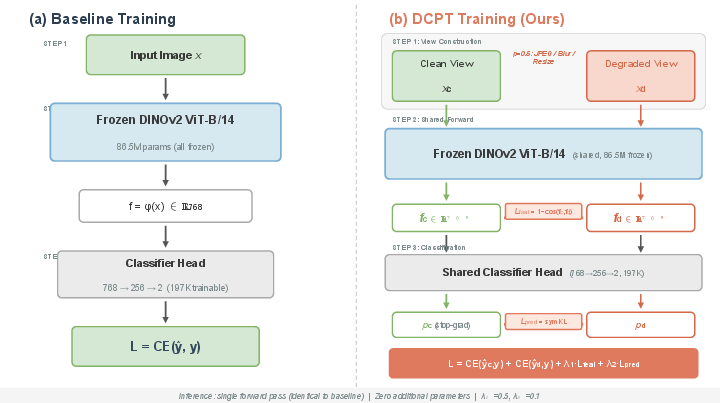
Figure 1: Comparison between standard baseline and DCPT training; DCPT introduces cross-view consistency losses without architecture changes or parameter increases.
Empirical Evaluation
Experiments leverage the Synthbuster benchmark, which consists of diverse synthesis sources (nine generators) and systematically applied degradations (JPEG, blur, resizing). The evaluation rigorously compares DCPT to a baseline using the same frozen backbone and classifier head, isolating the benefit of training objective modification.
JPEG Compression Robustness
DCPT demonstrates substantial resilience against JPEG artifacts. While the baseline's accuracy approaches random chance at severe compression (QF=30), DCPT preserves accuracy, substantially mitigating degradation-induced accuracy collapse.
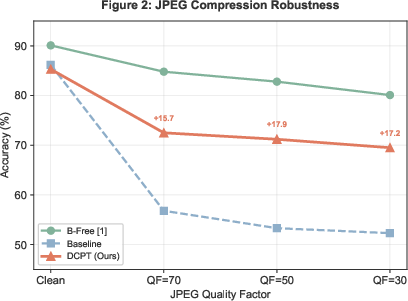
Figure 2: DCPT sustains accuracy across increasing JPEG compression, outstripping the baseline as compression intensifies.
Cross-Generator Consistency
DCPT consistently delivers improvements across all tested synthesis methods, mitigating the gap in degraded scenarios irrespective of generator architecture.
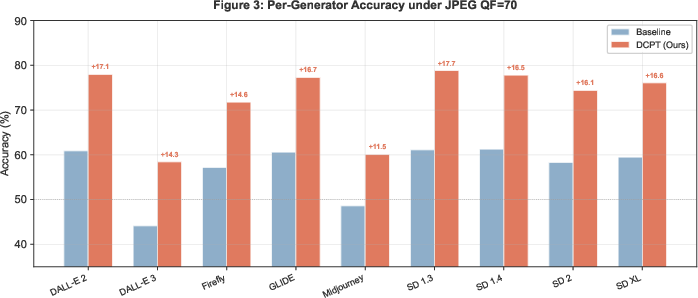
Figure 3: For every generator under JPEG QF=70, DCPT elevates detection accuracy, demonstrating method generality.
DCPT sharply reduces the clean-to-degraded performance drop. While baseline models exhibit a ∼22-point gap, DCPT halves this differential—crucial for real-world robustness.
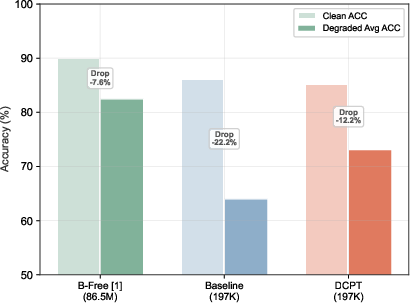
Figure 4: DCPT nearly halves the performance deficit between clean and degraded conditions, confirming effective invariance.
Degradation-Type Specific Impact
The improvement delivered by DCPT is most pronounced under JPEG compression (up to +17.9 percentage points), but also measurable for resizing and blur. The benefit is degradation-type agnostic, but greatest where baseline performance is weakest.
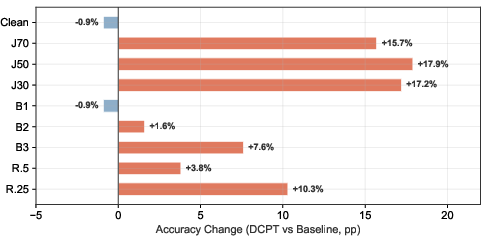
Figure 5: Per-degradation analysis reveals the dominant gains for JPEG, with nontrivial improvements for blur and resize as well.
Ablation and Overfitting Analysis
Ablation studies reveal that both feature and prediction consistency losses contribute, but prediction-level consistency is particularly impactful for severe degradations. Further, architectural modifications, such as adding frequency-residual branches (∼+1.4M parameters), not only fail to improve degraded accuracy, but also exacerbate overfitting due to limited training data, underscoring the primacy of training objective interventions over model augmentation.
Theoretical and Practical Implications
The results affirm that, given powerful frozen foundation models, robustness to distributional shift is better achieved through targeted training objectives than by increasing parameter count or augmenting architectures. This marks a transition from "bigger models" to "better training". DCPT exemplifies task-specific regularization, enforcing invariance properties that align with deployment conditions. The approach is orthogonal to standard augmentations and can be incorporated into diverse detection pipelines, including future fully fine-tuned backbones.
From a practical standpoint, DCPT enables lightweight, low-inference-cost deployment in sensitive environments (e.g., social media forensic monitoring), preserving detection efficacy in the presence of heavy post-processing. Theoretically, this work prompts further inquiry into loss-based regularization strategies for robustness, particularly in underdetermined, low-data regimes.
Future Directions
The research proposes extending DCPT beyond frozen-backbone settings to fully fine-tuned models—such as the original B-Free paradigm—and to more challenging, unseen corruptions (e.g., adversarial or unseen natural degradations). Application to multimodal forensics and benchmarking on broader datasets like GenImage remains open.
Conclusion
Degradation-Consistent Paired Training (DCPT) defines a principled, implementation-efficient path to robust AI-generated image detection. By enforcing feature and prediction invariance via explicit consistency losses, DCPT achieves significant gains in detection robustness without architectural or computational penalties. The evidence indicates that loss function design is paramount for generalized, degradation-robust detectors—especially in a frozen foundation model regime. Continued exploration of invariant training objectives is imperative for robust, scalable image forensics in adversarial real-world deployments.