- The paper introduces two temporal-aware enhancements—REINA-SAN and REINA-TAN—for mitigating read loop issues in SimulST systems.
- Integrating continuous-time sinusoidal embeddings in REINA-TAN results in superior streaming efficiency and more assertive emission trajectories.
- Empirical evaluations on Whisper Large V3 demonstrate significant improvements in latency-quality trade-offs without fine-tuning the underlying model.
Introduction
Simultaneous Speech Translation (SimulST) demands a delicate trade-off between translation quality and latency. Maintaining high translation fidelity while emitting target-language tokens early necessitates strategies capable of nuanced and temporally sensitive read/write decisions. Prior works, notably the Regularized Entropy Information Adaptation (REINA) framework, formalize this problem via information-theoretic principles, but practical deployments on large foundation models expose fundamental limitations related to deficient temporal grounding. This paper proposes and empirically validates two architectural enhancements to REINA, explicitly targeting stability, streaming efficiency, and systematic elimination of degenerate read loop behaviors in Whisper Large V3-based SimulST systems (2604.09916).
While REINA’s covariance maximization objective robustly exploits the ordinal structure of information gain for each target token, analysis reveals that without explicit temporal modeling, policies exhibit undesirable behaviors including "read loops"—persistent "Read" actions that collapse emission until the end of the utterance, thus maximizing latency and forfeiting streaming advantages. Examination of information gain distributions highlights a clear decision boundary, yet the absence of temporal bias undermines policy reliability under variation in utterance dynamics and input length.
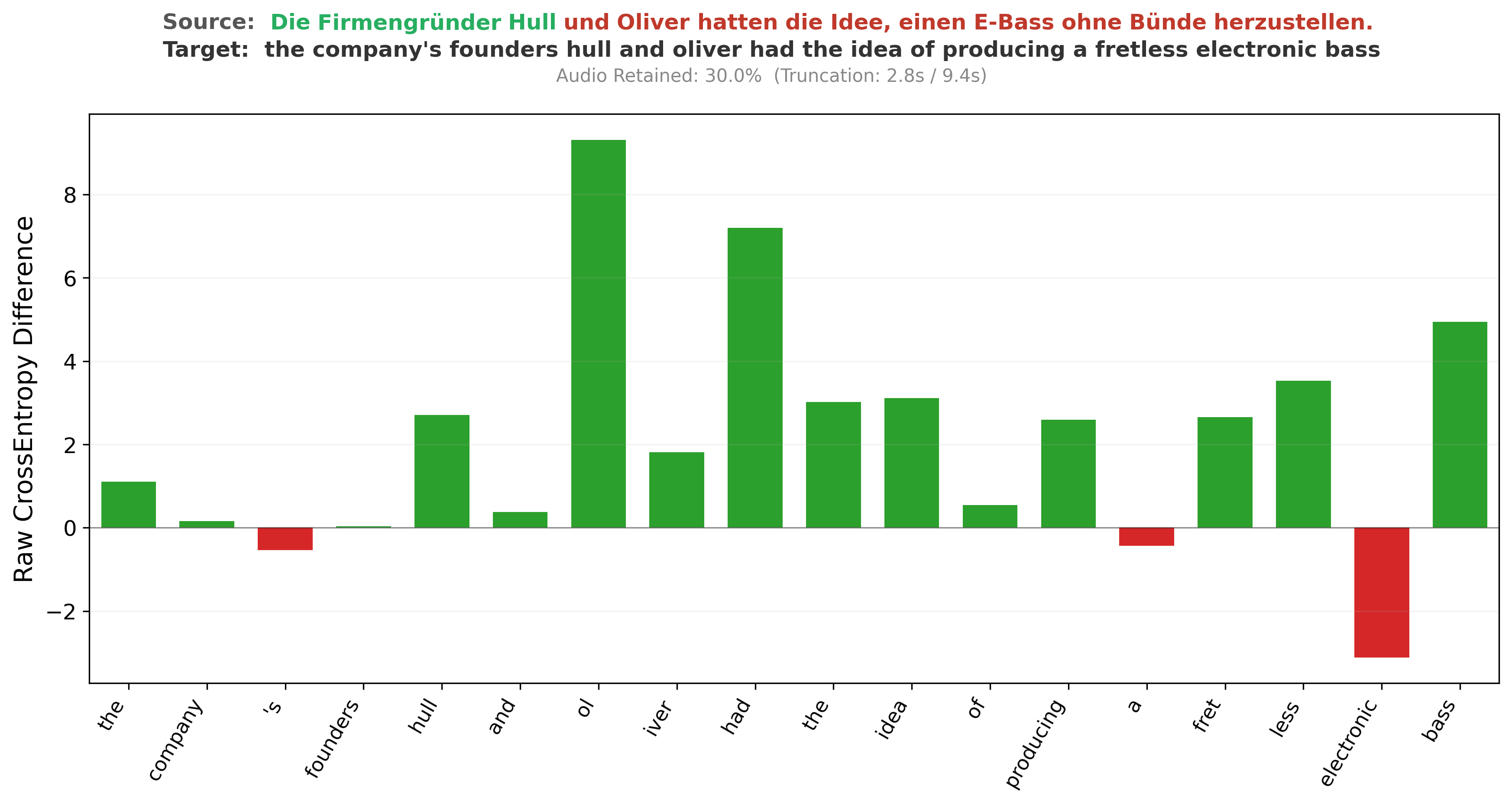
Figure 1: Information gain per label token as a function of source audio coverage; a distinct Read-Write boundary is visible at the token hull.
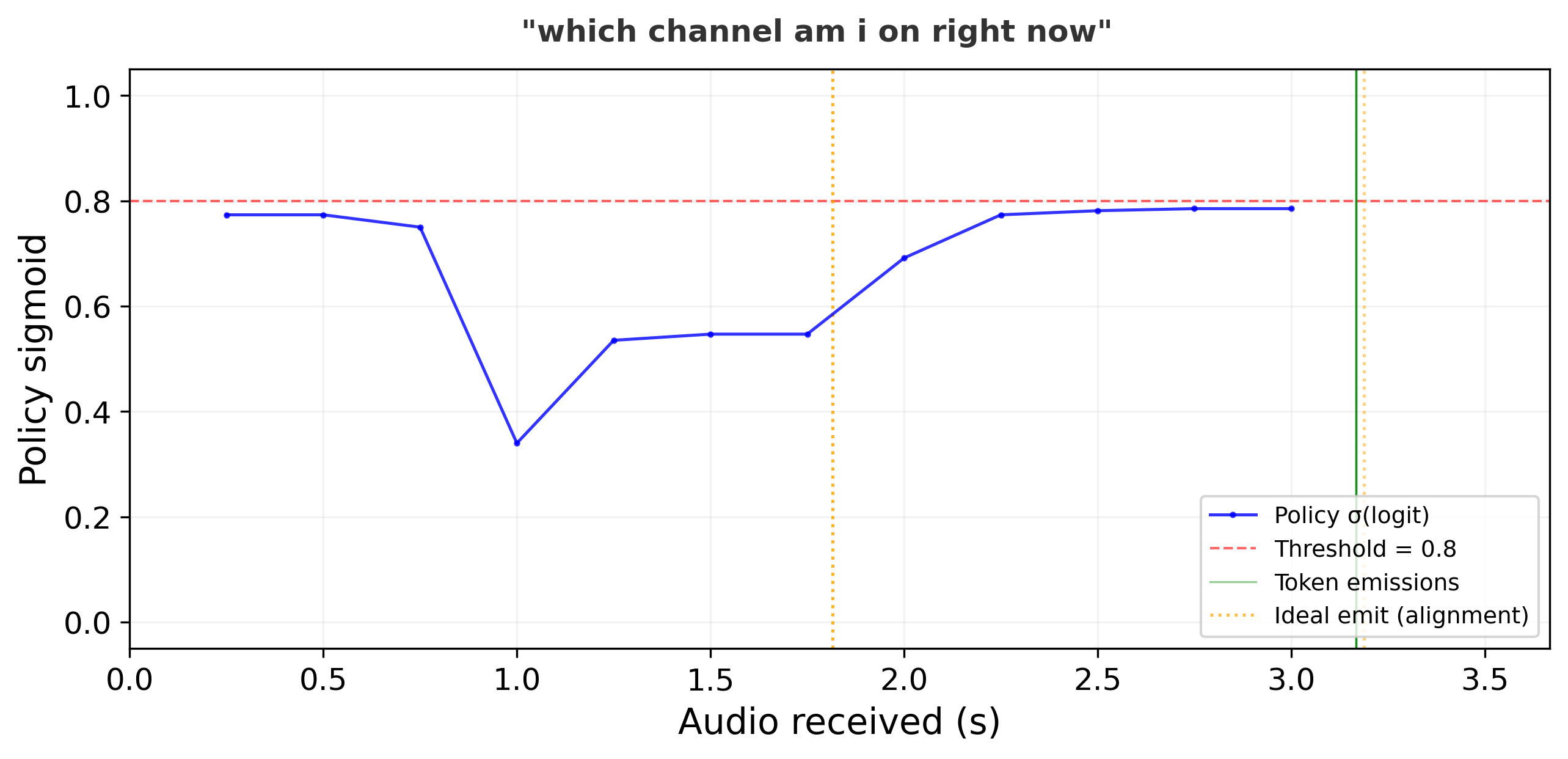
Figure 2: An example of a persistent read loop where, despite more input, the policy indefinitely predicts Read, failing to initiate transcription.
Temporal-Awareness Enhancements: Methodological Advances
Two distinct methods are introduced for explicit temporal conditioning:
Supervised Alignment Network (REINA-SAN)
REINA-SAN augments the REINA framework with secondary supervision derived from monotonic alignments computed via LLMs. For each target token, a soft emission probability is constructed based on audio duration relative to an ideal, monotonic emission alignment. This is optimized via a binary cross-entropy loss, combined in a multi-task regime with the original REINA covariance-based loss. The impact is global temporal regularization, enforcing robust monotonicity and significantly mitigating read loop occurrences, especially in high-latency operating points.
Timestep-Augmented Network (REINA-TAN)
REINA-TAN addresses REINA’s temporal agnosticism by injecting explicit continuous-time sinusoids as positional embeddings at each policy evaluation step. This feature provides the policy network with a calibrated "clock" signal encoding absolute and relative audio progress. Timestep augmentation substantially improves streaming efficiency and alignment with target emission schedules, without introducing artificial latency penalties. Empirically, this leads to more assertive and temporally consistent emission patterns, yielding superior Pareto efficiency on the latency-quality frontier.
Experimental Evaluation
Comprehensive experiments are performed with Whisper Large V3 as the frozen translation backbone, leveraging lightweight transformer policy heads trained on the fr/de/es → en splits of both CVSS-C and Multilingual LibriSpeech, with LLM-inferred transcript alignments where applicable.
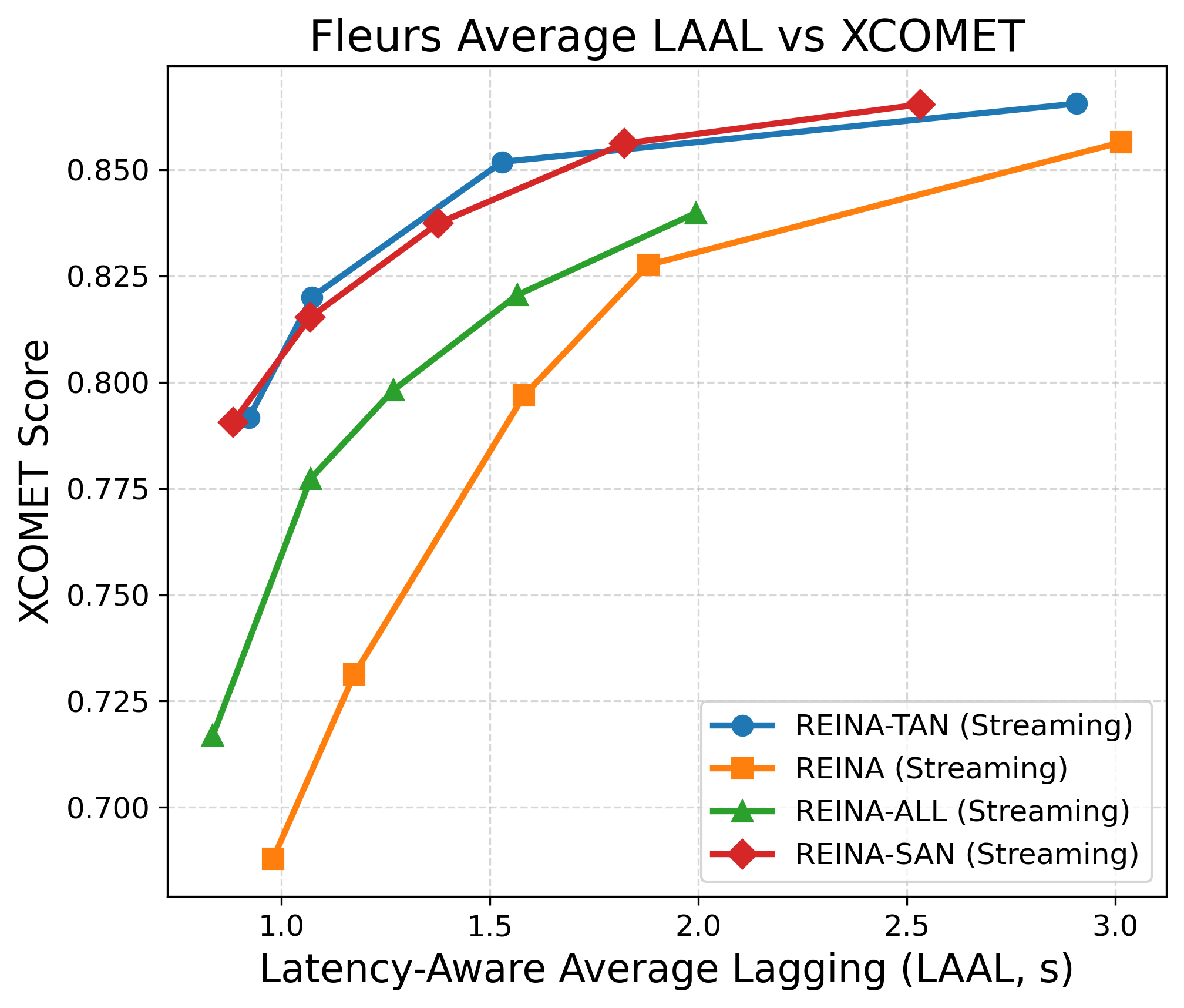
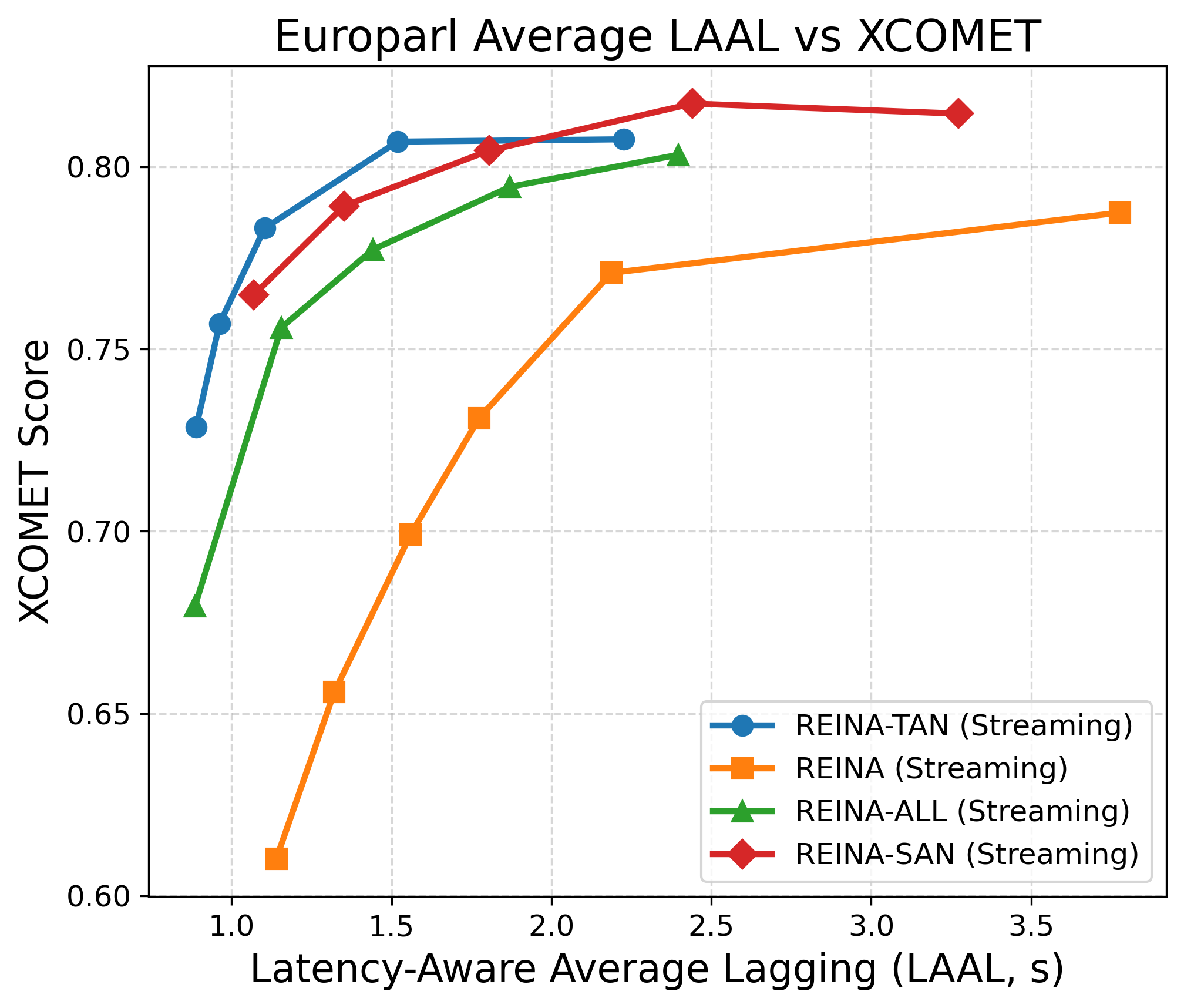
Figure 3: Tradeoff curves depicting XComet-XL versus LAAL (latency) under various policy configurations on FLEURS.
REINA-TAN consistently achieves the strongest Pareto frontier, outperforming both REINA-SAN and the combined REINA-ALL variant. Notably, temporal augmentation alone supplants weak monotonic supervision, indicating that explicit modeling of elapsed audio duration is more effective than externally supervised alignment losses in this context. A salient finding is the contradictory effect when both temporal augmentation and supervised alignment are used concurrently, hampering policy effectiveness and introducing emission schedule instability.
Further analysis of mean per-token latency as a function of relative token position underscores the shift in policy inductive biases with temporal augmentation. REINA-TAN yields flatter and earlier emission trajectories, whereas the supervised-alignment-augmented policies remain overly conservative, especially at sequence boundaries.
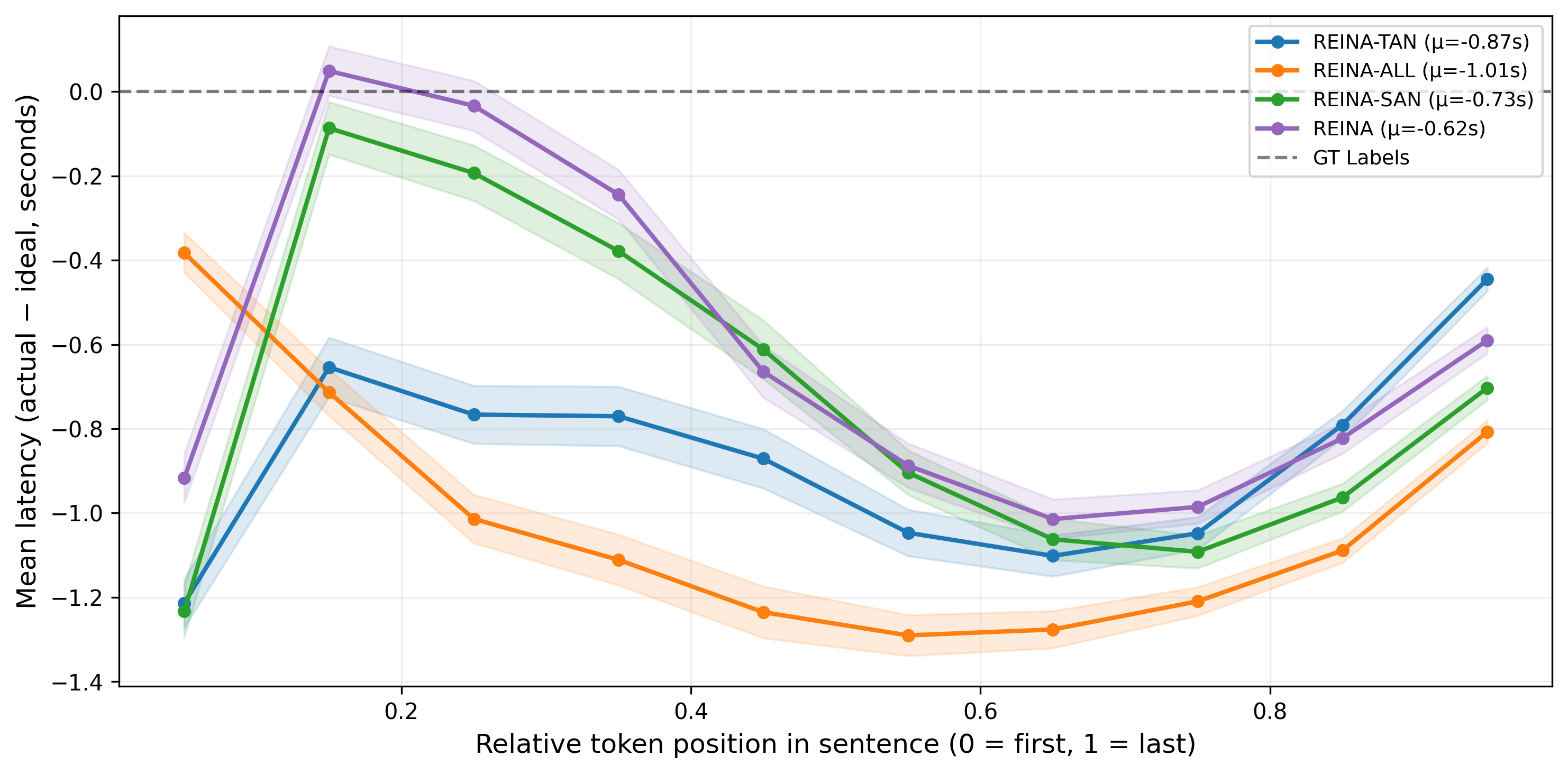
Figure 4: Mean per-token emission latency across positions, highlighting the effect of timestep augmentation and supervised alignment loss.
Practical and Theoretical Implications
The findings indicate that for foundation-model-based SimulST, adaptation strategies must furnish the policy with explicit models of elapsed time to prevent degenerate behaviors and to exploit backbone model knowledge efficiently. Weak alignment supervision can eliminate read loops but imposes rigidity, potentially increasing error accumulation via premature emission decisions. Timestep augmentation yields robust and flexible policies suited for dynamic streaming scenarios, improving Normalized Streaming Efficiency (NoSE) scores by up to 7.1% over competitive benchmarks at matched translation quality levels. Notably, this is achieved without fine-tuning the underlying translation model, preserving generalization and ensuring deployment tractability.
Future Directions
These results suggest that future SimulST research should prioritize hybrid adaptive policies that integrate continuous temporal conditioning with context-aware decision boundaries. Furthermore, scalable adaptation frameworks should be extensible to non-monotonic or semantically chunked emission strategies, potentially leveraging LLM-guided weak supervision for higher-level schedule alignment. Given the scalability of REINA-TAN to large foundation models, there is scope for generalized streaming adaptation across broader speech, translation, and even captioning tasks.
Conclusion
By diagnosing and resolving the core temporal deficiencies in information-based SimulST policies, this work demonstrates that explicit temporal awareness—via either weak monotonic supervision or direct timestep augmentation—is essential for reliable, low-latency translation on foundation models. REINA-TAN delivers state-of-the-art streaming efficiency without sacrificing translation fidelity. These methods establish new best practices for decoupled policy adaptation atop frozen foundation models, with significant practical implications for real-world speech-to-text simultaneous translation deployments.