- The paper introduces an explicit quantum circuit for block encoding the Difference-of-Gaussian operator, achieving constant subnormalization and efficient LCU integration.
- It employs Gaussian state-preparation circuits and controlled shift unitaries to discretize cyclic shifts on periodic grids, eliminating the need for QRAM and signed amplitude loading.
- Spectral analysis confirms the operator’s bandpass filtering properties with tunable frequency selectivity and a success probability scaling as O(h^4) in the fine-grid regime.
Explicit Block Encoding of Difference-of-Gaussian Operators on a Periodic Grid
Introduction
This work proposes a quantum circuit construction for the Difference-of-Gaussian (DoG) operator on periodic grids via explicit block encoding. The DoG is a canonical bandpass filter with extensive usage in image processing, quantum algorithms for PDEs, and related applications. The essential innovation in this approach lies in decomposing the DoG stencil into a difference of two normalized discrete Gaussian distributions. This enables an efficient and explicit mapping to the Linear Combination of Unitaries (LCU) framework, eliminating the requirement for signed amplitude loading, quantum random-access memory (QRAM), or structure-agnostic oracle circuits.
Mathematical Foundations and DoG Structure
The periodic grid setup used is ZND with n qubits per dimension, for a total computational basis suitable for quantum simulation of discretized spatial domains. The DoG operator is formulated as
Ah=∑t∈T(pt−qt)St
where St is the cyclic shift operator, and pt, qt are samples of discrete normalized Gaussians at varying spatial scales (σp<σq), properly renormalized post-discretization. The operator is naturally Hermitian when constructed with symmetric kernels, and the 1-norm of its coefficients is universally bounded by 2, framing an inherent advantage for quantum LCU-based implementation.
Block-Encoding Circuit Design
The explicit quantum circuit leverages the structure of the DoG operator, dividing computation into three key register types: indicator (one qubit splitting between p and q), shift-label (specifying the stencil offset), and data (encoding the state on the grid). Amplitude encoding for both Gaussians is achieved via Gaussian loader circuits Gp, n0. The circuit proceeds as follows:
- A Hadamard gate on the indicator qubit creates a superposition, preparing branches for n1 and n2.
- Controlled-Gaussian state-preparation routines load the distribution amplitudes into the shift-register.
- The sign needed for the difference is implemented by applying a Pauli-n3 gate to the indicator qubit.
- Controlled shift unitaries induce the respective n4 operation on the data register.
Explicit projection onto n5 registers realizes the desired non-unitary n6, postselected with subnormalization n7 that is independent of the stencil width, grid size, or spatial dimension.
The most expensive resources are the Gaussian state-preparation routines, which for small stencils can be implemented via Ah=∑t∈T(pt−qt)St0 rotations, but for larger stencils, an alternative Ah=∑t∈T(pt−qt)St1 routine with additional ancilla qubits can be used. Controlled shifts have polylogarithmic cost in grid size.
Spectral Analysis and Transfer Function
The paper provides a spectral characterization: Ah=∑t∈T(pt−qt)St2 is diagonalized by the discrete Fourier basis, with eigenvalues determined by the difference in the Fourier transforms of Ah=∑t∈T(pt−qt)St3 and Ah=∑t∈T(pt−qt)St4. This directly exposes the bandpass character of the DoG filter as implemented on the periodic quantum grid.
Ah=∑t∈T(pt−qt)St5
for each frequency Ah=∑t∈T(pt−qt)St6. For normalized inputs, DC response is always zero (Ah=∑t∈T(pt−qt)St7), and selectivity is tunable via the variance parameters Ah=∑t∈T(pt−qt)St8.
This spectral structure allows direct application of quantum linear algebra primitives, notably QSVT and qubitization transformations, without additional Hermitian dilations, provided Ah=∑t∈T(pt−qt)St9 symmetry is maintained.
Success Probability: Exact and Asymptotic Results
The probability of successful postselection (i.e., the amplitude squared in the St0 ancillas after applying St1 to a normalized state), is given by:
St2
where St3 is the spectral power of the input state. This quantifies the exact filtering action of the DoG block encoding: output amplitude is maximal when the input is concentrated within the DoG passband.
In the continuum limit (St4), for smooth input functions, the success probability scales as St5. This scaling originates from fundamental error and normalization constraints for second-order finite-difference approximations on quantum circuits. Unlike Laplacian encodings where the St6 factor appears as a diverging subnormalization, here the normalization is kept constant (St7) and the St8 appears in the amplitude instead, which has ramifications for QSVT-based transformations.
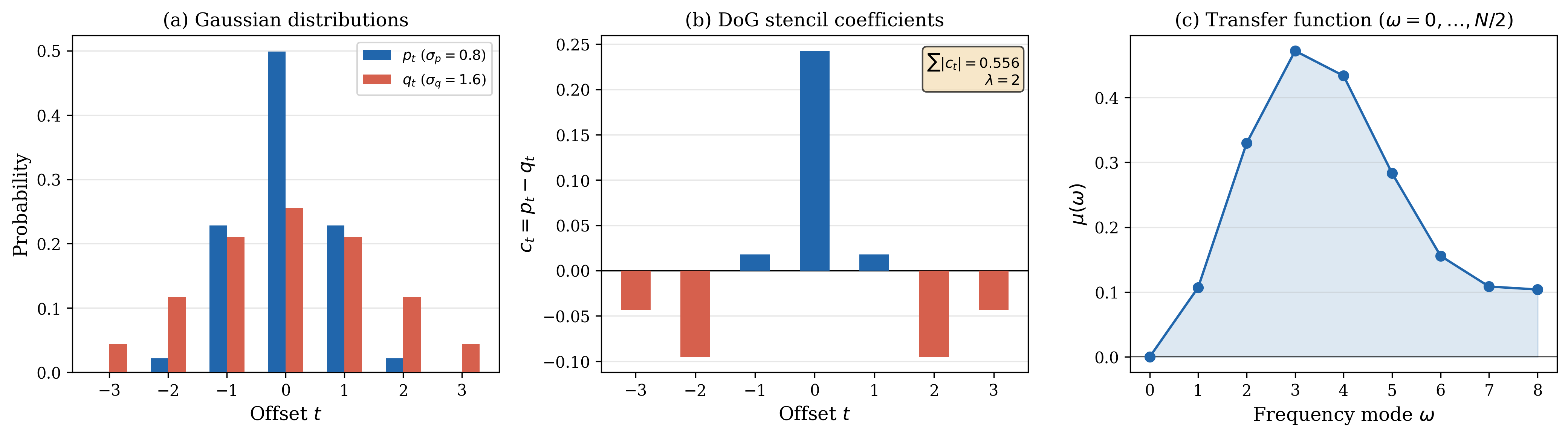
Figure 1: Scaling of the success probability with grid size St9, evidencing the theoretical pt0 behavior and convergence between the exact and asymptotic analytic predictions as resolution increases.
Numerical Examples
The explicit bandpass filtering and exact postselection probability are validated numerically on one-dimensional grids for various sizes, input states, and Gaussian parameters. The empirical results confirm that the transfer function matches analytic predictions and that the success probability aligns tightly with both the exact formula and pt1 scaling in the fine-grid regime.
Implications and Future Directions
The explicit block encoding presented here adapts naturally to any operator expressible as a signed combination of normalized distributions over spatial shifts. Key theoretical implications include:
- The approach achieves a constant subnormalization and eliminates the scaling bottlenecks present in structure-agnostic block encodings, which is crucial for practical, deep circuits.
- It provides an explicitly tunable, bandpass quantum filter—by varying pt2 and pt3, the frequency selectivity of the operator is finely controlled.
- The Hermitian structure and exact spectral form make this encoding directly compatible with the full spectrum of quantum linear algebra primitives, including time evolution for Hamiltonian simulation, polynomial eigenvalue filtering, and (bandpass) thresholding via QSVT.
On the practical side, this operator can serve as a direct quantum primitive in algorithms for quantum image processing, quantum PDE solvers, and quantum spectral filtering, providing a more resource-efficient path than approaches that rely on black-box data loading or general multi-controlled arithmetic. The design avoids QRAM, signed amplitude preparation, and expensive NEQR-style arithmetic circuits used in other quantum image processing schemes.
Potential extensions include adaptation to non-periodic boundary conditions (Dirichlet, Neumann), resource estimation and synthesis via toolkits such as Qualtran, and experimental deployment within quantum pipelines for edge detection or feature extraction in images.
Conclusion
The construction developed provides an explicit, efficient quantum block encoding for the discrete DoG operator, mapping its probabilistic structure directly to the LCU framework with constant subnormalization and well-characterized success probability. This enables practical quantum implementations of bandpass filters with direct spectral control, avoids generic data-loading overhead, and integrates with downstream QSVT-based quantum linear algebra methods. Future work can extend these techniques to broader classes of structured finite-difference operators and explore their utility in quantum algorithms for computational science and machine intelligence.

