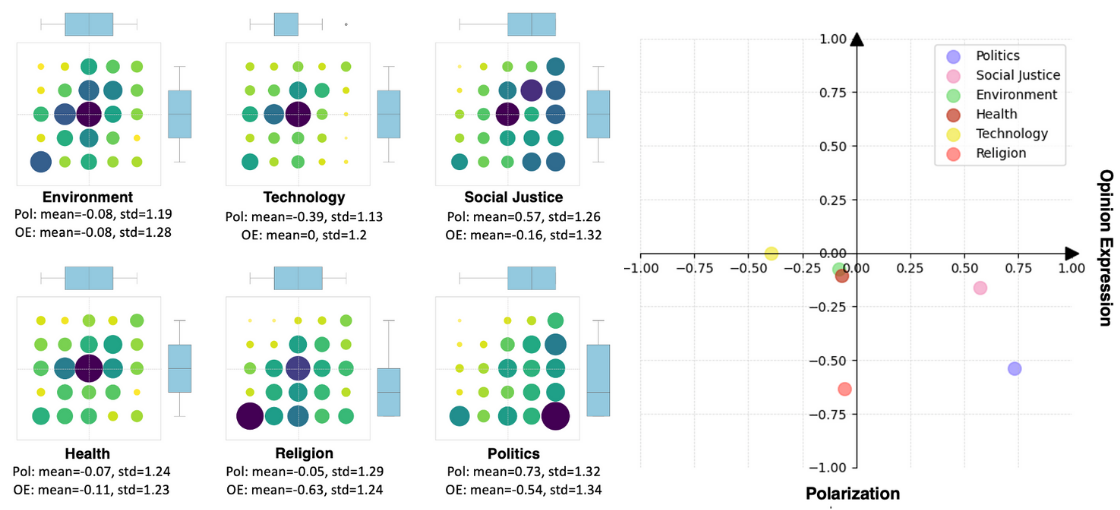
- The paper reveals that discrepancies between private beliefs and public posts are prevalent, using quantitative surveys and qualitative interviews to uncover self-censorship behaviors.
- The study employs mixed methods with 390 survey responses and 20 interviews, using Likert scale assessments and regression models to quantify conformity and opinion reinforcement.
- The paper highlights that factors like topic polarity, perceived audience size, and platform norms significantly shape online opinion expression and induce self-censorship.
Introduction
The study "Silence and Noise: Self-censorship and Opinion Expression on Social Media" (2604.09465) presents a comprehensive mixed-methods inquiry into how self-censorship unfolds in online environments, and its implications for digital public discourse. Drawing upon 390 survey responses and 20 semi-structured interviews, the authors address structural, psychosocial, and contextual determinants of opinion expression, focusing on the divergence between private beliefs and public postings, the contextual variables mediating this divergence, and user-conceived interventions for healthier online conversation spaces.
A central empirical finding is that discrepancies between private beliefs and publicly shared opinions on social media are highly prevalent and multifaceted. Quantitative analysis using 7-point Likert items demonstrates substantial self-reported divergence between internal beliefs and posted content. Most notably, conformity pressures—users aligning expressed opinions with perceived group norms—are salient, while only 29.2% of participants report amplifying rather than muting their beliefs in online arenas.
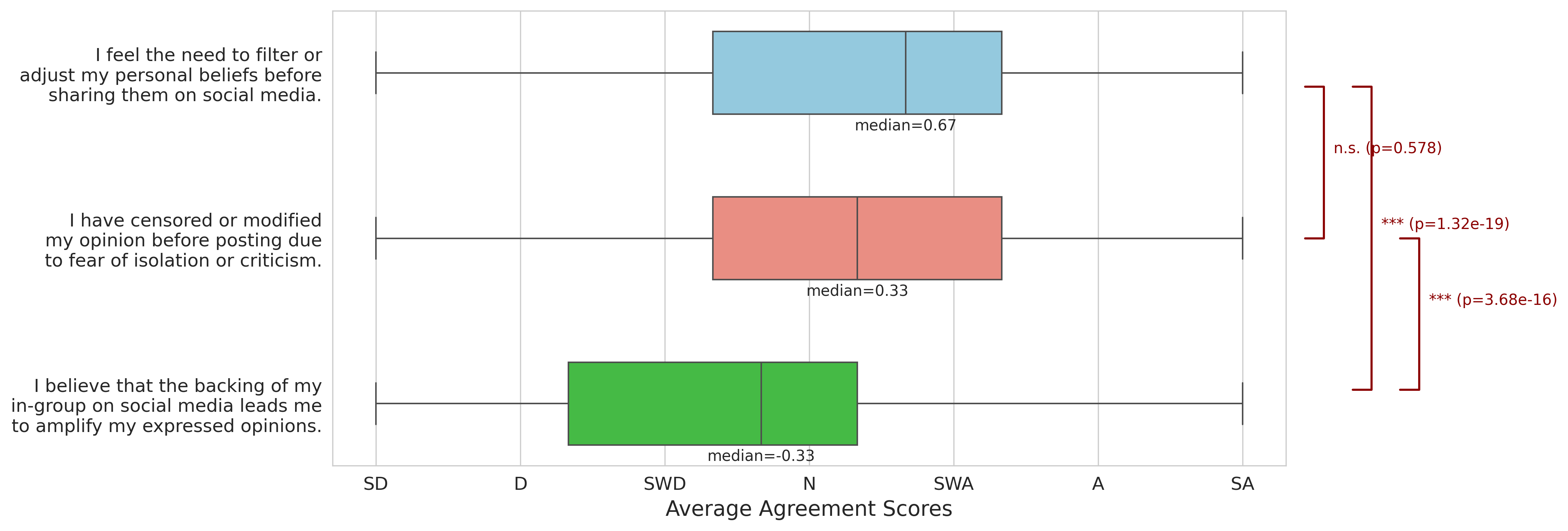
Figure 1: Survey results reveal frequent discrepancies between private beliefs and public expression, significant experiences of conformity/self-censorship, and a minority reporting opinion reinforcement effects.
The evidence problematizes the naïve interpretation of posted opinions as direct reflections of user beliefs, highlighting instead a spectrum ranging from total silence (outright self-censorship) to partial adjustment (opinion alignment/conformity), and, to a lesser extent, reinforcement. These distinctions have critical implications for the modeling of online opinion dynamics: public discourse is systematically filtered, with silence or conformity disambiguable only through self-report or experimental intervention, and not via raw social media traces alone.
Contextual Modulation: Topic, Community, and Behavior
The study systematically characterizes how willingness to express opinions and the extent of public-private divergence are contingent on topic, perceived audience, community support, and engagement patterns. Perceived topic polarity was measured across politics, social justice, health, environment, technology, and religion. Analysis via Spearman correlation and regression models demonstrates that:
Multivariate logistic and ordinal logistic regression models clarify that:
- Lower perceived support and less frequent posting significantly increase the probability of self-censorship (odds ratios 0.68 and 0.58, respectively).
- Larger perceived audience (community size) increases self-censorship directly, but also indirectly via its negative impact on posting frequency.
- Among those who share, lower perceived support still predicts greater alignment of the public post with group norms rather than true beliefs (i.e., higher opinion discrepancy).
These results solidify that context—especially perceived audience size, support, and topic—is a dominant factor in the willingness and fidelity of online expression.
Through qualitative thematic analysis, the study elucidates several latent determinants and moderators:
- Self-presentation and Audience Mismatch: Users strategically curate online personas, balancing authenticity against anticipated social costs, workplace visibility, and alignment with audience expectations.
- Platform Norms & Affordances: Opacity or stringency of platform moderation, perceived anonymity, and specific platform cultures (e.g., LinkedIn vs. Reddit) modulate willingness to express and forms of self-censorship.
- Latent Social Influence: Users may speak (despite risk) to combat misinformation, "educate," or influence group beliefs, but silence when the efficacy or safety of participation appears low.
These components reflect that platform, network structure, and the performativity of identity in digital public spheres deeply shape what is heard and what remains unspoken.
Consequences of Self-Censorship and Reinforcement
The consequences of these dynamics manifest at user, community, and societal levels:
- Suppression of rational discourse: The muting of minority or dissenting views results in homogeneity, undermining debate and information accuracy.
- Encouragement of extremism: Absence of moderate or dissenting voices allows extremist content to dominate ("silence as complicity"), intensifying polarization and misperceptions of group consensus.
- Indirect feedback loops: The more views are reinforced in public, the more minority perspectives are forced into self-censorship or conformity, closing the window for corrective discourse.
Counterintuitively, the study also notes conditional benefits to self-censorship (e.g., personal safety, social harmony) and reinforcement (e.g., facilitating marginalized group solidarity), framing these as context-dependent rather than inherently negative.
User-Driven Interventions and Design Implications
Participants propose several candidate interventions:
- Credibility-based fact-checking: Evidence support increases expression willingness. Well-designed, transparent fact-checking systems can reduce fear-driven self-censorship.
- Incentivization of constructive interaction: Modifying reward and moderation systems to foreground productive, respectful dialog over virality or engagement alone.
- External accountability mechanisms: Users express skepticism about the effectiveness of purely internal moderation; robust, transparent oversight and reporting are required.
- Algorithmic exposure to viewpoint diversity: Intentional feed interventions to break echo chamber dynamics and reduce reinforcement-induced conformity.
The design implications stress moving from exclusively reactive moderation to proactive, contextual, and incentive-aligned systems that reshape both social media affordances and user expectations.
Theoretical Implications and Directions for Future Research
This study fortifies and extends self-silencing theory by providing granular, empirical substantiation not only of absolute silence but also of conformist adjustment and its context dependency. The results converge with—and nuance—social identity and self-presentation theory, revealing how audience perception, group support, and anticipated social risk shape what is expressed online.
The findings directly challenge models of public opinion dynamics predicated solely on observed posts, demanding that measurement, simulation, and intervention frameworks in computational social science and online governance account for latent, context-contingent self-censorship.
Future research must investigate:
- Behavioral signals (as opposed to self-report) of self-censorship using experimental or unobtrusive methods.
- Cross-cultural generalizability—this study is limited to US-based users.
- Longitudinal effects of interventions (e.g., community-aware modes, external oversight) on diversity of expressed opinion and the resilience of digital public spheres.
Conclusion
The study rigorously demonstrates that self-censorship on social media is both prevalent and structurally determined by community context, perceived support, audience size, and topic. Conformity and reinforcement reinforce each other, fostering environments inhospitable to open, diverse discourse and accelerating polarization. Addressing these phenomena requires interventions that embed context-sensitivity, credible support for expression, and transparent, accountable moderation into platform design—thereby reconfiguring the balance of silence and noise in algorithmically-mediated public life.