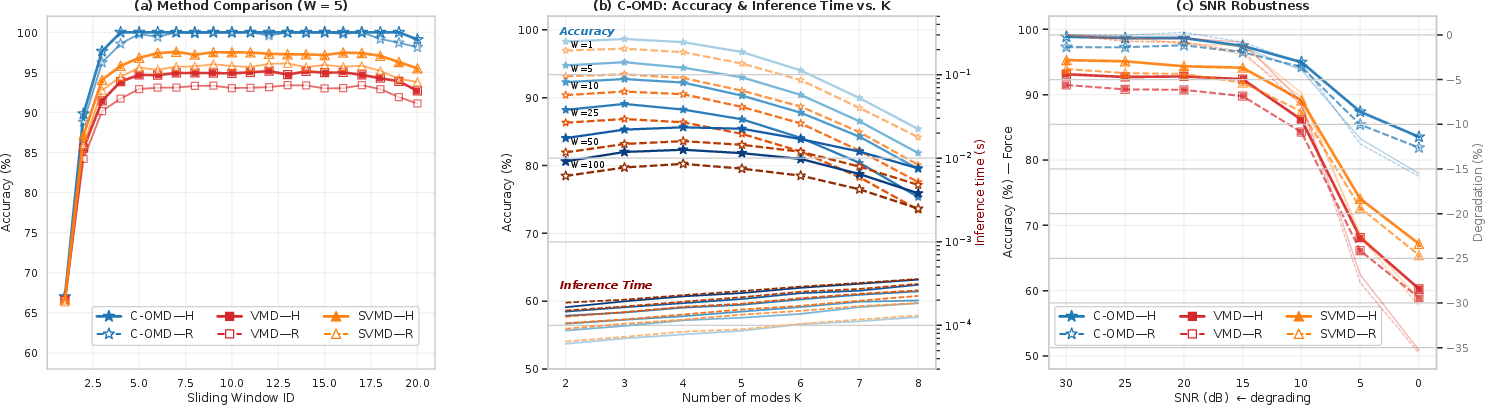
- The paper introduces C-OMD that enforces strict orthogonality between haptic signal modes to eliminate mode overlap and improve robustness.
- It employs a Mode-Domain Architecture using per-mode TCNs and cross-attention mechanisms to achieve sub-millisecond bilateral prediction.
- Empirical results show superior accuracy (98.6% human, 97.3% robot) and rapid inference (0.06 ms), outperforming traditional variational methods.
Continuous Orthogonal Mode Decomposition for Haptic Signal Prediction in Tactile Internet
Problem Setting and Motivation
The Tactile Internet (TI) demands ultra-low latency (<1ms) and extremely high reliability for real-time haptic interaction between human operators and remote robots. Packet loss or latency directly undermine system transparency and stability, severely impacting practical teleoperation. Traditional ML approaches largely operate on raw time-series signals, which forces all underlying dynamics—low-frequency user intent, high-frequency environmental cues, and abrupt transients—into a shared representation, hampering both generalization and robustness.
This work addresses those limitations by proposing a signal prediction framework based on Continuous-Orthogonal Mode Decomposition (C-OMD) and a purpose-built Mode-Domain Architecture (MDA). The C-OMD imposes hard orthogonality between extracted signal modes, eliminating the persistent “mode overlapping” issue present in variational mode methods, while MDA directly leverages this decomposition for bilateral haptic prediction.
Continuous-Orthogonal Mode Decomposition: Theory and Algorithm
Signal decomposition is historically foundational in time-series and communications analysis, with tools such as Variational Mode Decomposition (VMD) and its derivatives (VME, SVMD) formulating the extraction of AM-FM modes as variational problems. However, these often lack theoretical guarantees of mode separation, depend on a priori parameter settings, and are not amenable to parallel computation.
C-OMD introduces explicit orthogonality constraints in the continuous mode space. The core optimization jointly minimizes mode bandwidths, enforces exact signal reconstruction, and constrains all extracted modes to be (L2 or H2(R)) orthogonal, using an augmented Lagrangian formalism and ADMM-style updates. Explicit orthogonality is realized through a Newton–Schulz iteration applied to the Gramian of mode system and is further strengthened with per-frequency orthogonalization.
Significantly, the proposed method replaces the implicit, penalty-based attempts at reducing mode leakage (as in VMD/SVMD) with a convergence-guaranteed, projection-based process, augmenting large-scale parallelism and enhanced theoretical signal separability.
Mode-Domain Architecture for Haptic Bilateral Prediction
Rather than a monolithic sequence-to-sequence model, MDA operates fully in the decomposed mode space, processing each orthogonal component independently before selectively fusing information cross-side via cross-attention mechanisms.
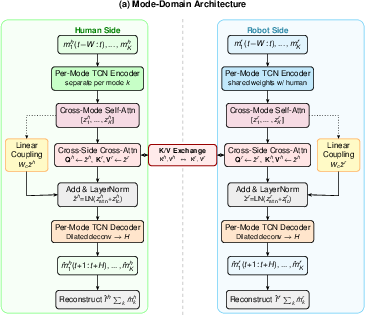
Figure 2: MDA decomposes each haptic signal into K orthogonal modes—each processed by per-mode TCNs and mode-wise self-attention, with cross-side attention and residual coupling for robust bilateral prediction.
The architecture consists of:
- Per-mode Temporal Convolutional Networks (TCNs) encoding each mode separately.
- Cross-Mode Self-Attention within the decomposed human and robot latents.
- Cross-Side Cross-Attention: bidirectional context exchange between human and robot representations, enhancing predictive capacity.
- Linear Coupling Residuals: improved trainability and stability by preserving identity paths through residual addition before normalization.
- Per-mode TCN Decoders for independent signal synthesis, reconstructing full haptic signals via mode summation.
This strict factorization encourages explicit learning of mode-specific temporal patterns and robust decoupling of distinct physical processes.
C-OMD and MDA are evaluated using high-rate (1000Hz) kinesthetic haptic datasets spanning multi-DoF force, velocity, and position signals. The model is trained using a composite loss:
L=Lpred+λ1Lrecon+λ2Lorth+λ3Lrel
where Lpred is the primary per-mode prediction MSE, Lrecon penalizes misalignment in reconstructed signals, Lorth enforces Gramian orthogonality, and Lrel regularizes per-mode relative error, particularly at low SNR or low-amplitude regions.
Teacher-forcing with scheduled annealing is implemented, and autoregressive inference is utilized to restore dropped packets.
Empirical Results
Prediction accuracy and inference time are evaluated across varying prediction windows (L20) and compared against VMD, SVMD, and baseline end-to-end neural architectures (Transformer, Mamba).
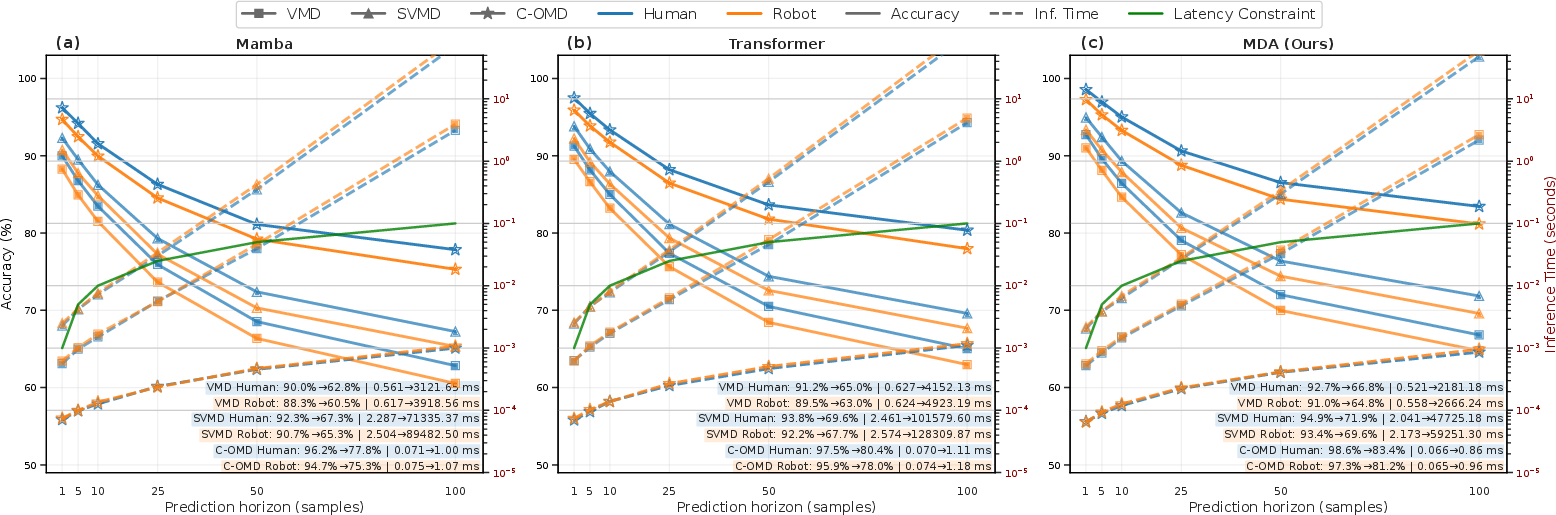
Figure 1: Prediction accuracy (solid) and inference time (dashed, log scale) vs. prediction window L21 for VMD, SVMD, and C-OMD architectures; green line denotes 1ms TI latency constraint.
A critical ablation demonstrates that increasing the number of modes does not improve prediction for VMD/SVMD—indeed, excess non-orthogonal modes degrade performance due to spectral redundancy and noise amplification. C-OMD, by enforcing strong orthogonality, achieves optimal and stable performance across varying mode counts and window sizes.
Architectural Insights
The results reveal a decomposition-first, attention-second principle: hard orthogonalization at the decomposition stage is prerequisite to effective sequence modeling and attention-based fusion in this domain. Mode leakage, prevalent in previous variational methods, is the primary source of predictive instability, and its elimination by C-OMD directly translates to tangible gains in performance, latency—even in the presence of channel noise.
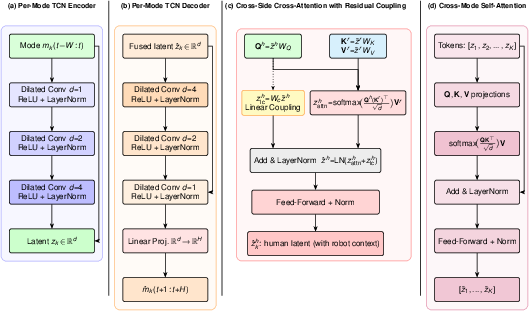
Figure 3: C-OMD maintains accuracy and inference speed advantages as number of modes increases, with no efficiency-accuracy trade-off.
Implications and Future Directions
The explicit orthogonality achieved by C-OMD enables robust multi-component signal modeling suitable for contemporary TI deployments. The practical implications include real-time haptic packet restoration at sub-millisecond speeds, resilience to network-induced noise/loss, and transparent control in demanding haptic feedback scenarios. From a theoretical viewpoint, enforcing strong mode separation provides a clear path for generalization and interpretability in haptic and other multi-component time-series prediction tasks.
Potential future developments include:
- Extending mode-domain structured attention architectures to other cyber-physical and communication systems.
- Adaptive mode number selection, potentially via Bayesian or nonparametric priors over the decomposition.
- Incorporating uncertainty modeling and active re-decomposition under variable network or task conditions.
Conclusion
This paper presents a rigorous orthogonal mode decomposition approach and a mode-structured bilateral prediction architecture for haptic signal restoration in Tactile Internet systems. Hard mode orthogonality, enforced via Newton–Schulz projection, is demonstrated as the critical factor for both accuracy and computational efficiency. The results establish C-OMD+MDA as the clear Pareto-optimal method for TI haptic signal prediction, with broad implications for fast, robust, interpretable signal modeling in resource-constrained, latency-critical environments.