- The paper introduces LuMon, a comprehensive benchmark suite with novel lunar datasets and authentic ground truth for evaluating monocular depth estimation.
- It rigorously compares 14 state-of-the-art metric and relative models across synthetic, terrestrial analog, and in-situ lunar data to expose domain adaptation challenges.
- Empirical results reveal that scaling data and fine-tuning yield minimal sim-to-real improvements, underscoring the need for innovative, robust architectural solutions.
LuMon: Benchmarking and Advancing Monocular Depth Estimation for Lunar Robotics
Motivation and Context
Robust monocular depth estimation (MDE) on the lunar surface is essential for enabling autonomous rover navigation using electro-optical (EO) cameras, particularly given strict mass, power, and size constraints for space hardware. However, the transfer of terrestrial deep learning-based MDE models to the lunar domain is significantly impeded by stark domain shifts, such as the absence of atmospheric scattering, omnipresent harsh and high-contrast illumination, textureless regolith, and unique local topologies. Existing benchmarks, often relying on terrestrial analogs or simulated data, fail to fully replicate these conditions or provide reliable metric ground truth.
The paper "LuMon: A Comprehensive Benchmark and Development Suite with Novel Datasets for Lunar Monocular Depth Estimation" (2604.09352) systematically addresses these challenges by introducing a rigorous evaluation suite (LuMon) for lunar MDE, novel datasets with authentic stereo-derived ground truth, a diverse model comparison, and empirical analyses dissecting the components underlying cross-domain generalization.
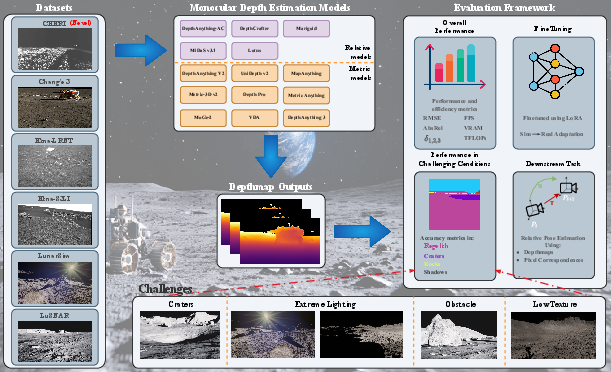
Figure 1: LuMon evaluation framework spanning real and synthetic lunar datasets, state-of-the-art MDE architectures, and protocol for both zero-shot and fine-tuned transfer evaluation.
LuMon Benchmark Framework
The LuMon suite integrates synthetic (LunarSim, LuSNAR), real analog (Etna-S3LI, Etna-LRNT, CHERI), and in-situ lunar data (Chang'e-3), each equipped with high-fidelity ground truth derived via stereo, LiDAR, or simulation pipelines. Notably, the authors contribute new ground truth annotations for authentic Chang'e-3 rover imagery and construct the challenging CHERI dark analog dataset, directly addressing the paucity of reliable lunar surface benchmarks.
The evaluation protocol rigorously compares a broad set of both metric and relative MDE models encompassing 14 leading architectures:
- Metric depth estimators (e.g., DepthAnything v2, DepthAnything 3, MapAnything, VDA, Metric-3D v2, UniDepth v2, Metric Anything, Depth Pro, MoGe-2)
- Relative that rely on scale-invariant cues (e.g., MiDaS v3.1, DepthAnything-AC, Lotus, Marigold, DepthCrafter)
All models are evaluated using affine-aligned predictions to disentangle structural fidelity from scale drift and are tested across zero-shot and fine-tuned scenarios, including sim-to-real transfer via LoRA-based adaption.
The analysis reveals robust trends:
Metric Foundation Model Superiority:
Metric MDE models consistently outperform relative and diffusion-based models on authentic lunar surface imagery such as Chang'e-3. MapAnything, DepthAnything 3, and Metric-3D v2 exhibit superior geometric consistency, internal linearity, and are more resilient to domain-induced scale drift.
Illusions in Terrestrial Analogs:
Near-perfect performance by all methods on well-lit Earth analogs (e.g., Etna-LRNT) is demonstrated to be misleading and non-indicative of real lunar deployment performance, primarily due to distributional overlap with Earth-based training data (Figure 2). Stricter analog splits (Etna-S3LI) and the CHERI dark analog expose collapse in model performance under conditions approximating the polar/shadowed lunar environment.
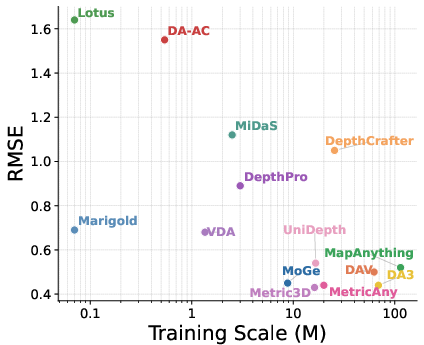
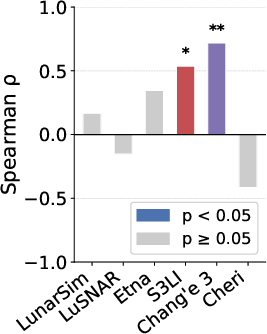
Figure 2: Relation between model training scale and RMSE, showing that training scale correlates with improved performance on authentic lunar data but not on synthetic benchmarks.
Topological and Illumination Challenges:
Robustness analyses using semantic segmentation (regolith, rock, crater regions) and shadow masks indicate that geometric complexity (rocks and craters) degrades accuracy significantly more than extreme shading. Metric models are more resilient, but even the best zero-shot methods struggle on craters and in dark analog settings.
Failure of Training Data Scaling:
Extensive analysis leveraging Spearman correlations finds that neither increasing the scale of terrestrial data nor the proportion of real images leads to statistically significant improvements in zero-shot lunar adaptation, except for marginal near-range improvements on authentic data. Likewise, the percentage of metric supervision in training yields no guarantee for cross-domain robustness. This finding is critical: raw data scaling is ineffective as a strategy for mitigating the lunar sim-to-real domain gap.
Sim-to-Real Adaptation: Opportunities and Limitations
Parameter-Efficient Fine-Tuning:
Adopting LoRA to adapt DepthAnything v2 on the LuSNAR dataset dramatically boosts accuracy and consistency in simulated lunar environments and for downstream tasks (pose estimation). However, this improvement is virtually nonexistent when evaluated on real/analog datasets (Chang'e-3, CHERI). The benefits of simulation-to-simulation transfer do not translate to real-world lunar or analog data, highlighting the persistent sim-to-real bottleneck.

Figure 3: Chang’e-3 RGB view, ground-truth depth, and DepthAnything v2 predictions; minimal generalization improvement is seen after fine-tuning, underscoring the sim-to-real gap.
Practical Relevance: Downstream Navigation
Integrating MDE outputs into pose estimation pipelines (via MADPose and MASt3R correspondences) confirms that metric models, especially after lunar-targeted adaptation, yield more accurate and reliable pose priors required for autonomous navigation. The geometric consistency imparted by these models is quantitatively validated by lower median rotation and translation errors. Nevertheless, the constraint of sim-to-real transfer limits practical deployment unless further architectural adaptation is pursued.
Implications and Future Directions
Architectural and Training Innovations Needed:
The study robustly demonstrates the insufficiency of current scaling and fine-tuning paradigms to close the lunar adaptation gap for MDE. The observed failure modes call for new architectural directions—explicit decoupling of illumination and geometry, integrating physics-based lunar priors, and inherent robustness to calibration artifacts and unlabeled hazards (e.g., craters, low-texture regions).
Robustness and Lightweight Design:
All evaluations done with maximum-capacity models highlight that on-board deployment for lunar rovers will require further research into efficient model distillation and adaptive inference to balance performance under extreme compute and memory budgets.
LuMon as a Catalyst:
The publicly released benchmark and datasets offer a foundation for standardizing lunar vision evaluations and for developing and validating sophisticated domain adaptation and robustification strategies.
Conclusion
LuMon constitutes a comprehensive benchmark for lunar monocular depth estimation, empirically pinpointing the limits of current terrestrial priors, data scaling, and simulation-based adaptation. It identifies the persistent gaps in cross-domain generalization, prescribes future research directions focused on architectural priors and robustification, and establishes a new standard for evaluating the readiness of visual perception systems for real-world lunar robotic autonomy.